Mujahid said these relations are being developed on the basis of Afghanistan’s national interests.
Speaking during a virtual briefing with the media from Kandahar, Islamic Emirate spokesman Zabihullah Mujahid said Afghanistan’s ties with regional countries are expanding under the government’s connectivity- and economy-focused approach.
Mujahid said these relations are being developed on the basis of Afghanistan’s national interests.
“We seek relations with all countries. Regional and neighboring countries are of particular importance because our economic ties and interests are interconnected. Afghanistan assures that its territory will not be used against any country, and our policy is centered on the economy and regional connectivity,” Mujahid said.
Political analyst Aziz Maarij said the Islamic Emirate needs to make changes on issues such as human rights, girls’ education, women’s employment, and the formation of an inclusive political system.
“The current global environment requires changes, particularly regarding human rights, girls’ education, women’s work, and inclusive governance. That is also why the international community has not recognized the Islamic Emirate,” Maarij said.
Mujahid also described Afghanistan’s security situation as stable and reliable.
He said there are no challenges along the country’s official borders or the hypothetical Durand Line with Pakistan, adding that the government has the security situation under control across the country.
“Our people should have no concerns in this regard. Our border forces are defending the country’s territorial integrity with great restraint,” Mujahid said.
Although the Islamic Emirate has established political and economic relations with a number of regional and other countries as it approaches its fifth year in power, Russia remains the only country to have formally recognized it. No other country has taken that step so far.
Islamic Emirate: Expanding Regional Ties ‘Foreign Policy Priority’
KABUL, Afghanistan — Gunmen killed a high-ranking local Taliban official in Afghanistan’s northwestern province of Badakhshan on Tuesday in a rare targeted killing in the country.
Two gunmen shot Zabihullah Amiri, Badakhshan’s director of information and culture, as he headed from a local district to the provincial capital Faizabad, the Information Ministry said in a statement.
“Immediately following the incident, security guards opened fire on the attackers; one attacker was killed and the second was captured,” the ministry said, adding that authorities were investigating the killing.
Targeted killings of high-ranking Taliban officials have been rare since the Taliban seized power in Afghanistan in 2021 in the wake of the withdrawal of U.S.-led forces.
In December 2024, the country’s refugee minister, Khalil Haqqani, was killed in a suicide bombing in the capital Kabul. Haqqani was the uncle of Interior Minister Sirajuddin Haqqani, who leads a powerful network within the Taliban.
In June 2023, a car bomb in Faizabad killed Badakhshan’s deputy governor, Nisar Ahmad Ahmadi, as well as his driver. A regional affiliate of the Islamic State group, known as the Islamic State in Khorasan Province, claimed responsibility for the attack, as well as a suicide bombing that struck a memorial service for the deputy governor days later, killing at least 13 people.
In March 2023, the governor of the northern province of Balkh was killed in a bomb attack on the governor’s office.
Gunmen kill high-ranking Taliban official in Afghanistan in rare targeted attack
Cross-border fighting between Pakistan and Afghanistan has killed nearly 500 civilians in Afghanistan and wounded over 1,000 others between October and the end of June, the United Nations said Tuesday.
In a report on the human rights situation, the United Nations Assistance Mission in Afghanistan said it had documented 499 civilians killed and 1,216 wounded by the fighting between the neighbors that has defied international peace efforts.
In one case, the report said, civilians trying to rescue others from the rubble of an airstrike were hit by a second one.
The report also explores other human rights issues, including a deadly crackdown on protests in western Afghanistan over restrictions on women’s clothing, and decrees that essentially legalize child marriage.
Pakistan accuses Afghanistan of harboring militants
Pakistan and Afghanistan have been fighting on and off for months. Tension escalated significantly in February, when Afghan forces launched a raid into Pakistan in retaliation for Pakistani airstrikes inside Afghanistan, and Islamabad declared it was in “ open war.”
Pakistan accuses Afghanistan of harboring militants who carry out deadly attacks that have killed thousands over the years in Pakistan, especially the Pakistani Taliban, known as Tehrik-e-Taliban Pakistan. The group is allied with the Afghan Taliban, which has ruled Afghanistan since it seized power in 2021 amid the chaotic withdrawal of U.S.-led troops. Kabul denies the allegation.
In the deadliest attack of the fighting, a Pakistani airstrike hit a drug treatment center in the Afghan capital, Kabul, in March, killing hundreds of civilians. Rights group Amnesty International said last week the bombing should be investigated as a possible war crime.
Pakistan has not given an overall figure for civilian casualties caused by the cross-border fighting in its territory. The U.N. mission, known by its acronym UNAMA, noted it is only mandated to monitor incidents in Afghanistan.
In a written response to UNAMA’s report, Pakistan’s Foreign Ministry said Afghanistan’s Taliban government “continues to maintain a permissive environment for a range of (militant) organizations.”
The response did not mention Afghan civilian casualties but said Pakistan’s military strikes “were directed exclusively at identified terrorist hideouts, sanctuaries, and support infrastructure linked to groups responsible for attacks inside Pakistan.”
The hundreds of civilian casualties listed by UNAMA include 22 — five of them children — who were killed in two successive airstrikes on a residential building in the eastern province of Paktia on June 28. At least 185 others were wounded.
Most of the deaths and injuries were caused by the second strike, when locals were trying to rescue the victims of the first one.
“International humanitarian law provides special protections for medical personnel and humanitarian workers, including first responders. Attacks against them while performing their duties are strictly prohibited,” said Fiona Frazer, director of human rights at UNAMA.
Afghan women still face harsh restrictions
UNAMA’s report also highlighted problems faced by women, who are subject to draconian restrictions by Afghanistan’s Taliban government. They include a ban on education beyond primary school, a strict dress code, bans on working in nearly all professions and a requirement to be accompanied by a male relative when outside the home.
The report detailed a crackdown in the western city of Herat in June, where at least 30 women were arrested on allegations of dress code violations. At least one person was killed and several others were injured when authorities opened fire during a rare protest against the detentions.
Rules governing women’s clothing stipulate they can only go out in public when wearing full hijab — which includes a headscarf and robe covering the entire body — as well as a face covering that leaves only the eyes visible. The regulations are policed by the feared Ministry for the Propagation of Virtue and the Prevention of Vice.
However, interpretations of the rules and what constitutes wearing the hijab correctly vary and can be arbitrarily enforced.
The UNAMA report said Vice and Virtue officials visited health clinics and shops in various parts of the country to advise them to refuse entry to women not accompanied by a male relative.
The report also said new rules on separation in marriage “ implicitly sanction child marriage ” by allowing for marriage contracts to be arranged for minors.
Months of fighting between Afghanistan and Pakistan have killed nearly 500 Afghan civilians, UN says
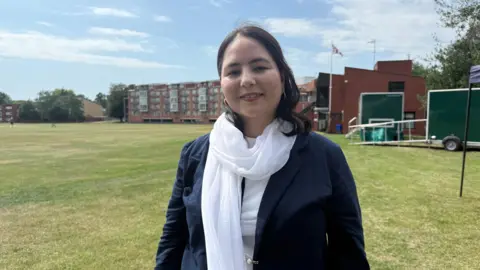
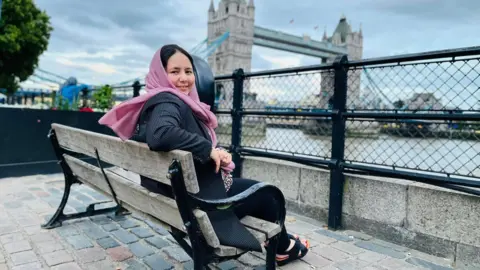
Zahra Joya fled to the UK in 2021 and is now a bye-fellow at Cambridge University
Zahra Joya was only five years old when a huge door closed to her – and to all girls in her home country of Afghanistan. The Taliban had seized power in 1996 and banned females from attending school. But with her father out of the country, Zahra’s mother came up with a daring workaround: presenting her daughter as a little boy.
“It was my mother’s idea to give me this chance, but I was passionate about learning. I always said, ‘I need to go to school, I need to play outside with boys’. I had the chance to become a self-made boy,” recalls Zahra, who now lives in the UK and is a bye-fellow at the University of Cambridge’s Hughes Hall.
She fled Afghanistan in 2021 after the Taliban regained control, and now runs a news agency that highlights the oppression of women.
Zahra, 33, says her passion for female equality is firmly rooted in the childhood days she spent playing the role of a boy called Mohammed: an experience that “shifted the course of my life”.
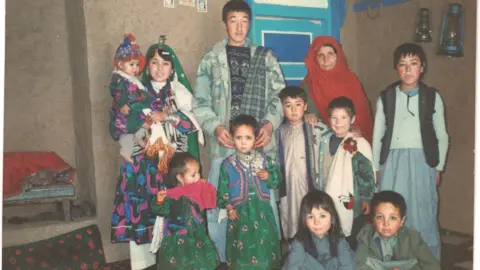
Zahra, front left, dressed in boys’ clothes so she could attend school
As a child living in a remote mountain village, Zahra swapped her headscarf for a button-up shirt and woollen blazer and made a two-hour walk to school.
The distance from her home meant people at school did not know her true identity, but she was still “very nervous” about being discovered.
“My hair was very, very long, and in my village boys didn’t have long hair. When I first met the headmaster, he asked me to cut my hair short,” she says.
“I really didn’t want to hide myself, my identity, but I had to because there was no choice for me otherwise.”
One of her relatives helped by teaching her how to play football and go into the mountains –”things boys would do, not girls”.
“Other girls were playing dolls but I never had a doll,” she says.
Zahra’s longer hair nearly gave her away
‘Act of bravery’
Only later did it dawn on Zahra what a risk her family had taken.
“My mum and grandad were very concerned about if people found out I was a girl, not a boy.
“I really didn’t understand the risk. It was an act of bravery from my family, and by me.
“I’m grateful to everyone who knew about me but respected and accepted me as someone who was passionate about education.”
The risk had been weighed up against another threat.
“The Taliban wanted to get married with young girls in my village,” Zahra says.
“[My family was] afraid they would come to our house and force us to get married with them.
“From that perspective, I was a little safer than other girls in my village.”
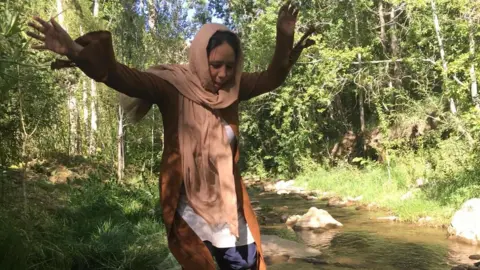
Growing up, Zahra loved the freedom she had while acting as a boy
At home, her family still called her Zahra, but she wanted to keep the privileges afforded to boys in a culture where girls rarely left their homes.
“It gave me the chance to be in the circle of male power,” she says.
“I could go anywhere I wanted: for shopping, to some ceremony in the village.”
In the house, she “felt I had the right to be a boss” while her father was working away.
“It was the man’s responsibility to turn on the TV. I had the opportunity to run the house, to serve and welcome guests.”
Even when girls were finally allowed to go to school again, after Western forces invaded Afghanistan in 2001, Zahra did not fully reverse her role .
“I had to change my clothes for school as my grandfather insisted. I dressed in my uniform, but when I returned home I put on my boy’s clothes.
“The whole family asked why, and I said, ‘I love it, it’s my world’.”
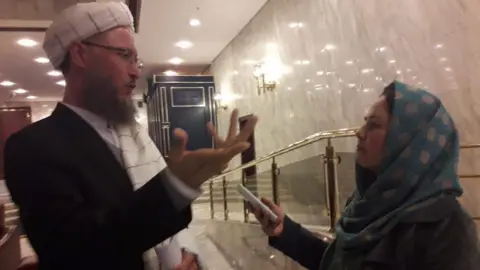
Zahra, who trained as a lawyer and journalist, interviewing a Taliban official in Moscow
Zahra says going to school “really changed my life”.
“It gave me a wider perspective on the world – the chance to [learn] about human rights.
“It helped me understand what it means to be a girl in a difficult position.”
She says masquerading as Mohammed taught her as much as any formal studies.
“It helped me to understand culturally about this society – that Afghanistan is deeply misogynistic and conservative about women,” she explains.
“This understanding really pushed me to fight for equality and human rights. I became a feminist.
“I realise now it was never just about going to school; it was about preserving my identity and dignity and my right to exist.
“I didn’t fully understand at the time, but that experience shifted the course of my life.”
Zahra Joya
Zahra and her family are now in London but she continues to cover stories from Afghanistan
Millions of girls joined Zahra in receiving an education when the Taliban were ousted from government.
But in 2021, Western forces withdrew from the country and the fundamentalist group quickly regained control.
“The day the Taliban returned to power, things collapsed in our lives,” Zahra says.
“It was about the collapse of freedom of women, of hopes for the future.”
In her book, The Vanishing Girl of Kabul, Zahra recounts the palpable fear she felt as the Taliban took one city after another.
“It was the most difficult moment of my life, [making] a decision in a minute to leave behind everything that we built – even my parents, not knowing if I would see them again.
“Thanks to God, the UK government gave us this chance to be safe, but I still feel like fleeing the country is not a solution. Freedom has a cost.”
She is now rebuilding her life in the UK with her parents and siblings, and hopes to “find a sense of home”.
“I will continue telling the stories of Afghan women until they reclaim their rights,” she says.
“The Taliban is a gender war. Hundreds of women are banned from public space and public life.
“It is really heartbreaking that history is repeating around us.”
In the past decade, Afghans aged 14 to 23 have become the single largest group of migrants in the Western Balkans. More than 2.5 million people – a fifth of them Afghans – are estimated to have crossed through this region since 2015 on their way to Western Europe. Over that time, Afghan migrant-smuggling networks have become ‘professionalised’, transnational and in some locations, violent criminal organisations. To understand how they have evolved and adapted over time, and how they operate now, AAN’s Jelena Bjelica and Fabrizio Foschini visited Serbia’s capital, Belgrade, and the country’s northern border with Hungary in June this year – for the third time in the last ten years. In this report, they synthesise a brief history of the Afghan migrant-smuggling networks in the Balkans, based on interviews with smugglers, migrants, government officials and organisations providing aid to people on the move. Their report begins in a migrant squat in Serbia.
In the heat of a Belgrade summer afternoon, the makeshift migrant squat – hidden by groves of wild acacia bushes in one of the capital’s suburbs that dot the southern bank of the Sava River – was buzzing with activity. Pakistani folk music crackled out of a wireless speaker in an improvised kitchen, kitted out under an electric-blue tarpaulin. A squat young smuggler crewman was cooking chicken karahi with rice over a firepit for a group of seven or so migrants and as many of his fellow smugglers.
Most of the smugglers were trying to pass the time by enticing others into a game of volleyball on an unlikely pitch, interspersed, as it was, with thorny acacias. One was napping in a tent, resting after a work shift that had seen him take a group of migrants to the northern border with Hungary a couple of days earlier. He had then been caught by the Serbian police and sent to a government centre for migrants in Preševo, far to the south on Serbia’s border with Northern Macedonia, from whence he had just returned. Two other smugglers suddenly stopped their volleyball game, saying they were going to shower in the flat they rented in a nearby neighbourhood; the rest stayed where they were, casually keeping a watchful eye on the ‘passengers’,[1] a prized asset, sometimes in short supply these days.
In the shade of a nearby shrub, a couple of worried-looking migrants were quietly chatting. They looked uneasy and often turned to us visitors, as if to determine, from our expressions more than from our words, what our real assessment of their current situation was and of their chances of reaching their destination. It was time for the group to have one last warm meal before they ‘hit the game’,[2] that is, try to illegally cross from Serbia into Hungary and the European Union.
Like many others, the group of migrants we encountered in Belgrade was forced to rely on smugglers. The days of ‘DIY migration’ for Afghans to Europe have all but disappeared in the face of the more aggressive posture of security forces and, now also, of smuggling networks. Fewer people travelling – IOM estimated that in 2025, 35,000 migrants passed through the Western Balkans compared, in 2022, to more than 192,000 – has also made for tough competition between the different groups of smugglers, often involving gun violence.
Although we did not see any weapons during our visit to the squat, they have become a staple item with smugglers and deadly clashes among groups for control of turf have become common. For example, a few weeks before our visit, on 12 May 2026, in a makeshift squat in Obrenovac, another suburban municipality of Belgrade city, two rival groups shot at each other, leaving one person dead and one wounded, both Afghans (Vreme). In 2022 and 2023, gunfire between rival migrant groups was often exchanged on the outskirts of the northern Serbian town of Subotica on the Serbian-Hungarian border (Al Jazeera) and sometimes even on Serbia’s western border with Bosnia (Nova.rs). There have also been news reports of migrants being kidnapped and held for ransom, robbed or abused by rival groups of smugglers, or even by their own travelling groups.
These developments point to new smuggling patterns in the Balkans. With DIY migration to Europe no longer really possible, migrants moving on the Balkan route really have only one choice – which smuggling group to opt for. Indeed, despite the increasing sophistication of the smuggling networks and their boasts of the high success ratios of their operations – at least if one is to believe what they consistently advertise on TikTok and other social media – it became evident on our trip that ‘good’ smugglers these days are hard to find.
This report opens with a brief history of migrant-smuggling networks in the Balkans, divided into two periods: 2001 to 2015 and 2016 to 2026. The period between October 2015 and March 2016, during which the route functioned as a humanitarian corridor for migrants, including Afghans (more detail in this earlier AAN report), was chosen as the cut-off between the two longer phases. This is followed by an account of how the route functions today, in 2026, as witnessed by the authors during their visit to Serbia. The two final sections discuss the crucial role of hawala as a secure money-transfer system, which functions like an escrow account, ensuring there is trust between the migrant/their family and the smugglers; and the innovative role of social media as a platform for smugglers to advertise and commercialise their ‘services’ and to recruit.
The information and insights in the report are synthesised from interviews with smugglers, migrants, journalists, government officials and organisations providing aid to people on the move, as well as published literature and the authors’ own long experience covering migration, especially in the Balkans.
Chicken karahi cooking in improvised kitchen, kitted out under an electric-blue tarpaulin. Photo: Jelena Bjelica/AAN, 5 June 2026
Migration in the new century: 2001 to 2015
In the first decade of the twenty-first century, smuggling activities were largely organised through Afghan diaspora networks concentrated in Iran, Turkey and Greece, rather than through permanent operational structures in the non-EU Western Balkans (comprising Serbia, Bosnia and Herzegovina, Montenegro, Kosovo, Albania and North Macedonia). Facilitators commonly came from the same family, clan, ethnic group or geographic area as the migrants themselves and functioned primarily as brokers who connected migrants with people who could provide transport and fake documents and with other intermediaries further along the route.
Norwegian sociologist Kristian Berg Harpviken argued in his seminal 2009 work on Afghan migration that it was fundamentally shaped by social networks, which provide information, financial resources and security.[3] Rather than acting independently, smugglers were embedded within these wider networks of relatives, friends and diaspora communities. Trust and reputation were essential, with migrants typically choosing facilitators recommended by family members or previous migrants whom they knew, rather than unknown brokers. This network-based organisation reduced both the perceived risks of migration and the transaction costs associated with illegal travel.
In those early days, Afghan smuggling networks were generally smaller, less visible and more clearly oriented towards facilitating transit, rather than, as is the case now, criminal groups bent on exercising territorial control.[4] They operated primarily to enable smuggling and were embedded in Afghan communities, linking people in Afghanistan with Afghan diasporas in Iran, Turkey, Greece and Western Europe. At this stage, however, the Western Balkans had not yet emerged as the dominant migration corridor it would later become. Most Afghans seeking to reach Europe travelled through Iran and Turkey before entering Greece or Italy, or accessed asylum systems through other means.
By 2010, Greece had become the principal gateway for Afghan migration into the European Union. The Evros/Maritsa River between Greece and Turkey emerged as a major entry point and Afghans constituted one of the largest groups seeking asylum in Greece. During this period, Athens developed into an important staging area for Afghan migration networks. Smuggling activities remained highly fragmented, with migrants frequently purchasing journeys in stages rather than through a single organisation. Routes typically followed the sequence Afghanistan–Iran–Turkey–Greece–North Macedonia–Serbia–Hungary–Austria and then going on to Germany and other Western European destinations. Afghan smugglers generally did not control movement within the Balkans directly, but instead relied on Turkish facilitators, Kurdish intermediaries and local people for transport and to provide fake documents. Their principal role was managing the gangs’ access to Afghan migrant communities and coordinating their relationships with migrants.
However, after the European Border and Coast Guard Agency (Frontex)[5] deployed its first-ever Rapid Border Intervention Teams (RABIT) to the Evros region in November 2010, the situation changed and in the years that ensued, the current incarnation of the Balkan migration route emerged. Although the RABIT mission ended in March 2011, Frontex has maintained a permanent operational presence and continued surveillance and border management activities along the Evros border to date. These increased controls, including the construction of fencing along the Evros River, encouraged route diversification, north, through Bulgaria, Serbia and Hungary. During this period, migrant smuggling expanded significantly in the Western Balkans, although the organisational infrastructure remained relatively informal compared with later developments. Afghans appear to have operated mainly as recruiters, brokers, payment coordinators and providers of information, while local Balkan facilitators managed transport, accommodation and border crossings.
In 2015, migration from Afghanistan increased sharply, driven by deteriorating security in Afghanistan, combined with the opening of the Balkan humanitarian corridor for refugees from Syria (later to include Afghans) and Germany’s asylum policy and perceived openness.[6] According to UNHCR, more than 213,000 Afghan asylum applications were lodged in Europe in 2015, making Afghans the second-largest nationality of asylum seekers after Syrians that year.
Afghan smuggling networks had, by this stage, accumulated considerable experience in moving migrants through Turkey and Greece, but the large-scale movements of 2015 transformed the system primarily because of their volume. The opening of the Western Balkan ‘humanitarian corridor’ for migrants between September 2015 and March 2016 provided certain nationalities, including Afghans, with transportation to the outer fringes of the European Union and temporarily reduced migrants’ dependence on smugglers, as governments themselves facilitated transit by registering migrants, organising transport and showing a degree of official tolerance (AAN). Afghan smugglers did not disappear, but their role diminished considerably as legal or semi-legal transit opportunities became available.
Overall, Afghan smuggling networks before 2015 were closely linked to Afghan diaspora communities in Istanbul, Athens, Tehran and functioned as migration-support systems as much as illicit enterprises. Turkey served as the principal centre of coordination for Afghan migration logistics, while the Western Balkans remained, primarily, a transit space. Unlike the more recent period, there is little evidence prior to 2015 that Afghan smuggling groups maintained any territorial control, employed violence or resembled conventional organised crime groups.
Towards ‘professionalisation’: 2016 – 2026
The closure of the humanitarian corridor in March 2016, as AAN reported (for links, see footnote 7), revived demand for clandestine facilitation services and gave new importance to Afghan smuggling networks as organisers of onward movement toward Western Europe. This was true especially at the most critical border crossings, such as those between Turkey and Greece/Bulgaria or between Serbia and Hungary/Bosnia/Croatia.
Between 2016 and 2020, Afghan smuggling networks in the Balkans could still be predominantly characterised as decentralised and facilitating migration, rather than hierarchical criminal organisations. Afghans acted as brokers, intermediaries and guides embedded within Afghan migrant communities, often connected to their ‘customers’ through family, village, ethnic and diasporic ties. At this time, Serbia, particularly Belgrade, emerged as a major logistical hub where migrants regrouped, arranged payments, received instructions and organised onward travel toward Hungary, Croatia, Austria and Germany.[7] Smuggling operations functioned through segmented chains of facilitators, rather than through vertically integrated transnational organisations, with different actors specialising in transport, accommodation, border crossings and communication. Migrants still largely relied on word-of-mouth recommendations and telephone contacts to access these networks.
From approximately 2021 onwards, a change becomes evident, as reported by the Global Initiative Against Transnational Organized Crime (GI-TOC), Europol and the Balkan Investigative Reporting Network (BIRN).[8] While Afghan networks were still community-based and flexible, parts of the smuggling operations appear to have become more professionalised, territorial, transnational and violent. They also became more visible on social media platforms, which they were increasingly using to promote their services and recruit new low-level smugglers.
In 2022, Europol described migrant-smuggling groups (of all nationalities) in Europe as dynamic transnational enterprises, operating through compartmentalised cells. It described their exploitation of digital communications, encrypted applications and online recruitment methods and said:
Criminal networks involved in migrant smuggling are adaptable and responsive to changes in their environment, and are flexible in the routes and modi operandi used. Furthermore, criminals plan their routes by capitalising on existing infrastructure such as availability of transport logistics, travel restrictions, law enforcement presence or weather conditions.
The GI-TOC also reported on the transnational nature of these groups, saying that foreign nationals “often collaborate with Balkan smugglers to navigate complex borders.” As an example, the report cited the case from November 2024, when the Bosnian police arrested an Afghan citizen on suspicion of human smuggling and organising a criminal group for this purpose. According to the report, the arrested individual allegedly had, with help from Balkan smugglers, smuggled more than 250 illegal migrants, primarily of Turkish or Kurdish origin, and unlawfully earned more than 100,000 euros (USD 114,000).
Most significantly, there has been the emergence of violence as a defining feature of parts of the migrant-smuggling economy in northern Serbia and Bosnia and Herzegovina. Investigations by BIRN describe Afghan groups as among the principal actors competing for control over profitable crossing corridors near Subotica, Horgoš and the Hungarian border fence.[9] Armed confrontations between Afghan and Moroccan groups were reported in 2023, with reports of automatic weapons, territorial disputes and clashes over access to migrants and border routes.[10]
Some Afghan-linked networks evolved beyond facilitation into more coercive forms of criminality, including extortion, kidnapping and ransom demands. They include the BWK (usually understood to stand for ‘Balkan Warriors Kabul’), which emerged in late 2024 in the Pirot area along the Bulgarian-Serbian border. After that, it shifted its activities to the Bihać/Gradiška area in Bosnia for approximately six to twelve months before relocating or expanding its centre of operation to the Loznica area on the Bosnian border in Serbia in early 2025. The group is primarily seen to kidnap migrants travelling with rival groups to demand ransoms from their relatives in Afghanistan. Their victims have included entire families, including women and children. The alleged activities of the group represent perhaps the clearest example of this shift in the nature of Afghan smugglers, with researchers describing practices involving detention, physical abuse and the extraction of ransom from migrants’ families.[11] According to a BIRN journalist, Saša Dragojlo, the change in the way the smuggling networks operate has brought a shift in the nature of violence: “Violence shifted from primarily inter-gang conflicts to more violence against migrants themselves, as a model of smuggling changed from smuggling fees to extortion and kidnapping as revenue streams.”
The significance of Afghan smuggling networks has been bolstered by the fact that, in the last ten years, Afghans aged 14 to 23 became the single largest group in the Western Balkans.[12] That strength in numbers helped lead to achange in the way Afghan smuggling networks and groups operate. The networks themselves have also demonstrated high adaptivity, responding rapidly to changes in migration policies, border controls and law-enforcement pressure. Yet it would be inaccurate to describe Afghan smuggling in the Balkans as controlled by a unified ‘Afghan mafia’. Afghan migrant-smuggling networks more closely resemble a fragmented ecosystem of numerous networks of varying size, sophistication and criminal orientation. Even so, there is a broad trajectory of Afghan smuggling networks in the Balkans since 2015 that reflects a broader paradox: the restrictive border policies outlined earlier in this report – the fences, the crackdowns, the expansion of Frontex to deal with unauthorised migration – have not eliminated smuggling. Rather, they have, as an unintended consequence, altered its organisational structure and in certain areas driven its criminalisation.[13]
Nowadays, the role of smugglers is especially prominent in Serbia and Bosnia and Herzegovina as these two countries are often used as respite points on the route, mainly due to relatively lax anti-immigration policies there. Smuggling networks have an entire infrastructure based in those countries – people who manage squats and flats, rendezvous with migrants arriving from Bulgaria and Greece and get them to the next border, as well as navigators, ie the people who get migrants across the borders using GPS coordinates.
In the following section, we describe a network as we witnessed it operating in Belgrade in June.
Migrant movements along the Balkan Route in 2026. Map: Roger Helms for AAN; Graphics: Žolt Kovač for AAN, 2026
Higher costs, fewer travellers: the Balkan Route in 2026
The group of seven Afghan migrants introduced at the beginning of the report had just arrived in Belgrade or rather had been delivered straight to the makeshift squat, with no chance to see the city or get their bearings. They were all Pashto speakers, comparatively young lads in their mid-twenties, from a broad range of provinces, from Kandahar to Kunar. They had all, without exception, recently embarked on the second leg of their journey from Turkey to Europe. Most had spent several years in Turkey, working in textile factories or livestock farming, earning enough to travel onwards. A couple had spent a year in detention for being undocumented migrants in Turkey. They all wanted to reach faraway countries to the north and west of Europe – the UK, Ireland, France and Germany – but were all heading first to Italy, from where they would embark on the rest of their journey. They had arrived in Belgrade in different groups. Some had come through Greece and North Macedonia; the others through Bulgaria where Bulgarian drivers had picked them up for short lifts to pre-set stages, then directed them on how to proceed over the border. Once they crossed into Serbia, the drivers on the Serbian side of the border, a local transport provider, had brought them to the Belgrade square where we met them.
The smugglers looked roughly the same age as their customers, most of them possibly even younger. They are no big shots in the smuggling industry: a couple of them looked like tough guys, one slightly more senior with a sterner, more conservative attitude, and one youngish and boastful. The rest were just sidekicks and helpers, ranging from ‘squat hands’ and housekeepers to bag carriers, ladder carriers and GPS navigators. Such segmentation and professionalisation is a long way from the pre-2016 system where one of the migrants would adopt a temporary role as jelaw-ro or guide.[14] All claimed to be Afghan except for a single Pakistani Pashtun. A few of the smugglers had quite clearly returned via the Balkan Route after spending time – and obtaining asylum papers – in Italy.
Some markers, mostly clothing items, differentiated the smugglers from migrants. Those going westwards, who were constantly on the move, could hardly afford the luxury of donning a traditional piran wa tomban (long shirt and baggy trousers) or a glittering, embroidered chamani cap. Such markers were hardly needed in a small and half-empty camp like the squat we visited; however, being easily spotted can be useful for meeting arrivals at the border, or at night, when smugglers need to first gather larger groups of migrants together before splitting them up again to try and ensure they cross unnoticed.
The fact that they, the smugglers, were as numerous as their customers, and that there were few more incoming migrants in the coming days, did not seem to over-concern them. Their earnings were apparently guaranteed. A trip from Turkey to Italy can now cost between 6,000 and 8,000 euros (USD 6,850 to 9,100), although in some instances, migrants might be asked to pay additional sums along the route.[15] So although migrants are fewer, the cost of the journey has increased significantly – ten years ago an entire trip from Kabul to Germany would cost around 4,000 euros (USD 4,550);[16] now only one leg of the journey, the trip through the Western Balkans, costs more than that. The smugglers in the Balkans region seem to be making good profits.
Migrants and smugglers walk along a railway track in one of Belgrade’s southern suburbs. Photo: Jelena Bjelica/AAN, 5 June 2026.
On the subject of fewer migrants, there is some discussion about the magnitude of that reduction. Frontex estimates that between 2024 and 2025 there was a 42 per cent reduction in the number of illegal crossings on the EU external border – into Croatia and Hungary – from the Western Balkans. The IOM, which does not measure the number of illegal crossings, but estimates the migrant population in selected regions, also recorded a decline in the number of people on the move in the six countries of the non-EU Western Balkans. According to IOM, the number of people on the move dropped from over 192,000 in 2022 to around 163,500 in 2023, then declined further to around 56,200 in 2024 and to about 35,300 in 2025. The estimates for further into the EU, in the Italian city of Trieste, which is now a major terminal of the Balkan route, also show a decline, although somewhat differently. The Italian Consortium of Solidarity, an organisation working with migrants there, told AAN it estimated the reduction in arrivals in Trieste last year at about 15 per cent and argued that in the first months of 2026, there was actually an increase. The IOM in Serbia also recorded an increase in the number of migrants in the Western Balkans in the first quarter of 2026 – a 37 per cent increase compared to the same period in 2025.
At the border
When AAN visited the border area between Serbia and Hungary in the Subotica region in June 2026, the change in the ‘smuggling landscape’ was clear. It was once dotted with small migrant camps, both informal and government-run. It is still a major transit point for migrants – as it has been for 15 years now – but they are no longer visible. Instead, migrants are brought to the area at night from Belgrade, split into smaller groups to cross under a cut in the fence at strategically selected points, and are over the border before dawn. One such transit point that we visited, an abandoned property near the Horgoš 2 border crossing, bore signs of both a long-term migrant presence dating back some years and of a recent, hurried passage. Access to such places still constitutes a bone of contention between smugglers, something to be fought for control of.
The need to secure favourable border crossing spots and the competition surrounding them have brought some groups of smugglers to develop favoured routes on which they specialise. The camp in the southern outskirts of Belgrade that we visited was, for example, managing mostly the crossings into Hungary. A parallel group, affiliated to the same gang but based in a separate camp, was more oriented towards leading migrants into Bosnia. Getting into Bosnia is easier compared to Hungary, despite the need to cross the River Drina, with its unpredictable whirlpools and fast currents. Boats and bridges are used, arguably with some level of connivance from local border authorities. Other gangs specialise in crossing into Croatia; indeed, AAN heard reports that crossings of the Serbia/Croatia border near Šid have resumed in recent months, after having been nearly abandoned for years due to tight controls. Some reports point to a laxer attitude also among Croatian police since its accession to Schengen, but crossing from Serbia or Bosnia into Croatia still carries significant risk.[17] However, most of the Western Balkan countries seem to be underreporting arrivals and transits to showcase success in repressing migrants on behalf of the other EU countries.
Stables on the abandoned property near the Horgoš 2 border crossing. Photo: Jelena Bjelica/AAN, 7 June 2026
The role of hawala
One key part of the infrastructure for smuggling migrants is not controlled by the smugglers and their gangs. Indeed, it is one of the few ways that there are checks on the smugglers and their gangs. This is hawala, the informal money transfer system used across South Asia and the Middle East. One of the people we met during our trip explained why it is of such pre-eminent importance. Saqeb (name changed to protect his identity) arrived in Belgrade in 2017 as a 13-year-old minor and over the past ten years has completed primary and secondary school in Serbia, eventually finding a job as a translator with an international organisation. Drawing on what he has learned from translating for Afghan migrants, he explained how hawala oils the machinery of migrant smuggling: “Smugglers often film the migrants crossing a border,” he said, “or just sitting in a squat, doing everyday things.” They then send the video to the hawaladar, the broker located at the point of departure or at another stage along the route, as proof that a migrant has arrived at a certain destination. Only after that will the hawaladar authorise payment to the smuggler.[18] “Some of the videos,” said Saqeb, “are then re-used in social media for promotion and recruitment.”
In academic literature as well, hawala has been identified as a critical enabling mechanism of Afghan migrant smuggling, for example, in a paper about Afghan migration authored by Mahadevan, Khoruk, and Mohmanzaï.[19] The authors argue that it should not be understood merely as a method of payment, but rather as a core component of the migrant smuggling infrastructure. They said that their investigations had established that “hawala networks are the lifeblood of irregular migration from Afghanistan.” The paper explains that hawala plays an important trust-building role within the migrant smuggling economy. Afghan migrants and their families frequently rely on hawaladars as intermediaries who hold funds until migrants successfully complete a stage of their journey or reach an agreed destination. In practice, hawala therefore functions as an informal escrow system, reducing the risk of fraud for migrants while increasing confidence in smuggling services. This mechanism is particularly important in irregular migration, as migrants often travel in stages, dealing with multiple facilitators and brokers operating in different countries. Hawaladars provide the financial continuity that links these otherwise fragmented transactions.
Hawala networks are deeply embedded in Afghan economic and social life and are widely used for remittances, trade and family support. Because hawaladars possess reputational capital and are viewed as trusted actors, their involvement in migration-related transactions enhances migrants’ confidence in particular facilitators or smuggling arrangements. The fact that funds can be deposited in Afghanistan and subsequently released in Iran, Turkey, Serbia, or Western Europe without physically moving cash across borders allows settlement between hawaladars to occur later through trade transactions, debt balancing, or other informal financial mechanisms. This flexibility allows smugglers to coordinate operations across multiple jurisdictions while reducing their exposure to regulatory scrutiny and financial monitoring.
In major Afghan migration hubs, like Istanbul and Belgrade, hawala has become integrated into the broader architecture of migrant smuggling. Hawaladars effectively function as financial intermediaries, guarantors and settlement agents within the Afghan migrant-smuggling economy. Further research is needed to look into who the hawaladars are, what nationality for example, and how they fit into networks back home in Afghanistan and elsewhere.
The role of social media
While hawala is more than a thousand years old, a very modern innovation is now also facilitating smuggling. The networks have innovated new usages of social media to advertise the illicit services they offer. Recent studies suggest that social media platforms are becoming increasingly important as tools for advertising migration opportunities, disseminating information and connecting migrants with facilitators. This is a change from when AAN researched Afghan smuggling through the Balkans in reports published in 2015 to 2017 (see footnote 7 for links) which then described the heavy dependency on interpersonal networks of trust. Migrants generally found facilitators through family members, village contacts, friends, previous travellers and recommendations circulating within Afghan communities in Afghanistan, Iran, Turkey and Europe, and communication relied primarily on mobile phones, messaging applications and personal referrals.
As a joint 2021 Europol and Frontex intelligence notification titled “Digitalisation of migrant smuggling” found, that has changed: “smuggling services are heavily advertised on social media platforms, particularly Facebook or Instagram pages, but recently also TikTok.” Advertising, it said, “is carried out on personal profiles or generic/business pages, but also on chat groups in messaging platforms like WhatsApp or Telegram,” adding that, “social media pages, groups and platforms offering smuggling services contain instructions, maps, photos, videos and prices for smuggling, updated on a regular basis.” Occasionally, it said, “the content posted by smugglers is complemented by information contributed by numerous other users, in the form of comments or notifications.”
Videos frequently show border crossings, advertise transport arrangements and depict successful arrivals in Europe, portraying migration as an achievable pathway to economic security. Such content serves the smugglers in both advertising and making sales, helping them build credibility and attract clients beyond their immediate social networks. Contemporary smuggling networks increasingly incorporate digital tools, including TikTok, Facebook, Telegram and encrypted messaging applications.
AAN reviewed several TikTok accounts identified by NGOs providing services to migrants in Serbia. TikTok is a global short-form video platform where users create, share and discover videos ranging from 15 seconds to 10 minutes. It is renowned for its highly personalised ‘For You’ algorithm and features videos with a primary active lifespan of 24 to 48 hours. On these accounts, we identified several recurring features in the video messaging. The most common is the portrayal of smugglers as victorious fighters, a parallel reinforced by their posing in army fatigues and camouflage gear – be it on the Bosnian hills or at a bus stop in Bayern, Germany – or as martial arts practitioners, and by their nicknames referring to military ranks such as Toran (captain) or athlete titles such as Pahlawan (champion wrestler). This show of strength is not only intended to suggest that the smuggler in question is the strongest around – and so the safest to travel with (something to be considered these days), but also to facilitate identification with his persona among future migrants.
Some promotional videos feature smugglers in expensive clothes and big cars, shot in front of famous landmarks in sought-after European capitals (Tour Eiffel in Paris, Tower Bridge in London), largely coinciding with the dreams of a younger generation of Afghans who are on the move, hoping to attain in Europe the ‘high life’ they feel they are unable to attain in their own country. These social media campaigns are obviously aimed at young men. Although, traditionally, the decision to migrate is taken by the family, AAN has been hearing how in Afghanistan, as in Europe, young men are more commonly making their own decisions and then either convincing or forcing their families to comply with their choices. Moreover, midway through what are usually two-phase migration paths, that is, in Istanbul or other Turkish cities, these youngsters likely have even more say over which group to connect with to try to complete their trip.
The videos uploaded by TikTokers associated with a brand like B.W.K., a serial number (such as 20…60 or 400/59),[20] or seemingly more individualised labels such as Jabar Mujrim (Jabar, the Criminal) or Farhad Rahbalad (Farhad, the Guide), serve to both promote their operations and familiarise prospective customers with some of the landscapes and events they will meet on the road. By featuring groups of young men marching through woodlands, resting and warming themselves around a campfire, or cutting or climbing border fences, the videos offer practical tutorials for future users. Some even show the tools of the trade, such as alternating clips of maps with pinpointed locations and Google Street View images of rendezvous; these are what smugglers provide their customers with to navigate those sections of the trip that they have to do on their own.
Some videos are used to recruit workers to the local labour force. For example, a TikTok account ‘Transport.555’ advertised for local drivers in Croatia, promising high pay of 4,000 to 10,000 euros (USD 4,560 to 11,400). Similarly, the Instagram account for ‘Transport Balkan’ (also Croatia-based) promises drivers willing to transport migrants from Nova Gradiškain Croatia to the Slovenian border for 500 euro (USD 570) per migrant, or, if they feel like braving it, onto Trieste, in Italy, at 1,000 euro (USD 1,140) per person.
Other features reinforce the conceptual link between migrating along the Balkan route and ‘the game.’ All videos are sprinkled with emoticons of ninjas, ladders or skulls, alongside the flags of Greece, Bulgaria, Albania or other countries to be crossed; the emoticons turn into crowns on the heads of successful voyagers or smugglers once the destination is reached. Slogans, poetry or lines from songs, or at the very least the words, “Insh’allah, very soon,” appear on screen. The music in the background is, inescapably, the heavily reverberated and synthesised sound of today’s Pashto pop, but the lyrics of some of the tarana-style[21] songs are pertinent, centred on travel to Europe, the reasons for leaving one’s homeland, the hardships and cold faced in the Bosnian mountains, and so on.
Altogether, most of the material available in TikTok videos is pretty basic, but detailed information vital to the organisation as to the route can be shared on this and other social media. The presence and welfare of the customers/travellers is publicised in the videos, incidentally, showing that travellers other than Afghans – South Asians or Africans – occasionally rely on Afghan outfits to be smuggled to Europe (the same applies to Afghans, who may travel with Pakistani smugglers, for example). The profile of a smuggling group can also be raised by videos that are not strictly promotional: they may be uploaded by smugglers and migrants for private reasons, but feature the smugglers’ identifying attributes (like a series of numbers) and enhance their name recognition.
It is evident that a digitalisation of migrant smuggling services points to an expanding ecosystem in which smugglers use digital platforms to circulate information, establish reputations and reach prospective clients. Irregular migration has become a competitive online market in which visibility, trust and accessibility are increasingly mediated through social media channels.
Game on
In the face of a diminished appetite by European governments to take high numbers of Afghan migrants[22] and the increased hurdles and controls on migration routes, the activity of smuggler networks in the Balkans has become more and more pivotal and profitable. This has led to an increased role on their part in managing all aspects of migrants’ movements in this part of the world – though it is a role they now play with more discretion and without deploying or risking themselves in person whenever avoidable. This development has also brought about the disappearance of independent migrant travel and border crossing and led to unbalanced power relations between migrants and smugglers. Migrants are now heavily dependent on the smugglers, but also in greater danger from them, as seen in the frequently reported cases of abuse and violence driven by inter-gang competition.
These changing patterns, together with the increased profits available, might be reshaping the profile and status of smugglers. Despite the ruthless and questionable side of their operations, they strive to present themselves as positive, successful role models to a broader section of their community of reference – young Afghan men who are on their way to Europe or have already arrived there. The appeal of the smuggler’s career would explain the presence of many Afghans, even very young ones, who have returned to the Balkans to work with the groups after receiving protection in one of the EU countries. It would also justify the style of the TikTok videos, in which top smugglers pose as a new class of military commanders, surrounded by their aides and deputies.
It would not take much for young Afghan men who make it, say, to Italy, and are waiting in reception camps for their documents, feeling bored and seeking economic opportunities, to seize such a seemingly golden chance to earn some money and achieve a higher status. Young migrants also have the flexibility and skills to adapt to European societies and learn languages that older smugglers, the nominal bosses of the organisations, often lack. Still, it is a shortcut on a tricky route, where rules keep changing, nothing stays the same and the game is afoot.
Edited by Kate Clark
References
References
↑1
While we use ‘migrants’ and ‘smugglers’ in this report, terminology used for them varies depending on who speaks. Some NGOs providing aid to migrants refer to migrants as ‘people of the move’ and to the smugglers as ‘facilitators’. Smugglers call migrants ‘passengers’ and ‘travellers’. Migrants themselves call a spade a spade, that is, for smugglers, they use the Pashto/Dari term – actually of Turkish origin – qachakbar (more commonly transcribed by Western media as kachakbar), which can be rendered exactly as ‘smuggler’.
↑2
The expression ‘the game’ (and ‘to hit/play the game’) refers to an attempt to cross one or more international borders irregularly, in order to continue the journey towards Western Europe. Used widely among Afghan and other migrant communities, the term reflects the uncertainty, danger and repeated nature of these attempts, which often involve travelling on foot through forests or mountains, evading border authorities and risking apprehension or pushbacks. Rather than describing smuggling itself, ‘the Game’ refers to the migrant’s attempt to make an irregular crossing, which may be organised or facilitated by smugglers through the provision of guides, transport, GPS coordinates or other logistical support. See, for example, Martine van Bijlert and Jelena Bjelica, The Aftermath of an Exodus: The Balkans’ Old Smuggling Routes and Europe’s Closed Borders, AAN, 14 June 2017 and Fabrizio Foschini, Keep on Moving on the Balkan Route: No quarter for Afghan asylum seekers in Croatia and Serbia, AAN, 26 September 2023.
Frontex is the European Union agency responsible for supporting EU and Schengen countries in managing the Union’s external borders, coordinating joint border operations and combating cross-border crime. It was established in 2004 and became operational in 2005.
↑6
In 2015, Germany’s welcoming stance toward refugees, together with widespread media coverage, contributed to a perception among Afghans that they would have a reasonable chance of obtaining asylum or protection in Europe, even though recognition rates varied by nationality. See also Thomas Ruttig, Afghan Exodus: Afghan asylum seekers in Europe (3) – case study Germany, AAN, 17 February 2017.
These are IOM and Serbian Commissariat for Refugees and Migration of the Republic of Serbia estimates.
↑14
As we reported previously, some migrants opted to become a jelaw-ro (lead-the-way), a person who informally takes charge of a group of migrants and keeps in touch with the smuggler network, in order to enhance the group’s success of arriving at the next destination. See Fabrizio Foschini, Keep on Moving on the Balkan Route: No quarter for Afghan asylum seekers in Croatia and Serbia, AAN, 26 September 2023.
↑15
Transport in each Western Balkan country is provided mainly by its residents, but a number of third-country nationals or former migrants with EU documents join in. In fact, among the people detained recently while trying to smuggle migrants across the border into Italy near Trieste, there were quite a few residents of Italy and other European countries who had gone to fetch their passengers deep into Croatia or even further afield (TriestePrima, Il Piccolo).
It remains to be seen how the Common European Asylum System (CEAS) which came into effect on 12 June 2026 will affect asylum applications for Afghans (InfoMigrants). For the moment, increased deportations of Afghans from countries such as Germany aim to act as a deterrent (Bild am Sonntag). A Taliban delegation travelled to Brussels on 23 June for talks with the European Commission and representatives of 15 EU member states on consular services and the deportation of Afghans who have been convicted of crimes or whose claims for asylum have been rejected. (Al Jazeera, Amu TV). In May 2026, Austria negotiated a deal with Tashkent to use Uzbekistan as a transit hub for charter flights carrying rejected asylum-seekers, following Poland’s lead. In April 2026, Poland deported three Afghan men via Uzbekistan despite an interim ruling by the European Court of Human Rights ordering a halt (Times of Central Asia).
A Good Smuggler is Hard to Find: The evolution of Afghan smuggling networks in the Balkans
The United Nations Office for the Coordination of Humanitarian Affairs (OCHA) has warned that a funding shortfall in 2026 is threatening nutrition programmes that support 5.7 million children and mothers across Afghanistan.
OCHA said on Sunday that millions of vulnerable Afghans could lose access to essential health and nutrition services unless humanitarian organisations receive urgent funding. The agency warned that financial constraints are already reducing the capacity of humanitarian partners to respond to growing needs, particularly among children and mothers at risk of malnutrition.
The warning comes as Afghanistan continues to face one of the world’s most severe humanitarian crises, driven by widespread poverty, food insecurity, weak public services and limited access to healthcare. Years of conflict, economic disruption and restrictions on humanitarian and development activities have left millions of Afghans dependent on international assistance.
Children remain particularly vulnerable. Poor access to nutritious food, clean water, healthcare and sanitation has increased the risk of acute malnutrition, while families struggling with poverty often face difficult choices between buying food and meeting other essential needs.
Women and children are also among the groups most affected by Afghanistan’s broader humanitarian challenges. Restrictions on women’s participation in public life and employment have limited household incomes and complicated the delivery of some humanitarian and health services.
OCHA has previously warned that Afghanistan’s nutrition situation remains concerning, with malnutrition increasing in several parts of the country. Humanitarian organisations have repeatedly called for sustained funding to maintain programmes that provide treatment for malnourished children, maternal nutrition support and essential health services.
The UN agency’s latest warning highlights the potential consequences of declining international humanitarian funding at a time when needs remain extremely high. Funding shortages could force aid agencies to reduce the scale or coverage of nutrition programmes, potentially leaving vulnerable communities without timely assistance.
The situation is particularly concerning in remote and underserved areas, where access to healthcare and humanitarian services is already limited. For families living in poverty, the loss of nutrition programmes could increase the risk of preventable illness and death among children and mothers.
Afghanistan’s humanitarian crisis has persisted despite a reduction in large-scale armed conflict since the Taliban returned to power in 2021. The country’s economy remains fragile, unemployment and poverty are widespread, and millions continue to struggle to meet basic needs.
International humanitarian agencies have warned that humanitarian assistance remains critical to preventing further deterioration, while stressing that long-term improvements will also require stronger public services, economic opportunities and sustainable development.
UN Warns Funding Shortfall Threatens Nutrition Support for 5.7 Million in Afghanistan
Afghan residents in Mazar-i-Sharif say intermediaries are demanding hundreds or thousands of dollars to arrange Iranian visas despite an announcement that visas for Afghan pilgrims travelling for Arbaeen would be issued free of charge under specified conditions, according to reports.
Residents in Mazar-i-Sharif reported that some intermediaries were offering to arrange Iranian Arbaeen visas for between $1,000 and $1,700. Some residents said they had been approached by intermediaries demanding large sums to secure visas, while an investigation found indications of an informal market for Iranian visas.
According to the report, some companies said intermediaries charged at least $500 per applicant to arrange an Iranian visa. The amount could rise depending on the applicant’s circumstances, the number of family members and the type of application, with some applicants allegedly asked to pay significantly higher amounts.
Several residents claimed that obtaining Iranian visas remained difficult despite the official policy. They said the gap between the announced free visa arrangements and their experience had created opportunities for intermediaries to exploit applicants.
Some residents also cited economic hardship, unemployment and limited job opportunities as reasons for seeking to travel to Iran, particularly to find work and support their families.
Iran’s Embassy in Kabul has previously announced that Arbaeen pilgrimage visas for Afghan nationals would be issued free of charge under specified conditions. Some residents, however, stated to the media that the announced policy did not always match their experience when they sought to obtain visas.
Relevant officials in Mazar-i-Sharif have not yet commented on the allegations.
Khaama Press could not independently verify the allegations, including the reported payments, the identities of the intermediaries or the claims made by others. The available information also does not establish any involvement by Iranian diplomatic or consular authorities in the alleged payments.
The reported allegations highlight concerns over the transparency and accessibility of the visa process for Afghan applicants. They also show how difficulties in obtaining travel documents can leave applicants vulnerable to intermediaries who promise to secure visas in exchange for large sums of money.
Afghans in Mazar-i-Sharif report Iranian visa black market charging up to $1,700
In many neighborhoods across Kabul, families wait for hours for water tankers to arrive, while others are forced to buy water at high prices.
Kabul’s water shortage is worsening, leaving millions of residents struggling with limited access to drinking water, rising water costs, and growing concerns over the future of the city’s water resources.
The capital, which relies largely on groundwater for its drinking water supply, has in recent years experienced a sharp decline in groundwater levels, the drying up of hundreds of wells, and contamination of a significant portion of its water sources.
Abdul Hamid, a Kabul resident, said: “Water used to be found at depths of 10 to 20 meters. Now it has dropped to around 80, 100, and even 120 meters. People are facing serious difficulties, and the water is also polluted.”
Shah Zaman Farooqi, another Kabul resident, said: “We ask people to be mindful of their water consumption and avoid wasting water.”
In many neighborhoods across Kabul, families wait for hours for water tankers to arrive, while others are forced to buy water at high prices.
The rising cost of water has turned the shortage from an environmental challenge into a livelihood crisis, particularly for low-income families.
Ramesh, a Kabul resident, said: “People are facing water shortages and cannot afford to buy water. Someone who earns 100 afghanis a day cannot afford to purchase it.”
Naser Ahmad, another resident, said: “As the water shortage worsens, people are increasingly forced to buy water. The difficulties people face are growing.”
Experts attribute the crisis to rapid population growth, climate change, prolonged drought, excessive groundwater extraction, and weak water resource management.
Sayed Mohammad Sulaimankhail, an environmental expert, said: “In the short term, water needs to be transferred from other provinces to areas facing severe shortages.”
Meanwhile, projects aimed at improving water resource management and strengthening resilience to climate change are underway. The Kabul Water Supply Company says it has short-, medium-, and long-term plans to address the crisis.
Shafiullah Zahedi, head of the Kabul Water Supply and Sewerage Zone, said: “Our long-term projects include the Panjshir water project, the Shah wa Aroos Dam, and the Shah Toot Dam. Survey and design work for the Panjshir project is currently underway, funding has been allocated, and six government agencies are carrying out the initial stages.”
Kabul’s water shortage is no longer just an environmental issue. It has become a challenge for public health, the urban economy, and the human security of millions of residents—a crisis that requires long-term planning, effective management, and cooperation between domestic institutions and the international community.
Kabul Water Crisis Deepens, Raising Health, Livelihood Concerns
Mujahid also said no malicious elements would be allowed to carry out activities, adding that the Afghan people support the country’s political system.
Zabihullah Mujahid, spokesperson for Afghanistan’s Islamic Emirate, described the recent clashes in Badakhshan as “propaganda” at the opening of the “Government in the Mirror of the Press” program.
Mujahid also said no malicious elements would be allowed to carry out activities, adding that the Afghan people support the country’s political system.
Zabihullah Mujahid, spokesperson for the Islamic Emirate, said: “No malicious agenda will be given the opportunity to operate. Such is the determination of the government and the security forces. Whenever people become aware of suspicious activities, they report them to the relevant authorities.”
Meanwhile, the Islamic Emirate’s Minister of Information and Culture said opponents of the government have no clear objective for fighting and are engaged in violence without a defined purpose.
Khairullah Khairkhwa, Minister of Information and Culture, said: “Who is fighting this war? Who is physically involved in it? These are important questions. Who finances those who fight? Who provides them with shelter? What are their objectives?”
Sheikh Noor-ul-Haq Anwar, Director General of the Administrative Office of the Prime Minister, said: “As Mr. Mujahid pointed out, we have enemies who cannot tolerate the progress and development that Afghans are striving to achieve.”
Elsewhere, Abdul Latif Nazari, Deputy Minister of Economy, stressed that Afghanistan is a secure country in the region, saying the country’s enemies cannot tolerate its freedom, stability, and economic growth.
Nazari said: “No country in the Middle East is completely secure, and conflict continues in the Caucasus. Afghanistan is the only island of security. That is why our enemies cannot tolerate this freedom, this stability, and this progress.”
At the same event, Abdul Wasi Khadem, Director General of the Office of the Prime Minister, described the role of the media as valuable and stressed that the government’s achievements should be reflected accurately.
Abdul Wasi Khadem, Director General of the Office of the Prime Minister, said: “The Islamic Emirate is working to ensure the media has timely access to accurate and reliable information.”
According to officials, the “Government in the Mirror of the Press” program is intended to provide the public and the media with accurate information on the activities, services, and key achievements of government institutions. The program is scheduled to begin on Tuesday with presentations on the accomplishments of various government agencies.
Islamic Emirate Spokesman Dismisses Badakhshan Clashes as ‘Propaganda’
Rising Anti-Taliban Activity: The Afghanistan Freedom Front (AFF) and a newly emerged group, Sepahian-e Mihan (Patriotic Soldiers Front), have conducted successful attacks in Badakhshan, including an AFF operation on July 23, 2026, that killed 21 Taliban fighters and captured weapons in Zebak District.
Internal Taliban Fractures: The Taliban are actively disarming local fighters and managing tensions with dissident Tajik commander Juma Khan Fateh, whose forces have been linked to land seizures, extortion, and control of gold mines; high-level Taliban officials have intervened with mixed results.
Resource and Ethnic Tensions: Ongoing disputes over gold, lapis lazuli, and other mineral resources, combined with the Taliban’s mistrust of non-Pashtun local commanders, are fueling protests by miners, internal clashes, and broader instability in the predominantly non-Pashtun province.
Badakhshan Province is in the midst of severe disorders, experiencing violent anti-Taliban rebellions, intense internal mutinies within the Taliban structure, and crises over the mining of natural reserves.
On July 23, 2026, fighters of the Afghanistan Freedom Front (AFF) killed 21 Taliban fighters and injured another 37, in a series of targeted operations against Taliban bases, units, and military detachments in the Zebak District of Badakhshan Province. One AFF fighter was also killed. During the fighting, AFF fighters captured ammunition, light and heavy weapons, military equipment, and other war materials, from the Taliban.
On the other hand, as reported on July 22, 2026, the Taliban ordered gunmen loyal to dissident local commander Juma Khan Fateh to surrender their weapons as soon as possible in the Shekay and Nusay Districts.
On July 21, 2026, Taliban fighters stationed in the Nusay District of Badakhshan Province ordered 350 armed men affiliated with the group, who did not hold positions within the Taliban regime’s structure, to surrender their weapons. The notice warned that if any individual refused to hand over his weapons, Taliban fighters would use military force to seize them.
On July 17, 2026, Taliban authorities claimed that they had retaken the Yaftal-e Payin District in Badakhshan Province after an overnight attack claimed by anti-Kabul forces. Police Spokesperson Ehsanullah Kamgar stated that the attack occurred while several Taliban fighters and commanders were on leave, adding that Taliban authorities had arrested seven people in connection with the incident and seized weapons and military equipment.
On July 13, the 2026, Taliban begun disarming their local fighters in the Shahr-e Buzurg District of Badakhshan Province. Taliban’s special forces have also been deployed in the area, alongside Mawlawi Saifuddin Tayeb, the Deputy Chief of the Taliban Administrative Affairs Office. The disarmament process began after the noon prayer in the district.
According to partial data compiled by South Asia Terrorism Portal (SATP), since the Taliban takeover on August 15, 2021, 216 people, including 57 civilians, 14 militants, and 145 in the Not Specified (NS) category have been killed in Badakhshan Province in 73 incidents (data till July 25, 2026).
Some of the major incidents include:
On March 29, 2026, AFF fighters carried out a planned attack targeting a watchtower of the Taliban’s 219th Division, located in the Qalatak area of Baharak District in Badakhshan Province, killing four Taliban fighters and injuring three.
On November 29, 2025, AFF fighters carried out a rocket attack on the Taliban’s Police District (PD) 7, in Faizabad, the capital city of Badakhshan, killing three Taliban fighters and injuring two.
On October 12, 2025, at least 10 Taliban fighters were killed in fighting between rival factions of the group at Yalor village in the Yaftali Sufla District of Badakhshan Province, over control of a gold mines.
On May 26, 2025, a local Taliban commander, Zaidullah, was killed along with his wife and child, during an internal armed clash in the Shahada District of Badakhshan Province. At least four Taliban members were also seriously wounded, including Abdul Saboor, the deputy head of the Taliban’s intelligence unit in Shahada District, and Mahmood, another intelligence officer.
On May 8, 2024, at least three Taliban fighters were killed and another six were injured in an Improvised Explosive Device (IED) blast. Later, on the same day, the Islamic State-Khorasan Province (IS-KP) claimed responsibility for the blast.
On June 8, 2023, a Taliban senior commander identified as Mawlawi Safiullah and 15 others were killed in a bomb blast inside the Nabawi Mosque in the provincial capital of Faizabad.
On September 30, 2022, four Taliban fighters were killed when the National Resistance Front (NRF) attacked them in the Payan Mor area of ??Shahr Buzurg District of Badakhshan Province.
Amidst this chaos, a new anti-Taliban group, Sepahian-e Mihan (Patriotic Soldiers Front) has appeared on the scene. On July 17, 2026, the group claimed responsibility for an attack in the Yaftali Sufla District and declared that its forces had controlled the district administration building for several hours. Following this attack, the Taliban sent Army Chief Fasihuddin Fitrat to the District, to lead operations. Fitrat claimed that the assault had been foiled and that the attackers had failed to achieve their objectives. Nevertheless, on July 22, 2026, Qayum Malang, Commander of the Sepahian-e Mihan, released his first audio message, declaring that he and his fighters were safe: “I am in full health. Do not follow the enemy’s propaganda. We are all safe and well.” He also stressed that the front “has its own plans and objectives” and that its members desire freedom above everything else. The group reportedly consists of people from different sections of society, including residents of Badakhshan, who came together in response to growing dissatisfaction with Taliban rule in the province. The official logo of the group includes symbolic elements such as the Simurgh (a giant bird of Persian mythology), the sun, the Hindu Kush mountains, lapis lazuli, a sword and the golden star of Bactria. The Hindu Kush mountains are seen as a symbol of the group’s geographical roots, while the sword and star may represent its military and defensive character.
Further, Juma Khan Fateh, the influential and disgruntled Tajik commander of Badakhshan Province has become a festering wound for the Taliban leadership. Fateh, his relatives (including brothers Mohammad Musa Shahryar and Abdul Fattah), and his loyalist gunmen, have been linked to land seizures, extortion, and illegal control of gold mines in Badakhshan. As reported on June 27, 2026, increased movements and a military build-up by Juma Khan was reported in the Darwaz area of Badakhshan Province. He had organised his forces over the preceding days and held extensive meetings with residents in Nusay District.
The Taliban however, initiated a few official interventions to assess the situation. On June 25, 2026, Taliban Defense Minister, Mullah Yaqoob Mujahid travelled to Badakhshan, following unsuccessful negotiations between a special Taliban commission and Juma Khan Fatah. Taliban officials said Mullah Yaqoob’s visit was to evaluate the security situation along the Wakhan, Ishkashim, and Shughnan border areas. However, sources suggest that he was also calculating military capabilities for a possible confrontation with Fatah. Later, as reported on July 9, 2026, Fasihuddin Fitrat, Taliban’s Chief of Army staff, and Mawlawi Amanuddin, Taliban Governor of Helmand, travelled to Nusay District to meet with Juma Khan, in an effort to ease ongoing tensions. Thereafter, on July 10, Juma Khan was transferred to Faizabad, capital of Badakhshan, after receiving ‘guarantees’ from Taliban Army Chief Fasihuddin Fitrat. No details of the talks or any agreement between the two sides have yet been released. A day later, Juma Khan Fateh returned to the Darwaz region of Badakhshan after pledging loyalty to the Taliban administration.
In parallel to these ongoing ‘negotiations’ at the administrative level, Zabihullah Mujahid, Taliban Spokesperson, announced on June 22, 2026, that Juma Khan had been removed as Zabul Deputy Governor, without being assigned a new role. Mujahid added that Taliban Supreme Leader Hibatullah Akhundzada had reshuffled several senior positions across government institutions. Moreover, as reported on July 9, Taliban forces established several checkpoints in the Shekay, Nusay and Maymay Districts in Badakhshan to monitor the movement of locals.
Badakhshan is a rugged and rocky, pre-dominantly non-Pashtun province in northeastern Afghanistan, rich in gold, silver, aluminum, limestone, lapis lazuli, etc. After their takeover in 2021, the Taliban leadership has been mistrustful of the local Taliban commanders of Tajik and other ethnic backgrounds. A major point of dispute has been the control of Badakhshan’s rich mineral resources and mines. There have been frequent disputes between Taliban and local miners. For instance, on July 21, 2026, a number of mine workers gathered in front of Taliban’s mining department building in Badakhshan, protesting against the Taliban’s continued closure of mining sites, and saying that Taliban forces threatened and beat some workers and ignored their demands. According to the protesters, the situation had left hundreds of families facing serious financial hardship. Earlier, on May 9, 2026, eight people were injured after local miners and residents clashed with Taliban-affiliated forces over control of the Qatqati gold mine in the Shirin Nazm village of Shekay District in the province. The tensions began after Taliban beat several miners. Crucially, in order to take full control of mining sites, as reported on February 19, 2026, Hibatullah Akhundzada approved the deployment of 1,000 fighters to protect gold mining operations in Badakhshan. Subsequently, on July 23, 2026, Taliban’s Ministry of Interior stated that it had signed an agreement with the Taliban’s Ministry of Mines and Petroleum to provide security for four of Afghanistan’s key economic projects, including the lapis lazuli mine of Badakhshan.
Badakhshan is in turmoil, substantially due to highhandedness and ethnic biases of the Taliban’s central leadership. The perennial mistrust of non-Pashtuns, untamed greed in exploiting local resources without paying heed to the common people, the emergence of anti-Taliban forces, and the unapologetic nature of the Taliban is pushing Badakhshan deeper into distress and violence.
About the author: Sanchita Bhattacharya, Research Fellow, Institute for Conflict Management
The United Nations says aid workers are still in a “race against time” to remove rubble and rebuild after the devastating earthquake struck eastern Afghanistan last month, killing at least 2,200 people and cutting off remote areas.
The 6.0-magnitude quake on Aug. 31 was shallow, destroying or causing extensive damage to low-rise buildings in the mountainous region. It hit late at night, and homes — mostly made of mud, wood, or rocks — collapsed instantly, becoming death traps.
Satellite data shows that about 40,500 truckloads of debris still needs to be cleared from affected areas in several provinces, the United Nations Development Program said Wednesday. Entire communities have been upended and families are sleeping in the open, it added.
The quake’s epicenter was in remote and rugged Kunar province, challenging rescue and relief efforts by the Taliban government and humanitarian groups. Authorities deployed helicopters or airdropped army commandos to evacuate survivors. Aid workers walked for hours on foot to reach isolated communities.
“This is a race against time,” said Devanand Ramiah, from the UNDP’s Crisis Bureau. “Debris removal and reconstruction operations must start safely and swiftly.”
People’s main demands were the reconstruction of houses and water supplies, according to a spokesman for a Taliban government committee tasked with helping survivors, Zia ur Rahman Speenghar.
People were getting assistance in cash, food, tents, beds, and other necessities, Speenghar said Thursday. Three new roads were under construction in the Dewagal Valley, and roads would be built to areas where there previously were none.
“Various countries and organizations have offered assistance in the construction of houses but that takes time. After the second round of assistance, work will begin on the third round, which is considering what kind of houses can be built here,” the spokesman said.
Afghanistan is facing a “perfect storm” of crises, including natural disasters like the recent earthquake, said Roza Otunbayeva, who leads the U.N. mission to the country.
 Afghanistan Peace Campaign