A woman who fled Afghanistan when the Taliban took control three years ago says she fears for those she left behind.
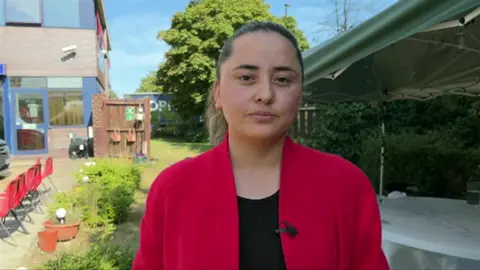
Sosan and her husband came to London in 2021 and have been granted indefinite leave to remain in the UK through the government’s resettlement scheme, along with thousands of other Afghan nationals now living in the capital.
“I was in Afghanistan and I saw the Taliban shoot women and girls, just because they didn’t wear the hijab,” she says.
“Women are all in danger I think in Afghanistan, doesn’t matter who she is,” she adds.
Sosan came to London in 2021 with her husband after the Taliban took control in Afghanistan
She says reports of her closest friend being punished by the Taliban for leaving the house without a hijab have haunted her.
“It was so hard for me to hear about her. The Taliban tortured her, and maybe they want to kill her,” she tells the BBC.
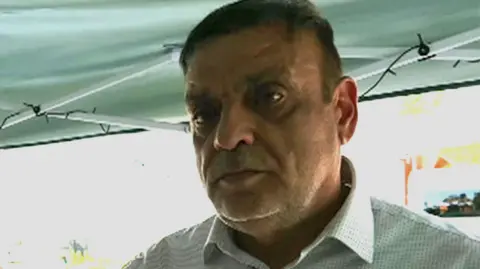
Rafiq grew up in Afghanistan and says he has been sent videos that show Taliban brutality
Rafiq has been living and working in the capital for the past 13 years, but grew up in Afghanistan.
“We say every day they kill our young people in Afghanistan,” he says.
‘He wants to cry’
Showing a video he has been sent over WhatsApp only yesterday, Rafiq says it shows one of many civilian murders carried out by the Taliban.
He also says that news from the region is often censored, to prevent the world outside from witnessing the scale and extent of Taliban brutality.
Visibly upset and with tears in his eyes, Sosan translates for him: “When he sees this kind of video he wants to cry, and when he sees the videos he shakes.”
US Air Mobility Command
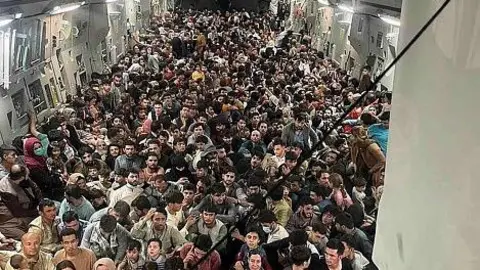
One of the most striking images from the Taliban takeover – hundreds of Afghans packed into a US military cargo plane as they fled Kabul
The Afghanistan and Central Asian Association centre (ACAA) in Feltham has supported people arriving in London ever since the evacuation began.
“Here in Feltham we’re surrounded by lots of bridging hotels around Heathrow Airport and people have been separated for three years,” says Darius Nasimi, director at the ACAA and the first British-Afghan Conservative candidate in the 2022 local elections.
“There are lots of people who have arrived recently because of family reunification and there’s always an ever increasing need to support them because there’s lots of pressure on the local authorities,” he says.
‘Anxiety’
Mr Nasimi adds: “During the recent riots that were happening across the UK, there was a hotel that came under attack and the asylum seekers living inside, some of them were from Afghanistan, so they felt quite unsafe.”
Dr Nooralhaq Nasimi, founder of the ACAA, says: “The anxiety of the people gets worse day by day.
“You see millions of people going to the streets in London to support the people of Palestine, but millions of people in the UK don’t know what’s going on in Afghanistan.”
The government says 17,039 people have arrived in the UK from Afghanistan via the Afghan Resettlement Programme as of the end of March 2024, with 2,562 in London.
Most came as part of Operation Pitting, the British military operation to evacuate British nationals and Afghans from Kabul, which began in August 2021, with some close family members being brought over afterwards.
The government told the BBC that long-term immigration had been granted to those who were identified for evacuation from Afghanistan.
On the third anniversary of the Taliban’s takeover of Afghanistan, the Committee to Protect Journalists (CPJ) has called on the group to halt the “unprecedented destruction of Afghanistan’s media and the brutal repression of journalists.”
The CPJ expressed concern that the Taliban has driven the few remaining media outlets in the country to the brink of collapse.
In a statement released on August 14, the CPJ reported that over the past year, the Taliban has detained 16 Afghan and foreign journalists, shut down four radio and television stations, banned one media outlet, and suspended the licenses of 14 others.
They also noted that at least one detained journalist had been severely beaten.
The CPJ’s Asia Program Coordinator stated, “The gross injustices committed by the Taliban are symbolic of their regime. The brutal crackdown has pushed the few remaining media outlets in Afghanistan to the edge.” She urged global countries to facilitate the resettlement of journalists.
The CPJ also highlighted that the Taliban’s restrictions on women working in media had created a “hostile” environment, forcing many Afghan journalists to flee to neighboring countries.
Earlier, Reporters Without Borders and the Afghanistan Journalists Center also voiced concerns over the state of journalism and media under Taliban rule.
These international bodies have underscored the dire situation facing journalists in Afghanistan, emphasizing the need for international support and intervention to safeguard press freedom and the rights of media workers in the country.
CPJ: Remaining Media Outlets in Afghanistan driven to the brink
John Bolton, the former US national security adviser, recently claimed that foreign terrorists have returned to Afghanistan. He argued that the United States should stop providing assistance, warning of the potential threats this situation poses.
In an interview with Newsmax TV, Bolton criticized the agreement made by the Donald Trump administration with the Taliban in February 2020. He stated that this agreement excluded a legitimate government in Afghanistan and was doomed from the start, as it was evident that the Taliban would not honor its commitments.
Bolton further criticized the decision to withdraw from Afghanistan, labeling it as “catastrophic.” He pointed out that while the decision itself was flawed, the Biden administration also failed in its implementation.
Bolton expressed concern that foreign terrorist fighters have returned to Afghanistan and have started launching attacks not just in the Middle East but also in Europe. He even claimed that these fighters attempted an attack on three Taylor Swift concerts recently.
Serving as a former US ambassador to the United Nations, Bolton suggested that the United States should prioritize isolating the Taliban regime. He emphasized that the US should not be providing any assistance, whether directly or indirectly, to the current regime in Kabul.
Bolton mentioned that despite official claims, reports are suggesting that US funds are still reaching agencies that assist the Taliban-led government. He highlighted that the US contributes 22% of the UN’s assessed budget, which might inadvertently be aiding the Taliban.
According to Bolton, the Taliban is now harboring terrorist groups like Daesh and al-Qaeda, which could pose significant threats to both Afghanistan and the wider world. He warned that Afghanistan could once again become a refuge for terrorists under the current regime.
John Bolton’s remarks underscore a deep concern about the current situation in Afghanistan, particularly regarding the resurgence of terrorism and the unintended consequences of international aid. His criticisms reflect broader anxieties about the effectiveness of US foreign policy in the region and the potential risks posed by the Taliban’s governance.
Bolton: Foreign terrorists back in Afghanistan, US aid to Taliban must stop
Meanwhile, the Chamber of Commerce and Investment said such meetings are crucial for the growth and development of trade.
A trilateral meeting of Afghanistan, Uzbekistan, and Azerbaijan was held in Kabul, hosted by the acting Minister of Industry and Commerce of the Islamic Emirate, with the participation of the Minister of Industry, Trade, and Investment of Uzbekistan and the Deputy Minister of Economy of Azerbaijan.
The Ministry of Industry and Commerce said that the meeting focused on regional cooperation, the development of trade and transit, and attracting investment in Afghanistan.
“The Kazakhs and Uzbeks are trying to connect to South Asia through Afghanistan and implement global projects, and our officials should be prepared and cooperate,” said Mohammad Nabi Afghan, an economic affairs expert.
In addition, a bilateral meeting between delegations from Uzbekistan and Afghanistan was also held, where they discussed establishing trade houses in Afghanistan and Uzbekistan and investing in the Termez International Trade Center.
Meanwhile, the Chamber of Commerce and Investment said such meetings are crucial for the growth and development of trade.
The chamber officials added that in the last three years, around forty high-level regional delegations have visited Afghanistan to enhance and expand trade relations with Central Asian countries, and efforts are being made to increase exports.
“With the arrival of the Islamic Emirate, the Ministry of Industry and Commerce is trying to reduce dependency on one country and turn to Central Asia. In three years, more than forty delegations at the level of ministers and deputy prime ministers have visited Afghanistan,” said Khan Jan Alokozay, a member of the ACCI’s board of directors.
Meanwhile, the charge d’affaires of the Islamic Emirate’s embassy in Islamabad, Sardar Ahmad Shakib, said in a virtual meeting that over two billion dollars of exports were made from Afghanistan to other countries last year, with $1.178 billion dollars worth of exports to Pakistan and $416 million dollars worth of exports to India.
Shakib said, “Last year, Afghanistan exported goods worth $2.025 billion, 36.3% of which were fresh and dried fruits. Among these, exports worth $1.178 billion were made to Pakistan, $416 million to India, $34 million to the UAE, $28 million to China, and $27 million to Iran.”
This comes as, in the past three years, representatives from several countries, including China, Iran, Uzbekistan, Turkmenistan, Kyrgyzstan, Pakistan, the UK, Russia, Qatar, and the United States, have visited Afghanistan to expand and develop Afghanistan’s commercial and economic relations with regional and global countries. Among them, China and Qatar have already invested in Afghanistan.
Afghanistan, Uzbekistan, and Azerbaijan Hold Trilateral Meeting in Kabul
In the weeks that followed, approximately 70,000 Afghans seeking to flee the returning Taliban government were evacuated. Nearly half had worked with the U.S. government or American nongovernmental organizations, some were family members, while others had no prior affiliation.
After going through security and health screenings in third countries and on domestic military bases, the vast majority were resettled to numerous states – with Texas, Virginia and California being the top destinations.
Humanitarian parole was only ever intended as a temporary fix to an immediate problem; it is only valid for two years, after which an individual must adjust their status.
Yet two years later, the act has still not passed. As experts on humanitarian rights, migration and refugees, we see the plight of tens of thousands of Afghans in the U.S. as the byproduct of the American political system in which bills struggle to pass. And the upcoming November elections will add another layer of uncertainty to those currently left in limbo.
Stalling in Congress
The first attempt at the Afghan Adjustment Act coincided with the first anniversary of the fall of Kabul. Introduced by Democratic Sen. Amy Klobuchar, the bill proposed expanded access to the already existing Afghan Special Immigrant Visa, to evacuated Afghans and offered a separate pathway for some Afghans to adjust their temporary residence to a permanent one.
The Special Immigrant Visa program was created in 2006 to provide Afghans who assisted American forces with a pathway for permanent resettlement in the U.S. Approximately 77,000 Afghans had already been admitted to the U.S. through the program by 2021. But due to bureaucratic inconsistencies and backlogs with the program, at least 18,000 at-risk applicants and 53,000 eligible family members had still not obtained their visas when Kabul fell.
Under Klobuchar’s bill, Afghans who arrived in the U.S. in or after 2021 would be able to apply for permanent residency either through the expanded Special Immigrant Visa program or by directly adjusting their status within two years of arriving.
Partly this is the general rule in American politics: The vast majority of bills fail to become law, and the current Congress has a historically low passing rate.
Yet the act’s failure comes despite bipartisan and wide-ranging popular support to assist Afghans – including among members of the military, veterans, religious groups and refugee advocates. Shortly after the fall of Kabul, the majority of Americans polled favored taking in Afghans who passed security checks. Even two years later, 80% of Americans thought the U.S. should help Afghans who assisted American forces in Afghanistan to resettle in the U.S.
There is also strong precedent for providing expedited pathways to permanent residency. The U.S. has previously passed adjustment acts for Cubans, Cambodians, Vietnamese and Iraqis, among others, allowing them to adjust their status from temporary to permanent residents.
Republican legislators opposing Klobuchar’s bill cited concerns that vetting procedures were not stringent enough, implying that some Afghans could have links to terrorist groups. Advocates for the Afghan evacuees counter that the bill has failed to pass simply because there is not a high-enough powered lobbying effort behind it.
And while allowing Afghans to legally come to the U.S. or obtain long-term residency has bipartisan support, the issue has played into partisan politics concerning executive authority over immigration, with Republican detractors broadly objecting to President Joe Biden’s use of humanitarian parole.
In July 2023, Sen. Tom Cotton, a Republican, introduced a competing bill, the Ensuring American Security and Protecting Afghan Allies Act. Rather than granting Afghans a direct pathway to permanent residency after further screening, this would require evacuees to meet the stringent standards for obtaining refugee status. And this could be difficult for many of the Afghan evacuees: Applicants would have to demonstrate individual fear of persecution from the Taliban – a high bar for those who have now been outside of Afghanistan for three years.
Even with its more narrow requirements, Cotton’s bill failed to pass.
Left in limbo
As a temporary fix, in May 2022, the Department of Homeland Security announced that Afghans without permanent legal status in the United States could apply for temporary protected status, allowing those with expired or about-to-expire permits to remain in the country for a further 18 months.
In September 2023, temporary protected status was extended for another 18 months, protecting Afghans from deportation but still failing to provide a long-term solution.
Instead, most Afghans have turned to an overburdened asylum system, with a backlog of 2.6 million asylumapplications as of mid-2024. Rather than refugees who are resettled to the U.S. from abroad, individuals have to already be in the U.S. to apply for asylum.
In an attempt to speed up the asylum process, U.S. officials exempted Afghans from filing fees in August 2021 and implemented a streamlined application process.
Yet even when Congress directed U.S. Citizenship and Immigration Services to issue a final asylum decision on Afghan cases within 150 days, only 136and 191 Afghans were granted asylum in fiscal years 2023 and 2024, respectively – out of tens of thousands of pending applications.
Afghans present in the U.S. under humanitarian parole can still apply for a Special Immigrant Visa, but without an extension this pathway is only available to those who worked for the U.S. government for at least one year.
The process was revised in July 2022 by combining two steps into a single one, but it remains arduous for Afghan applicants. Long processing times and uncertainty about their future in the U.S. have created structural barriers and psychological fears for Afghans attempting to rebuild their lives. These difficulties are compounded by trauma from years of conflict in Afghanistan and a rapid departure from the country – with many forced to leave numerous family members behind.
How the election may affect the act
So as the third anniversary of the fall of Kabul is marked, what happens next to Afghans still in limbo in the U.S.? The chances of the Afghan Adjustment Act passing under the next administration are uncertain.
Advisors to Vice President Kamala Harris have said the Democratic candidate for the White House is “committed to Afghan relocation efforts and looking for new ways to assist.” As such, a Harris administration could be expected to further pressure Congress to pass the act, emphasizing its moral and strategic importance.
Donald Trump, who slowed down the entry of Afghan allies by adding even more security checks to the Special Immigrant Visa process in 2017, has signaled that, if elected, his administration would prioritize stricter immigration policies. This could reduce the likelihood of the Afghan Adjustment Act being a legislative priority, despite some Republican support.
Just as crucial will be the composition of Congress. If Democrats retain the Senate or gain control of both the House and Senate, the act will have a higher chance.
Either way, we argue that the Afghan Adjustment Act should not be seen as simply an immigration bill. Regardless of which administration is elected in November, we believe failing to support wartime allies and ensure Afghans’ safety sends a damaging message to future partners. Without such assurances, the willingness of individuals and groups to aid the U.S. abroad could diminish, potentially leaving American forces without critical support in future operations.
3 years after fall of Kabul, US Congress has still not acted to secure future of more than 70,000 Afghan evacuees in US
Despite no international recognition as the country’s official rulers, the Taliban enjoy high-level meetings with major regional powers like China and Russia. They even attended United Nations-sponsored talks while Afghan women and civil society were denied a seat at the table . It was a triumph for the Taliban, who see themselves as the country’s only true representatives .
There’s no domestic challenge to their rule, and no overseas appetite to support one. Wars in Ukraine and Gaza draw the international community’s focus, and Afghanistan doesn’t represent the same terror threat it once did. But challenges remain.
Here are five things to know about the Taliban in power.
Culture wars and rewards
The Taliban supreme leader sits atop a pyramid-like ruling system as a paragon of virtue. Mosques and clerics are on one side. On the other is the Kabul administration, which implements clerics’ decisions and meets with foreign officials.
“There are different levels of extremism, and the Taliban are in an uneasy coalition of ruling hard-liners and political pragmatists . It has put them in a culture war ,” said Javid Ahmad, a non-resident scholar at the Middle East Institute.
The most controversial policies are unlikely to be reversed while supreme leader Hibatullah Akhundzada is in charge — and supreme leaders don’t retire or resign. They lead until death.
It’s wishful thinking that diverging opinions are enough to divide the Taliban, said Ibraheem Bahiss with Crisis Group’s South Asia program. “The Taliban are unified and will remain a political force for many years. They rule as one group, they fight as one group.”
To maintain cohesion and ensure discipline, seasoned Taliban have moved from the battlefield into bureaucracy, getting top jobs in government and provinces.
“You have to give them a reward for playing a significant role in the insurgency,” Ahmad said. Other perks can include a free hand in the running of a province or permission to have a third or fourth wife, a new pickup truck, a share in customs fees or the keys to a house.
Running the country
Bahiss called this “the strongest Afghan government in modern times. They can exact a decree to the village level.”
Civil servants keep the country running and are more likely to have a formal or technical education. But the Taliban leading civilian institutions have no proper knowledge of how such institutions are run. “Their qualifications come from God,” Ahmad said.
The Taliban’s legitimacy to govern doesn’t come from Afghans but from their interpretation of religion and culture, said Leena Rikkila Tamang with the International Institute for Democracy and Electoral Assistance.
If a government is defined by the trust and buy-in of citizens, recognition by international powers and legitimacy through processes like elections, then the Taliban do not qualify as a government, she said.
Keeping the lights on
Afghanistan’s economy has weakened. In 2023, foreign aid still made up around 30% of the country’s GDP.
The U.N. has flown in at least $3.8 billion to fund international aid organizations during the past three years. The United States remains the largest donor, sending more than $3 billion in assistance since the Taliban takeover. But the U.S. watchdog assigned to follow the money says a lot is taxed or diverted.
“The further the cash gets away from the source, the less transparency there is,” said Chris Borgeson, the deputy inspector general for audits and inspections at the Special Inspector General for Afghanistan Reconstruction .
Share this articleNo subscription required to readShare
The Taliban also apply vigorous taxation. In 2023, they collected around $2.96 billion. But that’s not much in a country with huge and complex needs , and the Taliban don’t have the means to stimulate the economy.
The central bank can’t print money. Cash is printed abroad. Interest transactions are banned because interest is forbidden in Islam, and banks aren’t lending. The Taliban can’t borrow money because they’re not recognized as the government, and international banking is cut off.
Natural disasters and the flow of Afghans fleeing Pakistan under pressure to return home have underlined Afghanistan’s reliance on foreign aid to meet essential needs.
It’s a big risk if the international community can’t send that kind of aid in the future. “We know Afghanistan will start receiving less money from the international community,” said Muhammad Waheed, World Bank senior economist for Afghanistan.
Another significant blow to the economy has been the Taliban’s ban on female education and most employment, removing half of Afghanistan’s population from the spending and taxpaying that can strengthen the economy.
In addition, the Taliban’s anti-narcotics policy “has wrecked the livelihood of thousands of farmers,” said Bahiss, warning that “just because the population is complacent right now, it won’t stay that way.”
Diplomacy and the global stage
Afghanistan is a small country in a neighborhood of giants, Bahiss said, and there’s a regional consensus that it’s better to have a stable Afghanistan.
But support from the West, especially the U.S., is key to unlocking billions in frozen assets and lifting sanctions.
The Taliban’s links with China and Russia are important because they are permanent members of the U.N. Security Council. They have also occupied seats on the United Nations’ Credentials Committee , which decides whether to withhold or bestow legitimacy on a government.
For now, Gulf nations are engaging with the Taliban to hedge their bets. “Qatar likes to be seen as leading mediation efforts and the (United Arab Emirates) has been taking that away, especially through supporting international aviation ,” Bahiss said.
The Taliban are keen to stress how effective they are as a government and to show the country is peaceful and that services are being provided, said Weeda Mehran, an international relations lecturer at the University of Exeter in the United Kingdom.
Although Afghanistan has lost dozens of media outlets due to a Taliban crackdown, the country’s rulers have grasped the impact of social media. Their content is intended to normalize their approach to Islamic law, which is where Arabic-language messaging is important.
“It’s a watered-down and whitewashed account of what is happening in the country,” Mehran said.
Secure, but not safe
The Taliban have secured Afghanistan through checkpoints, armored vehicles and hundreds of thousands of fighters. But the country is not safe, especially for women and minorities, as civilian casualties from suicide bombings and other attacks persist.
The Islamic State group has repeatedly targeted the mostly Shiite Dasht-e-Barchi neighborhood in Kabul. The police, slow to confirm attacks and casualty numbers, tell the media that investigations are underway but don’t say if anyone is brought to justice.
“A message for the mainstream media is that it’s OK and there is good security in Afghanistan under the Taliban,” Mehran said. “My argument would be, well, whose security are we talking about?”
The Taliban have ruled Afghanistan for 3 years. Here are 5 things to know
Afghanistan’s Taliban has celebrated three years in power with a military parade, paying homage to its homemade bombs, fighter aircraft and goose-stepping security forces.
The Taliban’s armed forces towed Soviet-era tanks and artillery pieces through Bagram, the former United States airbase, where Chinese and Iranian diplomats were among hundreds who gathered for the parade and speeches on Wednesday.
The airbase served as the lynchpin for the US-led operations against the Taliban for two decades.
Taliban forces seized Kabul on August 15, 2021, after the US-backed government collapsed and its leaders fled into exile. The anniversary is marked a day earlier on the Afghan calendar.
The Taliban government remains unrecognised by any other state, with restrictions on women, who bear the brunt of policies the United Nations has called “gender apartheid”, remaining a key sticking point.
“Three years have passed since the dreams of girls have been buried,” Madina, a 20-year-old former university student in Kabul, told AFP news agency.
“It’s a bitter feeling that every year, the celebration of this day reminds us of the efforts, memories, and goals we had for our future.”
Prime Minister Mohammad Hassan Akhund, who had been scheduled to appear at Bagram, praised the Taliban authorities’ victory over “Western occupiers” in a statement read by his chief of staff.
The Taliban government has “the responsibility to maintain Islamic rule, protect property, people’s lives and the respect of our nation”, he said.
Security has been a priority for Taliban authorities as they consolidated their power over the past three years, implementing laws based on their strict interpretation of Islam.
Rugby player Samiullah Akmal praised the day’s events, saying it was “better than other years”.
“As a young man, I see Afghanistan’s future is bright… We are independent and the people surrounding us are our own.”
‘Uncertain future’
While many Afghans expressed relief at the end of 40 years of successive conflicts, the economy remains stagnant and the population mired in a worsening humanitarian crisis.
“The past three years have been some of the worst of our lives,” said 26-year-old Zalmai, who works for a non-profit and only gave his last name.
“I don’t know what security the Taliban are talking about. People are hungry, the youth don’t have jobs… both girls and boys are facing uncertain future,” he said.
In a report, Al Jazeera’s Osama Bin Javaid said there have been attempts to revive the economy, but no country accepts Afghanistan’s rulers as the legitimate government and major international financial restrictions are in place.
“The Taliban says it inherited a bankrupt country in a corrupt economic system reliant on foreign aid,” Bin Javaid said. “The Afghanistan national bank’s foreign reserves have also been confiscated by the US.”
A joint statement from international nongovernmental groups warned of the growing aid funding gap, with 23.7 million people in need of humanitarian assistance.
Women have been squeezed from public life – banned from many jobs as well as parks and gyms – and barred from secondary and higher education.
Alison Davidian, the UN Women’s head of the Afghanistan country office, told Al Jazeera that “three years ago, a woman in Afghanistan could technically decide to run for president. Now, she may not even be able to decide when to go buy groceries.
“I’m not saying that three years ago, it was perfect. It was not perfect. But it wasn’t this.”
SOURCE: AL JAZEERA AND NEWS AGENCIES
Taliban celebrates three years of return to power in Afghanistan
Celebrations marking the third year since the U.S. withdrawal are amplifying a divide in Afghanistan over what principles it should be governed by.
The parade of cars rolled through Kabul from morning until night, clogging the streets in end-to-end traffic. Crowds of Taliban and their supporters lined the routes, chanting “God is great!” and “Long live the mujahedeen!” One truck dragged an American flag, a red X drawn across its stars and stripes.
Outside the old U.S. embassy, young children — maybe 6 or 7 years old — wearing military fatigues stood on the top of a gray Toyota pickup, clutching small white Taliban flags. A dozen others crammed into the back of the truck, white flags draped over their shoulders. Yet more flags were stapled onto wooden poles, waving in the air.
“Our way is jihad!” a man shouted through a loudspeaker from the passenger seat. The children responded: “Long live jihad!”
With August in Afghanistan come weeks of celebrations marking the anniversary of the U.S. withdrawal — the last American planes peeled off the runway at Kabul’s international airport on Aug. 30, 2021 — and the Taliban’s return to power.
The month has become a time of victors and vanquished, the swell of white flags marking conquered territory, just as past empires planted their own banners. It is also a time of heightened emotions, seeming to amplify the gulf between those who support the Taliban’s conservative rule and those who embraced the liberal ideals of the U.S.-backed Afghan government.
The country remains deeply divided over fundamental questions of what principles it should be governed by, and what ideals it should hold. The only point of consensus seems to be that three years into Taliban rule — with its extreme version of Shariah law — it is here to stay.
Image
As ordinary Afghans have adjusted to their new reality, so too have Taliban fighters. Once scrappy insurgents crafting homemade explosives and plotting ambushes from mountain hide-outs, they now serve as traffic cops, security guards and government bureaucrats. Many can count on one hand the number of times they have fired their weapons in the past three years, each one a celebration of sorts — the Eid holiday or a winning match for Afghanistan’s national cricket team.
Among the Talibs who have come out on the streets to celebrate, there has been a palpable itch for a return to jihad and martyrdom — the only way to live an honorable life, many say, and a guiding belief instilled in them since they were children in Taliban-run madrassas.
“In these three years, we are fixing the roads, helping other people, but we want to continue the jihad,” Panjshiri Shinwari, 27, said on Wednesday when the celebrations commenced. A Taliban fighter who joined the movement during the U.S.-led war, he now works for the government’s intelligence agency, the General Directorate of Intelligence.
He and a group of friends had joined the celebrations at Mahmood Khan Bridge, which stretches over the Kabul River, now a dry channel of weeds and sewage.
“I want to go to Palestine,” Mr. Shinwari continued. “We are all ready to continue our jihad in Palestine!”
“No, it’s Pakistan’s turn,” another young Talib, Ashiqullah Naziri, 19, piped in.
“Our first enemy is Pakistan. They destroyed our country,” he added, referring to the support that Pakistani authorities gave to American troops in Afghanistan. “We can’t just leave them alone after that!”
Image
As they spoke, a swell of young Talibs converged around them. Most wore cargo pants, American-made combat boots and black long-sleeve T-shirts with a faded logo of what looked like an American commando stamped on its shoulder. The Talibs’ embrace of the style of American soldiers is just one of the many ways the country has been turned on its head since the takeover.
“For jihad!” one of them yelled. The crowd cheered.
The anniversary celebrations span the country. In Kandahar, the Taliban’s southern heartland, a convoy of armored cars from the emir’s special protection force paraded through the city on Wednesday. In Helmand Province, another stronghold, a procession of motorcycles carrying the Taliban’s flag rode through the capital. And at Bagram Air Base, once America’s largest military post in Afghanistan, a procession of repurposed American tanks, armored vehicles and helicopters took over the runway.
In Kabul, the celebratory convoy of cars — a mix of government-owned and private vehicles — crawled around the city’s main squares. Many had large flags hanging out of all four windows, a version of the Shahadah, or the Muslim profession of faith, embossed on the white fabric. As the summer breeze picked up, the flags grew taut and the Arabic words decipherable.
At the Mahmood Khan roundabout, a Taliban policeman sat in the passenger seat of his forest green Ford Ranger, singing a tarana — a religious chant with a melody but no musical accompaniment — into a loudspeaker. A group had surrounded his vehicle, small flags tucked into the folds of their black turbans.
“The candle of success and freedom came back to our country! The sun of freedom came again to our sky!” the man sang. “Congratulations to all Afghans, independence has come again!” The Talibs in the crowd held their cellphones in the air, taking videos during the song.
Image
But for other Afghans in the city, its lyrics rang hollow.
“It is a black day for Afghans,” said Esmatullah, 25, a doctorwho is among Afghanistan’s Hazara ethnic minority, which was persecuted by the Pashtun-dominated Taliban during their first time running the country, in the 1990s. “I felt like a migrant today, like I was not in my country,” he added.
Esmatullah, who asked to be identified only by his first name for fear of retribution for speaking against the government, is trying to avoid the celebrations. He said they served as a reminder not of Afghanistan earning its freedom, but of being conquered by Pashtuns.
Still, for many ordinary Afghans who suffered at the hands of foreign and Afghan republic soldiers, the anniversary is not so much a celebration of the current government as it is of the end of two decades of war.
“War is gone, death is gone,” said Barakatullah Azizi, 23.
Mr. Azizi’s three brothers all joined the Taliban during the war, he said, while he worked as a shopkeeper in Kabul to earn money for his family. One of his brothers, Mansour Azizi, was killed nine years ago in an ambush by Afghan republic soldiers.
His brother’s death haunted him for months, he said. Every day, when he saw republic soldiers in the capital, he wondered which of them had killed his brother, and from whom he should seek revenge.
Now, he says, he walks through the city streets at ease.
“There is peace,” he said. “That’s what we are celebrating.”
Image
Safiullah Padshah contributed reporting.
Christina Goldbaum is the Afghanistan and Pakistan bureau chief for The Times, leading the coverage of the region.
On Anniversary of Taliban Takeover, Glee, Mourning and an Embrace of Jihad
In 2004, a major report mapping the war crimes and human rights violations committed in Afghanistan between 1978 and 2001 was published by the United Nations before being swiftly taken down under political pressure, allegedly from then president Hamed Karzai, some of his ministers and foreign backers and from within the UN. What became known as ‘the UN Mapping Report’, authored by Patricia Gossman and Barnett Rubin, was subsequently made available to the public on a website. As the link is now broken, the AAN is posting this important report on the Resources section of our website. AAN’s Kate Clark has been looking at why the UN Mapping Report remains so interesting and important but also how its aim, to help Afghans and others face up to the crimes committed during the war, is still unfulfilled.
You can preview and download the UN Mapping Report here.
The UN Mapping Report brought together all the published sources on the war crimes of the first two decades of the Afghan war. It is an invaluable resource for anyone interested in Afghanistan. Together with the Afghanistan Justice Project’s ‘Casting Shadows: War Crimes and Crimes against Humanity, 1978-2001’, published in 2005, which incorporated fresh eye-witness and survivor testimony into its account, these two reports meticulously documented patterns of war crimes up to the formation of the interim government in December 2001.[1] Crucially, they also provide the political context for the crimes, giving indispensable background to the emergence of the various political and military forces which continue to dominate Afghan life.
There was considerable support for either criminal accountability or for removing suspected perpetrators from power. How this was to be achieved was not included in the survey. There was also a wide recognition that sustainable peace required national reconciliation. Although the term was not fully defined, participants described it as including overcoming conflict at the local level. Reconciliation was not equated with forgiveness.
How the UN Mapping Report came about
The genesis for the mapping report had come during the final year of the first Islamic Emirate as a response to human rights groups’ dismay at the United Nations’ failure to investigate two massacres that followed successive captures of Mazar-e Sharif in the late 1990s, of Taleban prisoners of war by General Malek in 1997, and of largely Hazara civilians by the Taleban in 1998.[2] In mid-2001, the UN High Commissioner for Human Rights (UNHCHR) launched an attempt to ‘map’ human rights violations in Afghanistan over the course of the war. Later that year – after the 9/11 attacks and the United States’ toppling of the first Islamic Emirate – two researchers travelled to the region to assess what was required for the mapping exercise. At the time, news of a third mass killing was emerging, again of Taleban prisoners of war and again after Mazar-e Sharif had changed hands; the men who asphyxiated in shipping containers had this time been under the control of General Abdul Rashid Dostum’s forces.
The Secretary General’s new Special Representative in Kabul, Lakhdar Brahimi, opposed taking action over that third massacre, reported Gossman and Kouvo, and also opposed a callmade in October 2002 by Special Rapporteur on Extrajudicial, Summary or Arbitrary Executions Asma Jahangir for a commission of inquiry “to undertake an initial mapping-out and stocktaking of grave human rights violations of the past, which could well constitute a catalogue of crimes against humanity.” [3] In the end, the Office of the High Commissioner for Human Rights (OHCHR) commissioned only a limited mapping exercise that drew on already published material. Gossman and Rubin’s cataloguing of the major patterns of violations over the course of the war, from the 1978 coup d’état to the formation of the interim government in December 2001, became known as the UN Mapping Report.
How the UN Mapping Report was received
The mapping report was due to be published alongside the AIHRC’s ‘A Call for Justice’ in 2005. However, reported Gossman and Kouvo:
In the weeks before the scheduled release of the two reports, UN officials pressed the High Commissioner [for Human Rights], Louise Arbour, not to make the … report public. UNAMA officials argued that a public release would endanger UN staff, and complicate negotiations surrounding the planned demobilization of several powerful militias. They also argued that as a ‘shaming exercise’, the report raised expectations that neither the UN nor the Afghan government could meet: namely, that something would be done about the individuals named in the report.
Journalist and author Ahmad Rashid, who was in Kabul for the launch, described in an AAN report how deep and broad the pressure on OHCHR not to publish had been:
The Mapping Report … clearly implicated Afghan communists, present day warlords still holding power in Afghanistan, Taleban and a host of others as being responsible for war crimes. But when the report was about to be published – [UN High Commissioner for Human Rights] Louise Arbour already had arrived in Kabul -, almost all major players – the Americans, the Afghan government, many Europeans, the UN mission for Afghanistan – insisted that the Mapping Report be suppressed and not be made public.
They did not want to rock the boat of the fragile Karzai government that had been cobbled together of unlikely partners – Karzai and his circle of Afghan returnees from exile who had started as reformers and most mujahedin leaders (except Hekmatyar, Khales and Nabi Muhammadi) who were dead against all reforms that would threaten their key positions in the institutions, the security forces and the (licit and illicit) economy. These ‘Jihadi leaders’ were about to see their names printed in the report and threatened all kind of action to avoid this happening.
However, the UN Mapping Report slipped through the net. It was published briefly on the OHCHR website, “most likely,” reported Gossman and Kouvo, “by accident.” Despite being swiftly taken down, it had already been picked up by Human Rights Watch and other human rights organisations and as it had officially been published could legitimately be disseminated by others.[4] Moreover, as Rubin said, it was based on already public material so it could hardly be ‘suppressed’.
The pressure not to discuss or take action on war crimes never went away. Indeed, a worse fate was to befall the far more comprehensive mapping report compiled subsequently by the AIHRC.
The AIHRC mapping report
Following AIHRC’s publication of ‘A Call for Justice’, together with the United Nations and Afghan government, it drafted an action plan focussing on transitional justice. The plan was formally adopted and publicly launched by Karzai in December 2006.[5] However, said Gossman and Kouvo, the government “implemented little and finally shelved it for all intents and purposes.” The major action that did come out of the plan was the AIHRC’s own mapping report. This was an ambitious, multi-year-long project which gathered fresh material about the war crimes of 1978-2001 from witnesses and survivors from all of Afghanistan’s provinces. That report was never published. AIHRC chairwoman Sima Samar said she could not publish without Karzai’s support. He never gave it. Ahead of the 2014 election, when AAN asked the two frontrunners if they would publish the AIHRC mapping report should they become president, Ashraf Ghani said he would, Dr Abdullah appeared not specifically to have heard of it.
The consequences of ignoring the past
The inability of the post-2001 Afghan state to accept any form of truth-telling and the fearfulness of most of its international backers of any move to face up to the crimes and hurts of the past ultimately weakened the Republic. The argument in those early years was that stability was more important than justice, and peace had to come before accountability. That meant the foundations of the Republic were built on shaky ground that would eventually prove unstable.
Transitional justice, what to do about the perpetrators of war crimes, as Barnett Rubin has put it, “some reckoning with the past,” did come up at the December 2001 Bonn conference at which Rubin participated as an advisor to Brahimi.[6] It was discussed, Rubin said, but rejected from inclusion in the Bonn agreement, which set out a road map for what would become the Islamic Republic. As Rubin has stressed, the Bonn agreement was not a peace settlement. The parties did not “painstakingly negotiate over a period of years how to structure a government that would resolve the conflicts that had torn the society apart, create new armed forces and a new police service, and confront the painful legacy of the past to lay the groundwork for national reconciliation.” Rather, one side was still being “pulverised by US bombs” while representatives of four anti-Taleban groups thrashed out the Bonn agreement, along with UN, US and other interested parties.
In retrospect, the moment of de facto regime change had already taken place: when the US decided to arm the Northern Alliance and other anti-Taleban commanders to fight the Islamic Emirate while it bombed Taleban frontlines, it had established who gain the victory and who would capture the Afghan state. Once in power, some of those featuring in the AJP report, the UN and (presumably) the AIHRC mapping reports were able to stop any attempt at national reconciliation or a facing up to the past. Their efforts included, in 2008, MPs voting for a blanket amnesty for “[a]ll political factions and hostile parties who were involved in one way or another in hostilities before the establishing of the Interim Administration.”[7]
The silencing of the discussion of war crimes, at least those committed by the groups and individuals who ended up with power in 2001, has had repercussions. This author has argued that – as it was framed – favouring peace over justice and stability over accountability led to a lack of peace, justice, stability and accountability. Ignoring the past fostered impunity, encouraging continuing and future abuses by the state and pro-government individuals and groups, which meant there were never nationally representative, accountable security forces or government. Ultimately, as well, it helped spark the insurgency.[8]
Despite everything that has happened since 2001, the mapping of the war crimes of those first two decades remains important, given how the crimes of those years have still not been dealt with and how the patterns of violation in Afghanistan seem to keep repeating themselves.
Edited by Roxanna Shapour
References
References
↑1
Both reports include material from late 2001 on US bombing and its treatment of detainees, including forced disappearances and its use of secret detention facilities in Afghanistan and elsewhere.
↑2
These massacres are documented in both the AJP and UN mapping reports.
↑3
Brahimi argued that the time was not yet right for an investigation. As reported by the BBC, he said an enquiry should happen eventually, but the fledgling Afghan government did not have the capacity to deal with one at that time. “There is no judicial system,” he said, “that we can really expect to face up to a situation like this” and the priority had to be with the living not the dead, given the Afghan authorities were unable to protect potential witnesses.
↑4
For many years, it was hosted on a website called flagrancy net, but that link is now broken.
↑5
The Action Plan, wrote Gossman and Kouvo includes:
five measures in graduated sequence to be completed over three years: (1) according dignity to victims, including through commemoration and building memorials; (2) vetting human rights abusers from positions of power and encouraging institutional reform; (3) truth seeking through documentation and other mechanisms; (4) reconciliation; and (5) establishing a task force to make recommendations for an accountability mechanism.
↑6
See Rubin’s ‘Transitional Justice and Human Rights in Afghanistan’ published in ‘International Affairs’, vol 79, no 3, May, 2003, pp 567-581. His text is based on a lecture he gave in memory of Anthony Hyman at the School of Oriental and African Studies (SOAS) in London on 3 February 2003.
The food market was a rare taste of former freedoms. But as two members of the “morality police” appeared from the crowd, terror and panic eclipsed all thoughts of groceries. Although we were dressed in modest clothing and headscarves, the men chastised us for failing to wear face masks – a shortcoming deemed “bad hijab” under their law. Three years after the fall of Kabul to Taliban militants marked the collapse of western democracy across Afghanistan, these encounters are commonplace.
Afghanistan is now the only country in the world that prevents girls from attending school after sixth grade. Women can no longer obtain driving licences and even require a male chaperone to move from province to province and around the city. But while the liberties we once enjoyed continue to recede, the world’s attention has moved elsewhere. I am a female Afghan humanitarian aid worker, and I am confronted daily by the human toll of women’s struggle to reconcile their unbowed ambitions with a darkened and increasingly overlooked reality.
And yet three years after the plight of Afghan women has faded from global headlines, humanitarian support is dictated not by voices within Afghanistan but by people who have fled the Taliban, living across the world, who encourage the international community to sever all ties with the Taliban government. As someone who still lives and works here, I find this misguided: their interventions only harm the people who need help. I’ve lost count of the number of aid workers I know who have lost their jobs due to funding cuts – and my own work trying to help women here suffers as a result.
Veiling one’s face is just one of more than 50 restrictions that the Taliban have imposed on women since they seized power in 2021. From one day to the next, new laws are announced and our nightmares become reality. The ban on women going to their workplace worsened last month, with the news that the salaries of the female government employees who were obliged to stay home will be cut from about 50,000 rupees to only 5,000. Denied an income, many worry how they will support their families or cover basics such as food and fuel. The normality that we clung to in gyms and beauty parlours operating under the radar has likewise vanished in recent months, as growing pressure from the ministry for the propagation of virtue and the prevention of vice forces their closure.
In this climate of relentless constraints, nothing is guaranteed. Confined to their homes, women find that fear and speculation over possible new restrictions have become a constant preoccupation. While this aggression against our freedoms has left Afghanistan unrecognisable, its impact on women’s mental health is far more alarming. I support between 40 and 70 women on a weekly basis: about 80% of them are facing mental health challenges.
These manifest in a variety of ways. Some of the people I am helping are worried by material concerns such as funding a child’s medical treatment or funeral. Others are so unwell they areunable to register their surroundings and simply laugh hysterically. Many more are unwilling to even accept they are struggling.
Without the funding or time, I can only refer them to other agencies and offer temporary relief such as a coat, a carton of juice or a biscuit. After several appointments, women realise that the offer of aid is a dead end –their frustration and hopelessness match my own. Not only are we living in a limate where our government is stripping away our rights, but the agencies on the ground that could help have fewer and fewer means to do so.
As aid budgets shrink, humanitarian workers and resources are stretched even further, and the punishment is felt most by women already suffering from persecution. The international community must instead empower us to help the millions of Afghan women still living in the country, keeping politics and humanitarian aid distinct and apart. Here at home, we are fighting to be heard.
Afghan women are resilient and strong in our belief in a better future. We remain determined to stand tall and occupy the little space that remains for us in our country. The hard-earned achievements of the women before us were the result of this faith. We are ready to stand for this once again.
The author has been working for humanitarian organisations in Afghanistan since before the Taliban takeover, supporting and listening to the experiences of thousands of fellow Afghan women. She is remaining anonymous for her safety
As told to Elysia Taylor-Hearn
I live under the oppressive rule of the Taliban. That’s why I am urging the world to engage with them
The United Nations says aid workers are still in a “race against time” to remove rubble and rebuild after the devastating earthquake struck eastern Afghanistan last month, killing at least 2,200 people and cutting off remote areas.
The 6.0-magnitude quake on Aug. 31 was shallow, destroying or causing extensive damage to low-rise buildings in the mountainous region. It hit late at night, and homes — mostly made of mud, wood, or rocks — collapsed instantly, becoming death traps.
Satellite data shows that about 40,500 truckloads of debris still needs to be cleared from affected areas in several provinces, the United Nations Development Program said Wednesday. Entire communities have been upended and families are sleeping in the open, it added.
The quake’s epicenter was in remote and rugged Kunar province, challenging rescue and relief efforts by the Taliban government and humanitarian groups. Authorities deployed helicopters or airdropped army commandos to evacuate survivors. Aid workers walked for hours on foot to reach isolated communities.
“This is a race against time,” said Devanand Ramiah, from the UNDP’s Crisis Bureau. “Debris removal and reconstruction operations must start safely and swiftly.”
People’s main demands were the reconstruction of houses and water supplies, according to a spokesman for a Taliban government committee tasked with helping survivors, Zia ur Rahman Speenghar.
People were getting assistance in cash, food, tents, beds, and other necessities, Speenghar said Thursday. Three new roads were under construction in the Dewagal Valley, and roads would be built to areas where there previously were none.
“Various countries and organizations have offered assistance in the construction of houses but that takes time. After the second round of assistance, work will begin on the third round, which is considering what kind of houses can be built here,” the spokesman said.
Afghanistan is facing a “perfect storm” of crises, including natural disasters like the recent earthquake, said Roza Otunbayeva, who leads the U.N. mission to the country.
 Afghanistan Peace Campaign