UNSC Raises Terrorism Concerns; Islamic Emirate Rejects Allegations

While the United Nations Security Council has once again expressed concern over threats posed by the activities of terrorist groups in Afghanistan, the Islamic Emirate has rejected these concerns and insists that no group is allowed to use Afghan territory against other countries.

Zabihullah Mujahid, spokesperson for the Islamic Emirate, told TOLOnews that Afghanistan is under the government’s full control and that no independent armed group is permitted to operate in the country.

Mujahid said: “The Islamic Emirate of Afghanistan’s position on this matter is very clear. Afghanistan will not allow its territory to be used against other countries. No unauthorized group is permitted to operate in Afghanistan. The Islamic Emirate has full control over the entire country, and what some countries raised at the Security Council is completely incorrect. We assure everyone that no unauthorized group will be allowed to operate. ISIS has been completely suppressed in Afghanistan, and its safe havens have been eliminated.”

At the UN Security Council meeting held yesterday at the organization’s headquarters in New York, China’s representative stressed the importance of combating terrorism and called on the Afghan authorities to remain committed to their obligations in this regard.

Sun Lei, China’s representative to the UN Security Council, said: “The international community should help Afghanistan revive its economy and improve the livelihoods of its people so that the root causes that create favorable conditions for the spread of terrorism can be eliminated. China supports Central Asian countries and regional organizations, including the Shanghai Cooperation Organization, in strengthening cooperation with Afghanistan to jointly address cross-border terrorist threats.”

Meanwhile, a number of military analysts believe that continued security and economic cooperation between Afghanistan, regional countries, and the international community could play an important role in reducing shared threats and strengthening regional stability.

Military analyst Sadiq Shinwari said: “If the international community cooperates with the Islamic Emirate of Afghanistan in this regard, the expansion of ISIS activities across borders can be prevented.”

Another military analyst, Turyalai Zazai, said: “From Afghanistan’s side, there is no obstacle to continuing economic and security cooperation with regional countries; however, some countries in the region, due to their own political and economic objectives, are hindering the expansion of such cooperation.”

These concerns about the presence of ISIS in Afghanistan were raised during the UN Security Council meeting while, in recent months, several ISIS centers beyond the disputed Durand Line have been targeted in operations carried out by the forces of the Islamic Emirate of Afghanistan.

UNSC Raises Terrorism Concerns; Islamic Emirate Rejects Allegations
read more

They gave me to someone who could not read or write … it would be better if you buried me alive

Shabnam

The Guardian

Wed 5 Aug 2026 01.00 EDT

On my last day of school it seemed years of effort were now contained in one small piece of paper. Everyone was happy at graduation, holding our certificates, each of us had a different road ahead. Friends wanted to study medicine, civil engineering or economics. For me, I wanted aviation – to be a pilot.

We worked hard, preparing for Kankor – the university entry exam – then came the first delay. Coronavirus reached Afghanistan. Everywhere went into quarantine, our exams were postponed.

Eventually, I got into university. On my first day I told myself, “Shabnam, finally, your efforts were not wasted.” The smile would not leave my face.

I worked hard. At the end of the first year, I was the top student in my class of 120 from all 34 provinces of Afghanistan. My father was so proud of me. But my mother said, “My daughter, do not be so happy, someone may cast an evil eye on your happiness.” I wish I had listened.

My mother used to tell stories about the Taliban and say we were left behind from education. Then, in my second year, the Taliban took Afghanistan again. It was goodbye to the university and to our books. A university that would never open again for us. I wished that they had taken our lives instead.

With a thousand miseries, we returned home. I told my mother, “You were right. I wish I had not been so happy.” I did not know that worse lay ahead.

The Taliban said no girl over the age of 15 should remain unmarried. Girls were being forced into engagement. Either the Taliban would marry the girls themselves or the father had to find someone for his daughter.

They gave me to someone who had no education and could not read or write. Crying became all I did day and night.

I told my mother, “It would be better if you buried me alive.” The groom’s family wanted to take me to their home. If I did not accept, the Taliban would detain my father.

One day, my husband said: “If you love studying and education this much, we will get passports and go to Iran. I will work and you can study.”

After getting the passports, my husband asked me to walk to get the visas. I went out and saw a taxi so I got in. I took the risk and travelled alone because it was only about 10 minutes away and no one could come with me.

At the Taliban checkpoint, they asked, “Where is your mahram?” I said my husband had gone to work. They took me to prison.

When my husband came, they questioned him and asked where his wife was going alone. My husband explained. Then they asked what we would do in Iran. When he said “For education”, they replied “Death to education. Who has allowed women to study?”

They insulted me and said to my husband: “You are unfortunate and you have made this poor woman unfortunate, too.”

There were 84 women kept in 10 windowless small rooms around a courtyard. Even though the rooms were small, seven or eight women were kept in each with only two beds. Most slept on the floor. The toilet smelled very bad. Those who could afford pills took them to sleep; some became addicted.

I asked whether there was a phone to use and was shown a room. I phoned my husband and he told me he had been thrown out of the house. “My brothers have put me out and now I am on the streets. They tell me to choose either you or them. But I will never leave you, even if the whole world is against you.”

When I returned the phone, the guard said, “Now you must pay for it.” I was shocked.

The women explained that, without money, you can’t use the phone. The Taliban collect money from them every day. Then I understood why the Taliban use anything as an excuse to imprison people.

They kept people away from family and work and imprisoned innocent people for their own benefit. Each of the women, like me, had been imprisoned without any real reason. I saw a young girl imprisoned because her father had raped her.

Called, like me, bad women, lives were ruined. Some had no family to receive them after release. Women whose families will not take them back often kill themselves. Some have to marry elderly men just to have a roof over their heads. Others do whatever they can to survive. Some sell drugs, some sell their bodies.

Two women killed themselves inside the prison while I was there. After others had gone to sleep, they hanged themselves. I also knew another girl who threw herself in front of a car and died because she was homeless after release.

My husband’s brothers labelled me a bad woman. None of them spoke to my husband except to taunt him. The poor man endured all of it. After three months, I was released from prison. My husband had found a place to rent with great difficulty. The rent was expensive, but I was pregnant.

After my child was born, the landlord threw us out. When my son was two months old, there was a ruined house near my parent’s house and we moved in there. All kinds of insects had made their place inside it. We had no other choice. We could not rent a house in the city because the rent was too high.

Every day I worried over what our future would be. I told my husband, I will also help you and work.

I was following an online cooking channel and taught myself how to make sweets. I began with low-cost sweets and soon I mastered it. I took my sweets to shops to sell. But I had no budget and needed help.

Some foreign organisations support women who want to become self-sufficient. But the Taliban created a chamber of commerce through which they sell that support. If I had 2,000 afghani, they would loan me cash to buy the materials I needed for baking. But I needed to pay back 2,000 afghani (£22.50) each month and I didn’t have this.

So, for now, my dream to have a coffee shop and sell sweets remains just that. One day I will do it: it will be work for myself and girls like me, because I have promised my dreams that I will reach them.

They gave me to someone who could not read or write … it would be better if you buried me alive
read more

A Son of Jaghori: Remembering Grand Ayatollah Mohammad Ishaq Fayyaz, 1930-2026

For centuries, a steady stream of Afghan students have gone to the great Shia Islamic seminaries of Iran and Iraq in search of religious learning. Few rose as high as Mohammad Ishaq Fayyaz, who died in June 2026 at the age of 96. AAN’s Rohullah Suroush and Roxanna Shapour trace Fayyaz’s journey from a village madrassa in Ghazni province to the renowned Najaf seminary in Iraq, where he became one of the most influential Shia jurists of the modern era. They examine how he developed Islamic legal opinions on women’s place in government that broke established precedent and remained, for most of his life, little known in the country of his birth. Only in his final decades did Afghanistan begin to recognise one of its greatest religious scholars.
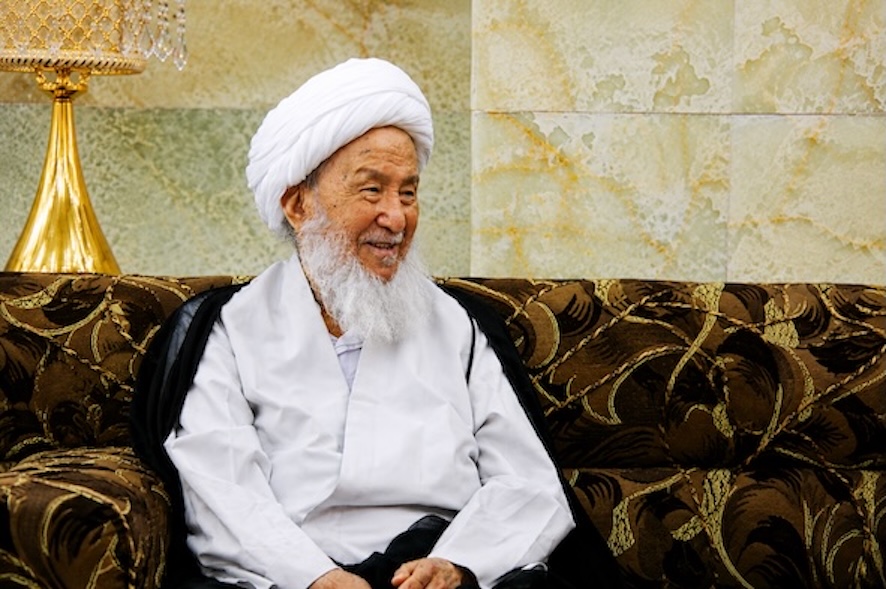
Grand Ayatollah Fayyaz Photo: The Iraq Studies Center, 9 June 2023

The loss of Sheikh al-Fayyad is a severe tragedy and the void he leaves behind is vast and difficult to fill. 

(Grand Ayatollah Ali al-Sistani)

When Grand Ayatollah Mohammad Ishaq Fayyaz (also spelled al-Fayadh or Fayyad) died in Iraq on 4 June 2026,[1] Iraq declared three days of national mourning (BBC Dari). Tributes came pouring in from across the Muslim world – from his fellow grand ayatollahs in Najaf and Iran to the governments of Iraq, Iran and Afghanistan – honouring one of the world’s foremost Twelver Shia)[2] jurists and one of the four most senior maraji al-taqlid (sources of emulation).[3] Yet outside specialist circles, relatively few people knew that one of the most influential Shia scholars of the twenty-first century had been born in Afghanistan’s remote central highlands, in the Jaghori district of Ghazni province.

Fayyaz’s life was remarkable not only because he rose to the highest ranks of the Shia religious establishment, but also because it is the story of the long and largely forgotten tradition of Afghan Islamic scholars who, over the centuries, have travelled to the great Shia seminaries of Iran and Iraq in search of religious learning. Among the many Afghans who travelled those routes, none attained greater international standing than Mohammad Ishaq Fayyaz. His story is therefore not only the biography of a distinguished jurist but also that of an Afghan intellectual whose influence reached far beyond his homeland.

From Jaghori to Najaf

Born in 1930 in Suba village in Jaghori district, Ghazni province, Mohammad Ishaq Fayyaz was the second son of a Hazara farming family of modest means. His father, Mohammad Reza, enrolled him in the village madrassa before he was five years old and, according to his official biography written by the late Sayyed Abdul Majid al-Khoei, “during the winter his father would wrap him up in blankets against Jaghori’s bitter cold and carry him to and from the madrassa on his shoulders.”[4]

After completing his primary religious education in Suba, Fayyaz spent four years studying at a religious school in the neighbouring village of Hutqol. He left Afghanistan at 17, after the death of his mother in 1947, to continue his religious education in the Iranian city of Mashhad (Afghan Bios). According to Majid al-Khoei, the move was intended as the first stage of a longer journey to Najaf, Iraq, the principal centre of Shia religious scholarship. Indeed, Fayyaz did later go to Iraq to continue his studies, first at the Salimiyah School and finally at the Hawza-ye Elmiya-ye Najaf (Najaf Seminary), one of the leading centres of Shia learning, which had, for centuries, attracted students from across the Shia world (Majid al-Khoei). He would call Najaf home until the end of his life. It was in this city that he entered one of the most demanding intellectual traditions in Islamic scholarship, devoting himself to the study of jurisprudence (fiqh) and legal theory (usul al-fiqh). At the Salimiyah School, one of his teachers was Ayatollah Modarres Afghani, himself an Afghan (BBC Dari; Shafaqna). At the age of twenty, he entered the advanced seminary of Grand Ayatollah Abu al-Qasim al-Khoei, one of the most influential Shia scholars of the twentieth century (Majid al-Khoei).

Among his fellow students in al-Khoei’s class was another future grand ayatollah, Ali al-Sistani. Over the next three decades, Fayyaz progressed from student to protege to trusted colleague. He spent fifteen years attending al-Khoei’s lectures before joining his office and becoming a member of the Majlis al-Istifta, the body responsible for preparing legal opinions (fatwas) and responding to religious questions submitted to the marja. There, he worked alongside Sistani and other senior scholars, helping to prepare responses to questions of jurisprudence for al-Khoei’s followers in Iraq and abroad (Grand Ayatollah Fayyaz’s official website, World Federation).

Fayyaz emerged as one of the most accomplished of al-Khoei’s students. His most important contribution during this period was the preparation of al-Khoei’s taqrirat (lecture notes) on legal theory (, which were later published as Al-Muḥadarat fi Usul al-Fiqh (Lectures on the Principles of Islamic Jurisprudence), a work that al-Khoei himself endorsed. In a commendation written for the book’s publication on 4 November 1966, al-Khoei thanked God for granting him “the honour of educating distinguished students, among them the learned Sheikh Mohammad Ishaq Fayyaz,” describing the work as “a valuable service” (Majid al-Khoei; Shafaqna). The work eventually expanded to ten volumes and remains the most significant published record of al-Khoei’s methodology in legal theory (official website, World Federation).

One of the ‘Big Four’

The death of Grand Ayatollah al-Khoei in August 1992 ushered in a new era for the Najaf Seminary. As the most influential Shia jurist of his generation, al-Khoei had attracted millions of followers and trained many of the leading scholars who would go on to shape Shia jurisprudence in the decades that followed. His death raised the question of who would emerge as the most senior religious authorities in the next generation (Majid al-Khoei).

By that time, Fayyaz had already established himself as one of Najaf’s leading scholars. More than three decades of study, teaching, writing and service in al-Khoei’s office had earned him considerable recognition among his peers. His reputation, together with the publication of Al-Muḥadarat and his work in the Majlis al-Istifta, placed him among the jurists regarded as qualified to exercise independent legal reasoning (ijtihad) and to issue their own legal opinions (Majid al-Khoei, World Federation). By the late 1990s, he came to be recognised alongside Grand Ayatollahs Ali al-Sistani, Mohammad Saeed al-Hakim (d 2021) and Bashir al-Najafi as one of Najaf’s four leading marjas. Although each maintained an independent office and following, together, they represented the continuity of the Najaf school after al-Khoei’s death (Afghan Bios, Majid al-Khoei).

While Ali al-Sistani emerged as the most influential Shia religious authority globally, particularly after Saddam Hussein’s downfall in 2003 (Majid al-Khoei; World Federation), some believe that Fayyaz, rather than Sistani, was the most senior of the four. However, according to the Encyclopaedia of Modern Middle East Wars, “he did not seek to chair the council because scholars who are not Iraqi or Iranian have little chance to gain followers among Arabs and Iranians, who make up the majority of the world’s Shi‘is,” instead, Fayyaz and his fellow grand ayatollahs backed Sistani for the role.[5]

Six decades in Najaf

For six decades, Fayyaz was an important member of the generation of scholars in Najaf who preserved the seminary through Saddam Hussein’s dictatorship, two wars and an occupation. Fayyaz understood his role as a marja not merely as issuing opinions and publishing treatises, but as the lifelong transmission of religious knowledge and service to the Shia community. His influence spread through the students he taught, the scholars he trained and the institutions he helped sustain. Over the decades, he taught successive generations of students. His lectures attracted students from Iraq, Afghanistan, Iran, Pakistan, India, the Gulf states and elsewhere, many of whom later became teachers, judges and religious scholars in their own communities (Majid al-Khoei).

Alongside his teaching, Fayyaz produced an extensive body of scholarship spanning jurisprudence, legal theory (usul al-fiqh), commentary on the Quran, theology and contemporary social questions. Among his best-known works are his multi-volume studies of jurisprudence and legal theory, Risalat al-Amaliyy (Practical Treatise),[6] and specialised works on Islamic governance,[7] medical ethics, banking and the position of women in Islam. His body of work reveals, wrote Majid al-Khoei, “a careful, methodical approach that drew on established principles of ijtihad to address questions relevant to the contemporary world.” His fatwas extended to questions with little precedent in classical jurisprudence: he held that organ transplants should be permitted where they could save a life and the donor had consented and he called for the unblocking of internet services in Iran, where access to the internet was, and continues to be, heavily restricted (see Qayoom Suroush’s 2014 AAN report, A new Afghan Shia Leader: Return to quietism versus political Islam?).

Unlike many other religious leaders in Afghanistan, Fayyaz never founded a political party or sought public prominence, Suroush noted, nor was he “involved in the violence of the civil war” that engulfed many other senior religious figures in Afghanistan. That distance from the violence and politics of the war years gave him a moral standing that some other religious leaders in Afghanistan could not claim, and it was this, together with his decades of teaching, extensive body of jurisprudence and the generations of Shia scholars he trained, that would be his making in Afghanistan’s Shia community.

The case for women’s equality

Among the many works during his long tenure, none attracted greater attention than Fayyaz’s writings on women. The mainstream position within Sunni and Shia jurisprudence alike holds that men and women are equal in their essential humanity and religious and spiritual obligations, but differ in certain legal matters such as testimony, divorce rights, inheritance and blood money and, crucially, that women cannot be heads of state, serve as judges, or become a marja (BBC Persian).[8][9] In Shi’a Islam, women can attain high levels of religious scholarship, including the rank of mujtahid – a jurist qualified to exercise independent legal reasoning, or ijtihad – but Fayyaz’s ruling that they could become a marja was radical. His Jayegah-e Zan dar Nizam-e Siyasi-e Islam (The Position of Women in the Islamic Political System), published in Arabic in 2014 and later translated into Persian, addressed one of the most debated questions in contemporary Islamic jurisprudence. It is a response to 25 questions posed by a doctoral researcher, covering women’s roles in politics, government, the judiciary, religious authority, ministerial office, parliament and military and police command, among other areas, according to former vice-president, Sarwar Danish, who translated the book. He described Fayyaz’s conclusions as “entirely without precedent,” and said:

I was not merely surprised but astounded by the fatwas and views regarding women presented in this book; never before had I heard such views [articulated] with such boldness, depth and candour about women’s rights and status from any of the known Sunni or Shia scholars. Had anyone other than Ayatollah Fayyaz expressed these views, they would have been branded an apostate by traditional society and the traditional clergy. Yet, who would dare – then or now – accuse a religious and scholarly figure of Ayatollah Fayyaz’s stature of apostasy or of opposing the tenets of the faith and sharia?

Danish measured Fayyaz’s position against three other positions: 1) a full-equality view that he associated with liberal and Western human-rights framing; 2) denying women political, social and economic rights altogether, a position he associated with the Taliban; and 3) the mainstream position as described above, including that they cannot rule countries, serve as judges or become marjas. Fayyaz believed that women could serve in all 18 of the offices addressed in the book and underscored this position with scholarly rigour (see also BBC Dari).

The significance of his opinion was not merely that they echoed contemporary political debates, but that he approached each question by asking what conclusions could legitimately be reached within established Shia jurisprudence. In other words, rather than seeking to influence Islamic law from the outside, he set out to show how contemporary questions concerning women’s participation in public life could be addressed through the canon of Shia Islam itself, finding that, for example, the traditions that deem women being “deficient in intellect and religion” were “not reliable and attributing them to the Prophet is not correct. In addition, these traditions cannot be supported or verified as they go against what has been observed and is essentially true” (see Sayed Hadi Tabatabaei’s analysis for Mobahesat in Persian and an English translation on Iqra).

Fayyaz argued that clear and convincing religious proof was required to assert any differences in how Islamic law treats men and women, and in the absence of such evidence, the default position has to be equality. In his analysis of Fayyaz’s reasoning, Seyed Hadi Tabatabaie explains that Fayyaz based his reasoning on two established principles of Shia jurisprudence: the Principle of Permissibility (Asalat al-Ibaḩa), under which actions are considered permissible unless expressly prohibited, and the concept of Mantiqat al-Faragh, the sphere in which no definitive legal ruling exists and where jurisprudence may respond to changing circumstances (Mobahesat, Iqra).

In his examination of Fayyaz’s The Position of Women in the Islamic Political System, Danish points out that Fayyaz drew on several further supporting principles: that men and women share equal religious obligations unless an authoritative text specifies otherwise, that the Quran addresses “the people” and not a particular gender, that family law and public or civil law occupy distinct legal domains and that an Islamic government may legislate on family matters within the sphere where no definitive legal ruling exists in women’s favour, according to the needs of the time.

In other words, instead of beginning from assumptions about gender roles, Fayyaz began with a jurisprudential principle: legal restrictions require clear textual evidence. Where neither the Quran nor reliable traditions established a prohibition, he argued, there was no legal basis for barring women’s participation in public life. He concluded that there was no conclusive religious evidence preventing women from serving as members of parliament, ministers or even heads of government. He also argued that women could serve as judges in many areas of law, provided they possessed the necessary qualifications. These conclusions, as Tabatabaie highlights, were a departure from the views of many contemporary jurists and generated considerable discussion within Shia scholarly circles (Mobahesat, Iqra).

Equally notable was the way Fayyaz viewed the textual evidence traditionally cited in support of those restrictions. Discussing the Quran’s Surat An-Nisa 4:34, which states: “Men are in charge of women,”[10] he argued that the verse concerns responsibilities within family life and should not be extended to public or political authority. Similarly, responding to a question about whether women could serve as judges, he said:

The majority of fuqaha [jurists] have taken the position that judging is the prerogative of Muslim men and does not extend beyond that [to women], but [I hold that] it does extend beyond that [to women], provided that the necessary requirements are met by a Muslim woman. However, when it comes to general judgement by a layman [in a customary or informal justice mechanism], where the authority of the judge does not rest on proof of religious authority [but rather it is a civil matter], there is no difference between a man and a woman.

On the question of women becoming marjas – religious authorities for other Shia Muslims – he said:

The majority of jurists are of the opinion that a woman cannot assume the position of issuing fatwas and becoming a marja … in my opinion, it is permissible; provided that all the conditions for issuing fatwas and being a marja are met by a woman.”

In his view, neither the Quran nor authentic prophetic tradition established a general principle of female inferiority that would justify excluding women from positions of responsibility or deeming them inferior to men (Majid al-Khoei).[11]

Fayyaz also challenged the weight traditionally attached to ijma (consensus among the jurists) on these issues. He argued that while many earlier jurists had regarded these roles as the purview of men, in the absence of evidence, consensus alone was not enough:[12]

Consensus in itself is not evidence and has no validity; unless it is proven that it was also the case during the time of the al-Ma’sumun (Infallibles) and has reached us [in an unbroken chain] and generation after generation, but there is no way to prove [such claims].

It was precisely because he remained firmly within the framework of Shia jurisprudence, even as he challenged established interpretations, that distinguished him from his more conservative peers. As Sheikh Mousa Rezaie, who was in charge of Fayyaz’s office in Herat, noted at a memorial gathering in Mashhad, “Few mujtahids would dare to break the traditions prevalent among the religious authorities of the past,” but Fayyaz had reached “such a level of ijtihad and intellectual credibility,” that he was able to offer new legal reasoning (see SNA’s coverage of the memorial on Instagram).

Fayyaz’s arguments about women were significant not only for his conclusions but also for the methods he used to reach them. Rather than appealing to modern concepts of equality or human rights, he grounded his reasoning in the established principles of Shia jurisprudence. By distinguishing between immutable religious principles and historically entrenched interpretations, he argued that Islamic law possessed the intellectual resources to respond to changing social circumstances.

His thinking was welcomed by a number of Afghan scholars and public figures. Ali Amiri, a Philosophy professor at Ibn Sina Private University in Kabul, lamented the fact that Fayyaz’s scholarship had not been more widely available to Afghans in the early years of Afghanistan’s Islamic Republic, saying: “If we had had access to his opinion at the time of tensions regarding the Shia family law, the law would look different today” (Afghan Bios).[13] Former Vice-President Sarwar Danish described the book as a significant contribution to contemporary Islamic thought, noting that it challenged long-held assumptions about women’s participation in public life while remaining firmly rooted in Shia jurisprudence:

The book addresses an important subject – the status of women in the Islamic political system, which is a current and important issue from a jurisprudential, legal and political perspective. … It views women’s rights from an inside-the-religion perspective by relying on ijtihad sources, and [by] grounding [his argument] in Islamic law and its theological, historical and political contexts.

Although the book was written primarily for an audience of Islamic scholars, its implications reach well beyond the seminaries. At a time when debates over women’s education, employment and political participation were increasingly contested in Afghanistan and elsewhere, his arguments offered an alternative reading of Islamic law from one of the world’s most senior Shia jurists. Rather than framing the discussion as a conflict between religion and modernity, Fayyaz sought to show that well-considered reasoning could itself be a vehicle for reform. Perhaps it was this approach that led the Financial Times Magazine, in 2004, to describe him as the “reformer’s reformer.”

An Afghan marja, recognised at last

Despite becoming one of the world’s leading Shia jurists, Fayyaz remained, for much of his career, a relatively little-known figure in Afghanistan. While Afghan seminarians and religious scholars recognised his standing in Najaf, his scholarship reached only a limited audience in his homeland. He had spent almost his entire adult life in Iraq and, thus, he remained outside Afghanistan’s political and religious networks. Unlike other Shia leaders, such as Ayatollah Qurban Ali Muhaqiq Kabuli, whose prominence was bolstered by close ties to Abdul Ali Mazari’s mujahedin faction Hezb-e Wahdat, Fayyaz avoided party politics. As a result, while his authority was firmly established in the seminary, it was less visible among the wider Afghan public (Majid al-Khoei).

This began to change after 2001. The collapse of the first Taliban emirate created new opportunities for higher education, publishing and intellectual debate within Afghanistan’s Shia community. As Qayoom Suroush observed in his report for AAN, a new generation of Afghans were increasingly looking beyond Afghanistan’s established political and religious networks towards the seminaries of Najaf for religious scholarship. The translation of Fayyaz’s books into Dari, from 2011 onwards, together with efforts by Afghan academics and intellectuals to introduce his work to a broader audience, brought his scholarship to the attention of readers in Afghanistan, particularly the book on women discussed above. It found precisely the broader Afghan readership that his earlier, more technical writings had not.

Recognition came in August 2014, when Kabul hosted the first national congress dedicated to Fayyaz’s scholarship, entitled ‘A Tribute to Ayatollah Fayyaz’s Scholarly Achievements’, in the Loya Jirga Tent, one of Afghanistan’s principal state venues for major national gatherings. Several thousand guests attended, filling the tent to its last chair, according to  Suroush. Danish, then Higher Education Minister, described Fayyaz as “the best of all the marjas currently out there.” Organised by Afghan academics, rather than by Fayyaz’s own office, it attracted a broad audience of political leaders, religious scholars, academics and civil society representatives from both the Shia and Sunni communities, including then Vice-President Karim Khalili and soon-to-be Chief Executive, Dr Abdullah. Mohammad Mohaqeq, deputy to Abdullah, also attended and used the occasion to press the case for Islam to modernise. President Hamid Karzai, along with the prominent Sunni mujahedin leaders Abdul Rabb Rassul Sayyaf and Sebghatullah Mojaddedi, did not attend, but sent messages of tribute (Bokhdi News, Ava Press). The gathering established Fayyaz not merely as a leading Shia marja but also as one of Afghanistan’s foremost contemporary scholars.

Although Fayyaz himself did not attend and sent his son instead to represent him, Suroush argued that the conference reflected growing interest in a model of religious leadership rooted in scholarship rather than political mobilisation – “a return to quietism versus political Islam” (Suroush). At the same time, Suroush cautioned against overstating Fayyaz’s influence. Within the Shia tradition, a marja’s authority depends not only on scholarly standing but also on institutional networks of representatives, seminaries, charitable foundations and religious offices.

In 2014, according to Suroush, Fayyaz’s Afghan operation remained modest by comparison: a small office in Kabul, with three further offices in Herat, Balkh and Ghazni, no madrassa-owned land and no newspaper or broadcaster of his own. His stipends to Afghan madrassa students were a fraction of those paid by followers to other marjas, such as Ayatollah Sistani or Ayatollah Muhaqiq Kabuli. “It was a modest operation,” wrote Suroush, set against a wider Afghan landscape awash in foreign aid and rent-seeking. His influence, therefore, rested primarily on intellectual prestige rather than on institutional or political power.”

By the time Fayyaz died in June 2026, he was supporting religious students, seminaries, charitable institutions and welfare projects across the Shia world, including Afghanistan. The activities were funded largely by sahm-e imam (the imam’s share, or the religious tax and payment sent to a marja by his followers), particularly khums.[14] In Afghanistan, this work was carried out chiefly through the Afghanistan Charity Foundation, which he established in 2012. In 2026, according to Dehmazang.org, the foundation delivered Eid gift packages to more than 27,000 orphans in 21 provinces, winter assistance to another more than 25,000 orphans and supported families affected by the 2022 suicide bombing at the Kaaj educational centre in Kabul.

By the time of his death, he had become one of Afghanistan’s most respected religious scholars and, for many Afghan Shia Muslims, an alternative model of religious leadership grounded in jurisprudence, learning and intellectual independence.

A hard-to-fill void

Following his death, memorial services were held in several Muslim-majority countries. In Najaf on 4 June 2026, Fayyaz’s funeral unfolded over three days in the shrine cities of Kadhimiya, Karbala and Najaf. Large crowds of mourners joined the processions as Iraq declared three days of national mourning (see photos on Reuters). The procession began in Kadhimiya, where Abbas al-Bayati, a senior figure in the Dawa Party, one of Iraq’s oldest Shia parties, paid tribute to him, saying: “We have lost one of the pillars of knowledge and wisdom. Someone who generously helped the Islamic ummah, was an agent of moderation and unity, and consistently called for coexistence and civil peace among Iraqis” (Hawzah News Agency). The final procession began from his office and residence in New Najaf and made its way to the Shrine of Imam Ali, near which he was laid to rest. For a scholar who had devoted almost eight decades to the Najaf seminary, burial beside the shrine of the First Imam represented the culmination of a lifetime spent in the service of Shia scholarship.

In Kabul, a memorial held on 8 June 2026 drew representatives from across Afghanistan’s religious and political spectrum. The Islamic Emirate sent an official delegation led by senior Ministry of Interior officials. Its spokesman, Mufti Abdul Mateen Qani, read a message from Interior Minister Sirajuddin Haqqani describing Fayyaz as “one of the great scientific and intellectual authorities in the Shia world” and praising his lifelong commitment to Islamic unity (Atlas News). In Iran, commemorations took place at the Imam Reza Shrine in Mashhad, in Isfahan and at the Shrine of Fatima Masumeh in Qom, where a major memorial organised on behalf of the Supreme Leader brought together leading clerics, representatives of the senior marjas, seminary scholars and public officials (ABNA; Ava Press). Ayatollah Sistani’s office in Qom also held a separate memorial (Shafaqna), while Afghanistan’s Shia community in Iran organised its own ceremony in recognition of one of their most distinguished religious scholars (see for example Sarie News posts on Instagram here and here).

The tributes that followed reflected the breadth of Fayyaz’s influence and the different worlds he had inhabited throughout his life. Ayatollah Bashir al-Najafi, one of Fayyaz’s fellow senior marjas in Najaf, wrote: “Today the sheikh of Najaf al-Ashraf and patron of the hawza has left us” (Shafaqna). Afghanistan’s former vice-president Sarwar Danish remembered him as “a unique and radiant jewel, the peerless pearl of Najaf,” and observed that the name Fayyaz means “a vessel filled overflowing with water,” an apt name, he said, for a scholar from whom “knowledge and wisdom flowed like a gushing spring … [benefiting] thousands, indeed millions” (Facebook). Iraq’s prime minister Ali al-Zaidi as well as Afghanistan’s former presidents Hamid Karzai and Ashraf Ghani were among senior political figures who also sent condolences, alongside religious and political leaders across Iran and Iraq.[15]

For students of Islamic jurisprudence, Fayyaz left behind a substantial body of scholarship that continues to shape contemporary Shia thought, from his ten-volume record of al-Khoei’s teaching to his own rulings on women’s place in public life. For many Afghans, he represented something equally significant: a boy from the remote highlands of Jaghori who rose, through scholarship alone, to become one of the world’s foremost marjas. His life demonstrated that Afghanistan’s contribution to Islamic learning extended far beyond its borders, and that patient scholarship could, in the end, reshape how a tradition reads its own texts.

Grand Ayatollah Mohammad Ishaq Fayyaz, modest, generous, a quiet rule-breaker who challenged longstanding assumptions, born in Afghanistan in 1930, died in Iraq on 4 June 2026, a son of Jaghori, whose legacy belongs as much to Afghanistan as it does to the wider Shia world.

Edited by Kate Clark 
References

References
↑1 Most sources report that Fayyaz died at a hospital in Baghdad (see for example ABNA), though the Iraqi News Agency reported that he died in Najaf.
↑2 Twelver Shia (Ithna Ashari) are the largest branch of Shia Islam. They recognise a line of twelve imams, beginning with Ali ibn Abi Talib, the cousin and son-in-law of the Prophet Muhammad, and ending with Muhammad al-Mahdi, the Twelfth Imam, who they believe to be in occultation and will return at the end of time.
↑3 In Twelver Shia Islam, a marja is a jurist whose legal opinions are followed by those who choose to emulate him in matters of religious practice. Unlike many religious traditions, there is no formal process of appointment or succession. Instead, authority emerges through recognised scholarship, the esteem of fellow jurists and the willingness of believers to follow a particular marja.
↑4 Much of the biographical information in this article is drawn from the authorised biography of Grand Ayatollah Mohammad Ishaq Fayyaz, written by Sayyed Abdul Majid al-Khoei, Grand Ayatollah Abu al-Qasim al-Khoei’s son, and published by the Office of Grand Ayatollah Fayyaz in Najaf. This report will refer to the biography in shorthand as Majid al-Khoei.
↑5 Encyclopaedia of Modern Middle East Wars is not available online, but a prepublication copy of the entry was posted online by View From the Occident and retrieved from the Internet Archive.
↑6 See the Persian translation here.
↑7 In al-Anmudhaj fi Manhaj al-Hukuma al-Islamiyya (The Model of Islamic Government), written in 1426 AH (2005), Fayyaz argued that neither the sayings of the Prophet nor those of the Imams provided strong evidence for welayat-e faqih – the doctrine, developed by Iran’s Ayatollah Khomeini, under which the most qualified jurist rules the state by divine right. He agreed that a state should be run by the most just, honest and educated jurist available, but held that this was because such a person was best suited to the task, not because religious leadership was itself God-given (see Qayoom Suroush, A new Afghan Shia Leader: Return to quietism versus political Islam?, Afghanistan Analysts Network, 2014 and the Financial Times Magazine).
↑8 For more detail on the mainstream view of the role of women in Sunni and Shia jurisprudence, see Explore Islam and Akif Tahiiev, Female Leadership in Shia Islam: Women on the Way from Mujtahid to Marjaʿ, Societies 14, No 1, 2024.
↑9 For example, Iran’s former ruler, Grand Ayatollah Ruhollah Khomeini ruled in 1978 that a woman could become a mujtahid, but could not serve as a marja (The Status and Rights of Women in the Islamic System). Akif Tahliev also discussed this in his 2024 paper, Female Leadership in Shia Islam: Women on the Way from Mujtahid to Marja’. Grand Ayatollah Ali al-Sistani stated: “A woman can also lead the prayer for other women,” although his rulings require the leader of Juma (Friday) prayer to be a man (Jurisprudence Made Easy).
↑10 The full surah reads:

Men are in charge of women by [right of] what Allah has given one over the other and what they spend [for maintenance] from their wealth. So righteous women are devoutly obedient, guarding in [the husband’s] absence what Allah would have them guard. But those [wives] from whom you fear arrogance – [first] advise them; [then if they persist], forsake them in bed; and [finally], strike them. But if they obey you [once more], seek no means against them. Indeed, Allah is ever Exalted and Grand (Sahil International translation).

↑11 See also Robert Gleave, ‘She should not raise her voice when among men’: Imami arguments against (and for) women judges, in Mirjam Künkler and  Devin J Stewart, Female Religious Authority in Shi’i Islam: Past and Present, Chapter 6, pp 121–37, Edinburgh University Press, 2021.
↑12 In Twelver Shia Islam, the Fourteen Infallibles (al-Ma’sumun) are the prophet Muhammad, his daughter Fatima Zahra, and the Twelve Imams. They are believed to possess ismah (divinely ordained freedom from sin and error).
↑13 This is in reference to the Shia Personal Status Law, adopted in 2009 under Article 131 of Afghanistan’s Constitution, which codified Jafari jurisprudence on matters such as marriage, divorce, inheritance and child custody for the country’s Shia community.
↑14 Khums (literally one-fifth) is an obligatory tax in Shia jurisprudence, levied on annual surplus wealth, spoils of war, and specific items such as minerals or treasure. It is owed by every sane adult Muslim who, after covering a year’s living expenses, has surplus income or savings.
↑15 Iraq’s prime minister, Ali al-Zaidi, who called Fayyaz’s death “a painful loss to the fields of scholarship, ijtihad and Islamic scholarship”; Afghanistan’s former president Hamid Karzai, who described him as “a dedicated son of Afghanistan” (ABNA); and former president Ashraf Ghani, who called him “one of Afghanistan’s greatest intellectual treasures” (Memar Press). Also sending condolences were Iran’s president, Masoud Pezeshkian; its foreign minister, Abbas Araghchi; parliament speaker Mohammad Baqer Qalibaf; and first vice-president Mohammad Reza Aref; former Iranian president Mohammad Khatami; senior marjas, including Ayatollahs Javadi Amoli, Jafar Sobhani and Hossein Nouri Hamedani; Iraqi political leaders Muqtada al-Sadr and Ammar al-Hakim; Iraq’s parliament speaker Mohammed al-Halbousi; former prime minister Nouri al-Maliki; the head of Iraq’s Supreme Judicial Council, Faiq Zaidan; and the president of the Kurdistan Region, Nechirvan Barzani (Shafaqna).


A Son of Jaghori: Remembering Grand Ayatollah Mohammad Ishaq Fayyaz, 1930-2026
read more

UN Security Council to Hold Meeting on Global ISIS Threat

The United Nations Security Council is set to meet on Wednesday to review the latest assessment of the global threat posed by the Islamic State (ISIS), with a new UN report warning that ISIS-Khorasan (ISIS-K) remains capable of carrying out major external attacks despite sustained counterterrorism operations.

The Council will receive briefings from the UN Office of Counter-Terrorism (UNOCT) and the Counter-Terrorism Committee Executive Directorate (CTED) on Secretary-General António Guterres’ 23rd Strategic Report on ISIS and its regional affiliates.

According to the report, ISIS-K continues to pose a significant threat to regional and international security, maintaining the ability to organize or inspire attacks beyond Afghanistan while rebuilding operational networks despite pressure from the Taliban and Pakistani security forces.

The report highlights two recent attacks attributed by several UN member states to ISIS-K: a January 19 suicide bombing in Kabul and a February 6 attack on a Shiite mosque in Islamabad, which together killed 32 people and injured more than 150 others.

While noting that ISIS has suffered operational setbacks, the report says the group has adapted by relying on decentralized regional branches to sustain its activities.

Globally, the UN identifies Africa as the organization’s main operational hub, with the Islamic State West Africa Province (ISWAP) remaining its most active affiliate and the Islamic State in the Greater Sahara (ISGS) expanding attacks across Niger and parts of Nigeria.

In Syria, the report estimates ISIS retains around 3,000 fighters and warns that the closure of the Al-Hol displacement camp has left thousands of women and children linked to the group missing or vulnerable to re-radicalization. Iraq, by contrast, has reduced ISIS to its weakest position in years after repatriating families associated with the group.

The report also warns that ISIS is increasingly exploiting artificial intelligence, drones, encrypted communications and cryptocurrencies to support recruitment, financing and operational planning, presenting new challenges for international counterterrorism efforts.

Security Council members are expected to discuss the evolving threat posed by ISIS across Afghanistan, Africa, Syria and Iraq, while examining whether existing international counterterrorism mechanisms remain adequate to address an increasingly adaptive extremist network.

UN Security Council to Hold Meeting on Global ISIS Threat
read more

UN Warns Funding Shortfall Threatens Humanitarian Aid in Afghanistan

OCHA said that it and other humanitarian organizations distribute aid based on people’s needs, and that political considerations do not influence the process.

The United Nations stressed that greater financial support from the international community is essential to make humanitarian operations more effective.

Olga Cherevko, spokesperson for OCHA in Afghanistan, said: “Funding is now critically low. Our Humanitarian Response Plan requires nearly $1.71 billion, but we have received just over 26 percent of that amount. This is deeply concerning, particularly as many indicators—especially malnutrition—are worsening.”

Meanwhile, the World Food Program (WFP) said that funding shortages have put its life-saving food and nutrition programs in Afghanistan under serious strain.

The agency warned that nearly 3.7 million children and 1.2 million pregnant and breastfeeding women in Afghanistan are expected to suffer from acute malnutrition this year.

It cautioned that without urgent funding and investment, the number of people affected by malnutrition will continue to rise.

Farhan Haq, Deputy Spokesperson for the UN Secretary-General, said: “Our colleagues at the World Food Program have warned that funding shortfalls have forced cuts to life-saving food and nutrition programs at a time when they are needed more than ever. WFP also reported that during the first quarter of this year, child food insecurity affected 47 percent of the population.”

At the same time, Afghanistan’s Ministry of Economy has called on the international community to support infrastructure and economic development projects in the country.

Abdul Latif Nazari, Deputy Minister of Economy, said: “The Ministry of Economy calls on UN agencies and the international community to invest in infrastructure, development, and economic projects in Afghanistan.”

The warnings over declining humanitarian assistance come as humanitarian needs in Afghanistan remain extremely high, while the continued deportation of Afghan migrants from neighboring countries is further worsening the country’s economic situation.

UN Warns Funding Shortfall Threatens Humanitarian Aid in Afghanistan
read more

UN: Recognition of Afghan Government and UN Seat Is Up to Member States

Farhan Haq said that no country has so far recognized the Islamic Emirate for the purpose of taking Afghanistan’s seat at the United Nations.

The Deputy Spokesperson for the UN Secretary-General has said that the recognition of governments and the allocation of Afghanistan’s seat at the United Nations are matters decided by member states, stressing that the UN itself is not the decision-making body on the issue.

Speaking at a recent press briefing, Farhan Haq said that no country has so far recognized the Islamic Emirate for the purpose of taking Afghanistan’s seat at the United Nations, and that there is currently no process among member states aimed at recognizing the current authorities.

Farhan Haq, Deputy Spokesperson for the UN Secretary-General, said: “It is up to governments to determine whom they recognize as the government of Afghanistan. So far, that has not happened with the current authorities in Afghanistan, and to the best of my knowledge, there is currently no process among member states to recognize them.”

Over the past five years, the Islamic Emirate has repeatedly called for Afghanistan’s permanent seat at the United Nations to be handed over to the current government. However, the status of Afghanistan’s UN seat remains unresolved.

The international community says respect for human rights, the formation of an inclusive government, and counterterrorism efforts are prerequisites for granting international legitimacy to the Islamic Emirate. In contrast, the Islamic Emirate has called for Afghanistan’s UN seat to be transferred to its administration, the removal of sanctions, and the release of the country’s frozen assets.

Ismail Roshan Gar, a university lecturer, said: “Both sides have demands of each other, and legal discussions are needed on these issues so that Afghanistan can reintegrate in the international community and its permanent UN seat can be handed over to the Islamic Emirate.”

Afghanistan has also been deprived of its voting rights in the UN General Assembly for nearly five years after failing to pay its annual membership fee of $200,000. The unpaid dues, which were covered by the former government before 2021, have now exceeded $900,000.

UN: Recognition of Afghan Government and UN Seat Is Up to Member States
read more

Biden’s $7 Billion Taliban Weapons Tab Is Still Coming Due

By

The Afghanistan withdrawal left thousands of U.S. weapons behind. Now, they’re in the Taliban’s hands.

Nearly five years after President Biden’s disastrous withdrawal from Afghanistan, American-funded military equipment left behind is making terrorists more lethal across the border in Pakistan.

00:00
09:47

Next Video


I recently traveled to Islamabad to meet with military boss Field Marshal Asim Munir to discuss the conflicts raging across the region, including more than 1,000 terrorist attacks in Pakistan last year — it’s now more affected by terrorism than any other country in the world is. Joining me on the trip was Representative Ryan Zinke. Neither of us approached the trip with illusions about the challenges of the region. Zinke is a former Navy SEAL Commander. I previously worked as an embedded adviser on an Afghan-government counternarcotics team in Helmand Province and occasionally lectured in the Afghanistan-Pakistan program at the U.S. National Defense University.

Field Marshal Munir predicted that Pakistan’s fighting with both terrorists and the Taliban government in Kabul is likely to grow. Last February, a suicide bomber attacked a mosque in Islamabad, killing 31 and wounding more than 200. A few weeks later, Pakistan responded by bombing Kabul in an attack that killed nearly 300. The Field Marshal also made clear his frustration that Pakistani counterterrorism forces are confronting the Pakistani Taliban (TTP) — fighters equipped with American-origin night-vision devices and sophisticated sniper weapons left over from the chaotic Biden pull-out.

Congressman Zinke and I both sit on the House Foreign Affairs Committee Foreign Military Sales (FMS) Task Force. The FMS process is mired in red tape that can make partner nations wait years to acquire U.S. weapons systems they’ve already paid for. The consequences are visible in Pakistan: China provided 81 percent of Pakistan’s major arms imports between 2020 and 2024. When America cannot deliver, we drive potential partners toward Russia and China, while weakening our industrial base. During our meetings in Islamabad in July, Munir noted a bitter asymmetry — that he has been unable to purchase U.S. attack helicopters to defend against terrorist forces using U.S. weapons to attack his troops and police.

This is not simply an allegation from Islamabad. United Nations monitors have reported that the TTP possesses NATO-caliber weapons obtained in Afghanistan and that its access to night-vision equipment has increased the lethality of attacks on Pakistani border posts.

The equipment is part of the dangerous military inheritance of the Afghan collapse. According to the Department of Defense inspector general, $7.12 billion in American-funded military equipment remained in the former Afghan government’s inventory when it fell in 2021. This was principally materiel previously transferred to Afghan security forces; departing American troops removed or destroyed nearly all the major systems they used directly.

More than 316,000 weapons, including specialized sniper rifles, remained in Afghanistan, along with approximately 42,000 pieces of specialized equipment, including night-vision, surveillance, biometric, and positioning devices.  The Afghan air force had roughly 40 American-funded UH-60 Black Hawk helicopters, and the Taliban captured and returned several to service. Those aircraft are not being used in the terrorist attacks now confronting Pakistan, but their presence illustrates the extraordinary scale of the military arsenal that the Taliban now control. The condition and precise disposition of this arsenal remain uncertain, but there is now mounting evidence that some of the equipment captured after the collapse has migrated into terrorist hands.

00:00
02:00


During America’s war, the Afghan Taliban exploited sanctuaries in Pakistan to attack Afghanistan. Today, the conflict has partly reversed direction: The TTP operates from sanctuaries in Afghanistan and mounts increasingly lethal attacks inside Pakistan.

The TTP and Afghan Taliban are distinct but closely connected organizations. Their relationship operates through the Pashtun belt straddling a permeable border, where tribal, familial, and commercial ties long predate the modern frontier.

President Trump’s strong rapport with Munir — they met in person twice last year and speak frequently — creates an opening to broaden cooperation. The United States should negotiate a tailored counterterrorism and security-assistance framework, with Pakistan focused on mutually defined threats, particularly the TTP and ISIS-K. Washington should streamline access to carefully selected night-fighting equipment, intelligence and surveillance support, counter-drone systems, and border-monitoring capabilities. Such cooperation must be mission-specific, rigorously vetted, and subject to strong end-use monitoring. It should be conditioned on measurable Pakistani counterterrorism cooperation and structured to prevent diversion or misuse. It should also be limited to capabilities that do not materially alter the conventional military balance with India.

Congress must also confront the underlying equipment problem. The No Equipment Left Behind Act of 2026, for example, would require the Pentagon to prepare for the possibility that a partner government receiving American equipment could collapse, so a debacle like Biden’s Taliban weapons bonanza doesn’t happen again.

A more capable TTP threatens more than Pakistan. It strengthens a regional terrorist network in which the TTP, al-Qaeda, ISIS-K, and other groups maintain overlapping networks, compete for recruits, and exploit many of the same ungoverned spaces. Instability along the Afghan-Pakistani border also carries obvious dangers in a nuclear-armed country. Counterterrorism should be the beginning of renewed engagement with Pakistan, not its outer limit.

Pakistan’s 250 million people make it the fifth-most populous country in the world. Its relatively young population — about 60 percent of Pakistanis are younger than 30 — means that it will probably grow in economic importance. It’s also home to immense mineral wealth; a high-end estimate of $8 trillion of copper, gold, and critical technology minerals lie in Pakistan’s mountains. In September of last year, the U.S. and Pakistan announced a $500 million mining agreement, the first of its kind between the two nations, although actual production is still likely years away. By comparison, China is already actively mining in Pakistan but doing little value-add processing in the country as it prefers to ship bulk material straight back home. The challenge is that much of the mineral wealth downstream is located in the same border regions undergoing regular terrorist attacks by Baloch militants. So far, there is no evidence that left-behind American-origin weapons have been used in attacks on mineral projects, but this region borders Afghanistan, and if those weapons spread more widely, they could make an already dangerous operating environment even harder to secure.

The question is whether Pakistan can establish enough security and stability for American companies to invest, mine, and process minerals there. Surging demand for copper in an increasingly electrified world and critical minerals needed for the AI supercomputing race make Pakistan enticing. Biden’s $7 billion blunder leaving weapons to the Taliban certainly complicates any decision to invest in the region.

The central lesson is not just about cleaning up the past administration’s mess. It is that security is a necessary prerequisite of economic engagement. Terrorists may kill people and damage buildings, but their real target is the stability of society and government. America’s Pakistan policy should therefore begin with counterterrorism, but extend to the investments, trade, technology, and mineral partnerships that give both countries a stake in a growing, safe, and prosperous Pakistan.

Biden’s $7 Billion Taliban Weapons Tab Is Still Coming Due
read more

After five brutal years of Taliban rule, Afghan women and girls need our help – and I have a plan

The Guardian

Tue 4 Aug 2026

Even in the face of appalling repression, girls yearn to fulfil their educational potential. We must set up a global fund to help them

Next week marks the fifth anniversary of the takeover of Afghanistan by the Taliban as US coalition troops were evacuated from the country. That’s five years for the terrorists to have consolidated their grip, so now is a good time to reflect on what the “coalition of the willing” left behind.

Through vindictive edict after edict, these five years have brought an ever-escalating repression of Afghan girls and women – with far too little done by any outside authority to speak up or stand up against the most egregious denial of girls’ rights in the world today.

Barely reported was the shocking massacre in June by troops who fired on a group of women’s rights protesters as they demonstrated against girls’ exclusion from education and the enforcement of strict dress codes. They were marching under the banner “Azadi”, meaning “freedom”. Two people, including a young boy, were shot dead and several were injured.

In the most medieval of ways, the Taliban are also imposing even harsher laws to legitimise child marriage and provide legal exemption for domestic violence perpetrated by husbands, including against school-age girls.

According to UN observers, these girls, often sold into marriage or forced to become child brides, are victims of a new form of crime: gender apartheid. Historians will look back and ask why it is that, after landing more than 1 million coalition troops, suffering more than 3,500 deaths and 23,000 injuries and spending in excess of $1tn, we have been unable to prevent the Taliban destroying the most basic of rights. But perhaps more important, and with the Taliban entrenched in Kabul and religious leaders regularly sending out instructions from Kandahar, the question for now is: what can we do immediately to improve the lives of girls and women?

Can we help them fulfil their potential? Globally, the proportion of women aged 20-24 who were married before 18 has declined over the past decade, and Unicef suggests at least 25m child marriages that could have involved school-age brides have been prevented. Yet an estimated 12 million girls under 18 are still married off each year when they could be at school.

The issue is acute in the Afghanistan the coalition left behind, where girls are banned from secondary schooling and Afghan women are banned from university, public sector employment and even work with NGOs and charities. They are forbidden to travel or to enter many public places, from parks to restaurants, unless accompanied. And with the Taliban confident that they can act with impunity, a dozen recent anti-girl, anti-women injunctions are tightening their grip. In one recent case, a 15-year-old Afghan girl is reported to have been killed, along with her mother, by a Taliban official after he tried to abduct her for a forced marriage.

It is appalling, and it does speak to the particular brutality of the Taliban. Pakistan’s Sindh province, by contrast, has enacted one of the strongest legal frameworks in the developing world against child marriage, criminalising marriage under 18 and introducing penalties for those who facilitate it.

Bangladesh, too, has enacted new laws. A stronger birth registration system has made it harder to conceal a girl’s age, closing off a common pathway into early marriage. At the same time, programmes providing small-scale financial support to poor families have enabled girls to remain in education. Save the Children reports that in one programme in Bangladesh, the offer of financial support helped more than 1,000 girls stay in school and avoid early marriage. Child marriage is not simply a cultural practice, as often portrayed. It is also driven by poverty, as much as weak enforcement of the law.

There are “child marriage-free zones” in parts of Pakistan and Bangladesh, where young people come together to support any school friend who is being married off against her will. Young people become known as “wedding busters” because of their willingness to intervene. With assistance and will, so much is possible.

It is no accident that the Taliban have focused so much attention not just on denying women rights but specifically on denying them an education, because they know, as we do, that schooling is the most potent enabler. Across the world, it is the single most powerful protection against early marriage. Organisations such as Girls Not Brides have established that every additional year a girl spends in secondary education significantly reduces the likelihood that she will be married as a child.

If we could open the doors to quality schooling, ensure girls had access to safe spaces and provide financial support for their families, tens of thousands more could get that education. Even in Afghanistan, that is no pipe dream. Through Unicef and Education Cannot Wait, and with secret, on-the-ground support, girls are learning in unconventional ways: often online, sometimes in underground schools or in family homes, unseen by the authorities.

But there is so much more to be done, not least because thousands of girls have had to leave the country to obtain schooling, and with tension rising between Afghanistan and Pakistan, one favoured route out of the country is fast closing.

Britain’s home secretary, Shabana Mahmood, has announced that under the new immigration and asylum bill, there will be two routes under a refugee resettlement scheme for students that could help girls get the education they have been denied. The first is through recognised charities sponsoring girls coming to the UK. The second is through colleges and universities offering scholarships.

That’s good, but we must go further. I believe a fund must now be set up in support of Afghan girls who are threatened with being married off against their will. It should offer them bursaries to continue their education, if necessary outside their home country. And as UN special envoy for education, I am happy to work with any charity or educational institution that wants to assist girls in defence of their human rights.

It may be a small gesture, but five years after they were condemned to Taliban rule, isn’t it time to truly support all the girls who risk their freedom and their lives for an education, and the hope of a meaningful existence? They yearn for things we take for granted. It is our moral duty to help them.

  • Gordon Brown is the UN’s special envoy for global education and was UK prime minister from 2007 to 2010
  • The future starts with us: Gordon Brown in conversation
  • On Thursday 10 September, join Hugh Muir and Gordon Brown to discuss the intricate connections between global instability and civic decline, as explored in Brown’s new book, The Future Starts With Us
    Book tickets here or at guardian.live
After five brutal years of Taliban rule, Afghan women and girls need our help – and I have a plan
read more

Ariana Resumes Direct Kabul–Delhi Flights After India Clears Operations

Ariana Afghan Airlines has resumed direct flights between Kabul and New Delhi after receiving fresh operating clearance from Indian civil aviation authorities, restoring one of Afghanistan’s key international air links.

The state-owned airline announced on Monday that scheduled services on the Kabul–Delhi route had resumed and would operate according to the published timetable. Ariana did not explain the reason for the earlier disruption.

Neither Ariana nor Indian aviation authorities disclosed details of the regulatory approval. However, international carriers operating to and from Afghanistan remain subject to aviation safety and operational compliance requirements.

The resumption follows a runway incident involving an Ariana aircraft at New Delhi’s Indira Gandhi International Airport in December 2025.

According to Indian media reports, including India Today, Ariana Flight FG311 from Kabul landed on Runway 29R while another aircraft had been cleared for departure on the same runway. Air traffic controllers intervened and directed the aircraft onto a taxiway, preventing a potential runway conflict.

India’s Directorate General of Civil Aviation (DGCA) subsequently opened an investigation into the incident, examining cockpit communications, air traffic control procedures and operational compliance.

Neither Ariana nor the DGCA has said whether the investigation was connected to the latest operating clearance.

Air links between Afghanistan and India have become increasingly important since the political changes in Afghanistan in 2021. India remains a major destination for Afghan patients, students, traders and humanitarian organizations, while direct flights also facilitate cargo movement and commercial exchanges.

Despite limited diplomatic engagement with Afghanistan’s Taliban authorities, India has continued humanitarian assistance and maintained practical cooperation in areas including trade, aviation and regional connectivity.

The restoration of direct Kabul–Delhi flights is expected to improve travel for passengers and strengthen commercial links between the two countries.

Ariana Resumes Direct Kabul–Delhi Flights After India Clears Operations
read more

Islamic Emirate Relations with Central Asian Countries Continue to Expand

Some analysts argue that Central Asian countries should take practical steps toward formally recognizing the Islamic Emirate.

Islamic Emirate of Afghanistan’s relations with the countries of Central Asia, particularly in the political, economic, trade, and transit sectors, have expanded in recent years.

The spokesperson for the Islamic Emirate says these ties are based on neighborly relations, shared interests, and the development of trade, and are currently at a satisfactory level.

Commenting on the recognition of the Islamic Emirate by Central Asian countries, Zabihullah Mujahid said the issue of formal recognition depends on the policy of each individual country. However, he noted that these countries continue to engage with Afghanistan at an official level, and Kabul has no concerns in this regard.

Zabihullah Mujahid, spokesperson for the Islamic Emirate, said: “Afghanistan has good and friendly relations with the countries of Central Asia. These relations are built on good neighborliness, shared interests, expanded trade, and strong diplomatic ties. We do not see any gap in these relations, and we continue to work to make them broader and stronger. High-level Afghan delegations have visited these countries.”

Meanwhile, the Deputy Minister of Economy said Afghanistan’s economic, political, and diplomatic relations with Central Asian countries complement one another, adding that expanding economic cooperation can further strengthen political and diplomatic ties.

Abdul Latif Nazari, Deputy Minister for Professional Affairs at the Ministry of Economy, said: “Strengthening political and diplomatic cooperation between Afghanistan and Central Asia will also expand economic, trade, and transit relations. Our policy is to enhance economic and trade cooperation with the countries of Central Asia, and we want these relations to reach a higher level.”

Some analysts argue that Central Asian countries should take practical steps toward formally recognizing the Islamic Emirate.

Political analyst Abdul Sadiq Hamidzoy said: “If the issue of recognition is resolved, the investment climate will become much stronger. Afghanistan needs to convince the countries of the region, or at least its neighboring countries, to recognize the Islamic Emirate.”

Former diplomat Aziz Maarij also said: “Afghanistan’s relations with Central Asian countries, particularly in economic and trade matters, have expanded and continue to grow, benefiting both Afghanistan and its regional partners. However, regarding formal recognition, the international community—including both friendly and rival countries—continues to share the same position.”

These remarks come as several senior officials, including the deputy prime ministers of Kazakhstan and Uzbekistan, have visited Afghanistan over the past month and a half, with expanding political and economic cooperation identified as a key focus of their visits.

Islamic Emirate Relations with Central Asian Countries Continue to Expand
read more