 Afghanistan Peace Campaign
For centuries, a steady stream of Afghan students have gone to the great Shia Islamic seminaries of Iran and Iraq in search of religious learning. Few rose as high as Mohammad Ishaq Fayyaz, who died in June 2026 at the age of 96. AAN’s Rohullah Suroush and Roxanna Shapour trace Fayyaz’s journey from a village madrassa in Ghazni province to the renowned Najaf seminary in Iraq, where he became one of the most influential Shia jurists of the modern era. They examine how he developed Islamic legal opinions on women’s place in government that broke established precedent and remained, for most of his life, little known in the country of his birth. Only in his final decades did Afghanistan begin to recognise one of its greatest religious scholars.
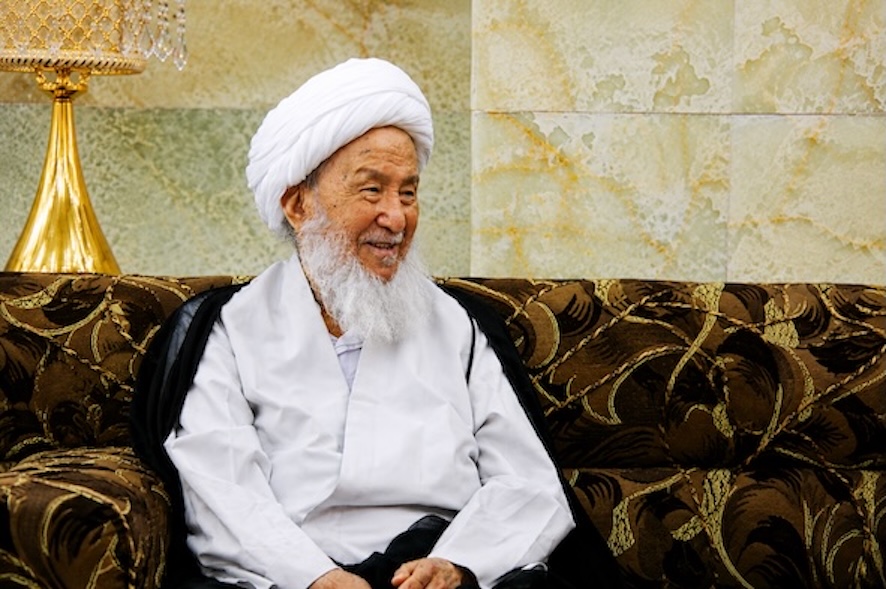
The loss of Sheikh al-Fayyad is a severe tragedy and the void he leaves behind is vast and difficult to fill.
When Grand Ayatollah Mohammad Ishaq Fayyaz (also spelled al-Fayadh or Fayyad) died in Iraq on 4 June 2026,[1] Iraq declared three days of national mourning (BBC Dari). Tributes came pouring in from across the Muslim world – from his fellow grand ayatollahs in Najaf and Iran to the governments of Iraq, Iran and Afghanistan – honouring one of the world’s foremost Twelver Shia)[2] jurists and one of the four most senior maraji al-taqlid (sources of emulation).[3] Yet outside specialist circles, relatively few people knew that one of the most influential Shia scholars of the twenty-first century had been born in Afghanistan’s remote central highlands, in the Jaghori district of Ghazni province.
Fayyaz’s life was remarkable not only because he rose to the highest ranks of the Shia religious establishment, but also because it is the story of the long and largely forgotten tradition of Afghan Islamic scholars who, over the centuries, have travelled to the great Shia seminaries of Iran and Iraq in search of religious learning. Among the many Afghans who travelled those routes, none attained greater international standing than Mohammad Ishaq Fayyaz. His story is therefore not only the biography of a distinguished jurist but also that of an Afghan intellectual whose influence reached far beyond his homeland.
From Jaghori to Najaf
Born in 1930 in Suba village in Jaghori district, Ghazni province, Mohammad Ishaq Fayyaz was the second son of a Hazara farming family of modest means. His father, Mohammad Reza, enrolled him in the village madrassa before he was five years old and, according to his official biography written by the late Sayyed Abdul Majid al-Khoei, “during the winter his father would wrap him up in blankets against Jaghori’s bitter cold and carry him to and from the madrassa on his shoulders.”[4]
After completing his primary religious education in Suba, Fayyaz spent four years studying at a religious school in the neighbouring village of Hutqol. He left Afghanistan at 17, after the death of his mother in 1947, to continue his religious education in the Iranian city of Mashhad (Afghan Bios). According to Majid al-Khoei, the move was intended as the first stage of a longer journey to Najaf, Iraq, the principal centre of Shia religious scholarship. Indeed, Fayyaz did later go to Iraq to continue his studies, first at the Salimiyah School and finally at the Hawza-ye Elmiya-ye Najaf (Najaf Seminary), one of the leading centres of Shia learning, which had, for centuries, attracted students from across the Shia world (Majid al-Khoei). He would call Najaf home until the end of his life. It was in this city that he entered one of the most demanding intellectual traditions in Islamic scholarship, devoting himself to the study of jurisprudence (fiqh) and legal theory (usul al-fiqh). At the Salimiyah School, one of his teachers was Ayatollah Modarres Afghani, himself an Afghan (BBC Dari; Shafaqna). At the age of twenty, he entered the advanced seminary of Grand Ayatollah Abu al-Qasim al-Khoei, one of the most influential Shia scholars of the twentieth century (Majid al-Khoei).
Among his fellow students in al-Khoei’s class was another future grand ayatollah, Ali al-Sistani. Over the next three decades, Fayyaz progressed from student to protege to trusted colleague. He spent fifteen years attending al-Khoei’s lectures before joining his office and becoming a member of the Majlis al-Istifta, the body responsible for preparing legal opinions (fatwas) and responding to religious questions submitted to the marja. There, he worked alongside Sistani and other senior scholars, helping to prepare responses to questions of jurisprudence for al-Khoei’s followers in Iraq and abroad (Grand Ayatollah Fayyaz’s official website, World Federation).
Fayyaz emerged as one of the most accomplished of al-Khoei’s students. His most important contribution during this period was the preparation of al-Khoei’s taqrirat (lecture notes) on legal theory (, which were later published as Al-Muḥadarat fi Usul al-Fiqh (Lectures on the Principles of Islamic Jurisprudence), a work that al-Khoei himself endorsed. In a commendation written for the book’s publication on 4 November 1966, al-Khoei thanked God for granting him “the honour of educating distinguished students, among them the learned Sheikh Mohammad Ishaq Fayyaz,” describing the work as “a valuable service” (Majid al-Khoei; Shafaqna). The work eventually expanded to ten volumes and remains the most significant published record of al-Khoei’s methodology in legal theory (official website, World Federation).
One of the ‘Big Four’
The death of Grand Ayatollah al-Khoei in August 1992 ushered in a new era for the Najaf Seminary. As the most influential Shia jurist of his generation, al-Khoei had attracted millions of followers and trained many of the leading scholars who would go on to shape Shia jurisprudence in the decades that followed. His death raised the question of who would emerge as the most senior religious authorities in the next generation (Majid al-Khoei).
By that time, Fayyaz had already established himself as one of Najaf’s leading scholars. More than three decades of study, teaching, writing and service in al-Khoei’s office had earned him considerable recognition among his peers. His reputation, together with the publication of Al-Muḥadarat and his work in the Majlis al-Istifta, placed him among the jurists regarded as qualified to exercise independent legal reasoning (ijtihad) and to issue their own legal opinions (Majid al-Khoei, World Federation). By the late 1990s, he came to be recognised alongside Grand Ayatollahs Ali al-Sistani, Mohammad Saeed al-Hakim (d 2021) and Bashir al-Najafi as one of Najaf’s four leading marjas. Although each maintained an independent office and following, together, they represented the continuity of the Najaf school after al-Khoei’s death (Afghan Bios, Majid al-Khoei).
While Ali al-Sistani emerged as the most influential Shia religious authority globally, particularly after Saddam Hussein’s downfall in 2003 (Majid al-Khoei; World Federation), some believe that Fayyaz, rather than Sistani, was the most senior of the four. However, according to the Encyclopaedia of Modern Middle East Wars, “he did not seek to chair the council because scholars who are not Iraqi or Iranian have little chance to gain followers among Arabs and Iranians, who make up the majority of the world’s Shi‘is,” instead, Fayyaz and his fellow grand ayatollahs backed Sistani for the role.[5]
Six decades in Najaf
For six decades, Fayyaz was an important member of the generation of scholars in Najaf who preserved the seminary through Saddam Hussein’s dictatorship, two wars and an occupation. Fayyaz understood his role as a marja not merely as issuing opinions and publishing treatises, but as the lifelong transmission of religious knowledge and service to the Shia community. His influence spread through the students he taught, the scholars he trained and the institutions he helped sustain. Over the decades, he taught successive generations of students. His lectures attracted students from Iraq, Afghanistan, Iran, Pakistan, India, the Gulf states and elsewhere, many of whom later became teachers, judges and religious scholars in their own communities (Majid al-Khoei).
Alongside his teaching, Fayyaz produced an extensive body of scholarship spanning jurisprudence, legal theory (usul al-fiqh), commentary on the Quran, theology and contemporary social questions. Among his best-known works are his multi-volume studies of jurisprudence and legal theory, Risalat al-Amaliyy (Practical Treatise),[6] and specialised works on Islamic governance,[7] medical ethics, banking and the position of women in Islam. His body of work reveals, wrote Majid al-Khoei, “a careful, methodical approach that drew on established principles of ijtihad to address questions relevant to the contemporary world.” His fatwas extended to questions with little precedent in classical jurisprudence: he held that organ transplants should be permitted where they could save a life and the donor had consented and he called for the unblocking of internet services in Iran, where access to the internet was, and continues to be, heavily restricted (see Qayoom Suroush’s 2014 AAN report, A new Afghan Shia Leader: Return to quietism versus political Islam?).
Unlike many other religious leaders in Afghanistan, Fayyaz never founded a political party or sought public prominence, Suroush noted, nor was he “involved in the violence of the civil war” that engulfed many other senior religious figures in Afghanistan. That distance from the violence and politics of the war years gave him a moral standing that some other religious leaders in Afghanistan could not claim, and it was this, together with his decades of teaching, extensive body of jurisprudence and the generations of Shia scholars he trained, that would be his making in Afghanistan’s Shia community.
The case for women’s equality
Among the many works during his long tenure, none attracted greater attention than Fayyaz’s writings on women. The mainstream position within Sunni and Shia jurisprudence alike holds that men and women are equal in their essential humanity and religious and spiritual obligations, but differ in certain legal matters such as testimony, divorce rights, inheritance and blood money and, crucially, that women cannot be heads of state, serve as judges, or become a marja (BBC Persian).[8][9] In Shi’a Islam, women can attain high levels of religious scholarship, including the rank of mujtahid – a jurist qualified to exercise independent legal reasoning, or ijtihad – but Fayyaz’s ruling that they could become a marja was radical. His Jayegah-e Zan dar Nizam-e Siyasi-e Islam (The Position of Women in the Islamic Political System), published in Arabic in 2014 and later translated into Persian, addressed one of the most debated questions in contemporary Islamic jurisprudence. It is a response to 25 questions posed by a doctoral researcher, covering women’s roles in politics, government, the judiciary, religious authority, ministerial office, parliament and military and police command, among other areas, according to former vice-president, Sarwar Danish, who translated the book. He described Fayyaz’s conclusions as “entirely without precedent,” and said:
I was not merely surprised but astounded by the fatwas and views regarding women presented in this book; never before had I heard such views [articulated] with such boldness, depth and candour about women’s rights and status from any of the known Sunni or Shia scholars. Had anyone other than Ayatollah Fayyaz expressed these views, they would have been branded an apostate by traditional society and the traditional clergy. Yet, who would dare – then or now – accuse a religious and scholarly figure of Ayatollah Fayyaz’s stature of apostasy or of opposing the tenets of the faith and sharia?
Danish measured Fayyaz’s position against three other positions: 1) a full-equality view that he associated with liberal and Western human-rights framing; 2) denying women political, social and economic rights altogether, a position he associated with the Taliban; and 3) the mainstream position as described above, including that they cannot rule countries, serve as judges or become marjas. Fayyaz believed that women could serve in all 18 of the offices addressed in the book and underscored this position with scholarly rigour (see also BBC Dari).
The significance of his opinion was not merely that they echoed contemporary political debates, but that he approached each question by asking what conclusions could legitimately be reached within established Shia jurisprudence. In other words, rather than seeking to influence Islamic law from the outside, he set out to show how contemporary questions concerning women’s participation in public life could be addressed through the canon of Shia Islam itself, finding that, for example, the traditions that deem women being “deficient in intellect and religion” were “not reliable and attributing them to the Prophet is not correct. In addition, these traditions cannot be supported or verified as they go against what has been observed and is essentially true” (see Sayed Hadi Tabatabaei’s analysis for Mobahesat in Persian and an English translation on Iqra).
Fayyaz argued that clear and convincing religious proof was required to assert any differences in how Islamic law treats men and women, and in the absence of such evidence, the default position has to be equality. In his analysis of Fayyaz’s reasoning, Seyed Hadi Tabatabaie explains that Fayyaz based his reasoning on two established principles of Shia jurisprudence: the Principle of Permissibility (Asalat al-Ibaḩa), under which actions are considered permissible unless expressly prohibited, and the concept of Mantiqat al-Faragh, the sphere in which no definitive legal ruling exists and where jurisprudence may respond to changing circumstances (Mobahesat, Iqra).
In his examination of Fayyaz’s The Position of Women in the Islamic Political System, Danish points out that Fayyaz drew on several further supporting principles: that men and women share equal religious obligations unless an authoritative text specifies otherwise, that the Quran addresses “the people” and not a particular gender, that family law and public or civil law occupy distinct legal domains and that an Islamic government may legislate on family matters within the sphere where no definitive legal ruling exists in women’s favour, according to the needs of the time.
In other words, instead of beginning from assumptions about gender roles, Fayyaz began with a jurisprudential principle: legal restrictions require clear textual evidence. Where neither the Quran nor reliable traditions established a prohibition, he argued, there was no legal basis for barring women’s participation in public life. He concluded that there was no conclusive religious evidence preventing women from serving as members of parliament, ministers or even heads of government. He also argued that women could serve as judges in many areas of law, provided they possessed the necessary qualifications. These conclusions, as Tabatabaie highlights, were a departure from the views of many contemporary jurists and generated considerable discussion within Shia scholarly circles (Mobahesat, Iqra).
Equally notable was the way Fayyaz viewed the textual evidence traditionally cited in support of those restrictions. Discussing the Quran’s Surat An-Nisa 4:34, which states: “Men are in charge of women,”[10] he argued that the verse concerns responsibilities within family life and should not be extended to public or political authority. Similarly, responding to a question about whether women could serve as judges, he said:
The majority of fuqaha [jurists] have taken the position that judging is the prerogative of Muslim men and does not extend beyond that [to women], but [I hold that] it does extend beyond that [to women], provided that the necessary requirements are met by a Muslim woman. However, when it comes to general judgement by a layman [in a customary or informal justice mechanism], where the authority of the judge does not rest on proof of religious authority [but rather it is a civil matter], there is no difference between a man and a woman.
On the question of women becoming marjas – religious authorities for other Shia Muslims – he said:
The majority of jurists are of the opinion that a woman cannot assume the position of issuing fatwas and becoming a marja … in my opinion, it is permissible; provided that all the conditions for issuing fatwas and being a marja are met by a woman.”
In his view, neither the Quran nor authentic prophetic tradition established a general principle of female inferiority that would justify excluding women from positions of responsibility or deeming them inferior to men (Majid al-Khoei).[11]
Fayyaz also challenged the weight traditionally attached to ijma (consensus among the jurists) on these issues. He argued that while many earlier jurists had regarded these roles as the purview of men, in the absence of evidence, consensus alone was not enough:[12]
Consensus in itself is not evidence and has no validity; unless it is proven that it was also the case during the time of the al-Ma’sumun (Infallibles) and has reached us [in an unbroken chain] and generation after generation, but there is no way to prove [such claims].
It was precisely because he remained firmly within the framework of Shia jurisprudence, even as he challenged established interpretations, that distinguished him from his more conservative peers. As Sheikh Mousa Rezaie, who was in charge of Fayyaz’s office in Herat, noted at a memorial gathering in Mashhad, “Few mujtahids would dare to break the traditions prevalent among the religious authorities of the past,” but Fayyaz had reached “such a level of ijtihad and intellectual credibility,” that he was able to offer new legal reasoning (see SNA’s coverage of the memorial on Instagram).
Fayyaz’s arguments about women were significant not only for his conclusions but also for the methods he used to reach them. Rather than appealing to modern concepts of equality or human rights, he grounded his reasoning in the established principles of Shia jurisprudence. By distinguishing between immutable religious principles and historically entrenched interpretations, he argued that Islamic law possessed the intellectual resources to respond to changing social circumstances.
His thinking was welcomed by a number of Afghan scholars and public figures. Ali Amiri, a Philosophy professor at Ibn Sina Private University in Kabul, lamented the fact that Fayyaz’s scholarship had not been more widely available to Afghans in the early years of Afghanistan’s Islamic Republic, saying: “If we had had access to his opinion at the time of tensions regarding the Shia family law, the law would look different today” (Afghan Bios).[13] Former Vice-President Sarwar Danish described the book as a significant contribution to contemporary Islamic thought, noting that it challenged long-held assumptions about women’s participation in public life while remaining firmly rooted in Shia jurisprudence:
The book addresses an important subject – the status of women in the Islamic political system, which is a current and important issue from a jurisprudential, legal and political perspective. … It views women’s rights from an inside-the-religion perspective by relying on ijtihad sources, and [by] grounding [his argument] in Islamic law and its theological, historical and political contexts.
Although the book was written primarily for an audience of Islamic scholars, its implications reach well beyond the seminaries. At a time when debates over women’s education, employment and political participation were increasingly contested in Afghanistan and elsewhere, his arguments offered an alternative reading of Islamic law from one of the world’s most senior Shia jurists. Rather than framing the discussion as a conflict between religion and modernity, Fayyaz sought to show that well-considered reasoning could itself be a vehicle for reform. Perhaps it was this approach that led the Financial Times Magazine, in 2004, to describe him as the “reformer’s reformer.”
An Afghan marja, recognised at last
Despite becoming one of the world’s leading Shia jurists, Fayyaz remained, for much of his career, a relatively little-known figure in Afghanistan. While Afghan seminarians and religious scholars recognised his standing in Najaf, his scholarship reached only a limited audience in his homeland. He had spent almost his entire adult life in Iraq and, thus, he remained outside Afghanistan’s political and religious networks. Unlike other Shia leaders, such as Ayatollah Qurban Ali Muhaqiq Kabuli, whose prominence was bolstered by close ties to Abdul Ali Mazari’s mujahedin faction Hezb-e Wahdat, Fayyaz avoided party politics. As a result, while his authority was firmly established in the seminary, it was less visible among the wider Afghan public (Majid al-Khoei).
This began to change after 2001. The collapse of the first Taliban emirate created new opportunities for higher education, publishing and intellectual debate within Afghanistan’s Shia community. As Qayoom Suroush observed in his report for AAN, a new generation of Afghans were increasingly looking beyond Afghanistan’s established political and religious networks towards the seminaries of Najaf for religious scholarship. The translation of Fayyaz’s books into Dari, from 2011 onwards, together with efforts by Afghan academics and intellectuals to introduce his work to a broader audience, brought his scholarship to the attention of readers in Afghanistan, particularly the book on women discussed above. It found precisely the broader Afghan readership that his earlier, more technical writings had not.
Recognition came in August 2014, when Kabul hosted the first national congress dedicated to Fayyaz’s scholarship, entitled ‘A Tribute to Ayatollah Fayyaz’s Scholarly Achievements’, in the Loya Jirga Tent, one of Afghanistan’s principal state venues for major national gatherings. Several thousand guests attended, filling the tent to its last chair, according to Suroush. Danish, then Higher Education Minister, described Fayyaz as “the best of all the marjas currently out there.” Organised by Afghan academics, rather than by Fayyaz’s own office, it attracted a broad audience of political leaders, religious scholars, academics and civil society representatives from both the Shia and Sunni communities, including then Vice-President Karim Khalili and soon-to-be Chief Executive, Dr Abdullah. Mohammad Mohaqeq, deputy to Abdullah, also attended and used the occasion to press the case for Islam to modernise. President Hamid Karzai, along with the prominent Sunni mujahedin leaders Abdul Rabb Rassul Sayyaf and Sebghatullah Mojaddedi, did not attend, but sent messages of tribute (Bokhdi News, Ava Press). The gathering established Fayyaz not merely as a leading Shia marja but also as one of Afghanistan’s foremost contemporary scholars.
Although Fayyaz himself did not attend and sent his son instead to represent him, Suroush argued that the conference reflected growing interest in a model of religious leadership rooted in scholarship rather than political mobilisation – “a return to quietism versus political Islam” (Suroush). At the same time, Suroush cautioned against overstating Fayyaz’s influence. Within the Shia tradition, a marja’s authority depends not only on scholarly standing but also on institutional networks of representatives, seminaries, charitable foundations and religious offices.
In 2014, according to Suroush, Fayyaz’s Afghan operation remained modest by comparison: a small office in Kabul, with three further offices in Herat, Balkh and Ghazni, no madrassa-owned land and no newspaper or broadcaster of his own. His stipends to Afghan madrassa students were a fraction of those paid by followers to other marjas, such as Ayatollah Sistani or Ayatollah Muhaqiq Kabuli. “It was a modest operation,” wrote Suroush, set against a wider Afghan landscape awash in foreign aid and rent-seeking. His influence, therefore, rested primarily on intellectual prestige rather than on institutional or political power.”
By the time Fayyaz died in June 2026, he was supporting religious students, seminaries, charitable institutions and welfare projects across the Shia world, including Afghanistan. The activities were funded largely by sahm-e imam (the imam’s share, or the religious tax and payment sent to a marja by his followers), particularly khums.[14] In Afghanistan, this work was carried out chiefly through the Afghanistan Charity Foundation, which he established in 2012. In 2026, according to Dehmazang.org, the foundation delivered Eid gift packages to more than 27,000 orphans in 21 provinces, winter assistance to another more than 25,000 orphans and supported families affected by the 2022 suicide bombing at the Kaaj educational centre in Kabul.
By the time of his death, he had become one of Afghanistan’s most respected religious scholars and, for many Afghan Shia Muslims, an alternative model of religious leadership grounded in jurisprudence, learning and intellectual independence.
A hard-to-fill void
Following his death, memorial services were held in several Muslim-majority countries. In Najaf on 4 June 2026, Fayyaz’s funeral unfolded over three days in the shrine cities of Kadhimiya, Karbala and Najaf. Large crowds of mourners joined the processions as Iraq declared three days of national mourning (see photos on Reuters). The procession began in Kadhimiya, where Abbas al-Bayati, a senior figure in the Dawa Party, one of Iraq’s oldest Shia parties, paid tribute to him, saying: “We have lost one of the pillars of knowledge and wisdom. Someone who generously helped the Islamic ummah, was an agent of moderation and unity, and consistently called for coexistence and civil peace among Iraqis” (Hawzah News Agency). The final procession began from his office and residence in New Najaf and made its way to the Shrine of Imam Ali, near which he was laid to rest. For a scholar who had devoted almost eight decades to the Najaf seminary, burial beside the shrine of the First Imam represented the culmination of a lifetime spent in the service of Shia scholarship.
In Kabul, a memorial held on 8 June 2026 drew representatives from across Afghanistan’s religious and political spectrum. The Islamic Emirate sent an official delegation led by senior Ministry of Interior officials. Its spokesman, Mufti Abdul Mateen Qani, read a message from Interior Minister Sirajuddin Haqqani describing Fayyaz as “one of the great scientific and intellectual authorities in the Shia world” and praising his lifelong commitment to Islamic unity (Atlas News). In Iran, commemorations took place at the Imam Reza Shrine in Mashhad, in Isfahan and at the Shrine of Fatima Masumeh in Qom, where a major memorial organised on behalf of the Supreme Leader brought together leading clerics, representatives of the senior marjas, seminary scholars and public officials (ABNA; Ava Press). Ayatollah Sistani’s office in Qom also held a separate memorial (Shafaqna), while Afghanistan’s Shia community in Iran organised its own ceremony in recognition of one of their most distinguished religious scholars (see for example Sarie News posts on Instagram here and here).
The tributes that followed reflected the breadth of Fayyaz’s influence and the different worlds he had inhabited throughout his life. Ayatollah Bashir al-Najafi, one of Fayyaz’s fellow senior marjas in Najaf, wrote: “Today the sheikh of Najaf al-Ashraf and patron of the hawza has left us” (Shafaqna). Afghanistan’s former vice-president Sarwar Danish remembered him as “a unique and radiant jewel, the peerless pearl of Najaf,” and observed that the name Fayyaz means “a vessel filled overflowing with water,” an apt name, he said, for a scholar from whom “knowledge and wisdom flowed like a gushing spring … [benefiting] thousands, indeed millions” (Facebook). Iraq’s prime minister Ali al-Zaidi as well as Afghanistan’s former presidents Hamid Karzai and Ashraf Ghani were among senior political figures who also sent condolences, alongside religious and political leaders across Iran and Iraq.[15]
For students of Islamic jurisprudence, Fayyaz left behind a substantial body of scholarship that continues to shape contemporary Shia thought, from his ten-volume record of al-Khoei’s teaching to his own rulings on women’s place in public life. For many Afghans, he represented something equally significant: a boy from the remote highlands of Jaghori who rose, through scholarship alone, to become one of the world’s foremost marjas. His life demonstrated that Afghanistan’s contribution to Islamic learning extended far beyond its borders, and that patient scholarship could, in the end, reshape how a tradition reads its own texts.
Grand Ayatollah Mohammad Ishaq Fayyaz, modest, generous, a quiet rule-breaker who challenged longstanding assumptions, born in Afghanistan in 1930, died in Iraq on 4 June 2026, a son of Jaghori, whose legacy belongs as much to Afghanistan as it does to the wider Shia world.
Edited by Kate Clark
References
| ↑1 | Most sources report that Fayyaz died at a hospital in Baghdad (see for example ABNA), though the Iraqi News Agency reported that he died in Najaf. |
|---|---|
| ↑2 | Twelver Shia (Ithna Ashari) are the largest branch of Shia Islam. They recognise a line of twelve imams, beginning with Ali ibn Abi Talib, the cousin and son-in-law of the Prophet Muhammad, and ending with Muhammad al-Mahdi, the Twelfth Imam, who they believe to be in occultation and will return at the end of time. |
| ↑3 | In Twelver Shia Islam, a marja is a jurist whose legal opinions are followed by those who choose to emulate him in matters of religious practice. Unlike many religious traditions, there is no formal process of appointment or succession. Instead, authority emerges through recognised scholarship, the esteem of fellow jurists and the willingness of believers to follow a particular marja. |
| ↑4 | Much of the biographical information in this article is drawn from the authorised biography of Grand Ayatollah Mohammad Ishaq Fayyaz, written by Sayyed Abdul Majid al-Khoei, Grand Ayatollah Abu al-Qasim al-Khoei’s son, and published by the Office of Grand Ayatollah Fayyaz in Najaf. This report will refer to the biography in shorthand as Majid al-Khoei. |
| ↑5 | Encyclopaedia of Modern Middle East Wars is not available online, but a prepublication copy of the entry was posted online by View From the Occident and retrieved from the Internet Archive. |
| ↑6 | See the Persian translation here. |
| ↑7 | In al-Anmudhaj fi Manhaj al-Hukuma al-Islamiyya (The Model of Islamic Government), written in 1426 AH (2005), Fayyaz argued that neither the sayings of the Prophet nor those of the Imams provided strong evidence for welayat-e faqih – the doctrine, developed by Iran’s Ayatollah Khomeini, under which the most qualified jurist rules the state by divine right. He agreed that a state should be run by the most just, honest and educated jurist available, but held that this was because such a person was best suited to the task, not because religious leadership was itself God-given (see Qayoom Suroush, A new Afghan Shia Leader: Return to quietism versus political Islam?, Afghanistan Analysts Network, 2014 and the Financial Times Magazine). |
| ↑8 | For more detail on the mainstream view of the role of women in Sunni and Shia jurisprudence, see Explore Islam and Akif Tahiiev, Female Leadership in Shia Islam: Women on the Way from Mujtahid to Marjaʿ, Societies 14, No 1, 2024. |
| ↑9 | For example, Iran’s former ruler, Grand Ayatollah Ruhollah Khomeini ruled in 1978 that a woman could become a mujtahid, but could not serve as a marja (The Status and Rights of Women in the Islamic System). Akif Tahliev also discussed this in his 2024 paper, Female Leadership in Shia Islam: Women on the Way from Mujtahid to Marja’. Grand Ayatollah Ali al-Sistani stated: “A woman can also lead the prayer for other women,” although his rulings require the leader of Juma (Friday) prayer to be a man (Jurisprudence Made Easy). |
| ↑10 | The full surah reads:
Men are in charge of women by [right of] what Allah has given one over the other and what they spend [for maintenance] from their wealth. So righteous women are devoutly obedient, guarding in [the husband’s] absence what Allah would have them guard. But those [wives] from whom you fear arrogance – [first] advise them; [then if they persist], forsake them in bed; and [finally], strike them. But if they obey you [once more], seek no means against them. Indeed, Allah is ever Exalted and Grand (Sahil International translation). |
| ↑11 | See also Robert Gleave, ‘She should not raise her voice when among men’: Imami arguments against (and for) women judges, in Mirjam Künkler and Devin J Stewart, Female Religious Authority in Shi’i Islam: Past and Present, Chapter 6, pp 121–37, Edinburgh University Press, 2021. |
| ↑12 | In Twelver Shia Islam, the Fourteen Infallibles (al-Ma’sumun) are the prophet Muhammad, his daughter Fatima Zahra, and the Twelve Imams. They are believed to possess ismah (divinely ordained freedom from sin and error). |
| ↑13 | This is in reference to the Shia Personal Status Law, adopted in 2009 under Article 131 of Afghanistan’s Constitution, which codified Jafari jurisprudence on matters such as marriage, divorce, inheritance and child custody for the country’s Shia community. |
| ↑14 | Khums (literally one-fifth) is an obligatory tax in Shia jurisprudence, levied on annual surplus wealth, spoils of war, and specific items such as minerals or treasure. It is owed by every sane adult Muslim who, after covering a year’s living expenses, has surplus income or savings. |
| ↑15 | Iraq’s prime minister, Ali al-Zaidi, who called Fayyaz’s death “a painful loss to the fields of scholarship, ijtihad and Islamic scholarship”; Afghanistan’s former president Hamid Karzai, who described him as “a dedicated son of Afghanistan” (ABNA); and former president Ashraf Ghani, who called him “one of Afghanistan’s greatest intellectual treasures” (Memar Press). Also sending condolences were Iran’s president, Masoud Pezeshkian; its foreign minister, Abbas Araghchi; parliament speaker Mohammad Baqer Qalibaf; and first vice-president Mohammad Reza Aref; former Iranian president Mohammad Khatami; senior marjas, including Ayatollahs Javadi Amoli, Jafar Sobhani and Hossein Nouri Hamedani; Iraqi political leaders Muqtada al-Sadr and Ammar al-Hakim; Iraq’s parliament speaker Mohammed al-Halbousi; former prime minister Nouri al-Maliki; the head of Iraq’s Supreme Judicial Council, Faiq Zaidan; and the president of the Kurdistan Region, Nechirvan Barzani (Shafaqna). |