Exclusive: Airlines fly over Afghanistan as Middle East becomes the greater risk

By  and 

LONDON/SEOUL, Aug 23 (Reuters) – Singapore Airlines, British Airways (ICAG.L), opens new tab and Lufthansa (LHAG.DE), opens new tab have increased their flights over Afghanistan after years of largely avoiding it now the Middle East conflict has made it seem a relatively safe option.
The carriers mostly stopped transiting Afghanistan, which lies on major routes between Asia and Europe, three years ago when the Taliban took over and air traffic control services stopped.
Those services have yet to resume, but airlines increasingly consider the skies between Iran and Israel are riskier than Afghan airspace. Many had started routing through Iran and the Middle East after Russian skies were closed to most western carriers when the Ukraine war began in 2022.
“As conflicts have evolved, the calculus of which airspace to use has changed. Airlines are seeking to mitigate risk as much as possible and they see overflying Afghanistan as the safer option given the current tensions between Iran and Israel,” Ian Petchenik, a spokesperson for flight tracking organisation Flightradar24, said.
There were more than seven times the number of flights over Afghanistan in the second week of August than during the same period a year ago, according to a Reuters analysis of FlightRadar24 data.
Reuters Graphics
Reuters Graphics
The shift began in mid-April during reciprocal missile and drone attacks between Iran and Israel. Flight tracking data from the time shows Lufthansa, Singapore Airlines, British Airways and others began to send a few flights a day over Afghanistan.
Flight path of Singapore Airlines flight 326 from Singapore to Frankfurt
But the main growth has been since the killing of senior members of militant groups Hamas and Hezbollah in late July raised concerns of a major escalation.
Some pilots are concerned.
“You’re depending on the analysis of your airline. Every time I fly out there, I don’t like the feeling of flying over a conflict area where you don’t know, actually, what is happening,” said Otjan de Bruin, a commercial pilot and head of the European Cockpit Association.
“It’s always safe enough, until proven otherwise.”
Flight path of Singapore Airlines flight 326 from Singapore to Frankfurt Daily flights over Afghanistan for select airline groups
Lufthansa Group told Reuters it decided to resume overflying Afghan airspace from early July.
Other carriers that have increased overflights since April include Turkish Airlines (THYAO.IS), opens new tab, Thai Airways (THAI.BK), opens new tab and the Air France-KLM (AIRF.PA), opens new tab group, data shows.
“Based on actual security information, KLM and other airlines currently safely overfly Afghanistan only on specific routes and only at high altitudes,” KLM told Reuters.
British Airways, Thai Airways, Turkish Airlines and Singapore Airlines did not respond to requests for comment.
Taiwan’s EVA Air (2618.TW), opens new tab began from late July, flight tracking data shows. EVA told Reuters it chooses routes based on safety, the current international situation and flight advisories.

REGULATION’S ROLE

The route changes have been facilitated by aviation regulators easing guidance on Afghanistan.
The U.S. Federal Aviation Administration (FAA) in early July said planes could fly at a lower altitude over a sliver of north-eastern Afghanistan, the Wakhan Corridor, which is used to cross from Tajikistan to Pakistan – opening that path to more types of flights.
A year earlier, the FAA lifted its ban on overflights for the entire country, but said planes must stay above 32,000 feet (9,753.6 m) where surface-to-air weapons are considered less effective.
But few started using Afghanistan until April.
Although more traffic has been using the airspace without incident, there is no guarantee of crew or passenger safety if a plane has to land, flight safety group OPSGROUP said in July.
In the absence of air traffic control, pilots crossing Afghanistan talk to nearby planes over radio according to a protocol drawn up by U.N. aviation body ICAO and Afghanistan’s Civil Aviation Authority.
European aviation safety regulator EASA said in a conflict-zone information bulletin re-issued in July that “extremist non-state actor groups remain active and might sporadically target aviation facilities in multiple ways.”
The industry is haunted by the memory of Malaysian Airlines Flight MH17 from Amsterdam to Kuala Lumpur, which was shot down over eastern Ukraine in 2014, as fighting raged between pro-Russian separatists and Ukrainian forces.

COST AND LIMITED CHOICE

Airlines are under pressure to save money after the loss since 2022 of many shorter paths through Russian airspace, and as they re-build from the pandemic.
There are few international rules that dictate which areas of airspace are safe and airline safety decisions are left largely to the discretion of individual carriers.
If an airline cannot fly through Russia, Ukraine or Iran, central Afghanistan offers a more direct route into southern Asia from Europe.
“This route saved us a fair chunk of time and fuel,” OPSGROUP reported from a pilot in July who flew from Amsterdam to Kuala Lumpur across central Afghanistan.
Exclusive: Airlines fly over Afghanistan as Middle East becomes the greater risk
read more

Afghanistan Slides Into ‘Ever More Hellish Conditions’ After New Morality Law Enacted

The Taliban has attempted to police the public appearances and behavior of millions of Afghans, especially women, since seizing power in 2021.

But the enforcement of the extremist group’s rules governing morality, including its strict Islamic dress code and gender segregation in society, was sporadic and uneven across the country.

Now, the hard-line Islamist group has formally codified into law its long set of draconian restrictions, triggering fear among Afghans of stricter enforcement.

The Law On the Propagation Of Virtue And Prevention Of Vice, which was officially enacted and published on August 21, imposes severe restrictions on the appearances, behavior, and movement of women. The law also enforces constraints on men.

Adela, a middle-aged woman, is the sole breadwinner for her family of 10. She is concerned that the new morality law will erode the few rights that women still have.

The Taliban has allowed some women, primarily in the health and education sectors, to work outside their homes.

“I fear that Afghan women will no longer be able to go to their jobs,” Adela, whose name has been changed to protect her identity, told RFE/RL’s Radio Azadi.

Dilawar, a resident of the capital, Kabul, warned of a public backlash if the Taliban intensified the enforcement of its widely detested restrictions.

“The youth are suffering from extreme unemployment. Oppressing them…will provoke reactions,” the 26-year-old, whose name was also changed due to security concerns, told Radio Azadi.

Long List Of Restrictions

The new morality law consists of 35 articles, many of which target women.

Women are required to fully cover their faces and bodies when in public and are banned from wearing “transparent, tight, or short” clothing. The law also bans women from raising their voices or singing in public.

Women must also be accompanied by a male chaperone when they leave their homes and cannot use public transport without a male companion.

The law forbids unrelated adult men and women from looking at each other in public.

Men must also dress modestly, even when playing sports or exercising. They are prohibited from shaving or trimming their beards. Men are also compelled to attend prayers as well as fast during the holy Islamic month of Ramadan.

“[Men] should not get haircuts, which violate Islamic Shari’a law,” says one of the articles in the law. “Friendship and helping [non-Muslim] infidels and mimicking their appearance” is prohibited.

Afghans are forbidden from “using or promoting” crossses, neckties, and other symbols deemed to be Western.

Premarital sex and homosexuality are outlawed. Drinking alcohol, the use of illicit drugs, and gambling are considered serious crimes.

Playing or listening to music in public is banned. Meanwhile, the celebration of non-Muslim holidays, including Norouz, the Persian New Year, are also prohibited.

The Taliban’s dreaded morality police are responsible for enforcing the morality law. The force, believed to number several thousand, is overseen by the Ministry for the Promotion of Virtue and the Prevention of Vice.

Under the new law, the powers of the morality police have been expanded.

Members of the force will be deployed across the country to monitor compliance, according to the law. Members of the morality police are instructed to issue warnings to offenders. Repeat offenders can be detained, fined, and even have their property confiscated.

The morality police can detain offenders for up to three days and hand out punishments “deemed appropriate” without a trial.

The Taliban revealed last week that the force detained more than 13,000 Afghans during the past year for violating the extremist group’s morality rules.

‘Hellish Conditions’

The Taliban’s morality law has been widely condemned by Afghans, Western countries, and human rights organizations.

The Taliban has defended the law, which it claims is “firmly rooted in Islamic teachings.”

“This new law is deeply harmful,” said Heather Barr, associate women’s rights director at Human Rights Watch. “It represents a hardening and institutionalization of these rules by giving them the status of law.”

She said the law is a “serious escalation” and “swift slide to ever more hellish conditions for Afghan women and girls.”

Roza Otunbaeva, head of the UN Assistance Mission in Afghanistan, on August 25 called the law a “distressing vision for Afghanistan’s future” because of the broad powers the Taliban’s morality police will have “to threaten and detain anyone based on broad and sometimes vague lists of infractions.”

Obaidullah Baheer, a lecturer of politics at the American University of Afghanistan, said that parts of the morality law are “extremely vague.”

Yet, the morality police are given broad powers, including to “arbitrarily” punish people without due process, he said.

“[This is] making them the judge, jury, and executioner,” said Baheer.

Afghanistan Slides Into ‘Ever More Hellish Conditions’ After New Morality Law Enacted
read more

They fled Afghanistan. In the US, they have freedom – but fear a return

in Sacramento

Almost three years after Esmatullah Sultani rushed to Kabul’s international airport, at the time besieged by Taliban forces who were seizing control of Afghanistan, the 24-year-old man walked into a busy neighborhood market near Sacramento, California.

Sultani greeted many of the stallholders, fellow Afghans, and ordered kebabs for lunch in Dari, a language spoken by more than 35 million people in Afghanistan.

Since the United States ended its 20-year military presence there, Afghanistan has become a country where those who assisted American forces are in danger of persecution and where women are deprived of fundamental rights, including education.

“This is the closest I am to home,” Sultani said, walking through aisles packed with canned food from the Middle East and an area adorned with colorful rugs and long-sleeved dresses known as kameez.

“But here in California, we are safe. My little sister can go to school. I go on picnics with my whole family and we even play soccer.”

While the Biden administration helped to airlift, screen and resettle tens of thousands of Afghans in the US, three years after the chaotic withdrawal of the US military, many continue to live in uncertainty, with only short-term legal protections amid fear of being returned to the country they were obliged to flee.

More than 77,000 Afghans have been relocated to the US under an immigration authority known as parole, according to data provided by the Department of Homeland Security. Sacramento county is home to the largest Afghan community in the US, with a population of almost 17,000, according to statistics from the Migration Policy Institute, a non-partisan thinktank in Washington.

Sultani’s father had worked as a civil engineer for several US military construction projects in Afghanistan and, thanks to a work certificate he brought with him to Kabul’s airport, Sultani managed to get on a US aircraft and evacuate as the Taliban closed in.

His humanitarian parole status was meant to be a quick, temporary fix, valid for two years, with evacuees instructed to apply for special immigrant visas, or for asylum.

Asylum offers refuge to immigrants fleeing persecution based on certain factors such as their race, religion and political views. The visas, on the other hand, are available to Afghans who served American forces as translators, as interpreters or in other roles. Both benefits offer recipients and their immediate relatives permanent legal status.

Sultani applied for asylum and waited anxiously.

“My asylum was approved, and then I applied for a green card, but until the day it comes in the mail the idea of going back to Afghanistan won’t disappear,” said Sultani, who is getting an associate degree in computer information science at American River College in Sacramento. With his father still in Afghanistan and his mother and siblings in the US, Sultani also works to help his family in both countries stay afloat.

More than 21,000 Afghan evacuees across the US have submitted asylum applications, according to US Citizenship and Immigration Services, which is reviewing a total of 1.2m pending asylum cases.

The Biden administration has created various temporary avenues for those Afghans in limbo, including extending temporary work permits and protections from deportation. Also, a temporary protected status program for Afghans in the US allows them to work here legally under a different law designed to protect immigrants from countries beset by armed conflict or other crises.

So far, 3,100 Afghans have successfully extended their temporary protected status through May 2025, according to the DHS.

But much uncertainty remains. The US military withdrawal should not end America’s commitment to vulnerable Afghans, said Krish O’Mara Vignarajah, who served as a policy director for Michelle Obama and is now the president of Global Refuge, an immigrant rights group.

“The bottom line is that our current system has proven insufficient for extending Afghans permanent protection in a timely manner,” she added, saying: “Three years later, thousands of Afghan allies have yet to secure a long-term status through asylum or special immigrant visas. And that’s because Congress failed to pass the Afghan Adjustment Act last year.”

Global Refuge has helped resettle more than 23,500 Afghans in the US, said Timothy Young, the director for public relations at the organization.

The Afghan Adjustment Act would have created a path to permanent status for evacuees such as Sultani, but the initiative, which received bipartisan support, has been stalled in Congress for more than two years.

Advocates say Afghans have been treated differently from similar refugee groups who have been offered permanent status under adjustment acts passed by Congress, such as Cubans escaping communism, Hungarians fleeing Soviet repression and Vietnamese refugees following the fall of Saigon.

The day that Kabul fell, Jaber, 24 – who asked for his last name to be withheld out of concerns for the safety of his family, who remain in Afghanistan – planned to go to the international airport with his siblings, hoping to get evacuated by US military aircraft. Instead, he had to stay home because two suicide bombers and gunmen killed 60 Afghans and 13 US marines.

Jaber is part of the long-persecuted Hazara ethnic minority group and said he had been an intern for a journalistic association in Afghanistan.

One month before the fall of the Taliban regime in 2001, the United Nations discovered mass graves of Hazaras in Bamiyan, part of an ethnic-cleansing campaign. After the Taliban swept back into power more than 20 years later, Jaber and his family lived in fear.

Having failed to get evacuated, Jaber fled to Iran, where he stayed for seven months with a visa. He then traveled to Brazil and, after two weeks of sleeping in churches and parks, he decided to head for the US.

Like hundreds of thousands of desperate refugees, he embarked on a perilous land journey, traversing Peru, Ecuador, the deadly jungle between Colombia and Panama known as the Darién Gap and the entirety of Central America before reaching the US-Mexico border in August 2022.

“I slept under benches with dogs. I remember my shoes had holes in the soles, and I had no money,” said Jaber, who now lives in northern California and works as a dispatcher for a security company.

“After I left Afghanistan, Taliban members came to our house and searched for any documents that would lead to the arrest of any of my family members.”

One of Jaber’s siblings escaped to Germany, but others remain in Afghanistan.

With the help of the International Rescue Committee, a resettlement organization that has assisted 11,621 Afghan evacuees, Jaber was granted US asylum this summer. His dream, he said, was to pursue a career in journalism, a job that might have gotten him killed in Afghanistan.

“For those coming up over the southern border, there are even fewer resources for them. They don’t have the same access to benefits as those that are paroled in,” said Tara Winter, executive director of the IRC’s chapter in northern California.

“They don’t qualify for the same family reunification benefits as other refugees do, and they experience so much anguish as they read about the worsening humanitarian situation in Afghanistan. It’s just a sort of unending legal limbo that makes it really hard for people to focus on rebuilding their lives here.”

They fled Afghanistan. In the US, they have freedom – but fear a return
read more

The Propagation of Virtue and Prevention of Vice Law, translated into English

The Islamic Emirate’s supreme leader, Mullah Hibatullah Akhundzada, has issued a new law laying out the duties, powers and punishments available to the enforcers of the Ministry for Promoting Virtue and Preventing Vice. The law also specifies numerous acts and particular behaviour that the Emirate deems either obligatory or forbidden for Afghan citizens. Today, AAN has published a basic translation of the 114-page, 35-article law, without its extensive footnotes, by Islamic scholar, John Butt.* We plan to publish a full version with footnotes, as well as a review of the new law.
The Propagation of Virtue and Prevention of Vice Law, in Pashto and Dari, can be downloaded from the Ministry of Justice website (search for 1452, using Arabic numerals, ie ۱۴۵۲). A working, basic translation of the law into English is available for preview and download below. 

The new law, issued on 21 August 2024, lays out the duties and powers of those enforcing it, the employees of the Ministry for Promoting Virtue and Preventing Vice, which the Emirate re-established when it retook power in August 2021. The enforcers (muhtasibin), the law says, should respect everyone’s social standing and human dignity, not pry into people’s private sins and avoid entering their homes. It gives them extensive powers to punish wrongdoers with penalties ranging from verbal admonishment to fines to prison.

The law details many acts which are forbidden or obligatory. Acts that enforcers should prevent include adultery, fornication, lesbianism, anal sex, gambling, animal and bird fighting, making pictures of animate objects, beard-shaving, befriending non-Muslims, observing Nawruz and Shab-e Yalda (festivals on the spring equinox and winter solstice) and dealing harshly with orphans. Enforcers, the law says, should refer those not praying, not fasting during Ramadan, or disobeying their parents to a court of law. Special injunctions apply to shopkeepers, farmers, artisans, taxi drivers and those responsible for beauty spots and tourist attractions.

The law orders women to cover their bodies and faces entirely and not speak or sing loud enough for non-family members to hear them. Men must dress so as to cover their bodies from navel to knee.

(See also a statement on the new law from the Ministry of Justice.)

We are publishing a basic translation of the law in response to demand from our readers, but are looking forward to publishing a complete translation, including the extensive footnotes, along with a separate section on praying, as well as a review.

You can preview the report online and download it by clicking here or the download button below.


*John Butt came to journalism and broadcasting from a traditional madrasa education; he was a graduate of the Darul Uloom Deoband seminary in northern India. For the last thirty years, he has been responsible for setting up radio serial dramas – storytelling in a contemporary setting – including in Afghanistan – ‘New Home, New Life’ in the 1990s and, more recently, a cross-border radio drama called ‘Da Pulay Poray’.

His previous report for AAN, ‘A Taleban Theory of State: A review of the Chief Justice’s book of jurisprudence, reviewed a book by the Islamic Emirate’s Chief Justice, Abdul Hakim Haqqani. ‘Al-Emarat al-Islamiya wa Nidhamuha’ (The Islamic Emirate and its System of Governance) is the fullest and most authoritative account yet of what the Taleban believe an Islamic state should be like. 


The Propagation of Virtue and Prevention of Vice Law, translated into English
read more

Afghanistan 3 years later: Many remain in limbo, feeling let down

BY REBECCA BEITSCH 

Politico

09/01/24 06:00 AM ET

Three years after the deadly and chaotic U.S. withdrawal from Afghanistan, many evacuees and allies remain in limbo.

Thousands airlifted out of the country are stuck in an immigration backlog that leaves them without a permanent way to remain in the U.S.

Those who worked with the U.S. military in Afghanistan, which is now under the rule of the Taliban, face significant obstacles and a crushing timeline for securing a visa to the U.S.

“It’s Groundhog Day. The things that mattered three years ago still matter. People are still not getting evacuated. People don’t have permanent status here. … There’s no money. All the little nonprofits that popped up, they’re out of money,” Joseph Azam, board chair of the Afghan-American Foundation, told The Hill.

The withdrawal succeeded in evacuating roughly 80,000 people who worked with the U.S. in Afghanistan, the largest such operation since the U.S. exited Vietnam.

But when the last flight went wheels up on Aug. 30, 2021, an estimated 100,000 more were left behind. It’s a group that includes former military interpreters, those who worked on U.S. democracy and civil rights efforts and others vulnerable under Taliban rule.

The different constituencies are united by the same feeling: the U.S. hasn’t fulfilled its promise to Afghan allies.

For evacuees

Most Afghans who managed to navigate the dangerous conditions to get to Hamid Karzai International Airport and secure limited flights to the United States believed that they would be able to permanently stay.

But sweeping legislation from Congress to ensure that has yet to be passed, leaving many Afghans feeling burned compared to other groups the U.S. had helped, such as people who fled Vietnam and Cuba.

“I think our situation was treated very exceptionally, and not favorably exceptionally. That was a little bit of a disappointment,” said Naheed Sarabi, an evacuee who previously served as the deputy minister for policy in Afghanistan’s Ministry of Finance.

Sarabi, who was only granted asylum to remain in the U.S. in April, 2 1/2 years after her arrival, noted that many Afghans held off on applying for asylum because they could not afford the legal fees associated with the process.

The U.S. has had some success with those who could afford it, processing 19,000 out of 21,000 applications for asylum among those who left during the evacuation.

And of the 35,000 who aided the U.S during the war effort and arrived in the U.S. on a so-called special immigrant visa (SIV), 21,000 have been awarded permanent residency.

But that leaves about 20,000 Afghans who were evacuated but remain on some kind of temporary program.

A shaky immigration status is just one roadblock facing those seeking to adjust to a new country.

Sarabi is U.S.-educated and has established her own development consultancy in addition to working as a fellow at Brookings Institution. But she said those without such strong English skills or whose professional credentials aren’t accepted in the U.S. have struggled to earn enough to pay their bills.

“I knew I was going to a new country just a week before, and the next week I’m on a plane going to the U.S. I had no plan. I came with a backpack. It’s really difficult to build a life based on a backpack,” she said.

She said many are still in mourning over their past lives.

“For some of us who have come who had leadership roles, it’s not about having a comfortable life here, although we are very thankful about it, but it’s also the burden of what we have lost in our country. For me, that’s heavier than my challenges in the U.S. to be honest,” Sarabi said of her long career in development work.

“Every day I think about Afghanistan, where I had an impact. I think, what impact do I have here? … It’s not about having power or having positions. It’s just about the impact that you make in your everyday life.”

Many are also struggling with the weight of hearing about the dire situation faced by friends and relatives.

“Every day, [you’re] hearing about your country, about your relatives being in distressed situations, the poverty level. Every day, I get calls and text messages from my former coworkers that they need help, they need money. And there’s a limit that you can help personally, to be honest,” she said.

“So there’s a lot of trauma and burden on you to function as you’re already trying to be settled in a country that you don’t know.”

For those left behind

In Afghanistan, quality of life under Taliban rule has plummeted across the board, but most acutely for women.

A United Nations report from last year concluded that Taliban rule has “ushered in a new era characterized by rapid economic rapid economic decline, hunger and risk of malnutrition, inflation driven by global commodity shocks, drastic rises in both urban and rural poverty, a near-collapse of the national public health system, a stifling of the media and civil society sectors, and almost-total exclusion of half the population – women and girls – from public life.”

People who helped the U.S. when it was in Afghanistan, including former interpreters or military contractors or those who worked on democracy and civil rights efforts, face hurdles to reaching the United States even if they are eligible.

While there are procedures in place to process visas for allies, the more than 135,000 who may be eligible face what could be a decades-long backlog.

Some are getting out. About 14,600 Afghans have arrived in the U.S. and applied for temporary protected status, which bars deportation from the United States, when the process opened anew in September of last year.

But the U.S. has processed just under 2,000 SIVs so far this year of allies still in Afghanistan, according to the latest data available through the end of March, a pace advocates see as too slow given the demand. The report notes the average processing time for the visa is 569 days.

Much of that is done under the auspices of the State Department’s Office of the Coordinator for Afghan Relocation Efforts (CARE), which contends with the complications of arranging relocation from a country where the U.S. no longer has an embassy.

“CARE team gets a slap on the shoulder. They’re really trying. They’ve done a good job. They put something in place that is working. Yet overall, no one has a right for any victory laps in this. And there’s a lot of people that are trying to put a little victory lap out there right now. And it’s not earned. It’s absolutely not earned,” said Kim Staffieri, director of the Association of Wartime Allies.

By her own estimates, Staffieri said current processing rates mean the government will take at least 15 years to offer an SIV to those who aided the U.S. during the war.

Getting an SIV is a complex process that involves securing proof of employment from supervisors as well as getting through a series of government hoops and stages of approvals. Staffieri said the slow processing is leaving the vast majority of applicants unsure of whether they will ultimately qualify. Meanwhile, she’s seen unusually high denial rates lately — leaving her wondering if the government is taking the time to validate each applicant’s employment credentials.

“All these people that should be coming here, we’re not going to get them here. We’re not going to fulfill our promise in time for them. That’s what keeps me up at night. We’re not going to fulfill this promise in time. It’s getting so bad over there that we’re going to lose folks. And that’s — it’s wrong,” Staffieri said. “It’s just so wrong.”

Staffieri said it’s clear the government needs to invest more in the program — something that’s been evident well before the evacuation when government watchdogs expressed alarm over slow processing.

“They know what they need to do. They need to surge staffing, they need to put the budget in place, and they need to get the f‑‑‑king job done,” she said.

“And that’s all there is to it.”

For advocates

Perhaps the biggest setback to security for Afghans is inaction from Congress.

Advocates have organized around the Afghan Adjustment Act, which would allow evacuees to remain in the U.S.

The bill is modeled after past legislation that helped groups in large-scale evacuations to start their journey to U.S. citizenship.

“We were told at the beginning that this act would be approved and everybody would have a path towards residency. But the bill was never passed,” Sarabi said.

At various turns, Congress has failed to advance the bill or attach it to a must-pass legislative vehicle.

There are a few lawmakers who have opposed the legislation over concerns about vetting — even though allowing Afghans to seek citizenship would kick off additional security reviews for a group of people already in the U.S. as it is.

But much of the GOP’s interest in Afghanistan has been focused on investigating the withdrawal itself. Congressional Republicans have long used the issue to attack President Biden, while more recently the Trump campaign has been hitting Vice President Harris over the issue. While the attacks focus on Democratic leadership, it was the Trump administration that first agreed to leave the country.

This has left advocates for some of the Afghan refugees and allies frustrated.

“Congress loves to blame Biden for all of these problems. And yeah, fine, yes, a lot of the issues that we’re facing now are because of the withdrawal and blame deserves to go around,” said Chris Purdy, founder of the veterans organization Chamberlain Network, who previously lobbied to improve processing of Afghan evacuees.

“But the policy can’t be just to blame the administration. Like you gotta fix it, right? And sometimes you gotta fix problems that you didn’t create. That’s what being a grown-up is. And hopefully we have grown-ups in Congress,” Purdy said. “They have real pieces of legislation that could make things so much better, and they just don’t — they just don’t do it for a variety of reasons.”

This result is that Afghans’ future is very much in the hands of the next presidential administration.

“We’d love to see Congress act statutorily, so that the next administration, whoever they may be, can’t just come in and say, ‘All these good things that we’ve done over the past three years, we’re just gonna kick it to the curb,’” Purdy said.

But he added that he’s concerned a Trump administration would not take action to help those in asylum limbo.

“What we do know is that the people who he intends to stack his administration with on immigration are not friendly to immigration … it’s highly unlikely that Stephen Miller will want to continue these efficiencies.”

Afghanistan 3 years later: Many remain in limbo, feeling let down
read more

ISIL claims responsibility for deadly Kabul attack

Al Jazeera

The ISIS (ISIL) group has claimed responsibility for a deadly suicide bombing in Kabul that killed at least six people.

In a Telegram post on Tuesday, ISIL said one of its members detonated an explosive vest in the Afghan capital the previous day, targeting the Taliban government’s prosecution service.

The bomber waited until government employees finished their shifts and then detonated the explosive in the middle of a crowd, the post said.

Thirteen people were wounded in the attack in Kabul’s southern Qala-e-Bakhtiar area, according to Kabul police spokesman Khalid Zadran.

ISIL, which put the casualties at “more than 45”, said the attack was revenge for “Muslims held in Taliban prisons”.

Afghanistan’s biggest security threat

While overall violence has waned in Afghanistan since the Taliban’s 2021 takeover, ISIL’s affiliate in the Khorasan region – Islamic State in Khorasan Province (ISKP) – remains active, regularly targeting civilians, foreigners and Taliban officials with gun and bomb attacks.

The last suicide attack in Afghanistan claimed by the regional chapter of ISIL was in the southern city of Kandahar – the Taliban’s historic stronghold – in March. That bombing, striking a group of people waiting outside a bank branch, killed more than 20 bystanders.

In 2022, an ISIL-linked suicide bombing killed 53 people, including 46 girls and young women, at an education centre in a Shia neighbourhood of Kabul.

Taliban government spokesman Zabihullah Mujahid told the AFP news agency last month that ISIL “existed” in the country before but the Taliban “suppressed them very hard”.

“No such groups exist here that can pose a threat to anyone,” Mujahid said.

SOURCE: AL JAZEERA AND NEWS AGENCIES
ISIL claims responsibility for deadly Kabul attack
read more

Here’s how we can help oppressed women and girls in Afghanistan

The Guardian

Your harrowing report on the worsening oppression of women in Afghanistan reminds us that our business in that country, despite the withdrawal of troops in 2021, is not done (‘Frightening’ Taliban law bans women from speaking in public, 26 August). Controversial though aspects of the Afghan campaign were, one undisputed success was the positive movement towards achieving the development goal of improving women’s education and rights. All that has been lost under the Taliban, and it would appear that they now wish to restrict women’s rights still further.

Short of another intervention, what can we do? For a start, we should open up the Afghan civil resettlement scheme still further: all those women thrown out of university by the Taliban should be offered visas and a chance to finish their studies in the UK. It will not be easy for them to get out, but it is not impossible.

Further, using the resources of the BBC World Service, we should offer a comprehensive distance-learning package to all women in Afghanistan.

The last element is to extract the costs of these measures from our bloated aid budget to Pakistan, which remains one of the major recipients of overseas development aid. While there is much need in Pakistan, it also manages to keep nearly 1 million (mostly) men under arms and has an active nuclear weapons programme. If it can afford those, it does not need our aid. Since the Pakistani spy agency, the ISI, has historically supported the Taliban, the country’s responsibility for the plight of Afghanistan’s women is manifest.

In effect, by providing Pakistan with aid, we are subsidising both its militarism and the oppression of Afghan women – this must stop.
Simon Diggins
Defence attache, Kabul 2008-10

 The situation for all Afghan women and girls is indeed dire, as spelled out in your editorial (20 August). Just when 11- and 12-year-old girls in Britain are about to start at their secondary schools, their contemporaries in Afghanistan are denied any education, and only a small minority are able to access teaching online. Many young girls are being forced into child marriages, especially if their mothers are impoverished widows, and prohibited from working outside the home. Their futures tragically damaged, their hopes crushed. What can be done for them?

Recently, I was able to put one such girl in Kabul, who had managed to learn English online, in touch with an 11-year-old schoolgirl here, and they are now joyfully corresponding – opening their hearts and minds to each other, each one learning about another sort of life.

Is this not an arrangement that we can spread across the country? Fostering such relationships between young girls from different cultures could be a source of hope for future peace.
Margaret Owen
London

Here’s how we can help oppressed women and girls in Afghanistan
read more

Mani once sang of freedom in Afghanistan. Now, silenced, she’s desperate to escape. Will Australia help?

The Guardian
Sun 1 Sept 2024

This brave journalist and young women like her are bearing the brunt of the failed democratisation project: ‘Hope is fading’

It’s three years since Australia pulled its final troops out of Afghanistan. Their presence over two decades saw the country emerge from the ashes of civil war, embrace a relative peace and a fragile democracy before falling back into the darkness of fundamentalism under the Taliban.

Now young women like Mani are bearing the brunt of this failed democratisation project. Like other Afghan women and their families, she is desperately seeking asylum in Australia – somewhere safe to live.

I’ve known Mani for years. She’s a brave journalist hailing from Afghanistan’s Hazara minority and has faced crippling oppression under the onslaught of Islamic State and the Taliban. She has been threatened and chased by the terrorists because of her profession, her ideals and her identity. But this young journo is holding on; punching back at the militants with her critical reporting. She told me that she is now running out of time, options and, most importantly – hope.

During Australia’s presence from 2001 till 2021, Mani had the chance to study and dream of a life filled with opportunities and equality.

Now, at 25, she feels abandoned and left to suffer at the mercy of a regime that has aggressively removed women from all areas of public life.

“I had a dream and I was committed to nurture values of freedom and equality in Afghanistan through poetry and journalism,” she told me via phone from an undisclosed location.

“But the world left us alone at the mercy of the wolves who have no shame in beating, silencing and killing women.”

When I asked why she chose Australia for her humanitarian visa application, she said the country had been a second home for her ethnic Hazara community, who have thrived and contributed immensely to the society. “I have always admired [Australian Afghan broadcaster] Yalda Hakim and want to be like her,” she said.

Girls of Resistance and Enlightenment remains her favourite poem; she it sang at many public gatherings in Kabul to warn against the Taliban’s takeover of the country:

Beating their chests for freedom

Holding on to wisdom

Enlightened like the sun

Chanting for liberty

Girls of love and freedom

Girls of resistance and enlightenment

The Taliban supreme leader, Hibatullah Akhundzada, has empowered his regime’s moral policing unit to ensure that women completely veil their bodies – including their faces – in thick clothing at all times in public.

This week the regime went further by introducing “frightening” laws that ban women from speaking in public. The laws label female voices as potential instruments of “vice” that need to be censored, regulated and silenced.

This means women must not be heard singing or reading aloud, even from inside their houses. “Whenever an adult woman leaves her home out of necessity, she is obliged to conceal her voice, face and body,” the new laws say.

Australia has condemned this latest effort to silence Afghan women and girls.

“We stand together with the women and girls of Afghanistan, and in support of their human rights,” the foreign affairs minister, Penny Wong, tweeted this week.

But is Australia really doing all it can to ensure that vulnerable and deserving women like Mani are getting a fair chance of life and a safe haven?

Mani submitted her visa application last year and only received a file number in February. “I haven’t heard anything [from the Department of Home Affairs] since then,” she told me. “I am in a desperate state of waiting while my options, resources and hope are fading.”

To halt the drastic erosion of human rights – and reverse this course towards the darkness in Afghanistan – Australia must indeed stand together with Afghan women and girls. This starts by expediting their humanitarian visa requests and giving them the freedom that they so badly deserve.

Only then can Australia say that it has ensured Afghan women are able to raise their strong voices – to never be silenced again.

  • Shadi Khan Saif is a Melbourne-based journalist and former Afghanistan and Pakistan news correspondent

Mani once sang of freedom in Afghanistan. Now, silenced, she’s desperate to escape. Will Australia help?
read more

Afghan women sing in defiance of Taliban laws silencing their voices

 and agencies

Afghan women, both inside and outside the country, have posted videos of themselves singing in protest against the Taliban’s laws banning women’s voices in public.

Late last month the Taliban published new restrictions aimed, it said, at combating vice and promoting virtue. The 35-article document, which includes a raft of draconian laws, deems women’s voices to be potential instruments of vice and stipulates that women must not sing or read aloud in public, nor let their voices carry beyond the walls of their homes.

As rights campaigners reacted with horror, Afghan women began pushing back. Across the country, women began uploading videos of themselves singing, in defiance of the Taliban’s systematic efforts to erase women from the public sphere.

“No command, system or man can close the mouth of an Afghan woman,” one 23-year-old said after posting her own video.

The 39-second video showed her singing outdoors. The song she sang had been carefully chosen for its lyrics, which spoke of protest and strength. “I am not that weak willow that trembles in every wind,” she sang. “I am from Afghanistan.”

In another video, reportedly recorded in Kabul, a woman is shown singing while dressed from head to toe in black. “You have silenced my voice for the foreseeable future,” she sang, her face concealed by a long veil. “You have imprisoned me in my home for the crime of being a woman.”

Other videos showed women in Afghanistan singing alone or in small groups, using hashtags such as “#My voice is not forbidden” and “#No to Taliban” as they raised their voices against what UN officials have described as a “gender-based apartheid”.

Others around the world soon joined in. “We do not go to the field with a gun, but our voice, our image,” said Hoda Khamosh, an Afghan woman living in Norway. She posted her own video in a bid to show “that we women are not just a few individuals who can be erased”, she said.

The new laws also force women to wear thick clothes that completely cover their bodies – including their faces – while in public, and bans them from looking directly at men they are not related to by blood or marriage.

Those who fail to comply with the restrictions can be detained and punished in a manner deemed appropriate by Taliban officials.

On Tuesday, the UN high commissioner for human rights called for the law to be repealed, describing it as “utterly intolerable”.

The new law cements policies that seek to completely erase women’s presence in public, “effectively attempting to render them into faceless, voiceless shadows”, said a spokesperson, Ravina Shamdasani.

Since the Taliban returned to power in 2021, they have steadily eroded women’s rights. Women and girls have been blocked from attending secondary school, banned from nearly all forms of paid employment, and barred from public parks and gyms.

Earlier this year, the Taliban also announced that they would resume the practice of stoning women to death for adultery.

Afghan women sing in defiance of Taliban laws silencing their voices
read more

Taliban: Suicide bomb blast in Kabul kills 6 Afghan civilians

Voice of America


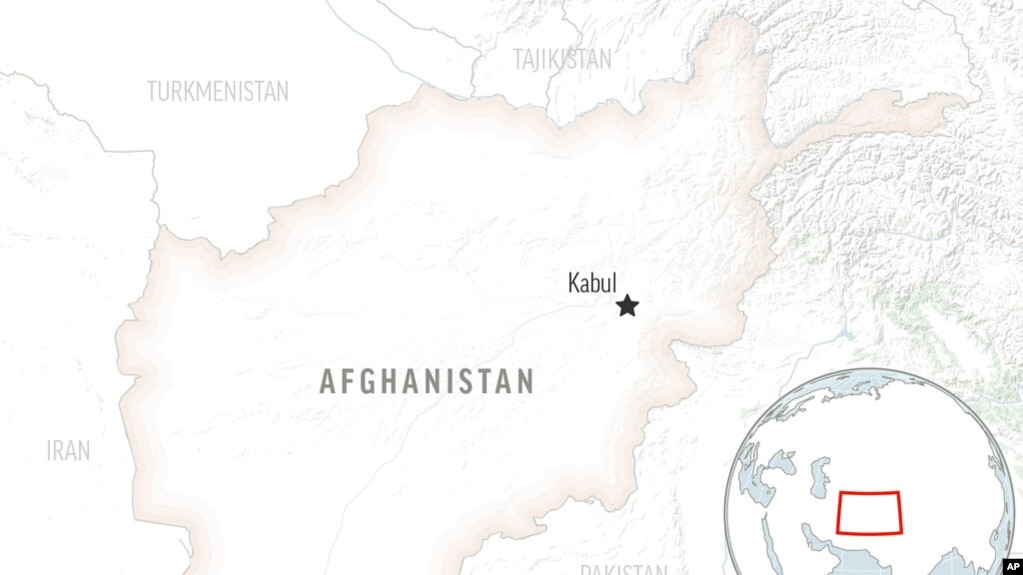
Taliban authorities in Afghanistan reported Monday that a suicide bomb blast in Kabul killed at least six people, including a woman, and wounded 13 others.

Police confirmed the deadly attack in the Afghan capital, saying it occurred in the city’s southwestern Qala Bakhtiar area when a suicide bomber detonated explosives strapped to his body.

Kabul police spokesperson Khalid Zadran wrote on the social media platform X, formerly known as Twitter, that the victims were civilians and that investigations into the attack were ongoing. He shared no further details.

There were no immediate claims of responsibility, but the Afghan offshoot of the Islamic State, IS-Khorasan, is the primary suspect. The terrorist outfit has taken credit for almost all recent attacks in Kabul and elsewhere in Afghanistan.

Taliban officials say their sustained counterterrorism operations have “almost decimated” IS-Khorasan, and it has no “physical presence” in the country. The United States and regional countries dispute these claims.

“We know that we can’t turn a blind eye to the threats from organizations such as ISIS-K and that we must keep a relentless focus on counterterrorism,” Pentagon press secretary Major General Pat Ryder told reporters in Washington last week while reiterating U.S. worries about the growing threat of terrorism in Afghanistan. He used an acronym for IS-Khorasan.

Taliban: Suicide bomb blast in Kabul kills 6 Afghan civilians
read more