Merz’s deal with the Taliban alarms Afghan dissidents in Germany

By NETTE NÖSTLINGER
in Berlin

Politico

12 August 2026

Under pressure from the rising far right, Germany is letting Taliban officials staff Afghan missions in exchange for more deportations. Afghan activists say the arrangement puts them at risk.

Illustration by Arnau Busquets Guàrdia/POLITICO

Zarmina Paryani and her four sisters fear they may soon have to again face the persecutors they fled from in Afghanistan — and this time inside Germany.

Paryani and her sisters were imprisoned twice in Kabul for protesting against the Taliban after the Afghan militants retook the capital in 2021, the 27-year-old said. After going into hiding for several months, the family eventually made their way to Germany in search of safe haven.

But now, Berlin has struck a Faustian bargain that allows the Taliban to deepen its diplomatic foothold in Germany in return for cooperation on deporting Afghan migrants back to Afghanistan. For Paryani and other Afghan activists who resisted the Taliban at home, the arrangement is giving their former persecutors new leverage over their lives in exile.“It’s hard to accept that my fate and my affairs are being discussed with the very same representatives whose oppression, prisons, whippings and violence I fled from,” Paryani, who worked as a midwife in Kabul and now lives in western Germany, told POLITICO.

German Chancellor Friedrich Merz’s government first struck a deal with the Afghan government announced last October that gives Taliban officials control of diplomatic missions in Berlin and Bonn in exchange for permission to return Afghan migrants directly to Afghanistan. That cooperation was deepened early this summer with a deal that allows more Taliban officials to work in Germany in return for cooperation on additional deportation flights — now up to three per month.

Under the new deal, Germany has expanded deportations to include not only Afghan men convicted of crimes, but also, more broadly, Afghan men with no protected status or legal right to remain in Germany.

The agreement with the Taliban makes Germany an outlier in Europe, making it the first EU country to allow Taliban-appointed officials to work in diplomatic missions inside the country. Before the agreement, Western-oriented Afghan officials representing the former government in Afghanistan had remained in charge.

The arrangement comes as Merz’s government grapples with rock-bottom approval ratings and the rise of the anti-immigrant Alternative for Germany (AfD) party, now the country’s most popular political force, according to polls. The AfD’s surge comes ahead of two elections in the former East Germany, where the far-right party is ahead in polls by wide margins. In one of those states, Saxony-Anhalt, the party may take real governing power for the first time since it was founded in 2013, a result that would serve as a great humiliation for the conservative Merz, who was elected chancellor last year partly on a promise to crack down on migration.

The AfD’s rise is piling pressure on the chancellor to deliver on his election pledge to deport more migrants — even as he insists that working with the Taliban does not legitimize a regime notorious for its human rights abuses. Overall, Afghans are the third-largest group of refugees or people who have fled war to come to Germany, behind Ukrainians and Syrians.

“We are not extending a hand to this Taliban regime,” Merz said in the German parliament in June. “Rather, we are seeking cooperation at the necessary technical level, which is in our country’s national interest.”

‘Nightmares’ and ‘psychological distress’

For Afghan rights activists in Germany, one of the worst consequences of Berlin’s deal with the Taliban is that it may particularly put at risk some 35,000 Afghans who came to Germany under special humanitarian programs for people deemed especially vulnerable to the Taliban. They include Paryani and her sisters in addition to thousands of human rights activists and Afghans who worked with the German military during its nearly two-decade presence in the country.

Paryani and others fear they will have to face the Taliban when attempting to renew their Afghan passports — which they need to extend their humanitarian visas — at Afghan diplomatic missions. Another 321,000 Afghans live in Germany as refugees or with other forms of protected status. They do not necessarily need Afghan passports, unless they want to apply for a permanent residence status.

More generally, activists and refugees also fear the Taliban, with their growing presence in Germany, could gain access to personal information held in databases in German missions, including details about their families, making them susceptible to blackmail and extortion.

“Given my personal history and my stance on extremism, I am concerned for my safety and that of my family,” one former teacher from Afghanistan granted anonymity due to his fear of retribution from the Taliban told POLITICO.

The former teacher, who lives in Germany with a humanitarian visa, said German immigration officials have asked him to renew his expired Afghan passport, a request that he fears will force him to deal directly with his persecutors.

“This situation continues to cause me significant psychological distress,” he said. “Sometimes I wake up at night because of nightmares related to the Taliban and this situation.”

‘Vulnerable to blackmail’

With its handling of the Taliban, Merz’s government is setting a precedent that will be closely watched by other EU countries. Government officials in Austria and Belgium have said they’re watching Germany’s cooperation with the Taliban closely. Taliban officials also held talks focused on deportations with the EU Commission in June in Brussels.

But Hamid Nangialay Kabiri, the former head of the Afghan consulate in Bonn, who quit last September in protest over the initial deal allowing Taliban officials to serve in diplomatic missions in Germany, warned that the German government’s decision to cooperate with the Afghan regime would come back to haunt it — and that the Taliban would use their new leverage over Germany to advance their interests in Europe, including by building networks that intimidate dissidents.

“They are destroying my country, and now they are coming here,” he said. “They are not thinking of diplomacy. They have a lot of plans in their mind.”

It’s a sentiment politicians inside the left-leaning opposition also share.

“The German government has made itself vulnerable to blackmail,” Schahina Gambir, a lawmaker for the Greens who was born in Kabul, told POLITICO. “We’re seeing recognition through the back door. The Taliban are being granted access to embassies, they’re being granted immunity, they’re given channels for dialogue — and at the same time, the situation for women and girls in Afghanistan is getting worse and worse.”

There are already signs that the Taliban are exercising their newfound leverage.

Last May, Kabul unexpectedly halted a deportation flight at the last minute, seemingly seeking to extract additional concessions from the German government. A couple of weeks later, Berlin announced the terms of the latest agreement allowing additional Taliban-appointed officials to work at diplomatic missions in Germany.

Officials in Berlin depicted the new deal as a victory and a practical necessity, allowing for more deportations.

“To increase the number of repatriations, more passports must be issued, more identities must be verified, and so on,” Martin Giese, a spokesperson for Germany’s foreign ministry, said at the time. “To this end, it will also be necessary for more consular officials to be involved.”

But Paryani, the Afghan midwife who fled to Germany with her four sisters, said the Taliban would use their new power to torment them in the country they had sought safety in.

“A Taliban member once wrote to me: ‘Just wait until our embassy in Germany reopens. Then we’ll find you there,’” she said of a comment that had surfaced under one of her social media posts about two years ago. She then deemed it irrelevant because it seemed so unrealistic.

“Today, I feel as though that threat has become a reality,” she said.

Merz’s deal with the Taliban alarms Afghan dissidents in Germany
read more

‘We are still here’: a day in the life of 12 Afghan women

The Guardian

Tuesday, 11 August 2026

In the five years since the Taliban’s return to power, the walls have been closing in on the women and girls of Afghanistan.

As the regime has tightened its grip, it has banned girls from education after the age of 12, ejected many women from the workplace and created legal frameworks for child marriage and husbands beating their wives. Taliban rule has ushered in a new era of women being whipped for minor infractions and constant inspections by ‘vice and morality’ officials, with men compelled to become enforcers in their own homes. Even the borders of the online world have been creeping inward, with a new spate of smartphone bans and internet restrictions.

Marking the grim anniversary, a dozen women and girls have, at great risk to their safety, documented their lives for the world to see

A composite of an Afghan woman in a blue veil

The soldier stripped of her uniform

Herat province
Every day, I wake up to the silence of dawn. I feel as though I am still holding my weapon. I lie on my bed for a few moments, taking deep breaths. With every awakening, I make a promise to myself: if my husband manages to return home safely today, I will thank God even more.

My name is Parasto*, and I live in Herat. For six years I served here as a soldier. Within a few days of taking the city, the first thing the Taliban did to me and my female colleagues was hold a meeting and demand that we hand over our uniforms. When they took that uniform, I felt as though I had lost something grand that belonged to me; it was a profound pain.

Because my husband and I served with the previous government, the Taliban have summoned him several times to question him about how many Taliban he killed, or how many I killed. We have been threatened with death many times, through phone calls and messages. In the early days, many of my colleagues fled. The Taliban arrested two women whose names I do not wish to mention, and nothing is known of their fate to this day. Where are they? Are they alive or not? We tried to smuggle ourselves over the border to Iran, but were turned back by border guards. Today, we still keep our bags packed and waiting, in case we have to flee.

Now, my morning begins with chores. I wake, light the fire, make breakfast, prepare my children for school and my husband so that he can search for a day’s work. I stand by the house gate until they leave. After the gate closes, the house sinks back into silence. I pull the curtains closed again so no one knows who lives here.

I spend the days alone in the heat of this house. Sometimes, to keep my mind off the past, I sit behind the sewing machine, thread the needle, stitch the fabric slowly. It is a way to pass long hours of loneliness. The weather is also getting hotter every day, as if fire is raining from the sky.

At night, before my eyes close, I think of the days when I would prepare myself for the next day’s shift.

I had so many dreams of serving this country more, but the times do not allow me to. I still dream that I am wearing my uniform and going to duty. When I wake up, it takes a few moments to realise that none of it exists any more.

As told to Goharshad

A collage featuring a cup of coffee and the cutout silhouette of a woman against a brick wall
The undercover journalist

Northern provinces
The fear of being exposed is constant. Every time someone knocks on our gate, I panic. Whenever I hear the sound, I immediately hide my laptop under my mattress because of what is held on its screen.

I am an undercover journalist in one of Afghanistan’s northern provinces, working under an alias. My writing days unfold in a 12-sq-metre room, with a small desk, a mobile phone and a laptop.

Coffee is my therapy. Every morning, as soon as I get out of bed, the first thing I reach for is a cup of coffee. I pick up my phone and check the latest news in Afghanistan. I open my pseudonymous email account to see what assignment my editor has left.

I have already lived through two house searches by Taliban officers. Since then, every knock at the gate fills me with dread. What if it is the Taliban? What if they enter the house while I am working on a report about a killing, interviewing a transgender person or writing the account of a survivor of violence? A thousand scenarios race through my mind and fear consumes me.

The job of a journalist is to meet people and record their stories – but every time I do so, it holds the risk that I could be betrayed. Last week, I went to interview a woman with a disability who had experienced domestic violence. She lived on the outskirts of the city, so a friend accompanied me. To reach her house, I had to change taxis twice. The trip was filled with anxiety because she lived in an area where restrictions are especially severe: women wear burqas, and it is unacceptable for a woman to move around without a male guardian.

We walked along dusty alleyways, winding through countless narrow turns. It was a small, impoverished house with barely any light. As I spoke to her, the entire time I was terrified. I had never met her before; she had only been introduced to me through someone I trusted. I did not know what kind of place I was walking into or whether I could trust the situation.

When I returned, I told my editor that we should not publish yet. I feared that, after publication, the Taliban could use the city’s expanding network of security cameras to trace my movements and identify her, or me. This is the reality of working under Taliban rule: reporting in a near-total suppression of press freedom is extraordinarily difficult.

By Sophia Malek

A woman preparing dough in a rudimentary hut

The neighbourhood baker

Kabul
Every day, when most people are still asleep, my sister Marzia and I wake at 4am. We light the oven. This is how our day begins.

My name is Fatema*. I am 32 years old and a mother of six: four sons and two daughters. Me and Marzia, who herself has eight children, run a small home bakery in a corner of Kabul.

Women from all over come to us with dough they have prepared the night before, asking us to bake their bread. This work has been our only stable source of income during these five difficult years.

My eyebrows and eyelashes have disappeared because of constant exposure to the heat of the fire. My eyes burn. My knees ache at night, and I no longer feel the burns on my hands. Work is good, but I never wanted such a hard life and such difficult work for my daughters.

I pray my morning prayer while the oven is heating up. After the prayer, women begin arriving one by one. Some come from distant neighbourhoods, carrying with them fear and worry. They say: “The Taliban were in such and such alley today.” Sometimes they arrive silently, hand over their dough and wait.

We bake the bread, and they return home with fresh loaves.

As I work, I always remember my mother. She taught my sister and me the art of breadmaking, and was a wise woman. She encouraged me to attend school so I could learn the Qur’an, and she taught me sewing, baking and caring for my children. All these skills have helped me survive. I still light the oven the way my mother taught me. But the wood, which used to cost 60 afghanis per bundle (70p), has risen to 110 afghanis (£1.25). Now, we use almond shells as fuel – they’re cheaper, but their bitter smell stays with me until the end of the day. We charge six afghanis for each batch of bread. On good days, we might earn about 1,000 afghanis (£11), but usually we earn half of that. My family of eight and Marzia’s family of 10 survive on this.

My eldest daughter is now 12, and my youngest is eight. Beyond how difficult the work itself is, my biggest worry is that I cannot do anything for their education. I don’t have enough income to send them abroad to study, and I have no hope that conditions inside Afghanistan will improve soon. I wanted my daughters to study and have a more informed and comfortable life. What if they end up like me? A difficult life with very limited choices.

By mid-morning, I can take a break, take off my work clothes, wash my hands and face, eat breakfast and rest a while. In the afternoon, I light the oven again, and the work continues until 7pm.

When women come and share stories about their lives, I realise that the lives of women and girls in Afghanistan have never been easy. With the arrival of the Taliban, they have become a living hell.

As told to Tarana Mohammadi

A young afghan woman writing in a notebook

The 12-year-old blogger

Undisclosed
I wake up to the sound of my parents’ laughter. In the living room, my mother spreads out her flower-patterned tablecloth and prepares breakfast. For me, she makes a boiled egg because she knows I love them. I am 12 years old, preparing for my sixth-grade exams – the last I will be allowed to take.

After breakfast, my sisters and I go to our room, where my older sister gets lost in old books and notebooks, studying and writing. She dreamed of becoming a writer whose books would be read around the world. But the Taliban buried that dream inside her. My other sister reached 10th grade before she had to leave. Now she sits for hours, searching social media for scholarships and journalism training programmes.

I know that soon the fate that came to my sisters will come for me. I will also remain trapped in this room, our forced refuge for years. Even at night we do not dare pull back the curtains for fresh air, fearing the Taliban or suspicious neighbours. What if someone says: “Three young girls live in this house and move around freely inside it”?

On the shelf where we keep our clothes, there is no colour left except black. I put on my black dress, scarf, mask and chador. I must wear my chador, even in this scorching heat – two classmates were arrested and expelled from school for failing to wear it correctly.

Finally, I reach the school gate, surrounded by girls. The teacher enters the classroom and places a preparatory exam paper in front of us. But I stare at the exam paper and ask myself: what should I write? What future am I studying for, when that path no longer exists?

Every day after school, I go straight to that same room and record my blog. I talk about life, recite poetry and speak about girls whose books have remained closed for years, women prevented from living an ordinary life. My mother brings her phone to record me. I receive encouraging messages from women and girls who relate to my words. But whenever I publish a video, relatives come to our home and fill my father’s ears with criticism. They say: “Your daughter has grown up. The honour and dignity of the family will be destroyed. Why is she blogging? Why is she speaking out against the Taliban?”

Every time I hear this, I feel like more walls are being built around my life. One greater fear stays with me: that someone might reveal my identity and location to the Taliban. Today, perhaps the Taliban see my videos and do not know who the voice behind them is. But what happens if they find me?

Sometimes I imagine that if one day I can return to seventh grade, if I can place my books on a desk again and hold my pen without fear, the first thing I will write will be the story of these days. I am a 12-year-old girl. Hear our voices, before our silent rooms become filled with buried dreams. We are still here.

As told to Awa Nikyar

A composite featuring a closeup of a sewing machine and fabric

The polio survivor who became a master tailor

Undisclosed
Twenty-five years ago, when I was 10, I contracted polio. Because we were a poor family living through war in a remote village, we had no access to doctors or vaccines. My legs bent at the knees, and walking was difficult. My body and height did not grow like those of average people.

As a child, struggling with the muscle pain and paralysis, I realised my life would be different from other people’s. I saw my pace in this world was slow, and that I was viewed as a burden. The pain I saw in my mother’s eyes made me realise how difficult my life was going to be. She never said it out loud, but I read it in her gaze.

To escape the pain in my mind and body, I would take a needle and plastic scraps to make clothes for dolls. Gradually, I won my mother’s trust and she let me hand-sew a dress for her. Her faint smile was a stamp of approval. I still remember the first proper garment I ever sewed: a white cotton shirt and trousers for my father. He made my heart swell with joy, saying: “Bravo, my daughter!”

This talent was a gift from the creator: I had never had a teacher, but I found I could look at anything, replicate its pattern and sew it. One day, one of my sisters showed me a dress by a skilled tailor and asked if I could make one like it. When it was done, seeing I could work like a master tailor, she promised to buy me a sewing machine – and she kept her promise.

From that day on, my reputation spread by word of mouth, and clients began coming from more and more distant villages.

When clients arrive, their first look is often searching and sceptical. They ask: “Is the tailor here?” I know exactly what they are thinking. When I tell them it is me, they place their orders with looks of disbelief and curiosity. When they see me using a pen and paper to write down measurements, they ask: “How are you literate?” They have no idea how hard I worked to teach myself to read. I became a student of my own students; in exchange for teaching them tailoring, I had them teach me writing.

I sometimes have so many orders that I can earn 6-7,000 afghani (£68-80) a month, helping to support the family. Since my mother died and my father lost his sight due to old age, I run the household myself. I keep thanking God for giving me the strength to do so. Despite my legs and skeleton being ravaged by polio, I have never looked down on myself. My art has ensured that people do not look at me with pity or condescension; instead, they look at me as their trusted tailor.

As told to Hura Omar

A composite of cut-out shapes of people and an unidentified woman wearing a hijab

The aspiring novelist

Balkh province
If you want to know me, do not start with my name, but with my room’s window. Every morning, before the city fully wakes up, I sit in front of it. The road in front of me is just an ordinary street, but to me it is filled with people, and each has a story that no one has yet written. An old man who slowly drags his cane across the asphalt; a girl who clutches her bag tightly to her chest and walks briskly; a child chasing his ball … Sometimes, before I write the first sentence, I just watch them for a few minutes.

I am Mahtab*. I am 23 years old and from Balkh province, and I am writing a novel.

I began writing on my own, but now I take online classes as well. One by one, students appear onscreen. Some could be my older sister or even my mother. Every time I see their faces, I think how remarkable it is: here, where the paths to learning grow narrower every day, there are still people who have not given up. Sometimes, the internet disconnects, sometimes the power goes out, but none of this stops the class.

Let me tell you about last week: I was missing going to the bookshop, so I adjusted my shawl and set off. The little bell above the door chimed as it opened, and the smell of paper and new books filled the shop. The bookseller smiled and said: “I haven’t seen you in a long time.” I went straight to the fiction shelf. My fingers slid over the spines of the books, and I was holding one in my hand when, through the glass, a few men in official attire passed by. Instinctively, I held my breath.

Through the glass, I saw girls passing the shop: one holding her little sister’s hand; one with a book hidden beneath her shawl; another walking so fast, as if she wanted to get away from the street’s gaze. When I stepped out, I held the book tight against my chest. In a time when so much can be taken from a person, the dream of reading, writing and creating cannot be stolen unless one gives it up. For me, writing is not just putting words together; it is a way to preserve what is being lost: dreams, memories, the voices of people who are still hopeful. Perhaps, one day, someone will read these writings and know there were people who, despite all the walls, still kept a window open to the future.

When night falls, I sit behind the same window again. I may not be able to change the pain of this city, but I can remember it, write it down and not let it be lost in silence.

As told to Sofia Malik

a composite of bricks being made by a woman and a cow being fed

The cleaner and brickmaker

Jawzjan province
My husband used to be the breadwinner in our family. But in 2021, he was in injured in a traffic accident, leaving him unable to stand on his feet or work. From that moment, the responsibility of providing for the family fell on my shoulders.

My name is Leilma*. I am 33 years old. I am originally from Faryab province, but I now live in Jawzjan. I am the mother of four children – three daughters and one son.

Every day, I wake up before sunrise, pray and begin my household chores. I prepare breakfast for my children and husband, send my children to school, prepare food for our cow and goats and feed them, then tie them under the shade of trees so they can be protected from the scorching sun.

Then, I head to the hotel where I work as a waitress and cleaner. From 6.30am until 8 or 9pm, I work continuously.

On days when there are wedding ceremonies at the hotel, I arrive early, arrange tables and chairs, and serve guests food. Then I clean every part of the hotel with brushes, mops and brooms, and arrange the tables and chairs again. I wash the tablecloths, chair covers and dining sheets, and dry them on the hotel roof. Once they are dry, I collect them, spread them back on the tables and chairs and return home.

For all this work, I earn only 200 afghanis (£2) a day. Although this income is very little and does not cover all our needs, I have no choice but to continue. My children’s hopes are tied to my tired hands.

I live with my husband and four children in a very small house with only one room. To be able to build at least one more room, I make raw bricks whenever I have free time.

My brother used to do this work so I know how bricks are made: preparing the soil, mixing it with water to make mud. I spend hours pressing and kneading the mud with my feet until it is ready. After that, using a brick-making mould, I shape the raw bricks from the mud and leave them under the sun to dry.

Sometimes, there is a wedding ceremony at the hotel while the mud for making bricks is also ready at home, so I cover the mud with plastic and go to the hotel. When I return home at night, I start making bricks again.

My neighbours tell me that if I continue putting so much pressure on myself, I will collapse. But I do not know any other way. My children are all still young, and I cannot bring myself to send them to work.

I tell myself: I did not have the chance to study and became a cleaner; let them study and become educated.

As told to Simin Daneshjo

The teacher at a girls’ school

Day Kundi province
My day begins at four in the morning. After waking, I pray and read the Qur’an until the sky begins to brighten. Then I pick up empty water containers and walk to the nearby spring to collect fresh water.

I have breakfast with my son – tea, sugar and tandoori bread. We live in a remote village in Day Kundi province, but unlike many other villagers, our table is not filled with eggs or cheeses. My name is Sediqa*. I am 41 years old, and I have been teaching at my village’s girls’ school for 18 years. I studied at this same school. After the fall of the previous Taliban regime, when Hamid Karzai came to power in 2002 and girls’ schools reopened, I was among the first to return – although I was over 20 years old at the time, I started my education from first grade. Eventually, I became a teacher.

I married a man who promised to support my work and education, because I hoped to build an independent life. But after my son was born, he failed to support me, did not allow me to study at university and opposed my going to work. Then, when the government collapsed and the Taliban took power, my husband left Afghanistan. My son and I were displaced, moving from one person’s home to another. The house I built through years of hardship and with the money I earned from teaching was taken away from me by his family. We eventually settled in a mud house near the school.

In the morning, I prepare dough and go to an area among the trees near my house to gather firewood. I light the clay oven and bake our bread, then leave for school with my son. We each take separate mountain paths and walk to our schools alone. My son walks an hour on foot while my journey takes 45 minutes.

Eighteen years ago, many girls and I gathered at this school under a single tent. There were no professional teachers, our school had no building and the tent was unbearable in the heat and cold – yet we gathered beneath that roof with great enthusiasm and a deep desire to learn.

Today, our school has a building, and classrooms with desks and chairs. But our girls can no longer study beyond sixth grade. The school uniform has been replaced with large black prayer garments, chador namaz, which education officials come to inspect. The youngest girls are just six years old. Despite their age and the long distances they travel, they must carry these heavy garments through the difficult journey, enduring the heat and cold.

I teach first grade, and my day ends with the happy laughter of these young girls. Girls who are starting school for the first time are happy, energetic and full of dreams. Being around them gives me a sense of joy.

As told to Nahid Naji

Cutout of an afghan woman, with notebooks and tuk-tuks

The student locked inside and losing hope

Nangarhar province
Sometimes, when I catch a glimpse of myself in the mirror during the day and see the colour of my face and my hair, I fall silent. I see how much I have truly changed over these past few years. My skin has become pale and lifeless, as if I am fading away; the dark circles under my eyes look frightening. Sometimes, I think the girl I see in the mirror is not me.

My name is Leima*. I am 24 years old, and I was studying computer science at a private university in Nangarhar when the Taliban announced the closure of universities. I was in my room, working on a course project. It was 9pm when I finished studying and saw the news on my phone.

I fell into a state of shock. When my mother and sisters saw me they became silent. They had wanted to hide the news from me, but I already knew. For days, my family and relatives tried to reassure me that the universities would reopen.

When the universities stayed shut, I was left hopeless. My father – who has always supported our education – told me not to worry, that he would find every possible way for me to continue my studies. Eventually, he decided that we should leave Afghanistan and go to Pakistan or Turkey so I could resume my education. But because my younger brother has a physical disability and is paralysed, we were unable to leave.

Now, life has reached a point where no ordinary day is truly ordinary. My mind is so filled with thoughts and worries that even when I’m cooking, tears fall from my eyes without me realising.

This morning I woke up at 2am, recited prayers and sat on my prayer mat, crying. Every night, I ask God to make everything right. In the darkness, I go into the courtyard and look at the silent sky, the moon and the stars. It gives me a sense of comfort. I tell myself that everything will change one day.

There was a time when I would dress up every day. I would lovingly dye and style my hair, apply my favourite bright lipstick, listen to my favourite music at full volume and dance happily in my room. This morning, after brushing my teeth, I wanted to comb my hair. But my worries are making it fall out: so much hair gathered on the brush that I felt as if every strand had died.

As I sat there, my eyes fell on my old perfumes sitting beside the mirror. I picked one up and sprayed it on myself; for a moment, my mood changed. I felt like the person I used to be years ago.

As told to Hosai Ismail Khan

Composite of prosthetic legs and medical apparatus for people with broken or injured legs

The prosthetist helping women to walk

Faryab province
My workday revolves around plaster, moulds, plastic prosthetics, scissors, screws, rubber, glue and other tools.

My name is Nazanin*. I am 42 years old and the mother of four children – two daughters and two sons. For the past 21 years, I have worked as a technician in a hospital, making orthopaedic assistive devices, casts and plastic prosthetic limbs for women and children with physical disabilities.

I begin each day with prayer, then wake my two sons, who leave for their classes at 6am. My younger daughter is in second grade, so I take her to school in my rickshaw. My older daughter, however, is 13 and no longer allowed to attend school.

Now, she stays home alone. She does all the housework, prepares meals for her father and siblings. She has been at home for two years, and it breaks my heart. No one truly understands a mother’s fear. Every time I close the gate behind me, it feels as though my soul remains on the other side with my daughter.

I arrive at work at 8am and check how many orders we have. I produce several casts or artificial limbs most days.

I think about my daughter as I work and wonder what she is doing. How long can she keep herself busy with housework? How much television can she watch? I worry that she might harm herself. I worry that she might lose hope.

Then I tell myself that there are women who need me – who dream of walking independently and doing everyday tasks on their own. One young woman I worked with was the mother of seven children. Her husband was a farmer and they lived in a remote mountainous district. Before receiving the prosthesis, she had to crawl to do her daily tasks.

Now, she can walk powerfully on those uneven fields. Later, when she visited us to have her prosthetic leg repaired, she told us with great happiness: “I went to the market – I saw the market up close. I work on my land now, and I no longer think about the fact that I once did not have a leg.”

In the evening, when my husband returns from work, he comforts me about our daughter. He says: “Are you anxious? Well, this is something that has happened to all girls.” He takes our daughters out for a walk and buys them ice-cream or something small. He says: “At least let their faces light up a little.”

As told to Tomiris Tamga

A closeup of dental equipment against the cutout shape of an afghan woman

The dental assistant who dreamed of being a surgeon

Jawzjan province
Getting to my place of work is never easy. On my way, I pass several mosques and a Taliban-run religious school. When the young men come out, the way they look at me sometimes makes me fearful. Every time I walk that route, I wonder whether I could end up like Farkhunda – a young woman killed by a mob for no reason. The men’s stares reveal how deeply they resent women leaving their homes.

My name is Marwa*. I am 23 years old, and once I dreamed of being a brain surgeon. When women were banned from universities, I found I could study an online course in dental prosthetics. Today, I work as a dental assistant in a small private clinic run by a friend of my father’s.

When I arrive at the clinic, I push fear aside and focus on my work. Taliban officials and soldiers all come to the clinic. One commander came to have a tooth extracted and asked the dentist about the anaesthetic injection. The soldier with him laughed and said: “Doctor, don’t numb the commander. Our commander has spilled so much blood – let him lose a little blood from his tooth as well.”

Hearing that, I wondered how many innocent people this man had helped kill, how many families he had left without loved ones, how many women and children had suffered because of him. Every moment, I worried that he might suddenly become angry.

Officials from the Ministry for the Propagation of Virtue and the Prevention of Vice visit the clinic to carry out inspections. They always ask: “Who is this young woman’s guardian and why is she working alone?” Every time, I worry they might shut down the clinic or create problems for us. Whenever they arrive, I hide so they do not see me.

This is not the future I imagined for myself. When I was 17 and began preparing for Afghanistan’s national university entrance exam, I told myself I would earn the highest score in my province. I had dreamed of becoming a doctor, but by the time exam results were announced, the political system had changed and I wasn’t able to pursue that. Once, a man who had been my teacher came in for treatment. When he saw me, he said: “You are capable of much more than being a nurse or an assistant. If circumstances had been different, you could have become a better doctor than many practising today.” His kind words meant a great deal.

There are months when I feel hopeless. But then, a small sense of hope returns. Maybe the circumstances are not right today, but no one knows what tomorrow will bring. Some girls have lost hope and are searching for a refuge in life – they think if they get married, they can find that refuge in their husbands. But I want to be my own refuge.

As told to Atousa Azar

A composite of an unidentified afghan woman hugging a child along images of rural life in afghanistan

The teacher who fears her students will be married off

Samangan province
People often say that the beginning of the week starts with motivation and energy, but since the day Afghanistan fell to the Taliban and my studies were left unfinished, I have had no motivation to live. Morning and evening, day and night, every day of the week feels the same: dark and heavy.

My name is Fatana*. I am 25 years old and live in one of Afghanistan’s northern provinces. When the Taliban seized control of Afghanistan, I was a third-year student of law and political science, living in a government-run dormitory. Since then, I have been prevented from continuing my education. My six-year-old sister and I get into a rickshaw and go to school – a private school where I have worked as a teacher for nearly two years and earn a monthly salary of 4,000 afghanis (£45). Alongside teaching, I try to encourage my students. I tell them that to achieve success, they often have to work several times harder than boys.

One of my students lost her father to cancer last year, and her family is struggling financially. She is a quiet and sorrowful girl who often keeps to herself. In addition to her regular lessons, I teach her English for one hour every day through WhatsApp. Sometimes, I cannot escape worrying about her future. I fear that poverty and family pressure could force her into child marriage – a fate that still shapes the lives of many children.

The most painful part of my work at the school is seeing my students graduate from sixth grade. Their sad and hopeless faces on their final days are unbearable for me. Every time I think about those girls, and wonder what conditions they are living in today, my heart aches. I ask myself: how many of them are still holding on to their dreams of education? How many have been forced into marriages they did not choose?

As told to Raha Malik

* Names have been changed

 This report is a collaboration with Zan Times, a collective of journalists inside Afghanistan who write under pen names for their own safety

‘We are still here’: a day in the life of 12 Afghan women
read more

Afghanistan: UN tells Taliban to open up on abuses committed by security forces

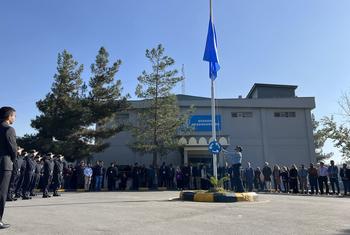
UN staff in Afghanistan observe a minute of silence as the UN flag is lowered to half-mast at the Mission Headquarters.
UN Photo/Tilak Pokharel Headquarters of the UN Assistance Mission in Afghanistan (UNAMA) in Kabul.

Five years into Taliban rule, Afghans still have almost no way of knowing whether soldiers, police and morality officers who abuse their power ever face consequences – and that secrecy is corroding trust in the State, the UN said Monday.

Key points

  • The Taliban have taken steps to promote discipline and oversight according to a new report by the UN mission in Afghanistan (UNAMA)
  • However, these steps have lack sufficient transparency on oversight and accountability measures, for such institutions as the Supreme Court
  • UNAMA recommendations include strengthening accountability by clarifying the rules governing the use of force, arrest, detention, searches and crowd policing

Five years after the Taliban seized power, such grave concerns as human rights violations, detention and discrimination against women and girls continue to be consistently raised by UN agencies and partners, from UN Women to the Security Council.

Since the takeover, UNAMA has monitored the situation of governance, rule of law, security and human rights across Afghanistan, including developments in domestic law, the criminal justice system and respect for victims’ rights.

UNAMA reports have already highlighted a significant lack of public information on the status of investigations or actions to hold perpetrators of human rights violations to account.

Insufficient transparency

While de facto authorities have taken some positive steps, there has not been enough transparency on oversight and accountability measures, the report highlights.

The findings examined bodies such as the so-called Security and Filtration Commission and the Ministry of Propagation of Virtue and Prevention of Vice, which were set up according to the Taliban’s strict interpretation of Sharia Law, replacing the former democratic constitution.

“The limited amount of public information on complaints received, investigations conducted and disciplinary or judicial actions taken by relevant de facto bodies undermine confidence and weaken deterrence,” said Georgette Gagnon, Deputy Special Representative of the Secretary-General and head of UNAMA.

She said the suspension of the constitution had resulted in “a blanket annulment of all former [existing] laws”.

Unresolved complaints

In the report, UNAMA documented instances where the de facto authorities conducted arrests and investigations of reported misconduct of security personnel – some of which were referred to Taliban military courts.

At the same time, many complaints reportedly remain unresolved, the report found.

Elements which are discouraging people from coming forward include fear of reprisals, lack of trust in institutions and barriers, particularly for women who are subjected to multiple restrictions in their daily lives, the report found.

Accountability

Ms. Gagnon said visible and consistent accountability measures should ensure that rules are applied equally and to every person, including those in positions of authority.

“Improving accountability is a legal obligation of the de facto authorities and a necessary step towards improving governance and respect for human rights, which support Afghanistan’s stability and its compliance with international obligations as a basis for the country’s reintegration into the international community,” she said.

UNAMA recommended de facto authorities strengthen accountability across all security institutions by ensuring that clear rules, procedures and codes of conduct are in place, consistent with international standards.

This includes clarifying the rules governing the use of force, arrest, detention, searches and crowd policing, establishing clear standards of professional conduct and requiring all personnel to report misconduct, with commanders responsible for enforcing discipline.

Read the full report here.


Afghanistan: UN tells Taliban to open up on abuses committed by security forces
read more

Taliban have barred 2.4 million Afghan girls from school since 2021, UNESCO says

By Reuters

  • UNESCO says Afghanistan is only country formally banning girls and women from secondary and higher education
  • Education ban could push 600,000 Afghan women out of workforce by 2066, UNESCO says
  • UNESCO estimates Afghanistan faces deficit ​of more than 11,000 qualified female teachers by 2030
PARIS/KABUL, Aug 11 (Reuters) – The Taliban have barred an estimated 2.4 ‌million Afghan girls from secondary education since they regained power in Afghanistan in 2021, the United Nations Educational, Scientific and Cultural Organization said on Tuesday.
The Taliban are preparing to mark the fifth anniversary of their return to power this week, as some nations expand ties with the government despite deepening ​human rights concerns among watchdogs..
Afghanistan is the only country where girls and women are formally banned from secondary and higher ​education, UNESCO said in its statement. It “risks condemning Afghanistan to decades of lost potential, deepening poverty, ⁠and irreversible harm,” the agency said.
UNESCO estimates the ban on female secondary and higher education could cause 600,000 Afghan women to ​leave the workforce by 2066, lead to $9.6 billion in cumulative income losses and increase the risk of early marriage.
The Taliban-run Ministry of ​Education did not immediately respond to a request for comment.

SCHOOLS CLOSED TO GIRLS IN 2022

When the Taliban returned to power in 2021 amid the withdrawal of the United States and its allies, they repeatedly assured the international community that women would remain free to go to school and to study.
Despite ​those promises, secondary schools were closed for girls in March 2022, followed by a ban on women studying in universities in December ​2022. The Taliban described both bans as temporary, but they have remained in place.
Taliban restrictions also limit women’s employment and their movement.
The Taliban argue ‌they respect ⁠women’s rights in accordance with their interpretation of Islamic law and Afghan culture.
Restrictions on women pursuing higher education in Afghanistan are also expected to exacerbate a shortage of female teachers, with more than 2 million primary school children already out of school for reasons other than the bans on girls and women, UNESCO said.
UNESCO estimates Afghanistan will have a deficit of more than 11,000 qualified ​female teachers by 2030.
“Many teachers have ​left the country … and those ⁠who were in the system are banned from continuing teaching,” Hoda Jaberian, the UNESCO programme coordinator for education in emergencies, said in a briefing.
“This decision to ban women from teaching boys has ​not only, of course, removed a substantial number of qualified teachers and educators from the education ​system, but it ⁠also resulted in boys being taught by unqualified male teachers,” Jaberian added. “We are left with unqualified male teachers or no teachers at all.”
UNESCO said over 90% of 10-year-olds cannot read a simple text, with national literacy rates at 37%.
Many schools are overcrowded and poorly equipped. Nearly ⁠half of ​schools lack water, sanitation or heating, UNESCO said.
In 2025 alone, 3 million people ​returned to Afghanistan, either forcibly or voluntarily, placing further pressure on the schools. Since 2021, natural disasters including earthquakes and floods have forced the closure of 1,000 ​schools, UNESCO said.

Reporting by Lewis Macdonald and Mohammad Yunus Yawar; Writing by Makini Brice; Editing by Toby Chopra, Rick Noack, Rod Nickel

Taliban have barred 2.4 million Afghan girls from school since 2021, UNESCO says
read more

Central Asia Has Learned to Live With the Taliban

When the Taliban reclaimed control of Afghanistan in 2021, none of its Central Asian neighbors welcomed the group’s return to power, and none have formally recognized it since then. Nevertheless, geographic proximity made ignoring Kabul impractical, leaving pragmatic engagement as the only option.

As a result, over the past five years, all five Central Asian states have to varying degrees adapted to Taliban rule in Afghanistan and advanced their national interests through relations with the Islamic Emirate that are normalized in all but name. Of them, Uzbekistan and Turkmenistan, which share borders with Afghanistan, have gone the farthest toward normalization of diplomatic and economic ties. Tajikistan—also an immediate neighbor—has remained the most skeptical, though it has still joined the regional trend of establishing working relations with the Taliban.

But for all the states in the region, the militant group’s return to power in Afghanistan has created complex realities that they are now forced to navigate.

Through a sustained political dialogue and functional cooperation with Kabul, Uzbekistan has become Central Asia’s leading interlocutor with the Taliban. Due to its prioritization of counterterrorism, border security and counternarcotics cooperation, Uzbekistan treats such engagement as a practical necessity.

But in addition to approaching Afghanistan as a security challenge, President Shavkat Mirziyoyev also sees it as an economic opportunity. Tashkent has expanded bilateral trade, transport and energy cooperation through the Termez free trade zone, as well as through new investments and bilateral agreements, with the aim of increasing annual trade to a target of $5 billion from $1.7 billion in 2025. This strategy has been bolstered through high-level visits, including that of Prime Minister Abdulla Aripov to Kabul in August 2024, underscoring Tashkent’s commitment to engagement. In serving as a bridge between Afghanistan and the wider international community, Uzbekistan seeks to promote stability and connectivity despite the risks associated with Taliban governance, with the goal of integrating Afghanistan into broader regional economic networks.

For neighboring Turkmenistan, meanwhile, Afghanistan’s importance is defined by connectivity and energy cooperation. Underscoring this regional vision is the Turkmenistan-Afghanistan-Pakistan-India gas pipeline (TAPI), which, when completed, will connect Turkmenistan’s Galkynysh gas fields with South Asian markets through Afghan territory. Former President Gurbanguly Berdimuhamedow visited Afghanistan in October 2025 to review construction progress, underscoring the project’s continued importance. However, with Afghanistan and Pakistan at war since October 2025, and the Pakistan-India war having revived tensions between Islamabad and New Delhi, TAPI’s prospects appear increasingly uncertain. Beyond gas, however, Afghanistan remains a major importer of Turkmen electricity, highlighting significant energy interdependence.

Turkmenistan’s doctrine of non-interference and “positive neutrality,” which emphasizes dialogue and practical cooperation, guides its foreign policy toward Taliban-ruled Afghanistan. Turkmenistan also stood out among Central Asian states for having not evacuated its diplomatic staff from Afghanistan amid the withdrawal of U.S. forces in 2021, nor did it release negative statements about the Taliban at the time. To the contrary, it quickly established contacts with Kabul, embracing a business-oriented approach. Similarly, Turkmenistan’s government kept key border crossings open for trade and transport.

For neighboring Kazakhstan, the region’s largest economy, security is the dominant concern along with economic and geopolitical interests. President Kassym-Jomart Tokayev has described the Taliban as a “long-term factor” in the region that Kazakhstan “must work with.” Reflecting this approach, Tokayev’s government transferred control of the Afghan Embassy to Taliban-appointed representatives in 2023. The following year, it accepted a Taliban-appointed chargé d’affaires and removed the Taliban from its list of designated terrorist organizations.

Kazakhstan has also sought to expand trade with Afghanistan from between $500 million and $1 billion annually to a target of $3 billion. To do so, the government has promoted business forums, established a trade house in the northwestern Afghan city of Herat and supported projects such as the Turgundi-Herat railway. Its policy has evolved from cautious engagement to active economic and diplomatic cooperation, even as it continues to avoid formal recognition of the Taliban government.

The Central Asian states hope that expanded trade with Afghanistan will enable greater economic and political influence over the Islamic Emirate in the years ahead.


Kyrgyzstan’s policy toward Taliban-ruled Afghanistan has similarly shifted from careful, security-focused overtures toward more open political and economic cooperation. Initially, the country limited contacts to security discussions and humanitarian assistance. Over time, however, concerns over regional security, extremist threats and economic initiatives such as CASA-1000—a regional infrastructure project for renewable energy—have encouraged deeper engagement with the Islamic Emirate.

A turning point came in September 2024, when Kyrgyzstan removed the Taliban from its list of banned terrorist organizations, signaling a willingness to establish stronger relations. By 2025, this approach had expanded into economic diplomacy, including ministerial visits, the opening of a Kyrgyz Trade House in Kabul and the signing of $156 million in trade agreements covering energy, mining, telecommunications, agriculture and logistics.

Finally, Tajikistan’s foreign policy toward the Taliban can also be characterized as a gradual evolution, in this case from outright hostility toward cautious engagement. Initially, President Emomali Rahmon’s government adopted the strongest anti-Taliban position among the Central Asian republics, refusing recognition, criticizing the Taliban’s lack of inclusivity, supporting Afghan Tajik opposition figures and portraying the Taliban regime as both lacking in legitimacy and constituting a major security threat.

Tajikistan’s concerns centered on militant groups such as Jamaat Ansarullah and the Islamic State-Khorasan Province (ISKP), as well as narcotics trafficking, with its major fear being the possibility of instability spreading across the Tajik-Afghan border. This hardline position reinforced Tajikistan’s image as a frontline state against extremism.

By 2024, however, the country began to move toward limited cooperation with Kabul without recognizing the Taliban. Since then, security concerns, electricity exports, and trade and connectivity projects have pushed Dushanbe further toward engagement. Over the past two years, cross-border markets have reopened, Tajik officials have held meetings with their Taliban counterparts and diplomatic contacts have become more visible. In sum, Tajikistan currently engages with the Taliban to manage security threats and protect national interests, even if it has maintained its reservations about the group.

Five years after the Taliban’s return to power, the Central Asian states have largely adapted to the new reality in Afghanistan. Although they vary in the extent of their de facto engagement with the Islamic Emirate, all five recognize that Afghanistan’s stability and economic interests are closely tied to their own. With regional infrastructure projects dependent on a stable Afghanistan and cooperation with Kabul essential to countering ISKP, Central Asian governments desire a regime in Kabul capable of acting as a stabilizing force both within Afghanistan and across the region.

The Central Asian states hope that expanded trade with Afghanistan will enable greater economic and, by extension, political influence over the Islamic Emirate in the years ahead. For their part, the Taliban have become increasingly oriented toward Afghanistan’s northern neighbors since the outbreak of the Afghanistan-Pakistan war in October 2025 and the subsequent closure of the Pakistan-Afghanistan border.

But while the Central Asian republics have compelling reasons to deepen their de facto ties with the Taliban, whether they will join Russia in formally recognizing the regime remains an open question. Recognition will probably depend on broader international developments. If China and perhaps the United Arab Emirates formally recognize the Taliban government, the Central Asian republics may well follow suit, aligning themselves with an emerging Eurasian consensus. Yet, these countries’ growing ties with the West mean they will remain mindful of the risks of moving too quickly to “legitimize” the Taliban, particularly given the potential for tensions with Western powers.

Although formal recognition would be symbolically significant, the more important trend is the continued deepening of practical ties between the Central Asian republics and the Taliban, reflecting a growing regional acceptance that engagement with the Islamic Emirate is not only possible but necessary.

Giorgio Cafiero is the CEO and founder of Gulf State Analytics, a Washington-based geopolitical risk consultancy that focuses on the Middle East, and an adjunct assistant professor at Georgetown University.

Central Asia Has Learned to Live With the Taliban
read more

What America Owes to Afghan Women

By Mursal Rahim

Ms. Rahim, who fled Afghanistan in 2021, provides support to migrants and refuges with Catholic Charities of the Diocese of Arlington, in Virginia.

The New York Times

Aug. 10, 2026

My hands shook as I crossed the stage to receive my master’s diploma from Cornell University last year. Wearing a graduation stole on which I had sewn an Afghan flag, I was filled with a jumble of pride and disbelief at how far I had come.

Four years before, I was among thousands of people evacuated from Afghanistan as its government collapsed and the Taliban seized Kabul, and I had since made the dizzying transition to a new life in America.

But as I teetered across the stage in high heels, the sad, hopeless faces of my girlfriends who never made it out of Afghanistan flashed through my mind. This is the whiplash I live with now — highs of freedom and newfound opportunity, punctured by lows of intense guilt.

The fall of Kabul, five years ago this week, marked the bitter end to the long, painful 20-year U.S. involvement in Afghanistan. But for Afghan women, the pain was only beginning. The Taliban have turned my home into what a senior U.N. official has called the most repressive country in the world for women, who are barred from school and most types of work and face restrictions on simply appearing in public.

I escaped all that. In America I’ve been able to further my education and get a job. I’ve discovered the joys of cycling, jogging, ice skating, kayaking, weight lifting and many other pursuits unavailable to women back home. I even learned to swim. I have the freedom to go out each day, unafraid of being punished for what I’m wearing, for whom I am.

But every freedom I enjoy reminds me of women in Afghanistan who lost theirs.

In July, I bought myself an inflatable paddle board for my 30th birthday. Propelling myself down the Potomac River, I reveled in a sense of power and independence. But my chest suddenly tightened as the face of a young girl came back to me.

She’s a family friend in Afghanistan, a bright, curious and promising girl who devoured books that my mom gave her. But I had just learned from friends in Kabul that, just 16, she is to be married off to a much older man. No school, or even leaving home without a close male relative at her side.

Afghan women were perhaps the biggest beneficiaries of the U.S. intervention in Afghanistan. The Americans arrived in 2001, driving the previous Taliban regime from power. Soon after, I was able to start primary school, something that had been unimaginable under the Taliban. The expansion of opportunities for women allowed me to graduate from law school in Afghanistan in 2020. I planned to start a career advocating for women who still faced challenges such as domestic violence but had few female lawyers to represent them.

The U.S. withdrawal ended those dreams.

I got out of Afghanistan only because my brother, Najim Rahim, had worked as a reporter for The New York Times. Anyone who was employed by Western news organizations or the U.S. military was at risk of Taliban reprisals, so The Times evacuated those who had worked for its Kabul bureau — journalists, drivers, gardeners and translators, along with their direct family members.

My family was having lunch at home on the day Kabul fell, contemplating what would happen to us under the Taliban, when my brother called: We were leaving Afghanistan. We had 30 minutes to pack one small bag per person before rushing to the airport. I stared into my closet, suddenly forced to decide how to fit my life into a backpack. I grabbed some clothes, my school diploma and a few head scarves.

We waited for hours with other evacuees under a baking sun as thousands thronged the airport. We watched, horrified, as desperate people clung to the exteriors of planes, falling as the aircraft took flight. That night, Taliban militants attacked our group with clubs and we had to run from the chaotic airport for our lives.

Two tense days later, we made it on board a military transport. As we finally lifted off, I sat on the plane’s cold metal floor, staring numbly at its windowless walls and the blank, fearful faces of people who were leaving behind everything they knew. Eventually, we landed in Houston and began the process of applying for asylum.

As new possibilities opened up for us in America, Taliban decrees barred women and girls from receiving education after the sixth grade, required women to cover themselves head to toe in public and even forbade them from speaking loudly enough that non-family members can hear them. In January, the Taliban approved a new criminal decree that the U.N. High Commissioner for Human Rights says legitimizes violence against women and children at home.

Despite the ever-tightening restrictions, I keep in touch with friends back home through calls and video chats. One friend in Kabul told me how she and other women were working out in a secret gym last year when Taliban morality enforcers arrived. The women managed to escape out the back before the Talibs burst in, sniffing at what they said was the telltale scent of perfume in the air.

Most of the 35 young women who were in my all-female law school class are still in Afghanistan. During calls, they pour out their frustrations about their new lives as wives and mothers, spent almost entirely at home, their dreams of becoming lawyers now out of reach.

That’s where my guilt comes in. Afghan women in America often return to the same haunting question: “What if that was me?” I was no smarter or more ambitious than many of my classmates, yet I got out, purely through luck. I am determined to make the most of my freedom here and to make it my life’s work to help the women left behind.

Since leaving Afghanistan, the United States has closed its embassy, withdrawn its diplomats, sharply reduced assistance and made it harder for Afghans to find refuge in America. It has increasingly disengaged from the country and its people.

I am grateful for the new life I have in the United States, and the kindness of the American people. I realize that Afghanistan no longer commands America’s attention as it once did, and I won’t pretend that there are easy solutions for helping Afghan women.

But America has a moral responsibility to not simply look away and accept that the systematic erasure of Afghan women is no longer its concern.

What America Owes to Afghan Women
read more

RSF Says Afghanistan’s Media Rules Have Deepened Press Restrictions

Khaama Press

Reporters Without Borders (RSF) says Afghanistan’s legal and regulatory system has been increasingly used to restrict independent journalism since the Taliban returned to power in 2021.

In a report marking five years since the Taliban takeover, RSF reviewed more than 20 nationwide orders, along with provincial directives and verbal instructions issued between September 2021 and January 2026. The organization said the measures have progressively controlled what media outlets can report, who can appear or speak on air and how journalists cover political issues.

RSF said the restrictions have affected criticism of officials, international media broadcasts, women’s participation in broadcasting, live political programs, guest selection and the use of images of living beings.

The organization said nationwide restrictions began weeks after the August 2021 takeover, when authorities introduced journalism principles prohibiting content deemed contrary to Islam or offensive to national figures. Media outlets were also instructed to coordinate detailed reports with authorities and adopt official terminology when referring to the government.

Restrictions on women in media expanded over subsequent years. RSF cited rules requiring female television presenters to cover their faces and later measures restricting women’s voices in radio and public information programs.

RSF said restrictions also targeted international broadcasts and political programming. Afghan media outlets were barred from rebroadcasting Voice of America and Radio Free Europe/Radio Liberty programs on FM frequencies, while later directives restricted live political programs and required prior approval for guests and experts.

The organization said provincial authorities have imposed additional rules, particularly in Kandahar, including restrictions on women’s voices, reporting access and terminology used for Taliban officials.

RSF also raised concerns over Afghanistan’s January 2026 criminal procedures regulation, saying its broad provisions could potentially be used against journalists and commentators and could weaken source confidentiality.

RSF said the restrictions represent a progression from controlling media content to regulating terminology, women’s participation, political programming and ultimately the potential use of judicial mechanisms against critical reporting.

The organization called for the repeal of rules that restrict journalism on the basis of what it described as vague religious, moral or “national interest” provisions.

RSF Says Afghanistan’s Media Rules Have Deepened Press Restrictions
read more

NRC Chief: World Is Turning a Blind Eye to Afghanistan’s Growing Crisis

Afghanistan is facing mounting humanitarian and economic pressures as more than six million Afghans have returned from neighbouring countries since late 2023, with 73% of returnees unemployed, the Norwegian Refugee Council (NRC) said.

Jan Egeland, secretary-general of the NRC, said Monday, August 10, that the scale of returns was placing additional pressure on communities already struggling with poverty, unemployment and limited access to basic services.

We are increasingly left alone in the face of growing needs and shrinking rights for girls and women across Afghanistan, Egeland said, accusing NATO member states of failing to maintain sufficient support for Afghan civilians.

The NRC said the large-scale returns were adding pressure to housing, healthcare, education, food security and other essential services, while many returnees were struggling to find work and rebuild their livelihoods.

The organization said 73% of Afghans who have returned are unemployed, highlighting the difficulty of reintegrating large numbers of people into an economy already facing limited employment opportunities.

Afghanistan’s humanitarian situation is also being compounded by recurring climate-related disasters, including droughts and floods. The NRC said these pressures are occurring alongside restrictions on women and girls, including their continued exclusion from secondary and higher education and restrictions on employment.

The organization warned that the combination of mass returns, unemployment, climate shocks and deteriorating rights is increasing the vulnerability of millions of Afghans and placing further strain on already limited humanitarian resources.

Egeland called for sustained international attention and support for Afghanistan, saying growing humanitarian needs require continued assistance as well as greater protection of the rights of women and girls.

The NRC’s warning comes as Afghanistan continues to absorb large numbers of returnees from neighbouring countries, increasing the pressure on communities and humanitarian organizations to provide shelter, livelihoods and basic services.

NRC Chief: World Is Turning a Blind Eye to Afghanistan’s Growing Crisis
read more

Tehran Praises Islamic Emirate’s Policy During Iran War

Iran maintains close relations with the Islamic Emirate.

Iran’s president says the Islamic Emirate of Afghanistan has cooperated well with Tehran in preventing foreign elements from entering Iranian territory.

According to Masoud Pezeshkian, during the conflict between Iran and the United States, Afghanistan deployed groups to manage the situation along its borders and prevented anyone from entering Iran through Afghan territory.

Masoud Pezeshkian, president of Iran, said: “Both Afghanistan and Pakistan deployed groups to control the situation and announced that no one had the right to enter Iran from their territories and create unrest inside our country.”

Meanwhile, the Iranian Embassy in Kabul has announced that the second meeting of the Coordination Committee for Foreign Economic Relations was held at Iran’s Ministry of Foreign Affairs.

The embassy said representatives of government agencies at the meeting emphasized strengthening economic diplomacy and expanding transit cooperation with neighboring countries.

A statement from the Iranian Embassy in Kabul said: “The second meeting of the Coordination Committee for Foreign Economic Relations was held under the chairmanship of the deputy foreign minister for economic diplomacy. Representatives of government agencies emphasized strengthening economic and transit diplomacy with neighboring and like-minded countries.”

Yousuf Aiman Zazi, a political analyst, said: “The Iranian president’s remarks show that Afghans pose no threat to others. However, we have some concerns regarding Iran, including the treatment of migrants and the execution of prisoners. We hope attention will be paid to these issues.”

Iran maintains close relations with the Islamic Emirate. The deputy head of Iran’s embassy in Kabul previously said that Tehran does not support groups opposed to the Islamic Emirate.

Tehran Praises Islamic Emirate’s Policy During Iran War
read more

Kabul Prepares to Mark 5th Anniversary of Islamic Emirate’s Return to Power

Across different parts of the city, flags, banners, and commemorative signs are being installed, and preparations are still underway.

Kabul is preparing to mark 24 Asad (solar month), the fifth anniversary of the Islamic Emirate’s return to power in Afghanistan.

Across different parts of the city, flags, banners, and commemorative signs are being installed, and preparations are still underway.

Nisar Ahmad, a Kabul resident, said: “Extensive preparations have been made across the city for the ceremony. The appearance of the city has changed significantly, and the preparations are still continuing.”

Toofan, a worker involved in decorating the city, said: “We are decorating and lighting different intersections in Kabul for 24 Asad.”

Some Kabul residents have welcomed the commemoration, while also stressing the need to address people’s daily problems.

Wahdatullah, a Kabul resident, said: “Over the past five years under the Islamic Emirate, justice has been established, administrative corruption has dropped to zero, and narcotics have decreased.”

The preparations are not limited to Kabul. The Ministry of Information and Culture says cultural and commemorative programs will also be held in a number of provinces to mark the fifth anniversary of the Islamic Emirate’s return.

Khabib Ghufran, spokesperson for the Ministry of Information and Culture, said: “Our effort is to make this year’s program more people-centered than in previous years.”

At the same time, some citizens say the Islamic Emirate should pay greater attention in the coming years to education, employment, and the economy.

Noor Ayoub, a Kabul resident, said: “Our request to the Islamic Emirate is that in the coming years it should work more than before in the areas of education, the economy, and the development of the country.”

24 Asad marks the day in 1400 when the Islamic Emirate, after entering Kabul, regained power in Afghanistan.

Kabul Prepares to Mark 5th Anniversary of Islamic Emirate’s Return to Power
read more