EU: Access to Healthcare Services crucial for women and girls in Afghanistan

The European Union (EU) delegation in Afghanistan has stated that access to healthcare services for Afghan women and girls is essential.

The EU delegation in Afghanistan emphasized on Thursday, March 13, that ensuring access to healthcare services for Afghan women and girls is crucial, especially amid ongoing challenges they face.

The delegation mentioned that, in collaboration with the World Health Organization (WHO), over 95,000 Afghan women have received outpatient care for infectious diseases, and more than 7,700 of them have received inpatient services.

The statement emphasized: “Strengthening Afghanistan’s healthcare system is vital for an effective response to disease outbreaks. The EU supports enhancing diagnostic and treatment services for infectious diseases nationwide to improve patient health outcomes.”

The EU delegation also noted that its programs have contributed to training healthcare staff, with over 581 women gaining new skills in mental health, 41 in infection prevention and control, and laboratory techniques, thus improving the quality of healthcare services.

The EU’s five-day campaign on International Women’s Day focused on supporting Afghan women, especially in the face of significant challenges posed by the Taliban’s restrictions. These restrictions have severely impacted women’s access to healthcare services, pushing the situation toward collapse.

The Taliban’s restrictive policies on women have significantly affected their access to healthcare services, pushing the healthcare system to the brink of collapse and causing widespread distress.

EU: Access to Healthcare Services crucial for women and girls in Afghanistan
read more

They crossed the world to reach the US. Now deported under Trump, they’re stuck in Panama

By  MATÍAS DELACROIX and MEGAN JANETSKY

PANAMA CITY (AP) — They crossed oceans to get to the U.S., fleeing conflict, religious persecution, poverty and government crackdowns in countries such as Afghanistan, Somalia, Cameroon, China, Pakistan and Iran.

After flying to Central and South America, they bused through countries where they didn’t speak the language and walked through unfamiliar jungle to get to the U.S.-Mexico border.

Within days, they were detained and put on military aircraft that flew nearly 300 of them to Panama as U.S. President Donald Trump sought to accelerate deportations to more complicated destinations.

Panama was supposed to be a stopover. But for those unwilling to return home — mostly out of well-founded fear — Panama sent them to a guarded camp without access to lawyers in the same Darién jungle many had crossed months earlier on their way north.

“It feels like the whole world is crushing down on me. It’s like everything is stopping,” said Isha Len, a 29-year-old from Cameroon. “I risked everything, my life, everything, crossing the Darién Gap, just to be sent back.”

Here are the stories that some of the deportees told The Associated Press:

Isha Len, 29, Cameroon

After conflict broke out in her small town, Len crossed Cameroon by car and minibus, then a fisherman friend carried her four hours by boat to Nigeria.

Len, a schoolteacher, flew to Sao Paulo, Brazil, where she said authorities detained her for a month in the airport. From there, she wound north through South America by bus, following other migrants until they reached the Darién Gap.

She walked days through the dangerous jungle that divides Colombia and Panama before boarding buses that carried her through Central America. After being kidnapped for days by a gang in Guatemala, she crossed into southern Mexico, where she took a boat along the Pacific coast to evade authorities. After she landed, she rode eight hours to Mexico City, continuing on by bus and car to Tijuana.

She crossed the U.S. border and presented herself to American authorities.

Artemis Ghasemzadeh, 27, Iran

Artemis Ghasemzadeh left her country in January, fleeing after converting from Islam to Christianity – something that could cost Ghasemzadeh her life in Iran. She flew to Dubai, where she stayed two weeks and then took a flight to South Korea.

From there she flew to Mexico City, staying there for three weeks before going to Tijuana. She crossed the U.S. border on Feb. 9, and was detained for five days, including her birthday.

“For changing your religion, your punishment is death,” she said. “We don’t know what will happen.”

Wang Qiu, 53, China

Wang Qiu said he left home after he was imprisoned for three years for speaking out about democracy and human rights issues.

He flew from Beijing to Cuba, then to the small South American country of Suriname. From there, he traveled by land: through Guyana, Brazil, Bolivia, Peru, Ecuador and Colombia, before trekking through the Darién Gap.

He moved up through Central America and Mexico before being detained after crossing into the U.S. in San Diego.

Qamar Abdi, 19, Somalia

Qamar Abdi, left for the U.S. on Aug. 17, due to warfare between the government and militants of al-Shabab, which the U.S. recognizes as a terrorist group.

She hopped from buses to shared cars for nearly a month until she reached South Africa. From there, she flew to Sao Paulo, Brazil, and spent the next six months riding buses north.

When she arrived at the northern tip of Colombia, she traveled six days through the Darién Gap, landing in Panama on New Year’s Day.

She took buses to the southern Mexican border city of Tapachula, where she was temporarily kidnapped and robbed by a gang. To avoid immigration authorities, she traveled hours packed on a boat with other migrants along Mexico’s Pacific coast, then took a bus to Mexico City. She spent two weeks there before driving to Tijuana, where she crossed into the U.S.

Ebrahim Ghezelgechi, 36, Iran

Ebrahim Ghezelgechi fled Iran with his wife, Sahar; 10-year-old daughter, Aylin; and 11-year-old son, Sam, on Nov. 21.

The family flew to Brazil, then to Panama and finally Nicaragua. From there, they took buses north to Guatemala, then crossed into southern Mexico by boat. They rode on top of trains and in buses and vans to get to Tijuana.

After Mexico authorities sent them back to the southern part of the country, they took a plane to the resort area of Los Cabos. There, they were detained, had their passports taken and were sent back south again.

They tried getting north a number of times, punted back by Mexican authorities, before eventually paying a driver to take them to Tijuana.

After crossing into the U.S., they were detained in San Diego for a week.

Samin Haider, 21, Pakistan

Samin Haider left for Dubai in 2023 after violence surged in his region of Parachinar, which borders Afghanistan and has been plagued for decades by conflicts between Shi’ite and Sunni Muslim communities.

Haider was there for 1 1/2 years before the United Arab Emirates canceled visas for Pakistanis.

Haider then flew to Mexico and traveled to the U.S.-Mexico border with the hopes of seeking asylum.

Now deported to Panama, he still hopes to reach the U.S.

Elham Ghaedi, 29, Iran

Elham Ghaedi left on Oct. 21, flying to Brazil and then to Venezuela’s capital Caracas.

She traveled to Colombia, where took a bus north and then walked five days through the Darién Gap.

She stayed 15 days in a migrant camp in southern Panama before taking a bus through Costa Rica, Nicaragua, Honduras, Guatemala and to Mexico’s southern border. There, migration authorities detained her for six days.

She traveled north to Mexico City, where she spent a month, before boarding a flight to Tijuana. U.S. authorities detained her when she crossed to San Diego.

Hayatullah Omagh, 29, Afghanistan

Omagh fled Afghanistan in 2022 after the takeover of the Taliban because he identified as an atheist and was part of an ethnic minority, something that could put his life in danger.

He first went to Pakistan, where he got a visa for six months, and struggled to get a new one due to his Afghani passport.

He then went to Iran and worked there for 1 1/2 years. But the country wouldn’t accept him as a refugee.

He managed to get a visa to Brazil, which offered a number of Afghan people refuge after the rise of the Taliban and flew to Sao Paulo in 2024.

Hoping to reunite with friends and family in the U.S., Omagh paid smugglers to move him north through Bolivia, Peru, Ecuador and Colombia. He trekked through the Darién Gap, then took buses north through Central America to southern Mexico.

Mexican authorities detained him and dropped him back in southern Mexico a few times before he managed to take a flight to Mexico City and later to the U.S., where he was detained.

“After so much time, I’ve lost hope,” he said.


They crossed the world to reach the US. Now deported under Trump, they’re stuck in Panama
read more

USAID cuts could be ‘death sentence’ for Afghan women studying abroad

By Dan De Luce

NBC News

March 12, 2025

More than 80 Afghan women studying in Oman say they face deportation and persecution by the Taliban after the Trump administration canceled their scholarship.

A group of more than 80 Afghan women who fled the Taliban regime to study in Oman say they are at risk of imminent deportation to Afghanistan after their U.S.-funded scholarship was canceled as part of the Trump administration’s cuts to foreign aid.

The female students received an email on Feb. 28 informing them that the scholarship program administered by the U.S. Agency for International Development at the Middle East College of Oman had been terminated along with thousands of other foreign aid initiatives, according to the email obtained by NBC News.

The State Department did not immediately respond to a request for comment. The plight of the Afghan students was first reported by the BBC.

In a letter to aid groups, the Afghan women are appealing for urgent help to allow them to continue their studies abroad and avoid returning to a country where, they say, they will face certain persecution and life-threatening risks.

“The situation is catastrophic,” the letter says. “Being sent back to Afghanistan would mean the permanent loss of our education and exposure to severe risks, including oppression, insecurity, and a future without opportunities. This is a life-or-death situation for many of us.”

The Afghan students were pursuing undergraduate and graduate degrees in Oman under the Women’s Scholarship Endowment, one of numerous programs eliminated in the Trump administration’s effort to drastically scale back USAID.

Secretary of State Marco Rubio said Monday that 83% of USAID programs had been canceled after a six-week review and that the remaining programs would be merged into the State Department.

“Please don’t let our dreams be shattered and the Taliban decide our fate,” the students’ letter reads. “We have fought very hard to get out of their hands, we won’t be living anymore if we have to go back to Afghanistan.”

The program for female scholars was launched in 2019 with a $50 million endowment from USAID, according to Brian Le, deputy legislative director of With Honor, a nonprofit group that works with veterans in Congress from both parties on bipartisan initiatives. Interest from the endowment has covered the cost of the program, which was administered by USAID, without requiring additional annual funding from the U.S. government, Le said.

Nonprofit groups are in discussions with the government of Oman to try to resolve the situation, he said.

“What we’re trying to avoid is their return to Afghanistan, which would functionally amount to a death sentence for these women who have been aided by the United States in pursuing higher education opportunities,” Le said.

While the letter from the Afghan students said 83 women were affected, Le said it now appears more than 120 Afghans had their scholarship funding cut off.

Since the Taliban returned to power in 2021 following the withdrawal of U.S.-led forces from Afghanistan, they have reimposed draconian restrictions on women, including banning them from secondary school and higher education, prohibiting them from most employment and limiting their freedom of speech and movement, according to human rights groups.

Rep. Seth Moulton, D-Mass., said the elimination of the scholarship program was “shameful” and called on the Trump administration to reverse course.

“The Trump administration thinks it’s politically advantageous to villainize USAID, but Americans need to realize that behind the cancelled contracts and mass layoffs are innocent lives now put at risk,” he said in an email.

“In this case, these bright young women with the world ahead of them could receive what could amount to a death sentence in a matter of days — simply because they were relying on a US-funded scholarship to get their education abroad.”

Dan De Luce is a reporter for the NBC News Investigative Unit.

USAID cuts could be ‘death sentence’ for Afghan women studying abroad
read more

Veterans Race to Bring Afghan Allies to U.S. Before Trump Travel Ban

The nonprofit No One Left Behind has raised millions of dollars for flights and other assistance to prevent Afghans from being stranded abroad and face retribution from the Taliban.

The fate of thousands of Afghans waiting to reach the United States after serving with American troops was thrown into limbo after President Trump took office. Now military veterans are scrambling to bring as many of them as possible to the country before the administration introduces a travel ban that could restrict their entry.

In an executive order on Jan. 20, Mr. Trump instructed cabinet members, including the secretary of state, to compile a list of countries “for which vetting and screening information is so deficient as to warrant a partial or full suspension on the admission of nationals from those countries.”

The order called for the list to to be completed within 60 days. As that deadline nears, supporters of the Afghan allies have accelerated efforts to bring those eligible to the United States.

Amid the chaotic pullout from Afghanistan in August 2021, the U.S. military helped evacuate 78,000 Afghans who worked as interpreters and in other capacities during the war. Tens of thousands of others who aided U.S. forces are still trying to reach the United States.

The wartime allies can apply for a Special Immigrant Visa, which allows them to travel to the United States with their families and receive permanent residence. Many have been waiting for months or longer in neighboring Pakistan and in Albania and Qatar to complete processing by U.S. authorities.

In his first term, Mr. Trump barred nationals from seven majority Muslim countries — Iran, Iraq, Libya, Somalia, Sudan, Syria and Yemen — from entering the United States. This time, Afghanistan is among the countries whose citizens could be categorically blocked, according to U.S. officials. The officials said that Cuba and Venezuela could also be added.

If Mr. Trump includes Afghanistan in a new travel ban, Afghans who helped the United States could be stranded indefinitely.

After his inauguration, the president also signed an executive order that paused funding for refugee resettlement, suspending travel to the United States for thousands of people around the world who had been screened and approved for entry.

Afghans who had obtained Special Immigrant Visas were not barred from relocating to the United States. But in shutting down refugee admissions, the State Department canceled the contracts that had also covered the costs of transporting the Afghan allies. Suddenly they had to pay their own way, and many could not afford the cost.

“People with visas in their passports saw their pathway to safety stripped away overnight,” said Sonia Norton, advocacy director for No One Left Behind, which is based in Arlington, Va.

The organization’s main role had been to supplement government support by providing Afghan families with loans to buy cars, further their education and adjust to the United States. After the executive orders, it quickly pivoted to an emergency fund-raising campaign.

About 37,000 Afghans, and their families, have been issued Special Immigrant Visas since 2009, when the program began. The Taliban, which rules Afghanistan, regards those Afghans as traitors. Thousands have faced retaliatory violence and hundreds have been killed for assisting the United States, according to a 2022 report by No One Left Behind.

At the time that Mr. Trump signed the executive orders in January, some 1,000 Afghans and their family members had visas to come to the United States. Returning to Afghanistan is not an option for them, Mr. Sullivan said.

“There’s a very real chance that they could get kicked back to the Taliban with a U.S. visa in their passport, and that could be deadly to these allies,” Mr. Sullivan, 38, who was an Army infantry company commander in Afghanistan, said in an interview from Doha, Qatar, where his team was on the ground in recent days.

“If we don’t know what’s going to happen with immigration policy, we’re not going to sit idly by,” he said. “We’re going to come and support them.”

No One Left Behind, established in 2014, has raised millions of dollars in a matter of weeks from veterans and other Americans to buy airplane tickets for Afghan families who had already been cleared to travel to the United States from Albania, Qatar and Pakistan.

Several veteran groups, including Iraq and Afghanistan Veterans of America, have voiced concern for the fate of the Afghan allies.

Three Republican members of Congress said in a letter to President Trump that his executive orders had resulted in the “immediate shutdown” of Afghan relocation efforts. “These are not random applicants or illegal migrants who’ve crossed the southern border,” said the March 4 letter signed by Michael Lawler of New York, Michael McCaul of Texas and Richard Hudson of North Carolina.

“For many Afghans in the pipeline, staying in Afghanistan is a death sentence,” they said.

The White House did not respond to request for comments on the impact of the executive orders or the effects of a potential travel ban on Afghans who supported the U.S. mission.

Aman Jafari, who interpreted for U.S. Navy Seals, arrived in Portland, Ore., from Albania on March 5 with his wife and four young children.

“When Mr. Trump canceled flights, we didn’t have money to book our own flights to America,” said Mr. Jafari, 33. ”We just worried terribly what would happen next.”

Then No One Left Behind stepped in, he said.

On Tuesday, Mr. Sullivan arrived in Los Angeles from Doha to meet potential donors.

Evelyn Moore, 67, who has no military connections, said she had donated to the organization’s effort because Mr. Trump’s policies could have “dire consequences” for those who risked their lives for the United States.

“We must keep our allies on a path to the U.S., as promised,” she said.

By the end of this week, No One Left Behind hopes to have flown to the United States every Afghan who already has a visa.

It must also help them get on their feet in their adopted country.

Mr. Trump’s executive order halted funding to nonprofits like the International Rescue Committee and HIAS, which used to provide services such as rental assistance and job placement to refugees and Afghan allies for at least 90 days after their arrival.No One Left Behind has partnered with community organizations and volunteers in cities like Portland, Rochester, N.Y., and Sacramento to fill the void.

Mr. Jafari’s family is living in an Extended Stay America hotel outside Portland while he waits for an apartment to be leased for his family. Rent will be paid by No One Left Behind and a local group, the Afghan Support Network, until Mr. Jafari becomes self-sufficient.

“I am so glad that I arrived in America,” he said. “I want to work hard for my family to have a good and bright future.”

Alain Delaquérière contributed research.

Miriam Jordan reports from a grass roots perspective on immigrants and their impact on the demographics, society and economy of the United States

Veterans Race to Bring Afghan Allies to U.S. Before Trump Travel Ban
read more

Save the Children: 18 Health Centers Closed in Afghanistan

In a report, the organization stated that it has also suspended life-saving programs for malnourished children due to funding cuts.

Save the Children has announced the closure of 18 health centers in Afghanistan and added that 14 more will be shut down in the coming month due to a reduction in foreign aid.

In a report, the organization stated that it has also suspended life-saving programs for malnourished children due to funding cuts.

The report reads: “In Afghanistan, the loss of funding has already led to the closure of 18 health facilities supported by Save the Children and its partner. Only 14 Save the Children clinics have enough funding to remain open for one more month, and without new financial support, they will be forced to close. These 32 clinics supported over 134,000 children in January alone.”

Save the Children has urged world leaders, partners, and people across the globe to financially invest in children and their future.

Meanwhile, families of malnourished children are deeply concerned about the situation.

“We took our child to the doctor. The doctor said he is severely underweight and in the red zone. Later, they provided some supplies for our child, and now he is slightly better,” Lalagul, the father of a sick child, told TOLOnews.

“This situation will lead to an increase in infectious diseases, worsening malnutrition, and a severe decline in maternal and newborn care. Ultimately, these factors will heighten the risk of maternal and infant mortality in the country,” said Rohullah Haris, a doctor in Kabul.

This comes as the US President has signed an executive order suspending US foreign aid for three months. Meanwhile, US Secretary of State Marco Rubio announced on Monday that 83% of the US Agency for International Development (USAID) budget has been revoked following a six-week review.

Save the Children: 18 Health Centers Closed in Afghanistan
read more

The Price of American ‘Safety’

Suzy Hansen

The New York Review of Books

March 13, 2025 issue

A number of new books recount the horror America created and then left in Afghanistan. Can anyone grasp the realities of occupation and the “war on terror” if they haven’t been on their receiving end?

Twenty Years: Hope, War, and the Betrayal of an Afghan Generation

by Sune Engel Rasmussen

Farrar, Straus and Giroux, 339 pp., $30.00

How to Lose a War: The Story of America’s Intervention in Afghanistan

by Amin Saikal

Yale University Press, 306 pp., $30.00

The first time the Taliban asked Omari to place a bomb beneath a convoy of American soldiers, he was happy the detonator used a motorcycle battery rather than a cell phone battery because the latter often blew up in people’s faces. He buried the bomb in the sand moments before four American Humvees passed over it, and hiding in tall grass he watched as a door flew over his head and American bodies fell to the ground. It was 2011, he was sixteen, and he had been seeing Americans for seven years of what was then a ten-year occupation. The first time he saw them, they were friendly in their silly gear and armadillo backpacks, openly peeing on the side of the road; the next time, rounding up old men in black-and-white turbans, forcing them to kneel, and hitting them with the butts of their rifles; another time, pulling off the headscarf of an old woman who was begging to know why the Americans had detained her son.

But it was the buzzing of drones flying overhead that finally drove him to look for a way to join the Taliban and defeat the invaders. The drones left him “unable to sleep” and “foretold of night raids, of foreign soldiers who descended on ropes from the dark night sky,” dragging people away to one of the twenty-five detention sites in the country. Those people “quivered like children” when they came back, if they returned. Near the end of Sune Engel Rasmussen’s devastating book Twenty Years: Hope, War, and the Betrayal of an Afghan Generation, Omari, now in his twenties, is so traumatized by the American occupation and war that his brain periodically freezes. He can’t remember the words he wants to say.

Rasmussen learns these details of a young Talib’s experience because of his attention and precision but also because of the techniques of immersion journalism. This type of reporting requires journalists either to constantly shadow their subjects or to reconstruct their stories through long interviews and the obsessive accumulation of facts. It is a form viewed by many journalists as the pinnacle of the craft, one that elevates mere reportage to literature.

The major American works of immersion journalism—such as J. Anthony Lukas’s Common Ground or Adrian Nicole LeBlanc’s Random Family—often center on pressing social issues like race or poverty or immigration, which means that the authors’ subjects are vulnerable people, ones the journalist knows society ignores or misunderstands. Foreign correspondents have similar instincts. They long to humanize—a word criticized as much as it is used—the people they have lived among and gotten to know, especially when those people are victims of an occupation or war. For many, there is perhaps a deeper hope: that the humanization of these foreigners will somehow make war against them less likely.

Rasmussen, a Danish-born correspondent for The Wall Street Journal, is now based in London covering European security. Before that he spent some ten years reporting from Kabul during the United States’ twenty-year war in Afghanistan. His Twenty Years joins an ever-growing body of work on the occupation, alongside Craig Whitlock’s The Afghanistan Papers, Carlotta Gall’s The Wrong Enemy, Carter Malkasian’s The American War in Afghanistan, Andrew North’s War and Peace and War, and Vanessa Gezari’s The Tender Soldier. This isn’t an unwelcome glut; America’s many failures in Afghanistan mean there is still so much to learn.

The books, in fact, seem in conversation with one another. Rasmussen’s follows Anand Gopal’s magnificent No Good Men Among the Living, in both chronology and intent. That book, published in 2014, was perhaps the first major work to show the war from the perspective of Afghans, and it was a rebuke to newspaper reportage driven by American announcements and talking points. Gopal’s Afghan voices offered a more scathing indictment of American malfeasance, but Rasmussen has the advantage of reporting up until the Americans’ August 2021 withdrawal. He can deliver a character such as Omari, who laughs at peeing American soldiers in year one and has brain damage by year twenty. His book promises the whole arc.

Like Gopal, Rasmussen provides an impressive range of figures to follow. His second primary character, Zahra, is Hazara, part of the country’s Shia minority; her family had fled to Iran during the Afghan wars in the 1990s, twelve days after she was born, and returned after the American invasion. Omari’s story is a battle for “national self-determination,” Rasmussen writes, but Zahra’s is a “personal war against the conservative norms of her society,” though these clichés fall away as the book progresses. While still in Iran, Zahra’s loveless family married her off at thirteen to a man named Hussein, who raped her so brutally on their wedding night that she woke up in the hospital. Hussein, who also turned out to be an opium addict, beat her daily, even during her first pregnancy, causing physical and mental impairment to their child. Later, after they returned to Afghanistan and became a family of four, Hussein set fire to their one-room house while Zahra and her children were sleeping inside. When Zahra begged for a divorce, her children were taken from her and given to her in-laws (though eventually they were returned). A bout of depression almost killed her. Then she escaped—from the countryside to the new Kabul.

There, in the city Omari will later call “sin incarnate,” Zahra begins to work. She becomes a TV show host, a theater actor, an activist, and a published author. “Sometimes people deserve to be stars,” one of her colleagues says, “and she was a fucking star.” Rasmussen conveys the increasing disconnect between the more traditional countryside and the city through Zahra’s story, the way that those in Kabul tended to benefit more from the American presence than those in the provinces. But he never presents Zahra as simply a beneficiary of the Americans’ modernizing success. Her numerous and varied achievements seem particular to her will and talents, but also to the length of the occupation, which forces people to take on many roles in order to survive.

That is especially true of Fahim, who, at the time of the American invasion, worked at his father’s pharmacy in Kabul. His family was doing well enough that he was able to take extra lessons in English, so when a friend gets him an interview at the International Security Assistance Force (ISAF) in Kabul, he is immediately hired and assigned to translate for a unit of Scottish soldiers, and then for the US Special Forces. Through these connections he learns that the Western forces have initiated a program called Afghan First, intended to buy goods for the occupation—bedsheets, boots, bottled water—from the Afghans themselves. Fahim and a friend get in on it, eventually winning, improbably, a $120 million contract to supply fuel. (American defense contractors were also making millions, of course.) This was the free-market economy the Americans implanted in Afghanistan, “before the country’s political and legal institutions were ready for it,” as Rasmussen writes. The absence of such institutions encouraged corruption, which undermined the new state.

Like Zahra, Rasmussen’s fourth major character, Parasto, was born outside Afghanistan, but when her family returns post-Taliban, they allow her to thrive within a relatively tolerant home. Her family practices an Islam different from the one practiced by the Talibs; where they see God as vengeful, Parasto, Rasmussen writes, is taught to see God “as kind, forgiving, and motivated by love.” Under the American regime, Parasto joins the 1.7 million Afghan girls going to school, and Rasmussen infuses her boundary-breaking with a sense of foreboding. She sits on the couch with her legs crossed like a tomboy, speaks loudly, and doesn’t care about boys. “If only you had been a boy,” her grandmother once said, but Parasto vastly prefers Beyoncé’s version, “If I Were a Boy.” She also loves Jane Austen, Orhan Pamuk, Che Guevara, and Ahmad Shah Massoud, the anti-Soviet and anti-Taliban resistance leader, and she dreams of joining the front lines. Instead she joins the “anti-corruption secretariat” in the office of President Ashraf Ghani, the second president of the rapidly disintegrating country.

This is how Rasmussen’s characters end up, by the time of the American departure—as a woman in the president’s office, a young man in the Taliban, a businessman benefiting from a wartime boondoggle, and a mother of two living a life the Taliban will surely destroy. Rasmussen may have intended the four to represent “the broader divisions running through Afghanistan since 2001,” but their unpredictable stories overwhelm such simplicities.

With each character, Rasmussen almost has to start all over again from the beginning, explaining how the Mujahideen rose up against the Soviet army in the 1980s, armed with surface-to-air missiles from the Americans; how after the Russian departure the country devolved into a bloody civil war; how the Taliban rose to cleanse the country of corruption, warlords, and vice, turning it into an Islamic emirate in 1996; how they enforced an unusual “ultraconservative interpretation of Islamic law,” sequestering women behind walls and inside the blue burka; how they allowed al-Qaeda safe harbor in caves, refusing to extradite Osama bin Laden even as he built training camps and hit American targets; how armed resistance by Tajik and Uzbek fighters in the Northern Alliance had begun to challenge the Taliban’s rule just before the attacks of September 11. The repetition of this history might seem like a flaw of the book, but in another way it’s haunting. The blue burka, the turbaned fighter, Ahmad Shah Massoud’s handsome face, that moonlike landscape—these images were once such a large part of our lives, and how strange it is now that they are gone.

In Afghanistan, as in Iraq, the Americans accumulated mistakes and crimes in the very first year, and those missteps damned the occupation for the next twenty. Many Afghans had fantasized about a new nation based on their own memories of a better time in their country rather than an imitation of the West. “For many Afghans, the arrival of the Americans and their NATO allies inspired hope of a return to a more liberal order of the past—in the 1970s,” Rasmussen writes. Omari’s father, who had once adopted the Mujahideen’s anti-Soviet, anti-imperialist stance before joining and quitting the Taliban, felt that “if the Americans could bring peace and prosperity to Afghanistan, he had no issue with them.”

But the Americans arrived with a crucial and possibly willful misunderstanding about the Taliban (and how much ignorance or spite caused the Americans’ blunders is always a question). The Americans believed that if the Taliban harbored international terrorists like al-Qaeda, that meant they were international terrorists, too. As Rasmussen writes, despite its anti-Western ideology, “the group had never carried out an attack against a Western country.” Some Talibs were even open to participating in a negotiated settlement with Hamid Karzai, the new interim president. The Americans refused this rapprochement. The Bush administration wanted to play the punisher. The Taliban escaped to Pakistan and waited.

Another major failure was not catching bin Laden. The Americans compounded this humiliation—after the humiliation of his September 11 attacks—by turning it into a vague crusade to prevent Afghanistan from again becoming a haven for terrorists. The pledge to prevent another September 11 would become the excuse to enter a forever war. The Americans “were there to hunt every last terrorist in the country,” Rasmussen writes, but bin Laden’s Arab fighters had disappeared, and “there were very few terrorists left to be found.” That left the Afghans, whom the Americans rounded up, often in alliance with rapacious Afghan warlords. This effort could be called clownish if it weren’t so deadly. In Gopal’s book, for example, the Americans keep confusing Muslim first and last names, hauling innocent people to prison at the Bagram Air Base and Guantánamo.

As the Afghan academic Amin Saikal writes in How to Lose a War: The Story of America’s Intervention in Afghanistan, a “sense of euphoria” in Washington muddled American strategy. Saikal is an emeritus professor of Middle Eastern and Central Asian history at Australian National University, as well as the brother of Mahmoud Saikal, Afghanistan’s representative to the United Nations between 2015 and 2019. How to Lose a War draws on sources including his brother and Karl Eikenberry, the US army general and ambassador to Afghanistan from 2009 to 2011. Readers may be skeptical of this influence, but Saikal’s central argument is a persuasive one: that the Americans’ twin messianic obsessions, promoting democracy and “destroying” terror, condemned the American enterprise from the start.

The Americans were so cocky, Saikal writes, that they initially waged war on the cheap, insisting on a “light footprint” approach. “By 2002, the Bush administration had spent $4.5 billion in Afghanistan,” Rasmussen notes. “Less than 10 percent went to recovery or even to building the new Afghan forces.” Money eventually flooded into the country in other ways, to private contractors or warlords turned magnates. “The money that did reach Afghans,” Rasmussen writes, “created an economic system based less on fair competition and merit than on corruption, nepotism, and the strong grip of old-time power brokers.” The Americans set Afghanistan up to be a nation of lawless grift, even as they shifted focus and military resources to the invasion of Iraq.

By the middle of the 2010s, under President Barack Obama, the “Afghan war” had reached its squalid stage. In Kabul warlords and businessmen lived in glitzy mansions, Shakira played on the TVs at the gyms, and journalists and aid workers got drunk in the gardens of various upscale restaurants. In the countryside, the Taliban mounted its comeback, and a reluctant Obama sent 30,000 new troops as part of General Stanley McChrystal’s counterterrorism surge. These were the years of night raids, bombed weddings, “enhanced interrogation techniques,” and soldiers peeing on Afghan corpses. In one incident, some soldiers at Bagram carelessly threw Qurans onto a pyre of trash, setting off riots. In another, the army sniper Robert Bales, who had done three tours in Iraq and been injured twice, got drunk on whiskey and Diet Coke, watched the revenge movie Man on Fire, and then went out and killed sixteen Afghan civilians. By the late 2010s foreigners traveled by helicopters because the roads were too dangerous. But there was a Cabaret feeling to it all—as the countryside became more dangerous, Kabul became more cosmopolitan.

Government corruption was by now endemic. Karzai’s own family members began to seem like bandits pulling off a heist (in fact his brother was involved in a bank heist). Both Rasmussen and Saikal criticize the Americans for insisting on a centralized system of government in a country of divided provinces and local leaders; the Americans could only imagine a government in their own image. They continued to pump more money into the country to sustain the erratic Karzai and then the ineffectual Ashraf Ghani, as well as a still-flailing Afghan military and police force. The Taliban, flourishing, bombed hotels and universities in Kabul. Then two new antagonists arrived: the Islamic State and Donald Trump.

In 2018 President Ghani, recognizing the Taliban as a “legitimate political stakeholder in Afghanistan,” invited them to peace talks. The Taliban rejected this offer, deciding instead to respond to overtures from the Trump administration. Representatives from the two agreed to meet in Doha alone, without the elected Afghan government. “The Americans had brought the war to Afghanistan draped in ornate language about democracy, nation-building, and human rights,” Rasmussen writes.

Now, in order to exit the war, they prioritized outreach to the Taliban over the autonomy of the Afghan government, which had been democratically elected—albeit in elections plagued by fraud—according to a constitution the United States had helped write.

The deal was made in February 2020, and the withdrawal deadline set for May 2021. Between the deal and May 2020—amid the pandemic—the Taliban went on the offensive, unleashing some 4,500 attacks.

It was President Joe Biden who “scrapped Trump’s original withdrawal date” and moved it to September 11, 2021, the twentieth anniversary of the attacks on the World Trade Center. Rasmussen writes memorably that “the Americans were ready to hand [the Afghans] over to the Taliban according to a timetable that seemed, most of all, designed to serve American sentimentalism and public relations purposes.” In July of that year the Americans turned off the electricity at Bagram and slipped out of the country without warning. Yet the Americans kept promising the Afghan people, people like Parasto and Zahra and Fahim, that the Taliban would not storm Kabul, and everyone kept taking the Americans at their word, which makes Twenty Years’ final scenes even more terrifying. After all the Americans’ mistakes, these Afghans still believed in the lives they were living.

The problem with immersion journalism is its implication that it can tell the whole story, that the writers can fully know their characters if they do enough reporting, spend enough time. As a journalist myself, I am skeptical that anyone can fully access another’s experience. But I am even more skeptical that anyone can fully understand the realities of occupation or the “war on terror” if they haven’t themselves been on the receiving end of it. The facts may be the same, but the knowledge comes from a different place. That may have always been true, but I wonder if it’s truer now, with the emergence of new drone and booby-trap weaponry, and with the increasing extremity of wars between ruthless DIY terror groups and unhinged nuclear powers. Maybe only a specific population can fully convey what this era of hyperatrocity is like: the Iraqis, the Afghans, the Syrians, the Palestinians.

Rasmussen, to his credit, recognizes his limitations. By the end of Twenty Years he acknowledges the abyss between his imagination and the experiences of the people he writes about. As Kabul falls, he leaves us at the rim of the chasm, mid-terror, with no release or closure. I found this passage so painful I almost hated Rasmussen as much as I admired him for it. There is the businessman Fahim watching his fellow Afghans clinging to the wheels of departing airplanes, one falling from the sky. There is Omari, now on the battle sidelines, bored and useless (“At the end of the day, I’m nothing”), and Parasto, forced to leave her country (“All I am is ashes”). And there is Zahra, in heels on a Kabul street, who learned of the Taliban’s arrival and “took her shoes off and ran.”

Agreat shame of the withdrawal was the large number of Afghans associated with the occupation whom the Americans left behind. Many of them went to the chaotic Kabul airport every day trying to get on some random airplane, some of which had been sent by private equity investors or Hillary Clinton or foreign correspondents frantically pooling their resources to save their fixers, translators, drivers, and loved ones. “Two years after the fall of Kabul,” Rasmussen writes, “roughly 150,000 Afghans who failed to get evacuated were stuck in Kabul awaiting a decision on their SIV [Special Immigrant Visa] application.” Some died. In the six months after the fall, he writes, “at least five hundred former government officials and members of the Afghan security forces were killed or forcibly disappeared.” Hundreds of civilians were killed in the first year.

All of the statistics are startling. According to the Watson Institute at Brown University, the war in Afghanistan killed at least 240,000 people, a great majority of them Afghan and many of them civilians. Of that count, roughly 2,300 US service members were killed, as well as over five thousand allied soldiers and private contractors. Countless more civilians and combatants on all sides have been sentenced to lifelong injury and trauma. The US spent $145 billion to rebuild Afghanistan, more than they spent on the Marshall Plan after World War II (even adjusting for inflation), and a separate $837 billion for the military effort. When they left, they abandoned $7.2 billion worth of military equipment, weapons, drones, ammunition, jet fighters, and helicopters. After pumping all that money into the Afghan economy, one of the first things the Americans did on their way out was maintain sanctions on the Taliban and freeze their currency. Afghanistan “sunk into the biggest humanitarian crisis in its recorded history,” Saikal writes, and 95 to 98 percent of the country suffered from “record levels of hunger.”

As expected, the Taliban have reimposed what Saikal calls the “wholesale Islamization of the country according to its own particular Taliban-centric interpretation and application of Islam, which has no parallel in any other Muslim country.” Girls are banned from school after sixth grade. Women again need to be accompanied everywhere by a male relative. You can no longer play live music at your wedding. Kabul is no longer a “cosmopolitan” place.

In the countryside, however, “a more common mood was relief, tinged with profound loss.” The killing and “disproportionate American punishments,” like razing hamlets for dubious reasons, sent many people into the arms of the Taliban. Rasmussen writes poignantly of a pomegranate farm where, “for the first time since 2005, farmers could now water their fields at night,” which was important because it saved them water. It is in such details of basic survival that wars are lost, though the Americans likely never knew about the pomegranate farmers. Saikal recalls former secretary of defense Robert Gates writing in his 2014 autobiography, “We had learned virtually nothing about the place.”

Being privy to Rasmussen’s Afghan lives feels like a belated obligation, as does learning their perceptions of their occupiers. Parasto found bin Laden’s justification for killing Americans—that the Americans had been killing people for decades—morally abhorrent. But she also believed that Americans went to war on similarly errant grounds. She knew that Madeleine Albright once said the sanctions-induced deaths of half a million Iraqi children had been “worth it” to contain Saddam Hussein in the 1990s. She knew Barack Obama had argued in his Nobel Peace Prize acceptance speech that war could be “not only necessary but morally justified,” and that he ordered a surge of troops into her country and launched a drone campaign that killed at least nine hundred civilians across the Middle East. Parasto drew the conclusion that, “like al-Qaeda, America justified the killing of civilians—even if unintentional—in pursuit of a bigger cause.”

Saikal, the Afghan academic, believes that bigger cause is American supremacy. He calls it a “doctrine of power” that “as the mightiest state on earth, the US should exert its economic and military power to rebuff its adversaries and export American democracy” to the world. The “subterranean geopolitical objective…was to target America’s main adversaries,” like Saddam Hussein. But the war in Iraq, for example, wasn’t only about Saddam, just as dropping the nuclear bomb wasn’t only about Japan. Invading Iraq was meant to turn it into a friendly ally that could then counter Iran, and to strengthen the US position, Saikal argues, “as the only global power, with the idea that the twenty-first century would be dominated by America, not any other power, particularly China.”

But those wars did embolden America’s adversaries—not only the Taliban, al-Qaeda, and the Islamic State, but also Iran, Russia, and China. This thoroughly failed outcome may be why Rasmussen searches for a more abstract explanation for American decisions. “Modern American warfare has generally been waged not against states, but against ethereal dark forces and beliefs: for ‘freedom’ against ‘evil,’ light against darkness,” Rasmussen writes, which makes Americans sound less Christian than mentally ill: the Americans as killer mystics, deranged tarot card readers. Humanizing Afghans wouldn’t make a dent in a worldview that hardly seems to be about people at all.

The third anniversary of the Afghan withdrawal passed in August 2024 with little notice. It was obscured by the joyful Democratic convention, at which candidate Kamala Harris extolled her support for America as the world’s “most lethal fighting force,” making her opponent, Donald Trump, look almost like a peacenik. At the anniversary ceremony, President Biden commemorated the deaths of thirteen American soldiers who died during the withdrawal (more than 170 Afghans also died), a tragedy that had kicked off the long decline in his approval ratings. “From the deserts of Helmand to the mountains of Kunduz, and everywhere in between,” Biden said, “these women and men worked alongside our Afghan partners to protect our nation.” Until the end of his presidential term, while engaged in two new catastrophic wars in Gaza and Ukraine, Biden repeated that same mantra, that the goal of the war in Afghanistan had been to prevent another September 11. After reading Rasmussen’s book, it was startling to be told this bewildering war had anything to do with American safety. It is also illuminating to remember that our leaders imagine the price of American safety to be the ruination of so many other people’s lives.

In Afghanistan, the Taliban celebrated the anniversary with parades. Ordinary Afghans said they were simply happy that there is no more war, The New York Times reported. But the young fighters, ones similar to Omari, were restless in their “American-made combat boots,” looking for a place to go. “We are all ready to continue our jihad in Palestine!” one says in the article. “No, it’s Pakistan’s turn,” says another.

This Issue

March 13, 2025

Suzy Hansen is the author of Notes on a Foreign Country: An American Abroad in a Post-American World. (March 2025)
The Price of American ‘Safety’
read more

Let Afghan women lead

 Palwasha Hassan & Shafiqa Khpalwak

IPS-Journal-EU

Democracy and society

Progress on women’s rights and representation is stalling. And the prospects for improvement appear bleak
picture-alliance/ dpa | S._Sabawoon
Forbidden from speaking outside their homes, Afghan women have used social media and the press to tell their stories. Unable to protest peacefully without facing violence from the authorities, women have embraced creative forms of resistance, depicting their experiences and demanding change in poetry, paintings, and film.

This year’s International Women’s Day is marked by a sense of foreboding, even despair. Progress on women’s rights and representation is stalling: the number of women in parliaments grew last year at the lowest rate in a generation, and the global financing gap for gender initiatives remains wide. At a time of widespread democratic backsliding – and with US President Donald Trump freezing foreign aid, including for gender initiatives – the prospects for improvement appear bleak.

No one understands the consequences of such setbacks better than women and girls in Afghanistan, where some of the world’s most severe gender-based rights violations are occurring. And yet, Afghan women also offer compelling reasons for hope and powerful motivation – especially for those of us who enjoy rights, freedoms, and opportunities they do not – to keep fighting.

Creative means of resistance and the need for support

Afghan women have long had to find imaginative ways to resist and circumvent harsh repression. In the late 1990s, as the Taliban consolidated control of the country and imposed regressive policies, women established underground schools, community centres, and health clinics. Since the Taliban’s return to power in 2021, Afghan women have renewed such initiatives. For example, they have set up secret schools, which girls – who are now prohibited from education past the sixth grade – can attend in person or online. Where such classes are not accessible, mothers often educate their daughters at home, using their phones or tablets to access the necessary materials.

Forbidden from speaking outside their homes, women have used social media and the press to tell their stories. Unable to protest peacefully without facing violence from the authorities, women have embraced creative forms of resistance, depicting their experiences and demanding change in poetry, paintings, and film. Sahra Mani’s moving documentary, Bread & Roses, which provides a glimpse into Afghan women’s efforts to resist Taliban repression, has earned international acclaim.

Admiring the courage or sympathising with the plight of Afghan women means little if we do nothing to keep them on the global agenda.

We are from Afghanistan, but we were fortunate to have the opportunity to restart our lives in a new country, where we can advocate for our sisters back home without fear for our personal safety. But the heroines of Bread & Roses, and countless other Afghan women activists, face mortal danger every day. It is thus imperative that we do not stop at listening to their stories. Admiring their courage or sympathising with their plight means little if we do nothing to keep them on the global agenda. That is why, at the upcoming United Nations Commission on the Status of Women (CSW), we will be calling on the international community to take three critical steps to support Afghan women.

First, Afghan refugees must have credible and timely options for safe and permanent resettlement. When the Taliban returned to power, hundreds of thousands of refugees – including Afghan nationals who had worked with American or NATO forces during the war – fled to neighbouring Pakistan, where they applied for their promised US visas. Many have waited for years for their chance at resettlement, often facing arbitrary detention and harassment in the meantime.

Far from accelerating this process, Trump has suspended the US Refugee Admissions Program. This has put Afghans at elevated risk of deportation – tantamount to a death sentence for many – by the Pakistani government, which has expressed frustration at the lengthy relocation timeframes. A credible pathway to permanent resettlement in safe locations must be established as soon as possible.

If the Taliban seek to deny women a seat at the table, as they have so far, the international community must push back.

Second, the international community must give Afghan women the resources they need to effect change within Afghanistan. Afghan women have the vision, tenacity, experience, and commitment needed to make a difference. But, since the Taliban’s return to power, donors have been afraid to support them. Far more financing must be provided to Afghan women-led programs, including those facilitating dialogue between Afghan women at home and in exile.

Finally, women – and civil society more broadly – must be included in any political dialogue or peace process related to Afghanistan. If the Taliban seek to deny women a seat at the table, as they have so far, the international community must push back. Afghanistan’s future, and the region’s stability, depends on it.

This year’s CSW meeting will mark the 30th anniversary of the Beijing Declaration and Platform for Action, the world’s most progressive blueprint for advancing women’s rights. When it was created three decades ago, the women involved were filled with hope that the fight for gender equality had reached a turning point. But despite progress in some areas – including women’s labor force participation, political representation, and financial inclusion – the declaration’s promise remains unfulfilled. Now is the time to draw on the creativity, leadership, knowhow, and courage of a new generation of women activists – not least those in Afghanistan.

© Project Syndicate

Let Afghan women lead
read more

Remarks by Ambassador Dorothy Shea, Chargé d’Affaires, at a UN Security Council Briefing on Afghanistan


AS DELIVERED
Thank you, Madam President, and thank you SRSG Roza Otunbayeva for your briefing. I would also like to thank Ms. Azadah Raz Mohammad for your remarks and I welcome the representative of Afghanistan.
We recognize the work of the UNAMA team, in very challenging conditions, to support the people of Afghanistan. UNAMA coordinates the provision of humanitarian assistance to the Afghan people; promotes good governance; and reports on the political and social developments in Afghanistan, including on human rights.
The security threat emanating from Afghanistan is a continuing driver of regional instability. The United States notes that, in February, the UN’s 1267 Monitoring Team echoed these concerns.
We are also concerned about the transnational threat posed by ISIS-K. We call on the Taliban to abide by their counterterrorism commitments.
The Taliban must ensure Afghanistan can never again be used as a safe haven for terrorist groups to threaten the security of the United States, our allies, or any country.
Madam President, colleagues, Afghanistan cannot achieve self-reliance and stability so long as the Afghan people remain subject to oppressive Taliban restrictions that strangle the economy. The situation for Afghan women and girls is particularly devastating given the over 80 edicts directly targeting their access to education, commercial activities, and overall participation in the economy. Furthermore, the December ban on women attending medical institutes will have dire consequences for all Afghans. The UN must be a stronger voice of the international community in pressing the Taliban to change course.
Over 22 million Afghans rely on emergency humanitarian assistance, making Afghanistan one of the worst humanitarian crises in the world. The Taliban’s repressive policies and Afghanistan’s struggling economy are drivers of human displacement, which strains the region’s limited resources and contributes to further destabilization.
The United States is skeptical of the Taliban’s willingness to engage in good faith in the Doha Process. We cannot build confidence with a group that unjustly detains Americans, has a long history of harboring terrorist groups on its soil, and ignores the basic rights and needs of its own people.
We look forward to working with members of this Council to maintain consensus on our collective demand that the Taliban act responsibly.
I thank you.


Remarks by Ambassador Dorothy Shea, Chargé d’Affaires, at a UN Security Council Briefing on Afghanistan
read more

Iran Ready to Cooperate on Afghanistan’s Security

While he did not provide further details, Baghaei emphasized in a press conference that discussions with the Islamic Emirate on this matter are ongoing.

Iran’s Foreign Ministry spokesperson, Esmail Baghaei, said that Tehran is ready to collaborate with the Islamic Emirate to ensure Afghanistan’s security.

While he did not provide further details, Baghaei emphasized in a press conference that discussions with the Islamic Emirate on this matter are ongoing. He expressed hope that these talks, based on a shared understanding of the importance of bilateral relations, would lead to tangible and effective outcomes.

“We are ready to cooperate in achieving lasting security and stability in our neighboring country, Afghanistan. A country’s foreign policy is not determined or changed by the replacement of one or two individuals. Foreign policy, including relations with neighbors, is formulated within well-defined frameworks and clear processes,” Baghaei told reporters.

Meanwhile, some political analysts believe that although Iran has not yet officially recognized the Islamic Emirate, it has strengthened diplomatic relations with the caretaker government. Iran is among the countries that have handed over Afghanistan’s diplomatic mission to the Islamic Emirate.

Political analyst Sayed Akbar Sial Wardak told TOLOnews: “Iran’s economic, political, commercial, and diplomatic ties with Afghanistan are moving in a positive direction. However, its decision not to recognize the Islamic Emirate so far is linked to global politics and US influence. Regional countries fear that recognizing the Taliban could lead to international pressure.”

Previously, Iran’s Foreign Minister visited Kabul and met with senior officials of the Islamic Emirate to discuss border issues, water rights, counterterrorism efforts against ISIS, economic cooperation, drug trafficking, and shared security concerns.

Iran Ready to Cooperate on Afghanistan’s Security
read more

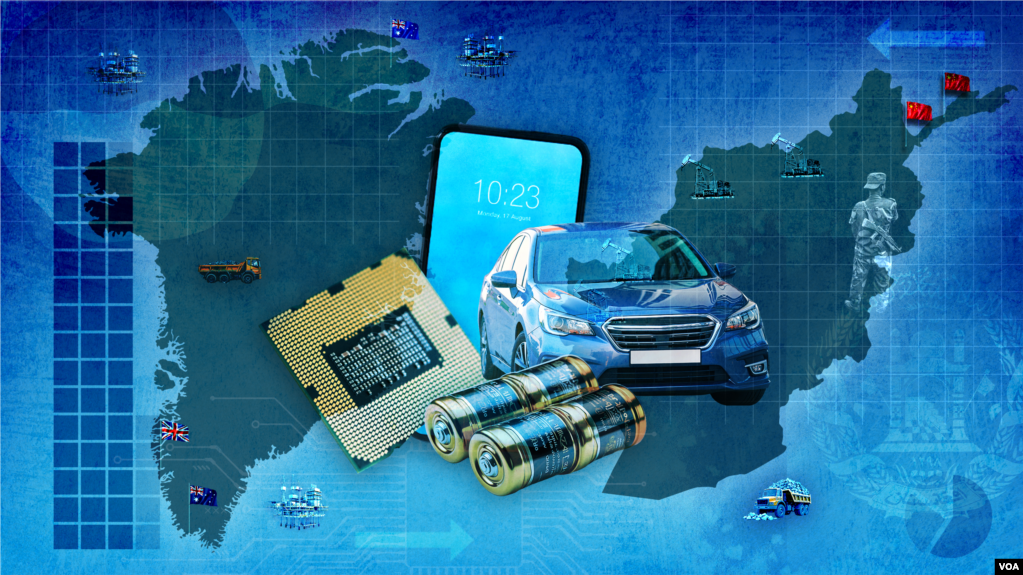
Greenland and Afghanistan: Frontiers in race for critical minerals

Voice of America

March 07, 2025

Critical minerals are seen as strategically crucial for modern economies, and Greenland and Afghanistan are believed to be rich in untapped reserves.

Where mineral resources are located and extracted has often played a major role in geopolitical and economic relations. Today, the world’s attention is turning to two places believed to be rich in untapped reserves — but accessing each of them comes with unique challenges.

Afghanistan

Sitting at the intersection of multiple tectonic plates, Afghanistan’s geology has resulted in extensive and diverse mineral deposits. Historically, its territory was a primary source of copper and gold as well as gems and semiprecious stones, particularly lapis lazuli, a stone prized for its intense blue color.

Today, Afghanistan is estimated to hold nearly $1 trillion worth of mineral reserves. This includes 60 million tons of copper, 183 million tons of aluminum and 2.2 billion tons of iron ore. Gold is mined on an artisanal scale in the northern and eastern provinces, while the mountainous north contains valuable marble and limestone deposits used in construction.

The China National Petroleum Corporation also pumps oil in the north, though Afghanistan has no domestic refining capability and is reliant on neighbors such as Turkmenistan, Iran and Kyrgyzstan for fuel.

Most of the international focus, however, is on Afghanistan’s other metal deposits, many of which are crucial to emerging technologies. These include cobalt, lithium and niobium, used in batteries and other electronics. The country’s unexplored lithium reserves may even exceed those of Bolivia, currently the world’s largest.

Afghanistan also holds major deposits of rare earth metals like lanthanum, cerium and neodymium, which are used for magnets and semiconductors as well as other specialized manufacturing applications.

One obstacle to extracting Afghanistan’s minerals is its terrain, considered the eighth most mountainous in the world. But security has been a much bigger impediment. Amid the political instability that followed the first fall of the Taliban in 2001, many gemstone and copper mines operated illegally under the command of local militants. With workers paid very little and the product smuggled out to be sold in neighboring Pakistan, the Afghan people saw little benefit from these extraction operations.

Since retaking power in 2021, the Taliban, who have been eager to make use of the country’s mineral wealth and increase exports, are hampered by a lack of diplomatic recognition and their designation as a terrorist group by multiple nations. This is, however, beginning to change, as some countries establish de facto diplomatic ties.

In 2024, the Taliban government’s resource ministry announced that it had secured investments from China, Qatar, Turkey, Iran and the United Kingdom. China, which was the first nation to accredit a Taliban-appointed ambassador, is expected to be a major player in Afghanistan’s extractive industries as part of its Belt and Road Initiative.

However, as newly discovered deposits require an average of 16 years to develop into operational mines, harnessing Afghanistan’s mineral potential will take a great deal of investment and time — if the political and security issues can somehow be worked out.

Greenland

For millions of years, Greenland has been mostly covered by an ice sheet, habitable only along coastal areas. Despite some offshore petroleum and gas exploration, fishing and whaling have remained the primary nongovernment industries.

Now, as ice recedes amid climate change, the large island’s frozen interior offers new opportunities in untapped mineral resources. These include more common metals such as copper and gold, as well as titanium and graphite. But as elsewhere, there is even greater interest in Greenland’s deposits of technology-critical minerals.

The autonomous Danish territory is estimated to contain deposits of 43 of the 50 minerals designated by the United States as crucial to national security. Among these are the sought-after rare earth metals, in addition to other metals with technological applications such as vanadium and chromium.

Currently, a majority of the world’s rare earth metals are mined in China, making Greenland’s deposits vital for countries seeking to reduce their dependence on Chinese imports. This strategic importance is one of the factors that led U.S. President Donald Trump to propose buying Greenland from Denmark.

Greenland’s government has issued nearly 100 mining licenses to companies like KoBold Metals and Rio Tinto. But these have mostly involved exploration, with only two mines currently operating in the country. Getting a mine to production can take as long as a decade, because it involves several unique challenges.

One such hurdle is Greenland’s strong environmentalist movement, which has successfully shut down mining projects for safety concerns. Rare earths pose a particular issue, because they must be extracted from other ores — a process that can cause waste and pollution. At the Kvanefjeld site in the south, metals were to be extracted from uranium ore until the fear of radioactive pollution led to a ban.

The receding ice and warming climate have made extraction easier not only by revealing more territory but also by extending possible working hours and easing ship navigation. However, the environment remains harsh and inhospitable, and the island suffers from a lack of infrastructure, with few roads or energy facilities outside major settlements. Nevertheless, Greenland’s government considers the mining industry to be an important means of developing the economy.

Conclusion

Shaped by both politics and geography, Greenland and Afghanistan have become two major frontiers in the global scramble for critical minerals. Which parties will have the opportunity to benefit from their resources will depend on the interplay of military power, economics and diplomacy.

Greenland and Afghanistan: Frontiers in race for critical minerals
read more