Peter Reynolds and his wife, Barbie, 75, who run a training business in Afghanistan, were detained last month when they travelled to their home in Bamiyan province.
Their daughter, Sarah Entwistle, said her father’s health had “significantly deteriorated” after the couple were separated and moved to a high-security prison.
“We hear he now has a chest infection, a double eye infection and serious digestive issues due to poor nutrition,” she said.
Speaking to the Sunday Times, Entwistle said: “Without immediate access to necessary medication, his life is in serious danger.” He requires pills for his heart after he had a mini-stroke before he was detained.
Entwistle said the family had been told that Reynolds was in immense pain after being “beaten and shackled”.
In a direct plea to her parents’ captors, she added: “Our desperate appeal to the Taliban is that they release them to their home, where they have the medication he needs to survive.
“We believe this request should be viewed not merely as a plea, but as a unique opportunity to demonstrate an unforgettable act of kindness that will resonate around the world.”
The couple’s business, Rebuild, has run projects in schools in Afghanistan for 18 years and continued after the Taliban regained power in 2021. Barbie previously became the first woman to receive a certificate of appreciation from the Taliban.
The pair were arrested on 1 February with an American-Chinese friend, Faye Hall, who had rented a plane to travel with them, and a translator from Rebuild.
The reason for their detention remains unclear. Entwistle suspects it was because they were teaching mothers with children.
The previous Taliban regime, before it was toppled by the US-led invasion in 2001, had accused the couple of teaching against Islam, but this case was dropped. The family said their parents respected Taliban rule and had adapted to the imposition of strict Islamic laws.
A Rebuild employee said last month the detained group was told their flight “did not coordinate with the local government”, adding that the three foreign nationals had been imprisoned in Kabul.
Hopes were raised in late February that the couple would be released.
In a statement reported by the BBC, the Taliban official Abdul Mateen Qani said: “A series of considerations is being taken into account and, after evaluation, we will endeavour to release them as soon as possible.”
He added that the three foreign nationals had Afghan passports and national ID cards.
Qani’s statement drew a cautious welcome from Entwistle, who told the Times: “It’s the first thing we’ve heard from the Taliban, so it’s really positive, but he’s really not saying very much. We know they were investigating to see if they were teaching anything against Islam, so that was a relief to us as we knew they wouldn’t be.”
She added: “Next thing we heard, the investigation was because they’re teaching parenting skills to mothers over the age of 30, with their children. Apparently, that was now against the law, but none of the influential people in that village [Bamiyan] thought it was a problem.”
The couple, who originally met at the University of Bath, married in Kabul in 1970 after travelling there as part of an academic placement scheme. They became Afghan citizens after returning to the country 30 years later to set up Rebuild.
The couple’s family initially did not want the UK government to get involved with the case.
A Foreign Office spokesperson said: “We are supporting the family of two British nationals who are detained in Afghanistan.”
Life of British man, 79, imprisoned by Taliban is in serious danger, say family
Until recently, the Taliban was a movement that wrote little about itself, in contrast to others – especially foreigners, but also Afghans – who have written so much about them. This was rooted partly in their reticence to discuss their movement and partly in a need to focus on fighting, when social media was their primary focus as it drove their propaganda effort. However, since their return to power in August 2021, they have begun to pivot towards creating a narrative about themselves. The Islamic Emirate is deploying state resources to this end, supporting the publication of numerous new books. In this report, AAN’s Sharif Akram summarises nine books written by prominent Talibs published in the last three years and discusses the narratives that emerge from them and the image of the Taliban they try to project as a people’s movement grounded in faith.
A second part in this mini-series on Taliban narratives will look at films, documentaries and audiobooks.
Introduction
When we first came to Kabul in August 2021, people were terrified of us. They viewed us as strange creatures. I remember one man asking me if I was Afghan or Pakistani. Why? Because for twenty years, the media had been propagating lies about us. They portrayed us as Punjabis [Pakistanis], as brutal men with no respect for rules. We’d had no chance to speak for ourselves. People had been completely brainwashed. Now it’s necessary for people to know who we are and why we fought. These are the essential questions that the Emirate must answer.
These were the words of a Taliban official working in Kabul who spoke to the author in April 2023. He was expressing a common sentiment, that the movement had been, as another official, a member of the Islamic Emirate’s Cultural Commission explained to the author, “introduced to our people and the world by our enemies.” After two decades of ultimately successful insurgency, the Taliban have embarked on a different endeavour – creating narratives about themselves. This is an important milestone because, in terms of books and other publications, the Taliban have, until now, been viewed pretty solely from the perspectives of outside observers. Since coming to power again, they have felt the need to explain themselves to other Afghans, who are either unfamiliar with or hostile towards them. Hence, a cascade of books in Pashto, Dari and occasionally English have been published since August 2021 about the movement, its leaders and the war, all sponsored and promoted by the state.
That such writing was not done earlier is a function of what had to be prioritised, either running the country while continuing to fight the Northern Alliance, pre-2001, or organising rebellion and insurgency, thereafter. The world knew little about the movement on the eve of the United States invasion in 2001[1] and it maintained its reclusive nature after it launched its first attacks against the US in the early 2000s. Being secretive helped avoid enemies tracking them down, while enigma remained part of the Taliban ‘brand’. However, as the insurgency expanded and grew in strength and power, the Taliban did make sporadic attempts to record and archive their wartime experiences, detailing the lives of their fighters and the suffering of their families in the conflict, showing that they understood early on the importance of narratives in winning the war[2]While they remained focused on military warfare, the increasing effort they devoted to psychological warfare during the last decade of the insurgency represented a huge shift, perhaps inspired partly by similar efforts from jihadist groups elsewhere.
In countering the narratives of the Islamic Republic and US and NATO, and spreading their own propaganda in turn on social media, the Taliban had some successes (see for example this Empirical Studies of Conflict paper on Taliban’s use of social media). Their emphasis was, by necessity, very much on addressing immediate practical needs to do with the war effort, such as promoting their cause and focusing on the military aspect of the conflict, rather than on systematically documenting the history of the movement and the war it was fighting. In terms of documenting the insurgency at this time, their efforts were patchy and random and had limited influence on their intended audience. They were mainly led by a small group within the movement’s cultural commission (coupled with a separate and more resourceful media wing under the auspices of the Haqqanis). They had limited resources at their disposal and lived in constant fear of being targeted by US or NATO forces.
Since the re-capture of power in August 2021, the Islamic Emirate of Afghanistan (IEA) has seized the opportunity to define itself through documenting its perspectives on the movement and the war and is putting resources into this effort. On 24 October 2024, the Ministry of Information and Culture announced that it had established a major new directorate under the name of the General Directorate for the Protection of Jihadi Values, which was tasked with documenting and safeguarding the history of the war. It will presumably have access to considerable state resources and build on the fragmented data previously collected by members of the Cultural Commission.
There have also been a number of books published by prominent Taliban members and supporters since August 2021 and these are the subject of this paper. The author has analysed the content of nine books that recount the history of the Taliban movement written by Talibs or their supporters, including its origins, the ideological and historical factors that led to its emergence, the fall of the Taliban’s first emirate in 2001 and what they see as their jihad against US and NATO forces.
This report opens with a summary of the books, before analysing their narratives. The author then discusses IEA attempts to construct an identity for their movement and the ways in which writers have documented the war they fought. The report also explores what lies behind these efforts to create the movement’s own narrative and how these narratives have been received and viewed by other Afghans.
All translations from the Pashto or Dari texts are by the author.
The books reviewed
Abdul Satar Saeed, Knowing the Emirate: A Brief Introduction To the Emirate and A Description of the Emirate, Kabul, Hurryat Publishing House, 2023 (Pashto and Dari)
This is the most significant work by the prominent Taliban writer, intellectual and poet, Abdul Satar Saeed. It systematically documents the history of the Emirate and the context from which it emerged. Knowing the Emirate has been widely distributed and promoted, and translated into Dari; it has been reprinted five times in the past two years, an extremely rare indication of popularity for a book published in Afghanistan. The author, writing in eloquent Pashto, provides an account of how the Taliban movement was formed, based on his first-hand observations and discussions with those involved. The book denies the allegations that the movement was created with the help of Pakistan and explains how the global and local political landscape influenced it early on. It delves into the organisational structure and political bases of the Taliban and portrays the group as having saved Afghanistan from disintegration caused by the civil war.
Muhajir Farahi, Twenty Years in Occupation: Memories of Jihad, second edition,Zahid Welfare Foundation, 2022 (Pashto, Dari and English)[3]
Muhajir Farahi, a prominent member of the Cultural Commission and current Deputy Minister of Information and Culture, here describes the activities of the Taliban during the early 2000s in Afghanistan’s southern region. It presents personal accounts of battles with a focus on the heroism of Taliban members. It also explores the tactics the Taliban employed against the US and the NATO coalition and describes the support of local communities for the insurgency. The book discusses the financial status of the movement and the channels through which it secured financial resources over the last two decades.
Shamsul Haq Samim, Malawi Said Muhammad Haqqani, unknown publisher, 2024 (Pashto)
This book looks at the life of Said Muhammad Haqqani, a senior Taliban leader from Kandahar. Haqqani held numerous roles within the Taliban during the first Emirate, including deputy foreign minister and later ambassador to Pakistan. In the formative years of the insurgency, he was the deputy head of the movement’s important Cultural Commission. The book is a collection of essays from scholars and writers on Haqqani’s life and accomplishments. The book was compiled and edited by Haqqani’s son, Shamsul Haq, and has been well received within Taliban circles. Zabihullah Mujahid, who was directly appointed and mentored by Haqqani as the insurgency’s spokesman, contributed a foreword to the work.
Abdul Satar Saeed, The Third Omar, Third Omar Publishing Agency, 2021 (Pashto and Dari)
Saeed documents the Taliban’s history through a biography of its first supreme leader, Mullah Omar. Saeed refers to Mullah Omar as the “third Omar,” after Omar ibn al-Khattab and Omar ibn Abdul Aziz, two Islamic caliphs renowned for their bravery and justice[4] The author said he started collecting the material for this book during the insurgency; it is primarily based on conversations with senior Taliban leaders who were comrades of Mullah Omar. The book traces Mullah Omar’s life, from his childhood to his death in Zabul. Saeed also included Mullah Omar’s public announcements, decrees and interviews and a chapter of reflections from those who knew him personally, including non-Afghan authors such as the Syrian Al Jazeera journalist, Tyseer Allouni, Egyptian Islamic scholar, Hani Al-Siba’i and the director of the famous Haqqania Madrasa in Pakistan, Mawlana Anwar ul-Haq.
Shuhrat Nangial, Great Reformer, Grand Warrior: From the Pulpit to the Battlefield, from Wars to Assemblies, Kabul, Jalal Foundation, 2022 (Pashto)
This book is by a renowned historian of the Afghan-Soviet war and former head of Jalaluddin Haqqani’s media wing during the 1980s and 1990s. It is published by the Jalal Foundation, which was established by the Haqqanis and works outside state structures. It explores the life of Jalaluddin Haqqani, founder of the so-called Haqqani network, tracing his life from childhood, focusing on his time as a jihadi commander during the Soviet occupation and later his role as a peace broker among the various factions of the mujahidin that were engaged in the civil war of the 1990s. The book not only emphasises Haqqani’s qualities as a military leader, but also portrays him as a mediator for peace. A grand ceremony launching the book was held at the Academy of Sciences, attended by numerous scholars of literature and history, many of whom wrote reviews of the work. Notably, it was not written by a single author but was a collaborative effort, with multiple contributors – including non-Taliban authors – sharing their impressions of Haqqani.
Javed Afghan, The Storyteller Herself Was Martyred: Stories of Tragedies, unknown publisher, 2023 (Pashto and Dari)
In his first book, Javed Afghan, the head of the state-run Afghan Film Organisation and a member of the Taliban’s Cultural Commission during the insurgency[5], recalls tales of night raids, drone strikes and Taliban heroism through first-hand personal stories collected from various provinces. The book offers perspectives from fighters and civilians, highlighting their struggles and sacrifices during the conflict. The stories in the book are often dramatic and emotional. They include stories from women describing their experiences during the war, as per the book’s title.
Javed Afghan, Behind thePrison Bars: The Battle for Liberation and Memories of Prison, unknown publisher, 2024 (Pashto)
This book captures the personal stories of Taliban members imprisoned during the insurgency, primarily in the notorious Bagram Prison, run until 2013 by the US military, which the author characterises as ‘Afghanistan’s Guantanamo’(see AAN’s dossier of reports on Bagram prison). It details their arrests and the harsh treatment they faced during their imprisonment. The narrative is designed to stir strong emotions, as it describes the torture and suffering endured by the prisoners. It also highlights the emotional strain on the families who visited them. The book features accounts of the imprisonment of several high-ranking Taliban figures, including member of the Political Commission Anas Haqqani, Deputy Chief of Army Staff Mali Khan Dzadran and IEA spokesman Zabihullah Mujahid.
Zia ul-Haq Hassan, The Morning After the Raid, unknown publisher, 2022 (Pashto and Dari)
This former Taliban fighter has written an autobiography describing his experiences during the insurgency in his home province of Wardak[6] The book describes the operations of US forces in Wardak, the killing and wounding of civilian and the bombing of homes. The second chapter focuses on the heroism of Taliban fighters and the third describes the ‘miracles’ attributed to the martyrs, recounting supernatural occurrences surrounding the deaths of Taliban fighters in Wardak.
Hasibullah Hewadmal, Stars That Have Fallen Out of the Orbit of Life: Biography, Deeds and Memories of Sheikhabad Valley’s Martyrs, Dajmir Dawoodzai Publishing, 2024 (Pashto)
Hewadmal, a resident of Wardak province who graduated from Literature and Human Sciences faculty of Laghman University and is currently a government employee, focuses on Taliban fighters who were killed during conflict in Shaikhabad a valley in Wardak’s Sayedbad district. The book details the backgrounds and memories of 165 fighters who were killed in the conflict. It explains their motives for joining the Taliban and focuses on their heroism before describing their deaths.
The emerging narratives
The nine books selected for this report can be divided into three groups. The first group comprises two works – Saeed’sKnowing the Emirate and Farahi’s Twenty Years of Occupation that deal with the history of the Emirate and the political history of the movement. The primary focus of these two books is how and why the Emirate was established and how it evolved.
Farahi’s book places emphasis on the Taliban’s status as a people’s movement, representing the Afghan people and supported by them:
In the initial days, we only had a few Russian-made Kalashnikovs, rockets and motorcycles. But as our jihad continued, our mujahedin received money from the people. They were helped by the mujahed nation.
Saeed’s book presents the Taliban as key players in the global geopolitical arena and emphasises their refusal to follow the US-led world order that emerged in the aftermath of the Cold War.
The Islamic Emirate arose during the peak of America’s global position at a time when, after its victory in the Gulf War, the US claimed there was a unipolar system and referred to the 21st century as ‘the American Century’. In the new global order of the United States, no system other than Western liberal democracy was allowed to hold power anywhere on Earth. In particular, the Islamic system, which had long been seen by the West as its primary rival, was not allowed to hold power.
He argues that the US’s hostility toward non-liberal and non-democratic ways of life, stemming from its position as the sole superpower, was a key factor behind its hostile stance towards the Taliban and eventual invasion of Afghanistan. This hostility arose because the first Islamic Emirate refused to adhere to the standards set by the West and instead chose to pursue an Islamic model of governance.
When [the US] saw the firm commitment of the Islamic Emirate to its religious principles and the implementation of sharia law, they began to oppose it. This opposition initially began with one-sided, poisonous propaganda and later escalated into the creation of political, economic and other challenges, alongside strategies aimed at isolating the Emirate. Human rights, women’s freedom, narcotic cultivation and other issues were used to criticise the Islamic Emirate.
Saeed considers the hosting of Osama bin Laden and the subsequent September 11 attacks as mere pretexts for the US to invade Afghanistan.
Before the Emirate’s rule, Sheikh Osama arrived in Afghanistan during the reign of Burhanuddin Rabbani, at the invitation of several jihadist commanders from Nangrahar and with the agreement of the Rabbani government. The US did not make much mention of this issue during the Rabbani government’s rule, but when Kabul and the eastern parts of the country fell under the rule of the Islamic Emirate, the US began pursuing this issue under the pretext of opposing the Emirate. They gave Sheikh Osama widespread attention and presented him as the greatest threat to the US and the world.
He gives his explanation as to why the first Emirate refused to hand Bin Laden to the US:
It stated that the US must first present evidence and documents to prove the allegations against Sheikh Osama. If he had indeed committed such actions that violated Islamic laws, then an Islamic government existed in Afghanistan with courts and legal procedures that could handle the case because no one is above the law. However, the US was arrogant and demanded that Sheikh Osama be handed over without any conditions or evidence. This demand was not in accordance with any legal standards.
The second group of books – Nangial’s Great Reformer, Grand Warrior, Saeed’s The Third Omar and Samim’s biography of Malawi Said Muhammad Haqqani – are histories of the movement told through the biographies of two prominent figures. These books are based on interviews with the Taliban leadership, personal observations, etc.
Nangial’s book is an attempt to portray Haqqani as a strong military commander who contributed greatly to the defeat of Soviets and later the US and NATO. It emphasises his actions both as a military commander and as a neutral person brokering a peace agreement among the warring mujahedin tanzims [political-military faction] in the 1990s. Nangial describes Haqqani as a unifying figure who did not seek to monopolise the jihad against the Soviets for a single tanzim, but sought to unite all mujahedin under a single cause.
Mullah Jalaluddin Haqqani organised the resistance and jihad not on an ideological or organisational level, but as a national Islamic uprising within the framework of a popular uprising. … Therefore, in the centre of [his] Dzadran tribe, no flag of any organisation or group was raised, no invitation was made in the name of a tanzim or a leader, no call for recruiting into a [particular] tanzim was heard. In this way, the jihad in the Dzadran region was protected from the harm of party politics and factionalism.
Nangial also attributes Haqqani’s war against the US to his unwavering belief in an independent Afghanistan, prompting him to take up arms against any invader, whether Soviet or American.
In Haqqani’s view, there is no good foreign invader, no matter if their slogans seem noble, appealing, or different. Their goals and essence are the same, and the outcome, even for their puppets in the countries they invade, is nothing but treachery, betrayal and hostility. For him, the meaning of any foreign invader in the dictionary of faith and belief is the same and resistance to them is an obligation. Fighting any foreign invader is an inseparable part of his faith and of his Afghan identity.
The Third Omar provides a comprehensive account of Mullah Omar’s life, portraying him as the leader who rescued Afghanistan from the chaos and civil war of the 1990s. It outlines the situation in Kandahar and across Afghanistan in 1994, detailing the brutality and oppression of the mujahedin factions. Mullah Omar’s rise to power is thus portrayed as the dawn of a calm and safe period in Afghanistan’s history after years of violent chaos. The book highlights that Mullah Omar’s decisions, both personally and politically, were guided by Islamic principles rather than “worldly or material” knowledge. The author notes:
Mullah Omar, as a true believer, was a man committed to the teachings of Islam, considering sharia the highest principle in both his personal and social life. During his rule, he would first evaluate governmental actions in the light of sharia, consulting Hanafi scholars on the permissibility or impermissibility of decisions. He would not take any action until he received a fatwa confirming its permissibility. In contrast, the decisions of contemporary political figures and groups are often driven by personal desires, reason, material gains, or research centres and they do not regard Allah’s religion and sharia as ultimate and credible sources.
The author attempts to portray Mullah Omar as a miraculous figure, whose limited religious and political knowledge proved to be no disadvantage because of his deep faith in God and commitment to sharia, which guided both his governance and the insurgency
As with the first group of books reviewed, the biography of Mullah Omar culminates in the defeat and decline of a global superpower and the victory of a pious and righteous movement’s over it. The idea of the Taliban as a ‘people’s movement’, based on strong faith in the divine, that defeated an evil empire. is noticeable here too.
The third and possibly most interesting group of books are the four based on oral histories and interviews with ‘ordinary people’. They include one autobiography. These books, especially those recalling the night raids, drone strikes and killings of civilians, could be accused of sensationalising the tragedies they present. They deal with the human side of the war, rather than its military aspect and aim to present the fight against the US and NATO as one in which the entire nation participated, not only the Taliban. In documenting the civilian casualties caused by US and NATO troops, the movement aims to expose what it sees as the hypocrisy of the US, in that the US used the rhetoric of human rights to condemn others whilst committing extreme violations of these rights itself. The Taliban, claimed the author of The Morning After the Raid, have exposed “the true side of the people who claim to have championed human rights and to be beacons of progress and development.”
The stories of civilians killed and the destruction of their homes and property are vividly portrayed in these books, which clearly implicate the US and Republic in targeting civilians. Here, again, the Taliban are presented as a people’s movement, a running narrative in all the books reviewed. To this end, these authors pay considerable attention to the support Afghans provided to the Taliban during the war. They recount many occasions in which civilians helped Taliban fighters evade night raids and search operations, gave them information on Afghan military movements and provided financial support.
The pain of Afghans who lost family members is another common theme. In The Storyteller Herself Was Martyred, the author recounts the following story:
The Afghan nation has experienced both bitter and sweet moments over the last two decades, but the bitterness was probably far greater. The price of blood became so devalued that an animal and a human became indistinguishable. Those who called themselves the leaders of the nation only showcased the good side while hiding resentments from the public. We heard the voices of people villages in Andar district [Ghazni province] and we now share these with you.
We were sitting with a number of elders in Gabari village. I asked the eldest, “Uncle, how much did your village suffer damage over the last 20 years?”
He fell silent when he heard my question and turned his face away. His silence continued; I thought some bad memories had probably made him unable to speak.
Another man who introduced himself as the son of the first elder said, “We were subject to dozens of raids and bombardments. Over 40 of our fellow villagers were martyred and a large number of others wounded.”
The author here recounts his entire conversation with the village elders. Moving from his position as outsider-interviewer, he becomes an active participant in the story, a technique that allows him both to express his feelings and share in the stories of others. This style, which is both personal and immersive, is popular in Pashto literature. The author of Behind the Prison Bars deploys a similar technique to narrate the story of a prisoner receiving a family visit:
After a brief silence, Qari Sahib [who was imprisoned in Bagram] said, “In my last visit, my little son, Rafiullah, came to see me. I don’t know if it was my seventeenth or eighteenth visit. He was very young when the Americans captured me, only about a year and a half old, but when I saw him this time, he had grown. When the translator came and said, “Your time is up, let’s go!” my son, who had grabbed hold of my prison clothes, asked, “Father, where are you going? I’m going with you too!”
I said, “I have to go!” and I cannot say what happened next. I cried even more, and for the first time, I saw tears in the guard’s eyes. The room became chaotic and I told my family I would be free soon, by the grace of God. About a month and a half later, I was released.”
As he finished his story, Qari Sahib’s voice changed and his tears became even more obvious.
I, too, was silent for a moment and then bade him farewell.
Alleged miracles performed by Taliban fighters are another recurrent theme in these works. The inclusion of these supernatural occurrences is intended to portray the fighters as divinely blessed and thus imply that their cause was divinely approved and supported. In The Morning After the Raid, the author claims that the blood of a Taliban fighter killed in conflict with US troops pooled on the ground and formed the word, ‘Allah’. Later, the author reports that a family who hosted Taliban fighters experienced many blessings: “The family said that when the mujahedin were there, there was abundance in everything; even the sheep and cows gave milk more than normal.”
Women are also mentioned in the books, although only as wives, daughters or mothers and never as fighters. The author of The Morning After the Raid, for example, recalls:
The invaders, after killing the father of an innocent family, turned their weapons on his two young daughters and gunned them down. The elder daughter of Mualim Nur Agha had recently become engaged in Goda Khil village and the marriage was planned for the following month. She had waited for the celebration of her wedding with many hopes and dreams, not knowing that the so-called defenders of human rights would not let her dreams come true. Her hands, that should have been painted with henna, were painted instead with her own blood.
Behind the Prison Bars, deals with the tales of prisoners and their experiences of torture.
During the Western invasion, the biggest human rights defenders of the world (!), America and its allies, built prisons in and outside of Afghanistan such as Abu Gharib, Guantanamo, Bagram, Pul-e Charkhi, 90 and 40 directorates [of the NDS} and many other torture houses in provinces and capitals in order to detain the Afghan Muslim youth, to torture, beat and imprison the defenders of Islamic values, Afghan traditions and national norms. Due to the massive torture, many of the prisoners went mad. Their mental health would be severely damaged and many, who had been caught during the raids, wished themselves dead.
What do the Taliban seek to achieve through these books?
The Taliban feel that history in Afghanistan has been highly politicised by previous regimes in power. This is now something the movement itself is now trying to counter. Those taking power – from the communists and mujahedin to the first and second Emirates to the Republic – have always rejected the legacy of their predecessors, labelling them as puppets or enemies of the nation. The Taliban now follow the same pattern, but with greater intensity, as one official explained:
There is no impartial history writing anywhere in the world. But Afghans have gone to extremes. The communists, who invited the Soviet occupation and imposed a foreign ideology, labelled freedom fighters as puppets and rebels, while they portrayed themselves as heroes. Then the Republic came and labelled the Emirate with the same names. They considered Amanullah Khan a hero for going against the norms of the people, while they themselves came [to power] on American tanks. They wrote books, made films and included this in school curriculums. This was very unfair.
One of the authors reviewed, Javed Afghan, writes:
It is a sad continuation of our historical mistakes that we have not documented the stories of the unjust invasions and their cruelties for future generations. I accept that Afghanistan has a 5,000-year-long history, but why haven’t we made fair efforts to preserve it? Why has our country been repeatedly invaded? Why are the stories of Afghan heroism, sacrifice and courage tied to unknown individuals?
How are these efforts viewed by the public?
The Islamic Emirate is actively seeking to shape the public’s perception of their history, particularly in relation to their conflict with the US-led coalition and the identity of their movement. They have not only been focused on documenting their version of history, but also on actively disseminating their newly polished narratives to the public.
One of their highest-profile initiatives has been book-reading competitions, organised by provincial Culture and Information Directorates since 2022. The Ministry of Education has also hosted similar competitions and seminars where participants would read a book assigned by the ministry and take a test on the material. Those with the highest scores were rewarded with various prizes, including cash, motorcycles and computers. These competitions have been held in nearly every province but seem to have been particularly frequent in areas where the Emirate lacks strong community support. In Panjshir province, the provincial Directorate Of Information and Culture organised such programmes not only in the provincial capital, Bazarak, but also in districts like Hesarak and Rukha where support for the National Resistance Front (NRF) has presented a problem for the Emirate.
Such book-reading competitions, along with major launch ceremonies for many of the books and high-quality printing (which is largely paid for by the state) are all part of a strategy to promote these newly published books to a larger and more diverse audience. One person who participated in a competition to read Saeed’s work, Introduction to the Emirate,said:
My perception about the Emirate had been different, but after reading this book, it changed. I understand what the Emirate is, why it was formed, whom it fought and why it rules Afghanistan. I really understand this. Like myself, most people sitting in this gathering may not have comprehended these issues. We want the Islamic Emirate to held more such programmes and explain its goals, strategy and why it is ruling. The Emirate fought for 20 years with basic weaponry against the most advanced militaries of secular states. The Emirate beat America and the 48 countries of NATO who never thought the Islamic Emirate would rule Afghanistan ever again.
However, based on conversations with booksellers in Kabul, these efforts have not yet been as successful as their architects hope. It appears their primary readership are Taliban members and their sympathisers. As one bookseller pointed out: “Most of the books produced by the Taliban are bought by people who look like the Taliban, or by the Taliban themselves. Very few non-Taliban, such as university students, purchase them.”
Several factors contribute to this limited readership. One significant issue is that most of the material is written in Pashto, and although there have been some attempts to expand into other languages, for example, Saeed’s book has been translated into Dari, the majority of the books are available only in Pashto. Secondly, the content is highly politicised and the authors are obviously closely aligned with the Taliban’s agenda, which appeals to Taliban supporters but is less attractive to others.
The situation is different in areas where the Taliban enjoy more support. For instance, Saeed’s book, of which over 5,000 copies were printed, sold well in some provinces in the south and east. A bookseller in Paktia province said he had sold 100 copies of Saeed’s Knowing the Emirate in less than a month, while in Kabul they still have copies left after a year.
As a general rule, as well, reading books is not a particularly popular pastime in Afghanistan, which is why the author will also be reviewing television documentaries and films, which get a wider audience. Nonetheless, written text are texts of ‘record’, more likely to be studied and to form part of what becomes accepted – or contested – history.
The importance of listening to Taliban voices (as well as others’)
The Taliban’s main narratives have been carefully crafted to challenge mainstream portrayals of the movement and present their struggle as righteous. They focus on countering dominant narratives that seek to undermine their cause, asserting that their fight was not only just, but necessary. At the heart of these narratives is a deep sense of their own moral integrity. They emphasise that this is a ‘true’ jihad, one that no one should doubt. They frame their own history through stories of heroism, sacrifice and resistance to oppressive tyranny that was so bad, it could not be ignored.
They have also tried to present their struggle as divinely approved. Through tales of miraculous events and descriptions of the piety of their leaders and fighters, they seek to convey that their armed struggle was not just a political act, but a sacred mission supported by higher forces. In contrast, they depict the West’s democratic ideals as hypocritical lies, the tools of an evil enemy. They argue that their cause is not only morally superior but also a necessary defence against this evil. They stress that theirs was a popular struggle, not the work of foreign powers or partisan self-interested groups. It was a national fight for freedom, led by local leaders deeply inspired by injustice and a desire to free their people.
Despite the Emirate’s efforts, the degree to which their narrative will be accepted by other Afghans remains to be seen. Javed Afghan, author of The Storyteller Herself Was Martyred, asks the same question:
Why can’t we stop the younger generation from embracing the culture of foreigners? Why are yesterday’s invaders and killers today’s heroes? The truth is, we have nurtured the garden, but we have been negligent in harvesting its fruits.
Most readers will be aware that it is important not to treat these writings as neutral history or objective journalism. In the same way as most other regimes and movements, the Taliban are driven by a desire to shape and control the narrative about themselves. Consequently, the books reviewed lack the critical distance needed to provide an objective account. For example, it is rare to find an acknowledgement in these texts of the death and suffering experienced by Afghan civilians due to the Taliban’s use of IEDs and suicide attacks.
When wars end, the victors write their story, focusing on their heroic acts, while the defeated are typically silenced. But it is often the civilians – the ones who suffer the most between the different sides – whose stories go untold. The war in Afghanistan is far from a simple story and no full account of the conflict can be written solely by one side. The Emirate’s narratives are a new thread in understanding Afghanistan, important because they have rarely been written down before, but still, one thread among many.
Edited by Jelena Bjelica, Letty Phillips and Kate Clark
References
References
↑1
The first books to shed some light on a reclusive movement were William Maley’s Fundamentalism Reborn? Afghanistan and the Taliban (1998), Ahmad Rashid’s Taliban: Militant Islam, Oil and Fundamentalism in Central Asia (2000) and Antonio Giustozzi’s Afghanistan’s Endless War: State Failure, Regional Politics and the Rise of the Taliban (2001). Other important books published at a later date were Alex Strick Van Linschoten and Felix Kuehne, An Enemy we Created: The Myth of the Taliban-Al Qaeda Merger in Afghanistan and Anand Gopal’s No Good Men among the Living: America, the Taliban and the war through Afghan lenses. For a fuller list of books , especially those published at later dates, see AAN’s Bibliography.
↑2
To this end, the Taliban established a Cultural Commission (Farhangi Kamisun) in 2004 and tasked it with documenting alleged war crimes committed by US and Afghan government forces, countering the narratives of their enemies and disseminating information. From the early 2010s, the Taliban began broadcasting radio programmes, producing DVDs and running websites about themselves. Towards the end of the insurgency, members of the commission also began to work on a book about the life of their late amir and one of the movement’s founders, Mullah Muhammad Omar, which was completed just before the takeover in 2021.
↑3
The first edition of this book was published just a few months before the August takeover.
↑4
Omar ibn al-Khattab (r 634-44) was the second leader of the Muslim community (for Sunni Muslims) after the Prophet Muhammad and is known as ‘al-Faruq’ because of his discernment of right and wrong. Omar ibn Abdul Aziz was the eighth Umayyad caliph, ruling from Damascus (r 717-20) and is credited with establishing significant government reforms, making the administration more efficient and egalitarian.
↑5
Javed Afghan also played an active role in running the Taliban-owned radio station, Voice of Sharia, during the insurgency.
↑6
Hassan is also a former member of the Cultural Commission. He is currently serving as the director of the Invitation and Guidance department of the Ministry for the Propagation of Virtue and Prevention of Vice at the Paktika Police Headquarters.
Revisions:
This article was last updated on 15 Mar 2025
Taliban Narratives (1) Books: “Who we are and why we fought”
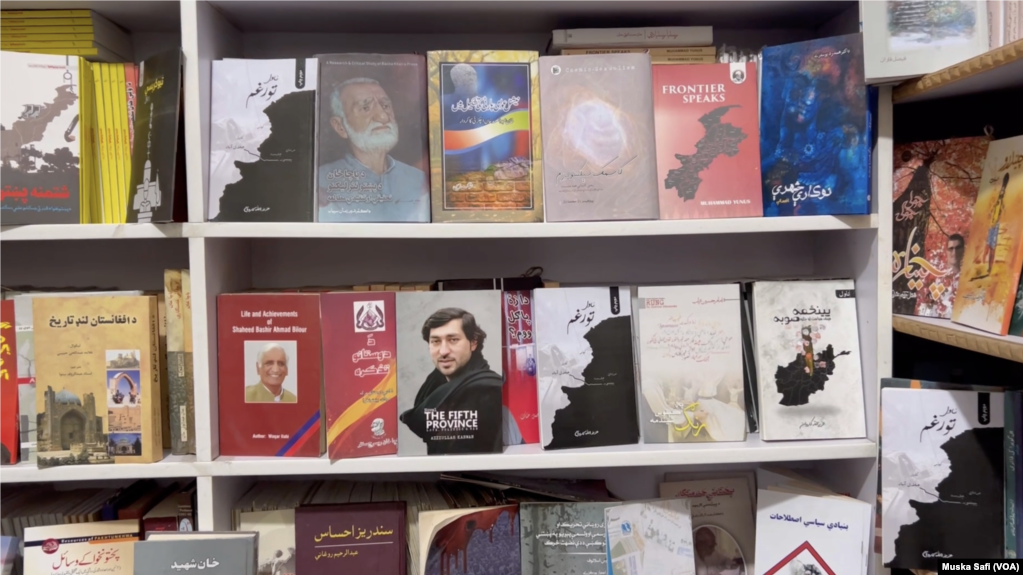
Books by Afghan and Pakistani authors are displayed in a store in Peshawar, Pakistan, March 14, 2025. The Taliban have banned 400 titles in Afghanistan.
WASHINGTON —
When Naveeda Khoshbo published her book of political analysis in 2019, she received widespread praise and recognition.
For many, “it was the first time that they were reading a book written by a young woman,” she said.
So, when she received a text message from a friend and fellow journalist in November 2024, telling her the Taliban had banned her book, she was shocked.
Khoshbo, 33, said she can’t figure out why the book, “Siyasi Jaj” or “Political Analysis,” was banned, saying “it did not address any sensitive topics.”
Published by the Peace Publish Center in Kabul, her book covers political events and processes from 2001 to 2019.
But last year it was included in a list circulated on social media of more than 400 books banned by the Taliban.
The list covers a range of topics: democracy, the arts, literature, poetry, history, religion, governance, rights and freedoms.
The Taliban’s deputy minister for the Ministry of Information and Culture, Zia-ul Haq Haqmal, told media his department had identified 400 books deemed “against Afghanistan’s national interest and Islamic values.”
‘Hostility is directed at women’
Khoshbo believes her book also was banned because it was written by a woman. She is now based in London.
“I believe their hostility is directed at women, and for them, the books written by women are the first to be targeted, regardless of their content,” she said.
About a dozen titles in the book ban are by women, or they were translated by women. Other titles include the book by Nobel laureate Malala Yousafzai, “I am Malala: The Story of the Girl Who Stood Up for Education.”
The Taliban, who seized power in August 2021, have imposed strict measures against women in Afghanistan, barring them from education, work, long-distance travel and participating in public life.
UN urges Taliban to end restrictions on girls on International Women’s Day
Afghan writer Nazeer Ahmad Sahaar told VOA the Taliban jettison anything they see as contrary to their ideology.
“Anything that is against the Taliban’s political and religious beliefs and narrative is banned under the Taliban,” said Sahaar.
The author has written more than a dozen books. One of those, “Waziristan: The Last Stand” is also on the list of banned publications.
Sahaar sees the book ban as part of a larger crackdown on “women, the press and freedom of expression.”
Sahaar said the ban on books, though, is of little surprise.
“It was evident that they would impose restrictions in many areas,” he said.
Alongside the book ban and restrictions imposed on women, the Taliban return has led to restrictions on freedom of expression.
Media outlets work under rules that are not always clear about what can and cannot be covered, and in some cases must submit coverage for review before publication.
The Taliban also imposed restrictions on printing books.
An owner of a printing press in the eastern province of Nangarhar, who requested anonymity for fear of reprisal, told VOA that the provincial Directorate of Information and Culture instructed publishers not to print anything without prior permission.
“In a meeting with publishers, the Taliban officials said that ‘if you are publishing any book, you must first obtain permission from the directorate,'” said the business owner.
The owner said that businesses are struggling under the Taliban, but there is an increased demand for books, particularly ones that are banned.
“The Taliban’s restrictions have sparked social and cultural resistance,” he said, with people seeking ways to oppose the limitations, including by reading prohibited books.
‘It reflects the fear’
Abdul Ghafoor Lewal, an Afghan writer and former diplomat, told VOA the Taliban’s actions reveal fear of any opposition.
“It reflects the fear authoritarian regimes have of freedom of expression, books and knowledge,” said Lewal.
Khoshbo said the Taliban’s ban would not stop her and other women from writing and participating in social and political life.
“The Taliban can’t suppress our voices by “banning books,” said Khoshbo, but “women can’t be erased from society and politics.”
Author says ban on her book reflects Taliban’s repression of women
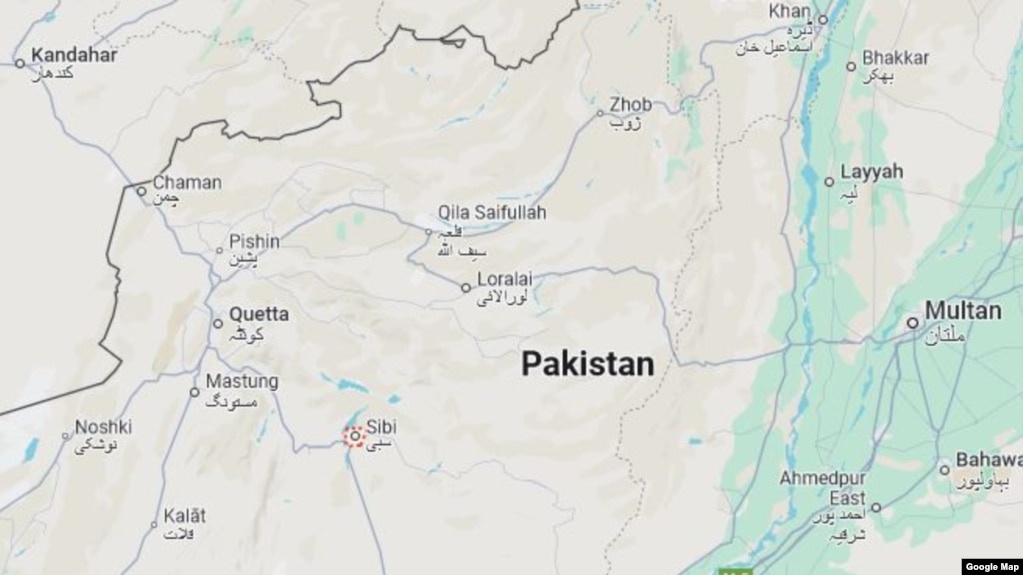
Locator map of Sibi, in Balochistan province, Pakistan
The Afghan Taliban have rejected Pakistan’s allegation that Tuesday’s deadly hostage-taking of a train was planned and directed from Afghan soil.
Afghanistan’s Ministry of Foreign Affairs called Pakistan’s assertions “baseless,” in a statement Thursday.
“We categorically reject baseless allegations by Pakistani army spokesperson linking attack on a passenger train in Balochistan province with Afghanistan,” foreign ministry spokesperson Abdul Qahar Balkhi said in a statement posted on X.
Militants linked with the banned Baloch Liberation Army attacked a passenger train Tuesday near Sibi, Balochistan, taking hundreds hostage.
Militants attack train, take hostages in Pakistan’s Balochistan province
At least 21 passengers and four paramilitary troops died in the attack. The military claimed the killing of 33 terrorists.
During a visit to Quetta for a high-level security meeting Thursday, Pakistan’s Prime Minister Shehbaz Sharif told media 339 passengers were rescued.
Lieutenant General Ahmed Sharif Chaudhry, director general of the Pakistani military’s media wing Inter Services Public Relations, had earlier said attackers collaborated with partners in Afghanistan.
“During the operation, these terrorists were in contact with their supporters and masterminds in Afghanistan via satellite phone,” Chaudhry told a private news channel as he declared the clearance operation over Wednesday night.
Later, the military’s media wing reiterated the assertion.
“Intelligence reports have unequivocally confirmed that the attack was orchestrated and directed by terrorist ringleaders operating from Afghanistan, who were in direct communication with terrorists throughout the incident,” a statement from the ISPR said.
Rebutting the claim, Balkhi said Islamabad must address internal issues.
“[We] urge Pakistani side to focus on resolving their own security and internal problems instead of such irresponsible remarks,” the Taliban foreign ministry spokesperson said..
Tuesday’s attack marked a dramatic escalation in the separatist insurgency that has ravaged Balochistan for nearly two decades.
The militants blew up tracks, bringing the train with nearly 450 passengers to a halt in a tunnel, where they stormed it.
Survivors told VOA the attackers singled out security personnel and ethnic Punjabi passengers, shooting many.
Eyewitnesses give harrowing account of Pakistan train attack
“Pakistan expects the Interim Afghan Government to uphold its responsibilities and deny use of its soil for terrorist activities against Pakistan,” the military said in written comments to the media Wednesday, repeating an increasingly frequent demand.
On Thursday, the spokesperson for Pakistan’s Ministry of Foreign Affairs, Ambassador Shafqat Ali Khan, repeated Islamabad’s stance.
“We urge Afghanistan to hold perpetrators, organizers, financiers, of this reprehensible act of terrorism accountable and cooperate with the government of Pakistan to bring all those who are concerned with this attack, including the real sponsors of terrorism, to justice,” Khan told media at the weekly briefing.
Balkhi rejected the allegation that Baloch separatists have put down roots across the border.
“No members of Balouch opposition have presence in Afghanistan, nor have they ever had or have any links with the Islamic Emirate,” Balkhi said in his post on X. The Taliban refer to their government as the Islamic Emirate.
Pakistan has seen a sharp increase in terrorism in the last year, with deaths rising by nearly 45% in 2024 from the year before.
The country now ranks second on the Global Terrorism Watchlist with Tehreek-e-Taliban Pakistan, or TTP, an ideological offshoot of the Afghan Taliban, and the separatist Baloch Liberation Army emerging as the deadliest outfits.
Speaking at a United Nations Security Council meeting on Afghanistan this week, Pakistan’s permanent representative to the United Nations, Munir Akram, said Kabul was failing to rein in Baloch separatists.
“The Kabul authorities have failed to address the threat posed to the region and beyond by other terrorist groups, such as al Qaida, the TTP and Baloch terrorists, including the BLA and the Majeed Brigade, which are present in Afghanistan,” the Pakistani envoy said Monday.
Afghanistan denies link to train attack in Pakistan
The TAPI gas pipeline in Afghanistan has completed 10 kilometers of construction. Hamayon Afghan, the spokesperson for the Ministry of Mines and Petroleum of the Taliban administration, announced that the practical work on the TAPI gas pipeline project in Afghanistan has made 10 kilometers of progress.
On Saturday, March 15, Afghan shared a video clip revealing the acceleration of the TAPI project’s work as the weather warmed up.
According to Afghan, the TAPI project is one of the government’s priorities in the energy infrastructure sector, and there are hopes for its swift completion.
The TAPI pipeline is a major regional project that aims to transport Turkmenistan’s gas through Afghanistan to Pakistan and India.
This project was launched in 2015 in Merv, Turkmenistan, by the leaders of Afghanistan, Pakistan, and Turkmenistan, and was inaugurated in Afghanistan in 2017.
It is worth noting that the implementation of this project was delayed due to insecurity in Afghanistan. The TAPI project is one of the largest regional projects, with a length of 1,821 kilometers and an annual gas transmission capacity of 33 billion cubic meters.
Meanwhile, significant progress has been made on the TAPI project, the challenges posed by security concerns in Afghanistan remain. The successful completion of the project could significantly impact the region’s energy landscape, fostering closer cooperation among neighboring countries. However, continued efforts will be required to ensure its timely and secure completion.
10 Km of TAPI Gas Pipeline Completed in Afghanistan
The protesting retirees stated that they are enduring severe economic hardships, especially during the holy month of Ramadan.
Following previous gatherings of retirees, a number of them once again held a protest today (Saturday) in front of the Pension Treasury Directorate, demanding the payment of their overdue pensions.
The protesting retirees stated that they are enduring severe economic hardships, especially during the holy month of Ramadan.
They say that for nearly four years, they have been gathering almost daily at the doors of the Pension Treasury, hoping to receive their pension payments.
Abdul Hanan Oryakhil, one of the retirees, told TOLOnews: “We only want the pension we used to receive every year. Our wives and young children also have the right to receive our pension.”
Abdul Khaleq, a representative of the retirees, said: “We have served this country, and our beards turned white in service. We roamed the mountains and dedicated our lives to this land. As you can see, all these retirees are facing economic hardship.”
Among the protesters, a former Ministry of Defense employee told TOLOnews that he is now struggling with countless challenges day and night.
Qader, another retiree, told TOLOnews: “We don’t have flour at home, no oil, nothing. Our pensions must be paid. The UNAMA office and the United Nations exist, but we have not received any assistance so far.”
Previously, the leader of the Islamic Emirate issued a decree for the payment of retirees’ pensions. However, there have been no recent updates on its implementation, and details remain unclear.
This move is part of Trump’s strict immigration policies during his second term in office.
The administration of Donald Trump is considering imposing extensive travel restrictions on citizens of 41 countries, including Afghanistan, for entry into the United States.
According to sources cited by Reuters, these restrictions are categorized into three levels:
1. Complete visa suspension for 10 countries, including Afghanistan, Iran, Syria, Cuba, and North Korea.
2. Partial visa suspension for 5 countries, including Eritrea, Haiti, Laos, Myanmar, and South Sudan, which would involve restrictions on tourist, student, and some immigration visas.
3. Conditional visa suspension for 26 countries, including Belarus, Pakistan, and Turkmenistan, where visa issuance will be restricted if security deficiencies are not addressed within 60 days.
The report states that these countries have been given a 60-day deadline to rectify security shortcomings; otherwise, visa issuance for their citizens will be restricted.
This proposal has not yet received final approval from the Trump administration or US Secretary of State Marco Rubio, and changes to the list of affected countries may still be made.
This move is part of Trump’s strict immigration policies during his second term in office.
In an October 2023 speech, he had announced his intention to impose restrictions on citizens of Gaza, Libya, Somalia, Syria, Yemen, and any country deemed a threat to US national security.
If finalized, this policy could have far-reaching impacts on travelers, students, and immigrants from dozens of countries and is expected to trigger both domestic and international reactions.
Afghanistan Among Countries in Proposed US Visa Ban
In response to remarks made at a UN side event on Afghan women, Khyber stated that such claims are merely an attempt to “mislead public opinion.”
Saif-ul-Islam Khyber, spokesperson for the Ministry of Vice and Virtue, has dismissed concerns from various countries about the situation of women in Afghanistan, calling them “unfounded.”
In response to remarks made at a UN side event on Afghan women, Khyber stated that such claims are merely an attempt to “mislead public opinion.”
Khyber reaffirmed the Islamic Emirate’s commitment to women’s rights, stating: “Since the Islamic Emirate came to power in Afghanistan, it has ensured that all women receive their Islamic rights as prescribed by Sharia law. The Emirate remains committed to protecting women’s rights and has demonstrated this in practice.”
However, some women’s rights activists and political analysts are urging the Islamic Emirate to uphold women’s rights, including the right to education and employment.
Zarif Danishjoo, an advocate, stated: “Our request to the Islamic Emirate is to reopen schools for girls, as education is the only hope for a nation’s future.”
Lima Shirzai, a women’s rights activist, said: “Afghan women and girls want to work like women in other Islamic countries so they can contribute to Afghanistan’s growth and development while playing a role in raising and educating their children.”
Previously, representatives from Canada, the Netherlands, Albania, Australia, and several other countries expressed concerns about the situation of women in Afghanistan. They emphasized that practical steps are needed to ensure women’s rights in the country.
Islamic Emirate Responds to Concerns Over Women’s Rights in Afghanistan
The Islamic Emirate has yet to respond to the matter. However, it previously deemed last year’s UNAMA mission in Afghanistan as ineffective.
The United Nations Security Council (UNSC) is set to vote tomorrow (17 March) on a draft resolution extending the mandate of the UN Assistance Mission in Afghanistan (UNAMA) until 17 March 2026.
According to a report from the council, the draft resolution for UNAMA’s mandate has been presented without any changes to its duties and priorities. The resolution includes key topics such as human rights—especially women’s and girls’ rights—Afghanistan’s economic and humanitarian situation, terrorism, drug trafficking, and the condition of internally displaced persons.
The report further states: “The draft resolution renews UNAMA’s mandate for an additional year without changing its tasks and priorities and also contains preambular language regarding several issues, including human rights, particularly those of women and girls; women, peace and security (WPS); the economic and humanitarian situations in Afghanistan; terrorism; drug trafficking; small arms and light weapons, internally displaced persons (IDPs) and refugees; and the impacts of natural disasters.”
“The extension of UNAMA’s mission is beneficial for Afghanistan, as it serves as a gateway for relations with the United Nations and other countries. Given Afghanistan’s current global isolation, renewing UNAMA’s mandate is in the country’s best interest,” said Aziz Maarej, a former diplomat.
Despite Security Council members agreeing on extending UNAMA’s mandate without major changes, certain issues remain contentious in the draft resolution. These include development aid, Afghanistan’s frozen central bank assets, commitments, accountability, and environmental concerns.
“They should represent not only the international community but also the Afghan society and convey the aspirations of the Afghan people,” said Enayatullah Hammam, an international relations analyst.
The Islamic Emirate has yet to respond to the matter. However, it previously deemed last year’s UNAMA mission in Afghanistan as ineffective.
The United Nations Office on Drugs and Crime (UNODC) has reported a significant rise in the price of opium, reaching $750 per kilogram in 2024, ten times more than in 2022. Despite a reduction in production, high prices continue to benefit major drug traffickers.
According to the UN, the reduction in drug production following the Taliban’s ban on opium led to a decrease in heroin and opium trafficking, with seizures of these substances dropping by about 50% since 2021.
The UNODC stated that the high price per kilogram still generates large profits, mainly benefiting high-level traders and exporters within organized criminal groups.
The UN’s report estimated Afghanistan’s opium stockpiles at approximately 13,200 tons by the end of 2022, enough to meet demand for Afghanistan’s opium until 2027.
Ghada Waly, Executive Director of the UNODC, emphasized that the rising price of opium and substantial reserves indicate that drug trafficking in Afghanistan remains a highly profitable illegal business.
Waly added that the profits from drug trafficking flow to transnational organized crime groups, contributing to instability in Afghanistan, the region, and beyond. Addressing this issue requires a coordinated strategy that targets trafficking networks while investing in sustainable economic alternatives for farmers.
The UN highlighted that before the reduction in poppy cultivation, Afghanistan’s opium reserves could have been worth between $4.6 billion and $5.9 billion, representing 23-29% of the country’s GDP in 2023. This could help mitigate some of Afghanistan’s economic problems following the Taliban’s return to power.
UN: Opium prices in Afghanistan skyrocket to $750 per Kg
The United Nations says aid workers are still in a “race against time” to remove rubble and rebuild after the devastating earthquake struck eastern Afghanistan last month, killing at least 2,200 people and cutting off remote areas.
The 6.0-magnitude quake on Aug. 31 was shallow, destroying or causing extensive damage to low-rise buildings in the mountainous region. It hit late at night, and homes — mostly made of mud, wood, or rocks — collapsed instantly, becoming death traps.
Satellite data shows that about 40,500 truckloads of debris still needs to be cleared from affected areas in several provinces, the United Nations Development Program said Wednesday. Entire communities have been upended and families are sleeping in the open, it added.
The quake’s epicenter was in remote and rugged Kunar province, challenging rescue and relief efforts by the Taliban government and humanitarian groups. Authorities deployed helicopters or airdropped army commandos to evacuate survivors. Aid workers walked for hours on foot to reach isolated communities.
“This is a race against time,” said Devanand Ramiah, from the UNDP’s Crisis Bureau. “Debris removal and reconstruction operations must start safely and swiftly.”
People’s main demands were the reconstruction of houses and water supplies, according to a spokesman for a Taliban government committee tasked with helping survivors, Zia ur Rahman Speenghar.
People were getting assistance in cash, food, tents, beds, and other necessities, Speenghar said Thursday. Three new roads were under construction in the Dewagal Valley, and roads would be built to areas where there previously were none.
“Various countries and organizations have offered assistance in the construction of houses but that takes time. After the second round of assistance, work will begin on the third round, which is considering what kind of houses can be built here,” the spokesman said.
Afghanistan is facing a “perfect storm” of crises, including natural disasters like the recent earthquake, said Roza Otunbayeva, who leads the U.N. mission to the country.
 Afghanistan Peace Campaign