Bennett also said that the existing restrictions on women and girls will affect the whole Afghan nation in the long term.
The UN special rapporteur for Afghanistan Richard Bennett said that the “slide” of the human rights situation has accelerated in Afghanistan.
Bennett presented his report about the human rights in Geneva.
“When I presented my initial report last September, I expressed concerns about the deteriorating human rights situation in Afghanistan stating that ‘Afghans are trapped in a human rights crisis that the world has seemed powerless to address.’ I regret to report that subsequently the slide has accelerated,” he said.
Bennett also said that the existing restrictions on women and girls will affect the whole Afghan nation in the long term.
Speaking at the same conference, Afghanistan Ambassador at the Geneva, Nasir Ahmad Andisha, called on the world to put the issue of human rights as a condition of their engagement with the caretaker Afghan government.
“We call on all members of this council to ensure that any engagement with the Taliban is contingent up on and center around respect for human rights and fundamental freedom,” he said.
But the Islamic Emirate denied the remarks of the UN special rapporteur about the situation of human rights in Afghanistan.
“Unfortunately, the foreign organizations don’t have information about the real issues in our country and thus they rely on inaccurate information,” said Bilal Karimi, deputy spokesman of the Islamic Emirate.
The European Union in an earlier report said that the ban on female employees working in the country has affected the humanitarian aid delivery in the country.
UN Rapporteur Concerned by Afghan Human Rights Situation
Guterres made the remarks at a session of the Commission on the Status of Women conference.
The UN Secretary General António Guterres said that women and girls “are erased from public life” in Afghanistan.
Guterres made the remarks at a session of the Commission on the Status of Women conference.
“The session of the Commission on the Status of Women is one of the important … events at the United Nations. And it takes on even greater significance at a time while human rights are being threatened and violated around the world. Progress of over one decade is vanishing before our eyes. In Afghanistan women and girls are erased from public life,” he said.
This comes as the US special envoy Rina Amiri at a meeting which was held in New York on the situation of women, expressed concerns about the situation of human rights and the rights of women.
“This is the message that I have taken in every meeting that I have had with the international community and with the Taliban. And I think that is a message that we all should be carrying and that this is something that we should continue to advocate,” she said.
“The continuation of these policies will further deteriorate the socioeconomic situation in Afghanistan and will hamper efforts by the people of Afghanistan in achieving self-reliance, sustainable development goals and ultimately peace and sustainable development,” said the Chargé d’Affaires of the Afghanistan Permanent Mission to the UN, Naseer Ahmad Faiq.
The deputy spokesman for the Islamic Emirate, Bilal Karimi, denied the “concerns” regarding the human rights situation, saying that the rights of all Afghans are preserved within an Islamic structure.
“The Islamic Emirate as a responsible government ensures the rights of all citizens of the country and takes steps based on beliefs and Islamic values. No side should be concerned in this regard,” he said.
This comes as a number of female students in the capital city of Balkh held a gathering and called on the caretaker government to reopen the doors of schools and universities for girls and women.
Afghan Women and Girls Erased from Public Life: Guterres
Nadim said that there has been no drop in female instructors and directors’ salaries.
The Minister of Higher Education, Neda Mohammad Nadim, said that the closing of universities for female students is a temporary decision and not permanent.
Speaking at a graduation ceremony, the acting minister also stressed that the Islamic Emirate is committed to the rights of all citizens.
“There is a certain issue that all the media is focusing on. That is the issue of female education. In this regard, since the start, there has been no word about a ban, but it was a temporary decision,” he said.
Nadim said that there has been no drop in female instructors and directors’ salaries.
“Currently, all of our female instructors and directors are receiving their salaries. There has been no drop in payment of their salaries,” he said.
Nadim said the people should not bring up the demands which are against Islamic law and Afghan culture.
Addressing the same ceremony, the acting Minister of Refugees and Repatriation, Khalil Rahman Haqqani, speaking about the responsibility of legal professionals, said that judges should make their decisions with caution.
“The judges should not come under pressure from anyone and should make their decisions courageously, and should not give in under pressure,” he said.
The acting Minister of Refugees and Repatriation ensured that the Islamic Emirate is committed to strengthening the educational sector in the country.
Barring of Women From University ‘Not Permanent’: Nadim
Afghan universities have begun reopening after a winter break, but the new term is another painful reminder to young women of how their world is shrinking.
The higher education ministry announced late last year that female students would be barred from returning to class, reversing policies that had allowed them to continue their studies after the Taliban government took power in Kabul in 2021.
“Now I’m a No-one,” said a fourth-year computer science student.
“My plan was to finish university, do my masters, and then my PHD. I wanted to work and serve my nation, my people, my country. I can’t do that now.”
Just months earlier, she and her friends had been talking about how to prepare for graduation.
Now several young women who spoke with the BBC said they cried as they shared memories of happy hopeful times and watched their brothers and cousins resume studies without them.
Atefa, the only one willing to let her first name be used for the article, is a 19-year-old computer science student in Herat who didn’t even have a chance to form those memories.
She had just passed the university entrance exam and planned to become a website developer, but “all that has been wasted”, she said.
“My friends and I put a lot of pressure on ourselves to pass the exam [but] my dream couldn’t come true… it has come to an end.”
There have been a lot of endings for Afghan women as the Taliban steadily rolls back their rights and freedoms, squeezing them out of public space.
Girls had already been excluded from secondary schools last year before the government applied the same ban to university students.
Several Taliban officials say it’s temporary. They’ve presented various explanations for it, from alleged violations of a strict dress code, to a lack of funds, to the need to remodel the syllabus along Islamic lines.
But there is evidence of disagreement within the ranks, with the clerics advising Taliban supreme leader Hibatullah Akhundzada strongly opposed to education and work for women.
The reality is that most universities had already introduced measures to separate men and women.
“If they are telling us to wear a hijab, we are happy to do that,” said a second-year theatre student at Kabul University. “If we need to have a segregated class, we are happy for that to happen, but just let us learn.”
The ban has been traumatic for male students as well.
Returning to class felt like a funeral, said one in the east of the country.
“The feeling was as though someone had died in our university,” he said. “Everyone was really upset. I know the reason… but I was scared to speak up because I thought that the Taliban government would arrest me.”
“You can’t build our country with only men,” said another young man in Parwan province. “We need women to work with us shoulder to shoulder.”
He told the BBC that even though it’s women who’ve been banned, “we feel there are restrictions on us as well.”
Protests have been muted. The Taliban broke up a small demonstration outside the United Nations office on Tuesday. Social media also showed a handful of female students apparently sitting on the street outside Kabul University reading their books.
Some put out a joint statement calling on male students to boycott classes until universities open for all. But so far that hasn’t happened.
A second-year language major said a boycott would be a waste of time because nothing would change.
But he challenged the Taliban to “show me a single quote in the Quran that girls should not be educated”.
“If I’m right and there isn’t any such passage, then girls should be allowed to go to schools and universities,” he said. “We need … female employees because men can’t do those jobs alone.”
The Taliban’s treatment of women and girls has outraged the international community, increasing Afghanistan’s isolation at a time when its economy is collapsing. A UN report released this week said the restrictions could amount to crimes against humanity.
In an interview with the BBC Pashto language service, the Taliban’s Foreign Minister Amir Khan Muttaqi acknowledged there were “some shortcomings” when it came to employment and education for women.
But “it is not like everything completely shut,” he said, noting that tens of thousands of women were still working in government ministries.
“We hope the problems will be solved gradually,” he added without elaborating. “The world should have patience for this.”
Some female students are clinging to a rumour that the education ban may be lifted on 23 March. That’s the formal start to the academic year – the universities have opened early so students could make up lessons they missed last year.
But that is a desperate hope borne out of a profound sense of loss and despair.
“Let us complete our education,” said the theatre student, “so that we can do something about our future.”
Afghanistan: Hopes fade as universities reopen without women
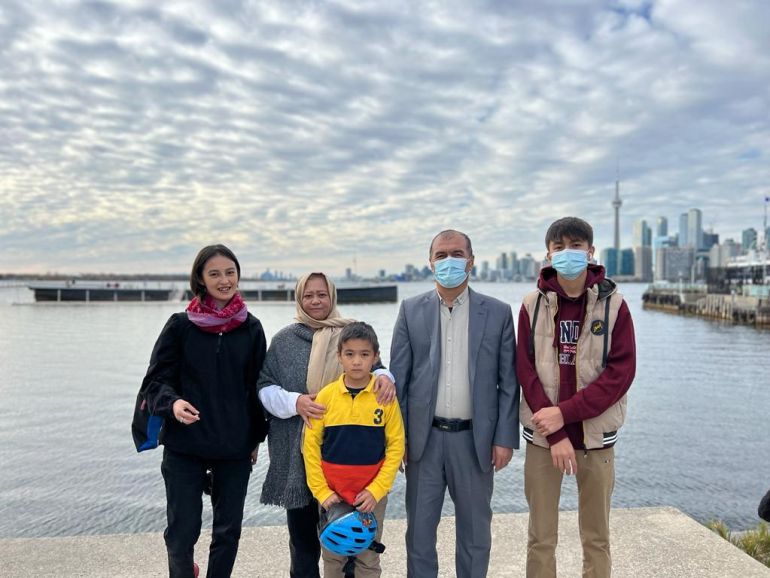
On a cold November day, Aqila Tavakali and her 14-year-old son brace themselves against an icy wind as they walk the several blocks from their temporary apartment to his new school.
Abolfazl says goodbye to his mother at the corner, and Aqila watches as he disappears through the yawning doors of the main entrance.
Newtonbrook Secondary, just north of Toronto, Canada, sprawls across an entire city block. More than 2,000 students from grades eight to 12 attend the school.
With basketball courts, a swimming pool and a large auditorium, the school offers the type of education 44-year-old Aqila could only dream of providing when she was principal at a girls’ school in Kabul, Afghanistan until October 2021.
She wipes a tear from her eye in a futile attempt to stem a torrent from streaming down her cheeks.
“Not a day goes by that I don’t think about my students at Sayed ul-Shuhada,” she told Al Jazeera. “They were very poor economically, but they were also very smart.”
Aqila, her husband Musa, a 47-year-old former taxi driver in Kabul, and their three children, aged nine, 14 and 22, are among the estimated 1.2 million Afghans who fled their country after the Taliban seized power in August 2021.
Aqila and her family in Toronto, in November 2022 [Courtesy of Brennan Leffler]
In Afghanistan, Aqila had dedicated herself to improving conditions for her female students. Sayed ul-Shuhada was one of only a few high schools in the Hazara neighbourhood of Kabul. More than 7,000 girls attended the school in three shifts a day, from grades one to 12.
When Aqila was appointed principal in 2013, girls were hungry for education, but resources for them were scarce. They took classes outside, sitting on the ground in the elements while boys were taught in classrooms indoors. So Aqila embarked on a years-long fundraising campaign to construct new buildings for the growing number of female students.
But her success made her and the school a target.
‘Their aim was to stop girls from learning’
In May 2021, several car bombs exploded outside the school gate just as girls were leaving their classes. Eighty-five people were killed, most of them young women. When she spoke to Al Jazeera two months after the attack, she was still mourning their loss.
“It was like the end of the world,” Aqila said, the images of blood and bodies and the frantic families searching for their daughters still raw in her mind. “Their [the attackers’] aim was to stop the girls from getting an education. Whatever way, they wanted to stop them.”
Even before the bombing, Aqila had started receiving anonymous threats. Messages and phone calls from unknown numbers, warning her to stop her work or face serious consequences for continuing. “They said they know where I’m living, and where my daughter is going to university. They said they would kidnap her if I didn’t stop going to my job.” At about this time, the Taliban was gaining territory around the country, with province after province falling under their control. Still, few believed that Kabul would fall imminently, despite the fact that American forces had set a September deadline to leave.
But the Taliban did take Kabul, and took over the rest of the country, in August that year, and almost immediately stopped all girls from attending high school. Aqila did several interviews with Afghan media, calling on the group to reopen schools for older girls. Her relatives worried that she was putting herself, and her family, in greater danger. When the threats started to come more frequently, she decided she had no choice but to leave.
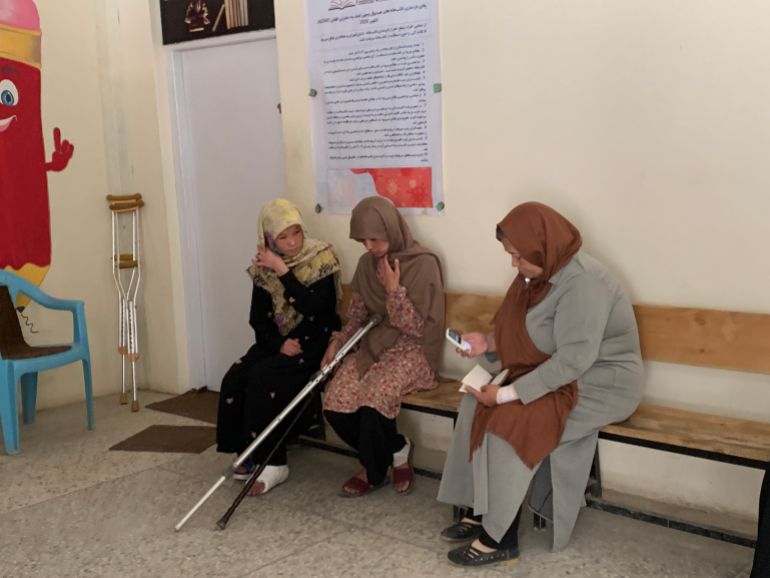
Aqila, in July 2021 when she was principal of Sayed ul-Shuhada girls’ school, sitting with students injured in the May 2021 bomb attack that killed 85 people in Kabul [Mellissa Fung/Al Jazeera]
“It was really hard for me,” she confessed. It would be the second time Aqila fled her country. She had left for Iran with her parents and siblings when she was a teenager in 1994 as the Taliban rose to power, returning in 2005, four years after the US invasion that toppled their rule. “When Hamid Karzai became president [in 2001], he asked people to please come home and rebuild. And I was one of those many thousands of refugees who came back to Afghanistan with the hope of rebuilding the country.”
This time, though, getting out of Afghanistan would prove to be one of the biggest challenges Aqila has ever confronted. Despite numerous attempts – including by foreign acquaintances – to get the family on the manifests of the foreign airlifts, it proved impossible. And going to the airport was growing more dangerous by the day.
In the days leading up to the final withdrawal of Western forces on August 30, 2021, the world watched in horror as heartbreaking scenes were broadcast from Kabul airport. Tens of thousands of desperate Afghans crowded outside, some climbing over the blast walls and hanging onto the wheels of evacuation flights taking off, before falling to their deaths.
After the final flights left, opportunities to flee the country dissolved.
Aqila became discouraged. The Taliban issued a decree that all women in senior positions should stop going to work. But she resisted and returned to Sayed ul-Shuhada to run the primary school for the younger girls.
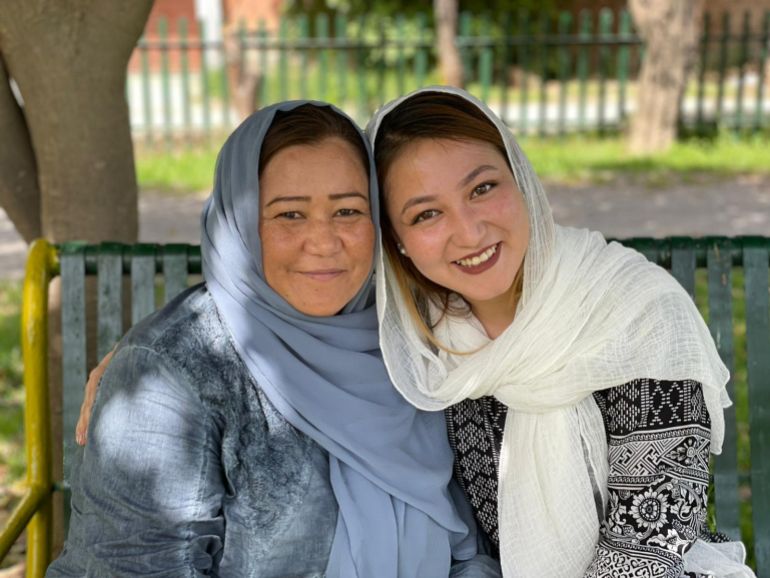
Aqila with her former student, Mahnaz Aliyar, in Islamabad, after they fled Afghanistan [Mellissa Fung/Al Jazeera]
“The Taliban were coming frequently [to my school],” she said, her eyes still flashing with disbelief at all that unfolded during those tense weeks. “And they would refuse to recognise that I was the principal, speaking only to [my male colleagues]. It was very painful for me.”
‘We just ran to the border’
Their plight captured the attention of Canadian journalist Brennan Leffler. That September, he, along with a group of friends, decided to apply to a government programme that allows Canadians to sponsor and resettle refugees, with an upfront pledge of their own money that would support the family through their first year. The programme was set up years earlier to help settle Syrian refugees; the group of friends was advised to apply in anticipation that the government would revive it to help the 40,000 Afghans Prime Minister Justin Trudeau had committed to bring to Canada.
Then they connected with a non-profit organisation, Journalists for Human Rights, that worked to bring at-risk Afghans to Canada. Their list already had 500 names on it. It seemed overwhelming. But Brennan managed to get Aqila and her family’s names on this list.
The greatest challenge was getting the family out of the country when thousands of people were desperately trying to do the same thing. Seats on private flights were promised by various private citizens and NGOs who were organising them, then cancelled at the last minute without giving reasons, as they waited with their bags packed to go to the airport.
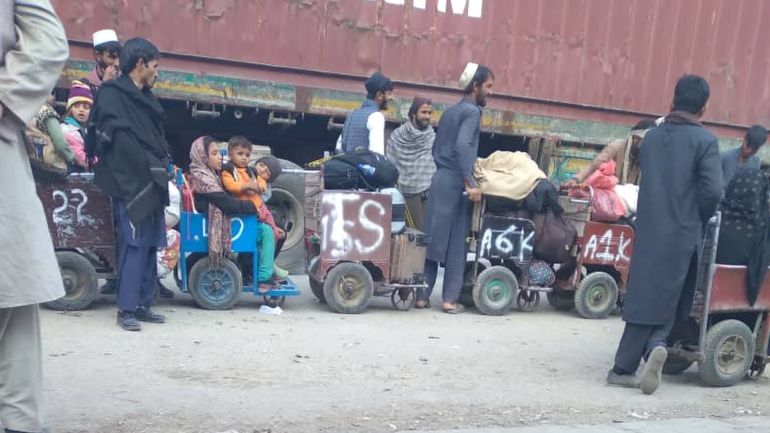
With options to leave dwindling by the day, the non-profit helped them get visas to Pakistan in October 2021, after two excruciating months of waiting, and arrangements were made to drive them from Kabul to Islamabad. They quietly sold their home and most of their belongings, and Aqila said goodbye to her colleagues at Sayed ul-Shuhada. And then, in the early morning hours one day in late October, a car came to pick them up from their home to take them out of the city. Exhausted, worried, and fearful of the Taliban guards at the border, they waited in line at the Torkham crossing for eight tense hours before their passports were finally stamped and they were waved through.
The queue at the Torkham border crossing from Afghanistan to Pakistan [Courtesy of Mahnaz Aliyar]
“There’s about 10 metres to the border,” Aqila recalled, “and when we got our passports back, we were so happy we just ran the 10 metres to the Pakistan side. And we finally could breathe.”
In Pakistan, the family stayed at a guesthouse with other Afghans who had fled. The non-profit that helped them leave Afghanistan covered most of their expenses since they were unable to work or go to school in Islamabad.
Their first weeks in the city were spent sightseeing and enjoying the freedoms that were being taken away from them back in Afghanistan. But as weeks turned into months with no word on when they might get to Canada, a sense of unease crept in. What if their sponsors’ application was rejected? “We started thinking, what if this doesn’t work? What if we can’t get to Canada? Would we have to go back to Kabul? Because we lost everything. We can’t go back.”
In Toronto, Brennan was growing more frustrated by the day. “We were trying everything,” he said. “I mean, I was trying all my sources. I had a former military person who was based in Kabul who knew some people [in the Canadian government] and was pushing them. But no one was getting anyone out. There was a group of Canadian generals who were trying to get people who had worked with them and risked their lives during the war and they couldn’t get them out.”
Aqila’s daughter Tamanna Sharifi, right, with sponsor Brennan Leffler and Mahnaz Aliyar, in Toronto in November 2022 [Courtesy of Brennan Leffler]
Although Canada had committed to taking in 40,000 Afghan refugees after the fall of Kabul, fewer than 28,000 have made it to the country since the programme started in August 2021.
How Afghans are treated versus Ukrainians
When Russia invaded Ukraine in February 2022, Canada’s focus shifted to accelerating the process for Ukrainians fleeing their homeland. More than 140,000 Ukrainians have since arrived in Canada, with close to half a million applications approved, leading to accusations that the government has a two-tiered refugee system.
“They allowed Canadians to bring [Ukrainians] in on their own accord,” Brennan pointed out. “And they were giving out visas for Ukrainians to get here within days, which I think is great. I think that that’s how it should have been for Afghans, as well.”
Heather Barr, associate women’s rights director at Human Rights Watch, told Al Jazeera Canada is not alone. “You can’t escape noticing the difference in how Afghans are being treated versus how Ukrainians are being treated. And it’s impossible not to assume that at least part of what’s going on is about racism and Islamophobia.”
Al Jazeera made several requests to speak with Canada’s minister of immigration, refugees and citizenship but received no response.
After fleeing Afghanistan, Aqila and her family lived in Islamabad, Pakistan for nearly a year before they received approval to move to Canada [Mellissa Fung/Al Jazeera]
In the meantime, the Taliban have, in the past 18 months, rolled out one restriction after another, mostly directed at women. First, they reneged on a promise to re-open schools for girls above grade six. Then women were forbidden to leave the country without a male relative, or “mahram”. In December 2022, women were told they could no longer attend university, and then were banned from working for all non-governmental organisations, including those delivering badly needed aid to a starving population. The Taliban have brought back public beatings and executions, silencing Afghan women even further.
“It’s one thing after another,” Heather said. “The list keeps growing so I don’t think that there’s any reason to think that people who’ve had to flee are going to be able to go back safely anytime soon.”
Those who have not been able to leave are growing more desperate by the day. Asraa, who Al Jazeera is not identifying by her real name due to safety concerns, used to work for the government of former President Ashraf Ghani. She travelled around the country working on anti-corruption projects. Asraa was not able to leave the country after the Taliban took power; instead, she stayed and started helping out as a teacher at an underground school for girls who have been shut out of their education.
In the last few months, she has received threatening phone calls and messages with greater frequency, warning her to stop what she is doing. Her family fears she is also putting them in danger. Asraa is now desperately seeking a way out of Afghanistan, but finding that her options are very limited.
“I have never been forced to leave my country,” she said tearfully, her voice tinged with anxiety. “But now I feel there is danger … and I am worried about going to Pakistan because I know the situation there is not good for Afghans.”
Ali and his mother, Aqila, with Ash, their sponsor Brennan’s dog, in Toronto in November 2022 [Courtesy of Brennan Leffler]
18,000 Afghans returned
Doors have closed everywhere to Afghans desperate to escape the Taliban, and many who managed to leave the country have found themselves stuck in limbo in third countries like Pakistan, with opportunities and funds quickly running out.
Aid agencies have said it is hard to estimate the number of Afghan refugees in Pakistan because most are undocumented. Many have decided to return home, with hopes of going to Canada, Australia, or Europe extinguished. The UN Office of Migration estimated that, in the three months from April to June 2022, almost 18,000 Afghans returned to their country, despite its economy collapsing and growing insecurity.
For Aqila and her family, the news they had long been waiting for came through almost a year after they fled Afghanistan. Their sponsors’ application was approved and 11 months after they left their homeland, they finally flew from Islamabad to Toronto last November, where Brennan and his friends greeted them excitedly, ready to help them start this new chapter of their lives.
“It’s a whole new country, a whole new culture,” Aqila said, a little hesitation in her voice. “There is a lot to learn.”
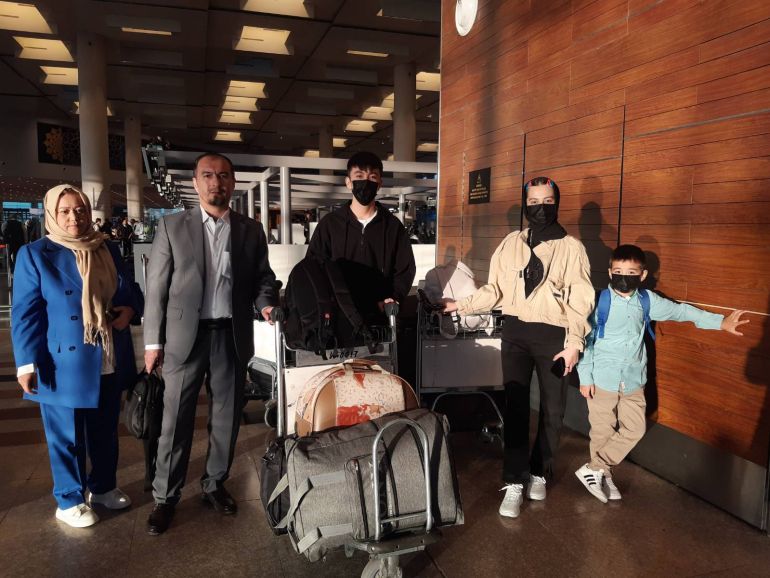
Aqila, left, with her husband and children, checking in for their flight to Toronto, at Islamabad Airport in October 2022 [Courtesy of Mahnaz Aliyar]
Within weeks of arriving, her two sons, 14-year-old Abolfazl and nine-year-old Ali, were enrolled in local schools, while Aqila and her husband Musa, along with their 21-year-old daughter Tamanna, started intensive English classes. Aqila worries about how hard it might be to get a job, and whether she will have to retrain. Musa – who does not yet have a job, but is working on improving his English – needs hearing aids, so their sponsors started a new round of fundraising.
The cost of living in Canada is another concern; housing is expensive and rental apartments for a family of five are hard to come by. Their sponsors are financially committed to supporting them for a year; after that, they will be on their own.
But Brennan is not worried. “I know it’s been a shock to them how much things cost,” he said. “So, that’s going to take an adjustment. But they’re tough people. They’re smart people. They’ll figure it out and we’ll be there to help them.”
Aqila knows she and her family have an opportunity that many others back home can only dream of.
“I was talking with my children the other day and I told them that the sponsors have worked so hard for us,” she said. “Our response to their work should be that you study hard to become a good doctor or good engineer. Then [my daughter] told me that, ‘Mum, if we become anything, tell us to become the best in that field, whether that be a salesperson or anything, and we will give a response to their love by being the best human beings and best citizens of Canada’.”
SOURCE: AL JAZEERA
How an Afghan girls’ school principal fled the Taliban
The United Nations Special Rapporteur on the situation of human rights in Afghanistan, Richard Bennett, has said the Islamic Emirate is increasingly flouting “fundamental freedoms, including the rights of peaceful assembly and association, expression and the rights to life and protection against ill-treatment” and is “ruling Afghanistan through fear and repressive policies.” He also said the authorities’ “systematic violation of the human rights of women and girls” has deepened and asked the Prosecutor of the International Criminal Court (ICC) to consider whether the “crime of gender persecution” is taking place. As AAN’s Kate Clark reports, he also had words of criticism for the ‘international community’ and its contribution to the “widespread extreme poverty and acute food insecurity” faced by millions of Afghans.
Introduction
This is Richard Bennett’s second report to the UN’s Human Rights Council and is bleaker than his first, [1] with just glimpses of anything positive. It follows a visit by Bennett to Afghanistan in October 2022, during which he met government officials – whom he thanks for their cooperation – human rights defenders, legal professionals, women’s groups, journalists, businesswomen, teachers, clerics, representatives of minority groups, the UN, NGOs and diplomats, and visited Kabul, Bamyan and Panjshir. He will present his report to the UN Human Rights Council today, 6 March 2023.
What is in the report?
Bennett’s description of human rights in Afghanistan is of a crisis worsening, of the Islamic Emirate blocking the expression of fundamental freedoms – to assembly, free speech, and the right to life, and with policies “aimed at suppressing communities… women in particular.” Inclusiveness, he reported, is “negligible; there is very little tolerance for difference, and none for dissent.” He also criticised the international powers for how their policies contribute to the harm being done to Afghans’ economic rights and right to life. Even so, most of Bennett’s conclusions are directed at the Islamic Emirate. He assessed the various categories of rights in turn (see full report here).
Women and girls
The Special Rapporteur listed the many ways the Taleban are restricting the rights and freedoms of women and girls: banning them from higher education (adding to the ban on secondary schooling), “restrictions in their movement, attire, employment options, ability to seek public office or perform public roles and access to public spaces.” He said that instead of “taking steps to eliminate discrimination against women” and honouring the Convention on the Elimination of All Forms of Discrimination against Women, to which Afghanistan is a state party, the Taleban authorities are “flagrantly contravening it” and normalising discrimination. By punishing the male relatives of women they consider to be breaking laws and norms, the Taleban “pit men against women, take away the agency of women and girls, and further normalise discrimination and violence against them.”
He noted, “with profound concern,” the rise in sexual and gender-based violence against women and girls, including “report of young women found dead, with indications of having been sexually violated.” He said such violence was occurring “with impunity and with minimal support for victims.” He cited the high number of “unnatural deaths of women and children” taking place in this environment and how restrictions, coupled with the economic and humanitarian crisis, have resulted in forced and child marriage, especially among teenage girls denied an education, widespread reports of depression and suicide. Bennett also noted:
Human rights defenders, who peacefully protest the increased restrictions on women and girls, are at heightened risk and have been increasingly beaten and arrested. The intention is clearly not only to punish them for protesting, but also to deter others from protesting.
The theme of gender-based discrimination, exclusion and harm runs through this report, appearing in almost every section – economic rights, rule of law, fundamental freedoms, and the rights of disabled people. It also featured in Bennett’s welcoming of the resumption of the International Criminal Court’s (ICC) investigation into war crimes and crimes against humanity in Afghanistan that have allegedly occurred since May 2003. [2] The Special Rapporteur encouraged the ICC prosecutor to “take note of the unprecedented deterioration of women’s rights” and “consider the crime of gender persecution.” It is an indication of just how serious he believes the stripping of rights and freedoms of Afghan women and girls is. [3]
Economic, social and cultural rights
Afghanistan’s economic crisis, Bennett reported, has resulted in “widespread extreme poverty and acute food insecurity, which had severely undermined the public health system and impacted the right to work.” He welcomed the United States’ facilitation of Afghanistan’s central bank acquiring new bank notes, and the UN Security Council exempting humanitarian activities from sanctions. However, he expressed concern about the adverse consequences of various actions from international actors, including blocking the central bank from the international banking system. “Largely due to risk averseness on the part of foreign banks,” the humanitarian exemption, Bennett said, has not been effective in mitigating those consequences, while “the absence of clear guidance on the humanitarian exemption and [due] to its rigid framework” has created difficulties for businesses and international organisations trying to carry out legitimate activities. At the same time, Bennett said he was also disturbed that the Taleban authorities “have not taken all necessary measures to address the dire situation, including meeting fundamental human rights standards, such as reopening girls’ secondary schools and universities.”
Without international assistance, the Special Rapporteur said the Taleban government will be unable to “mobilize sufficient resources to ensure that the Afghan people enjoy economic, social and cultural rights at the minimum base level.” He added that the United Nations has stressed that “this cannot be achieved without female aid workers.”
Bennett noted that two-thirds of Afghan households had reported difficulties in meeting basic food and non-food needs, that healthcare has become unaffordable for many, more children have dropped out of school in order to work, about 700,000 people have lost their jobs since August 2021 and the nature of work itself has deteriorated, with casual work and self-employment, that is poorly paid and unpredictable, on the rise. He is concerned about the “large unmet portion of humanitarian funding required” by Afghanistan. He also noted the “precarious circumstances” facing humanitarian workers with local authorities “routinely interfere[ing] and restrict[ing] their operations, contrary to humanitarian principles, hampering the delivery of life-saving support.” He pointed out that “this dire situation” has been seriously exacerbated by the Taleban’s barring of women from working for NGOs.”
Minority Rights
Bennett’s reporting on minority rights covered attacks, forced evictions and political marginalisation. Hazaras, Sikhs, Hindus and other minorities, he said, “have endured historical suffering that has evolved into a form of structural injustice that needs to be addressed, including through transitional justice processes.” He noted minorities’ “low representation in public positions, both at the most senior levels of government (the cabinet has 25 Pashtuns, two Tajiks, two Uzbeks, one Nuristani and no Hazaras) and in the provinces:
Over the past two decades, locals tended to work in provincial administrations in rough proportion to their presence in an area’s ethnic make-up. However, since the Taliban return to power, the ethnic composition of governance structures has been reconfigured, including at the provincial and district levels. In Bamyan, Daikundi and Ghor Provinces, the Taliban has replaced a number of former government employees at the Departments of Justice, Agriculture and Irrigation, Mines and Petroleum and Education, including at Bamyan University and in the municipalities, almost certainly due to their ethnic affiliation.
He also reported that “forces associated with the de facto authorities” have ordered many “Hazaras and other locals” to leave their homes and farms, frequently with only a few days’ notice and without giving them a chance to assert their legal rights to the property.” They included “at least 2,800 Hazara residents [who] were forcibly displaced from 15 villages in Daikundi and Uruzgan Provinces in September 2021 alone.” Community representatives who demanded an investigation were, reported Bennett, arrested. He also reported that on 19 December 2022, the largely Uzbek and Tajik residents of Sar-e Pul Province, who protested against their forced eviction and the seizure of 6,000 jeribs [12,000 hectares] of land in eight villages by the Taleban, were “reportedly threatened with a military response.” He said the authorities responded to his concerns by saying that, in October 2022, based on a decree by the Supreme Leader, “a regulation was issued to prevent land grabbing and that subsequently a commission and a special court were established to implement the decree.”
Bennett also noted threats against and attacks on Hazara Shia and other Shia Muslims, Sikhs and Sufis: between 30 August 2021 to 30 September 2022, he said, there were 22 recorded attacks against civilians, with at least 334 killed and 631 injured. Of those, 16 attacks targeted Hazaras, including three against educational facilities. He notes that in the past, the Islamic State in Khorasan Province (ISKP) has claimed such attacks, although not for the most egregious recent assault, on the Kaaj Educational Centre in Dasht-e Barchi in Kabul on 30 September 2022, which killed 54 people and injured 114. Most victims were girls and young women studying for the university entrance exam. He pointed out that after that attack, it took one hour for ambulances to reach the scene and moreover, that the authorities had reportedly “physically assaulted and humiliated” some family members, denied them access to the site of the attack, and prevented them from transporting victims to hospitals, collecting dead bodies and donating blood. Journalists, he said, were prevented from covering the incident at the site and visiting the hospitals and relatives of the victims were told not to speak to the media.
Bennett said community representatives, fearing such attacks, said they had requested protection from the authorities in vain. They had also had weapons, authorised by the Republic for guarding educational centres, confiscated and licenses not re-issued. The Special Rapporteur acknowledges “the counter-terrorism efforts by the de facto authorities against [ISKP], which indicate that they have the capacity to undertake intelligence and investigative work and should be capable of bringing those they believe responsible to justice through the holding of trials that meet international standards.”
Rule of Law
Bennett noted the absence of any codification of law, or the issuing of standardised procedures or substantive statutes relating to criminal or civil matters, that police, judges or lawyers could follow. With almost all judges appointed under the Republic fired and prosecutors increasingly sidelined, Bennett said that often, judges, who are now largely religious scholars, are acting as both investigators and adjudicators in contravention of fair trial standards.
In practice, it appears that the muftis [mullahs deemed capable of giving rulings, or fatwas, on religious matters] have become even more powerful, being involved in pretrial and trial processes, including investigations and the provision of advice on punishment, with judges mainly following their advice. Alarmingly, there are reports that it is common for alleged perpetrators to be detained, sentenced and punished by the police and other security agencies all on the same day, without any semblance of due process or judicial review. There have also been allegations of bribes.
Given that court officials are all men, Bennett says women’s access to justice is now severely restricted. They generally need to be accompanied by a man in court, and their testimony may not be allowed at all or given less weight than a man’s.
Fundamental freedoms
Bennett said he is deeply concerned about the “rapidly shrinking civic space” in Afghanistan. Journalists, he said, have increasingly been “subject to surveillance, intimidation, threats, violence, arrest and detention” and are resorting to self-censorship to try to protect themselves from the authorities. He said members of civil society have reported increased limitations and surveillance of their activities by the authorities, and human rights defenders have been “subjected to intimidation, including by phone calls, visits to their homes, physical and verbal attacks and arbitrary arrest, which have created a climate of fear and sense of desperation.” He said the authorities had raided several civil society organisations, he reported, demanding the names and contact details of the staff and associated individuals, sometimes including family members, and added:
[The de facto authorities] are increasingly using bureaucratic mechanisms to control civil society organizations. Their requests are incoherent, inconsistent and difficult to interpret. Disclosure requirements have been noted as a major obstacle for several civil society organizations which are required to re-register at the de facto Ministry of Economy.
Bennett noted the extra pressure women are under, with female human rights defenders at particularly high risk of harassment. He said the UN, international NGOs and civil society organisations had all expressed concern to him about their female staff being harassed by the authorities. He also reported an increase in the arrests of humanitarian workers, from 3 in 2020 to 76 in the first ten months of 2022.
Bennett said he is alarmed by Taleban policy towards protesters, the banning of protests, use of excessive force to disperse those who do demonstrate, deployment of arbitrary arrest and detention, abusive interrogations, denial of access to lawyers and other due process rights and coerced confessions. Again, he expressed special concerns for women protesters, who “have been subjected to threats, intimidation, arrest and ill-treatment while in detention.”
Conflict-related violence
Bennett is concerned about the ongoing clashes between Taleban and armed opposition forces in Panjshir and other provinces from where he had received “credible reports and documents” regarding a whole host of violations of the laws of war and human rights by government forces, including:
Torture, arbitrary arrest and disappearance of individuals perceived to be affiliated with the National Resistance Front, and extrajudicial executions of captured fighters;
Heavy suppression of communities and an information blackout;
The routine subjection of civilians considered by the Taleban to be associated with the National Resistance Front to house-to-house searches, arbitrary arrest and detention, extrajudicial killings, torture and displacement.
He also reported multiple sources describing Taleban forces looting gold and cash from people’s homes and reports of forced marriages, including of children, to Taleban fighters in the Khawak area of Paryan District.
Bennett also reported that the targeted and revenge killings of former members of the Afghan security forces and prosecutors continue, despite the 2021 amnesty given by the Islamic Emirate’s Supreme Leader. He said he believed “these killings only fuel tensions and animosity within communities and may hamper reconciliation efforts in the future.” He renewed his call for the amnesty to be enforced and for those who break it to be prosecuted.
Conclusion
Asked what he hoped to achieve from this and other reporting, Bennett told AAN he was mandated to publicly report on the developing human rights situation and to make recommendations. Beyond that, he said:
I want Afghans to feel that an independent official of the UN is monitoring the human rights situation diligently and reporting publicly, expressing concerns about the situation and the violations they’re experiencing. I want others to pick the report up and use it – I want it to be useful. I want the Taleban to take note of it. Even if they don’t like or agree with it, I want them to know someone is watching and to debate the issues with me, so that a dialogue takes place. And I’d like the recommendations to be considered, even better implemented, but at least considered.
Those recommendations are largely to the Taleban, whom he called on to recognise the equality of men and women, immediately restore equal access to education, ensure women are represented in the judiciary, government and commissions, and immediately restore the right of women to work in NGOs and other organisations. On economic rights, he wants the Taleban to take steps to meet the requirements that would allow Afghanistan’s assets to be unfrozen and to refrain from interfering in humanitarian operations. He has called on the authorities to ensure representation for minorities, support a free media and “immediately and unconditionally” release all those detained for exercising their rights to freedom of expression.
As to ICC member states and the ‘international community’, he wants them to ensure the situation in Afghanistan is “central to foreign policy, bearing in mind their responsibilities for the human rights and well-being of the population and the regional and global implications of failing to protect human rights in Afghanistan, especially those of women and girls and minorities.” He calls on other countries to increase humanitarian funding, provide clear guidance to end the “overcompliance with sanctions by financial institutions” and support international investigation and accountability mechanisms.
On 7 October 2022, the Human Rights Council renewed Bennett’s mandate as Special Rapporteur for a further year (Resolution 51/20). The Council also added a significant new responsibility, “to document and preserve information relating to human rights violations and abuses.” [4] This, in itself, looked like a challenge to impunity, a signal to perpetrators that their actions will be recorded and that there could be consequences.
You can read the full report: Situation of human rights in Afghanistan – Report of the Special Rapporteur on the situation of human rights in Afghanistan, Richard Bennett here.
Edited by Roxanna Shapour
References
References
↑1
The Special Rapporteur’s first report was published in September 2022 (see AAN analysis here).
↑2
The ICC’s investigation is into the war crimes and crimes against humanity which have taken place in relation in Afghanistan since 1 May 2003, when Afghanistan became an ICC member state, and July 2002 for international crimes allegedly committed in Poland, Lithuania and Romania, as part of the Afghanistan conflict nexus: those countries, which joined the ICC on that earlier date, and hosted CIA black sites where detainees rendered from Afghanistan were held and allegedly suffered the crimes of torture, cruel treatment, outrages upon their personal dignity and/or rape. For more on this, see AAN’s 2016 report, One Step Closer to War Crime Trials? New ICC report on Afghanistan.
Bennett also said he “trusts that the Court will investigate international crimes by all parties to the conflict in Afghanistan,” an apparent reference to the ICC prosecutor indicating that he wanted to drop investigations into the US military, the CIA and former Afghan government forces, all of whom face. For more on the decision to resume the investigation and questions over who to investigate, see Ehsan Qaane’s report for AAN on this decision, ICC Afghanistan Investigation Re-Authorised: But will it cover the CIA, ISKP and the forces of the Islamic Republic, as well as the Taleban?, published on 11 November 2022.
↑3
On 7 December 2022, the ICC published a document, Policy on the Crime of Gender Persecution, in part, to provide clarity and direction to ICC staff on the application of this crime, as per the Rome Statute.
↑4
The new mandate also gave him a duty to report from a child’s rights perspective.
A Worsening “Human Rights Crisis”: New hard-hitting report from UN Special Rapporteur
Hundreds of Afghan journalists remain stranded in increasingly “dire” circumstances as frustration mounts over the UK government’s refusal to share the latest entry criteria for its flagship resettlement programme.
This weekend, a coalition of press freedom and free expression organisations, including Index on Censorship, the National Union of Journalists, PEN International and English PEN, have written to home secretary Suella Braverman asking why details of the next phase of the Afghan citizens’ resettlement scheme (ACRS) have yet to be revealed.
Germany, France and Kosovo are among the countries that have offered safe refuge to a number of journalists, with critics accusing the UK of failing to meet its obligations to the journalists who supported the west’s mission in Afghanistan.
Martin Bright, editor-at-large of Index on Censorship, said the organisation had received a “deluge” of relocation demands from Afghan journalists in Afghanistan, Pakistan and Iran who had been offered no reassurance, despite apparently being prime candidates for resettlement, because of the UK government’s unwillingness to offer clarity.
“Without clarification on progress for ACRS, there is little if any support that can be provided, and this leaves the journalists vulnerable to threats of disappearance, violence, arrest, imprisonment and assassination,” said Bright.
Estimates indicate that 200 Afghan journalists have fled to Iran and Pakistan, many of them women, where they report being targeted as their visas expire, with little sign of getting their paperwork renewed. Index is talking directly to 35 at-risk journalists in Afghanistan and Pakistan via an encrypted platform.
One case involves a female Afghan journalist who fled to Pakistan, itself a perilous place due to the presence of Taliban sympathisers – and was routinely harassed there due to her nationality and ethnicity, culminating in a street attack during which she was sexually assaulted.
Eight Afghan journalists who worked for the BBC have recently had their UK visa applications reopened after legal action against the Home Office.
In August 2021, then prime minister Boris Johnson announced the creation of ACRS with priority for those who stood up for democracy, women’s rights and freedom of speech – including a specific reference to journalists.
It officially launched in January 2022 for those already evacuated, with a second “pathway” later opened for refugees in neighbouring countries such as Pakistan and Iran.
After giving priority to contractors who worked for institutions like the British Council, the third pathway is planned to fully open this year, with journalists expected to be among its priority groups, though no details are yet available.
A government source said more information “will be set out in due course”. Index, PEN and the NUJ are urging Braverman to explain how the scheme will help at-risk journalists.
Meanwhile, accounts are increasingly emerging of journalists, particularly women, who have escaped to Pakistan only to continue to face threats. One reporter and women’s rights activist, whose work led to her publicly denouncing the Taliban, is now living in poverty in Pakistan with a five-month-old baby boy.
Another, a prominent young Afghan broadcast journalist, also made it across the border, where she now survives in a slum and goes days without food.
“During this period, I have gone through hell. There is much discrimination, racism and prejudice in Pakistan society, and hostility towards Afghan women in particular,” she said.
Her Pakistani visa expired in August 2022, with the authorities yet to offer her an extension. Any Afghan in Pakistan without a valid visa could be jailed for three years or deported back home.
A spokesperson for the British government said that 24,500 people had so far been brought to safety from Afghanistan, including “campaigners for women’s rights, human rights defenders, scholars, journalists, judges and members of the LGBT+ community”.
They added that, since the evacuation of Kabul, the UK had helped “7,000 vulnerable people leave the country. Our work continues to help other eligible Afghans.”
Anger grows over Afghan journalists still stranded by Home Office inaction
GENEVA, March 6 (Reuters) – The Taliban’s treatment of women and girls in Afghanistan could amount to a crime against humanity, according to a U.N. report presented on Monday at the Human Rights Council in Geneva.
The Taliban seized power in August 2021, drastically curtailing women’s freedoms and rights, including their ability to attend high school and university.
In a report covering July to December 2022, the U.N. Special Rapporteur on the situation of human rights in Afghanistan, Richard Bennett, found that the Taliban’s treatment of women and girls “may amount to gender persecution, a crime against humanity”.
“The Taliban’s intentional and calculated policy is to repudiate the human rights of women and girls and to erase them from public life,” Bennett told the United Nations Human Rights Council. “It may amount to the international crime of gender persecution for which the authorities can be held accountable.”
A spokesperson for the Taliban-run information ministry did not immediately reply to a request for comment. The Taliban have in the past said they respect women’s rights in line with their interpretation of Islam and Afghan culture and that they plan to open schools in future once they establish certain conditions for girls.
Bennett said the Human Rights Council should send a strong message to the Taliban that the “abysmal treatment of women and girls is intolerable and unjustifiable on any ground, including religion”.
“The cumulative effect of the restrictions on women and girls has a devastating, long-term impact on the whole population, and it is tantamount to gender apartheid,” he said.
In December, the Taliban banned most female aid workers, prompting many aid agencies to partially suspend operations in the midst of a humanitarian crisis unfolding during the cold winter months.
Reporting by Gabrielle Tétrault-Farber in Geneva; Additional reporting by Kabul newsroom; Editing by Shounak Dasgupta
Taliban’s persecution of women could be ‘crime against humanity’ – UN report
In response to a question on how could the “Taliban” show they have the support of the people of Afghanistan, Niklasson said:
The European Union’s special envoy for Afghanistan, Tomas Niklasson, said that the “de facto” officials in Afghanistan need to prove they have the people’s support through an election or Loya-Jirga (Grand Assembly).
Speaking to TOLOnews, Niklasson said that the recognition of the caretaker Afghan government has been delayed due to the “actions and sometimes inaction of the Taliban.”
In response to a question on how could the “Taliban” show they have the support of the people of Afghanistan, Niklasson said:
“They can show that through elections, they can perhaps show that through a Loya Jirga, they make a claim that Afghans support us. How do we know? How can they prove that? But what we do know and what we do see is that the human rights situation is consistently moving with a few exceptions in a very negative development,” he said.
But the Islamic Emirate’s spokesman Zabiullah Mujahid said that the people have an affinity for the current government and that there is no need for election.
“The Islamic government was the ambition of everyone and the Afghans have fought for 40 years for this government. No one should show concern in this regard. We don’t need elections or other programs but both we and the nation know that we are satisfied with each other,” he said.
“The amount of satisfaction and support of the people from the government is only possible through the expression of people’s will, and the holding of an election,” said Sayed Jawad Sijadi, a political analyst.
Niklasson also said that the “de facto” Afghan authorities need to engage in talks with the non-Taliban Afghans.
“I think the first thing, as I mentioned, would be to find a way of entering into dialogue with non-Taliban Afghans. Bringing them on board in the government, giving them a voice over the future of the country. Continuing to make progress–and they have made some progress in the fight against terrorist organizations inside the country– respect human rights. Those three would be – three very, very good starting points,” he said.
The Islamic Emirate’s spokesman said that they have fulfilled all conditions for recognition but some of the organizations are trying to find a way to interfere in Afghanistan.
Niklasson: Islamic Emirate Should Prove Public’s Support With Forum
Farnosh is a medical student and said that after years of education, she is now concerned about their final exam.
The Afghanistan Medical Council said that after the approval of this council’s plan by the Islamic Emirate, the final exam for medical university will be taken by women.
Technical consultants of the council said they have sent the plan to the Islamic Emirate.
“After the approval of this plan we are ready to take exams of doctors that have graduated recently,” said Ahmad Shah, technical consultant of the council.
Farnosh is a medical student and said that after years of education, she is now concerned about their final exam.
“The exit exam is important and it’s not just an exam for doctors, it’s a path for our future and career, if we don’t take this exam, it will be the end of female doctors’ work and education,” said Farnosh.
Meanwhile, the Afghan Medical Council allowed four of the doctors who obtained the most points in the sixth round of the final examination of medical schools to work.
Some doctors asked the Islamic Emirate to give the exam to female doctors immediately.
“We request to give exams to female doctors so their fate is known, after all the effort they put in,” said Feroz, a doctor who got first position in this exam.
“Immediately provide education opportunities for every student and solve the challenges so students can complete their education,” said Ghulam Mujtaba, a doctor.
According to officials, the medical council in Afghanistan gave an exam and 30 percent of male doctors passed the exam and over the next two days they will receive their licenses from this council.
If Plan Approved, Female Medical Students Will Take Exam: Council
The United Nations says aid workers are still in a “race against time” to remove rubble and rebuild after the devastating earthquake struck eastern Afghanistan last month, killing at least 2,200 people and cutting off remote areas.
The 6.0-magnitude quake on Aug. 31 was shallow, destroying or causing extensive damage to low-rise buildings in the mountainous region. It hit late at night, and homes — mostly made of mud, wood, or rocks — collapsed instantly, becoming death traps.
Satellite data shows that about 40,500 truckloads of debris still needs to be cleared from affected areas in several provinces, the United Nations Development Program said Wednesday. Entire communities have been upended and families are sleeping in the open, it added.
The quake’s epicenter was in remote and rugged Kunar province, challenging rescue and relief efforts by the Taliban government and humanitarian groups. Authorities deployed helicopters or airdropped army commandos to evacuate survivors. Aid workers walked for hours on foot to reach isolated communities.
“This is a race against time,” said Devanand Ramiah, from the UNDP’s Crisis Bureau. “Debris removal and reconstruction operations must start safely and swiftly.”
People’s main demands were the reconstruction of houses and water supplies, according to a spokesman for a Taliban government committee tasked with helping survivors, Zia ur Rahman Speenghar.
People were getting assistance in cash, food, tents, beds, and other necessities, Speenghar said Thursday. Three new roads were under construction in the Dewagal Valley, and roads would be built to areas where there previously were none.
“Various countries and organizations have offered assistance in the construction of houses but that takes time. After the second round of assistance, work will begin on the third round, which is considering what kind of houses can be built here,” the spokesman said.
Afghanistan is facing a “perfect storm” of crises, including natural disasters like the recent earthquake, said Roza Otunbayeva, who leads the U.N. mission to the country.
 Afghanistan Peace Campaign