Preaching Without a Party: Independent religious figures find space under the Islamic Emirate

Sharif Akram

You can preview the report online and download it by clicking here or the download button below.

Our new report considers four online preachers – Rahmatullah Nowruz, Nasratullah Sahibi, Abdul Samad Qazizada and Jawed Ibrahimi – who have risen to prominence since the Taliban’s return to power in August 2021. Most were already active during the Islamic Republic, running small charities, posting religious content on Facebook and YouTube and quietly building schools and orphanages, but they were not particularly visible. In the last five years, that has changed, even as the Islamic Emirate of Afghanistan (IEA) has sought to monopolise religious authority. It has banned or suppressed the various Islamist parties that were active under the Islamic Republic and moved to control religious discourse, including who may legally preach, how and on what. A large number of the Taliban’s own cadre, as well as mullahs affiliated with the movement, are now embedded in state structures, as ministers, members of the security forces, university chancellors and judges, becoming the public face of religion in Afghanistan.

Despite all this, these four preachers have emerged – young, urban, ‘online-first’ Islamic influencers who blend short videos on personal piety, family life and self-improvement with charitable and educational projects. The four are marked out by dress, language and subject matter from the Taliban and Taliban-aligned mullahs who prohibit and warn, dwelling on what people must not do and what punishments await sinners in the hereafter. Emirate discourse focuses on the failings of urban Afghans, of women’s dress, music and the influence of Western media. Traditional mullahs do not, by and large, address how a young man should manage his anger, how a husband and wife should communicate or how a person should cope with depression. The online preachers address precisely these questions, in a tone that is encouraging rather than chastising. As to their appearance, instead of robes, turbans and untrimmed beards, they look more like urban professionals. Their followers collectively number in the millions and include young women as well as men. Notably, as well, none of the four has gone through the full, rigorous madrasa education, which means they are dismissed by the religious establishment and more conservatively minded Afghans as unfit to speak about Islam. Yet, their popularity keeps on growing.

Part of their appeal is that, under the Islamic Emirate, religion and the state have become increasingly difficult to tell apart. Ordinary people used to look to mullahs as figures who could, at least in principle, stand apart from power. Now, their sermons sound less like religious counsel and more like state communication. Into this gap in religious authority and teaching have stepped the online preachers. This report draws on a review of the four figures’ online output, their televised interviews, audience comments on their posts and secondary reporting by other outlets. The analysis is based on what they have chosen to say in public. The report begins by examining how religious activism operated before the Emirate takeover and why, with its return, the space for independent religious voices has opened up. Sharif looks at what they preach and how their audiences receive them. He asks whether, ultimately, the four are helping the Emirate maintain its rule, or subverting it.

Edited by Kate Clark and Rachel Reid

You can preview the report online and download it by clicking here or the download button below.
 

Preaching Without a Party: Independent religious figures find space under the Islamic Emirate
read more

UNHCR, UNDP Call for Stronger Support for Afghan Returnees

Interior Minister Khalifa Sirajuddin Haqqani also held talks with Barham Salih and his delegation.

Following their joint visit to Afghanistan, UN High Commissioner for Refugees Barham Salih and UNDP Administrator Alexander De Croo said in a joint statement that investment in protection, livelihoods, economic opportunities, and the reintegration of returnees is essential to achieving lasting stability in Afghanistan.

UN High Commissioner for Refugees Barham Salih said that millions of Afghans continue to rely on humanitarian assistance, adding that the ongoing return of Afghan migrants is placing increasing pressure on local communities.

Charlie Goodlake, spokesperson for UNHCR in Afghanistan, said: ” The Chiefs of UNHCR and UNDP visited Afghanistan for the first time from the 5th of July to the 8th of July. The focus of their visit was to see how humanitarian and development partners can work together, complement each other, to support returnees.”

Economic analyst Shams-ur-Rahman Ahmadzai said: “Following these meetings, the United Nations, particularly UNHCR, should establish structured systems and major projects in coordination with the Ministry of Refugees and Repatriation. If infrastructure projects are launched, they can create suitable employment opportunities for deportees and returning Afghans.”

Separately, Interior Minister Khalifa Sirajuddin Haqqani also held talks with Barham Salih and his delegation.

The two sides discussed addressing the challenges facing migrants, supporting returning Afghan refugees, and continuing humanitarian assistance.

Interior Ministry spokesperson Abdul Matin Qani said: “The meeting emphasized expanding cooperation, particularly on migration issues. We recorded a number of points to further strengthen cooperation in the future.”

During his visit to Afghanistan, Barham Salih also told Sky News that tensions between Afghanistan and Pakistan should be resolved as soon as possible, urging both neighboring countries to work toward easing the situation.

UNHCR, UNDP Call for Stronger Support for Afghan Returnees
read more

Funding Shortfalls Force Closure of 150 Health Centers Across Afghanistan

Sadiq Zahirzai, a physician, called on the World Health Organization to expand its support for provincial health facilities.

Hanan Balkhy, the World Health Organization’s (WHO) Regional Director for the Eastern Mediterranean, says that nearly 150 health centers have been forced to close since the beginning of 2026 due to funding shortages.

She also reported that more than 22 million people in Afghanistan require humanitarian assistance, while 14.4 million people are in need of healthcare services.

In a post on X, Balkhy wrote: “This means that health workers are less able to vaccinate children, mothers are less able to find safe care and patients find it more challenging to access essential health services. These losses cannot be overlooked.”

Sadiq Zahirzai, a physician, called on the World Health Organization to expand its support for provincial health facilities.

“We urge the World Health Organization to provide greater support to healthcare centers in the provinces and help meet their operational needs.”

Sayed Shah, a resident of Nahr-e Saraj district in Helmand province, has brought his two-year-old son to Indira Gandhi Children’s Hospital in Kabul for treatment. His exhausted appearance reflects the hardship he has endured, saying the lack of pediatric specialists and standard medical services in Helmand forced him to seek treatment in the capital.

Speaking to TOLOnews, he said: “There is a large hospital in Bost, Helmand, but my child could not be treated there. I then went to a private hospital, but I couldn’t even afford to buy a single tablet. People there are under tremendous strain, so we came to Kabul for treatment.”

The head of the outpatient clinic and diagnostic center at Indira Gandhi Children’s Hospital said that between 6,000 and 7,000 patients visited the hospital over the past four days, around 70 percent of whom came from the provinces.

Mohammadullah Rasouli, head of the hospital’s outpatient clinic and diagnostic center, said: “Diagnostic and treatment facilities should be available in the provinces. Afghanistan’s economic situation is weak, and many people even have to borrow money just to cover the cost of traveling to Kabul.”

Dr. Mashal Faqiri also described the growing patient load.

“We examine approximately 120 to 150 patients every day. Some require hospitalization, some undergo surgery, and others are prescribed treatment. Around 70 percent of them come from the provinces.”

Meanwhile, families waiting anxiously for their children’s recovery are calling for the establishment of standard hospitals across Afghanistan’s provinces.

Mahfooz, who traveled from Parwan for his son’s treatment, said: “Healthcare facilities should be made available in our own provinces. Standard hospitals should be built, and every medical specialty should be available.”

Fazl Jalal, who came from Kunar for medical treatment, added: “When we seek treatment in Kunar, we are referred to Jalalabad. If treatment is not available there, we end up traveling all the way to Kabul, facing numerous hardships along the way.”

The World Health Organization had previously warned that, following the reduction and suspension of a significant portion of U.S. aid, at least 422 health facilities across Afghanistan had ceased operations by the end of June 2025 due to funding shortages, leaving more than 3.1 million people without access to essential healthcare services.

Separately, Afghanistan’s Ministry of Public Health announced on 25 December 2024 (5 Jadi 1403) that 318 district-level hospitals would be constructed across the country.

Funding Shortfalls Force Closure of 150 Health Centers Across Afghanistan
read more

Baradar urges UN, international organisations to focus aid on development

Pajhwok News

Jul 8, 2026

Baradar urges UN, international organisations to focus aid on development

KABUL (Pajhwok): Deputy Prime Minister for Economic Affairs Mullah Abdul Ghani Baradar has urged the United Nations and international organisations to channel their assistance towards development projects to help provide housing, schools, electricity, clean water, employment and other essential services for returning refugees and internally displaced persons (IDPs).

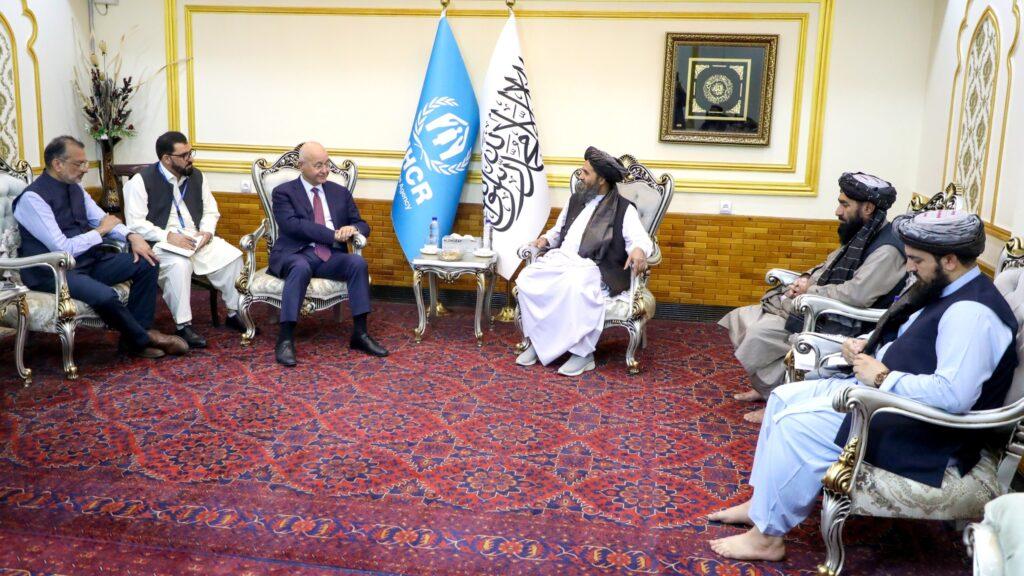
He issued the call at a meeting with the United Nations High Commissioner for Refugees Barham Saleh in Kabul on Wednesday, according to a statement from his office.

It said the two sides discussed the situation of Afghan refugees, humanitarian and development assistance for returning refugees, and future cooperation in support of the Afghan people.

Mullah Baradar thanked the United Nations and international organisations for providing humanitarian assistance to Afghan refugees.

He stressed that the United Nations and international organisations should prioritise development assistance so that housing, schools, electricity, clean water, employment opportunities and other basic services could be provided for returning refugees and internally displaced Afghans.

For his part, Barham Saleh praised the efforts of the Islamic Emirate of Afghanistan (IEA) in the development sector and expressed hope that greater international assistance would be mobilised for Afghanistan to help improve the living conditions of the Afghan people.

Baradar urges UN, international organisations to focus aid on development
read more

Newsweek: Brussels Meeting Marks Diplomatic Victory for Islamic Emirate

Two weeks after a delegation from the Islamic Emirate met with representatives of 15 European Union member states, the U.S. magazine Newsweek described the Brussels meeting as a “diplomatic victory” for the Islamic Emirate in an analytical report.

According to the report, Europe’s need to cooperate with the Islamic Emirate on the return of Afghan migrants created the conditions for holding the meeting.

The report says the meeting resulted in three significant developments:

  1. Breaking the taboo surrounding official dialogue between European institutions and the Islamic Emirate.
  2. Using the issue of migration as a source of political and diplomatic leverage.
  3. Launching discussions on the possible resumption of Afghan consular services in Europe.

Political analyst Idris Hamdi Zazi said: “The door to European Union countries has been opened to Afghanistan. Holding this meeting in Belgium signaled that Afghanistan has been recognized as an important interlocutor, and that the Islamic Emirate is viewed as a significant party for dialogue. In the future, discussions concerning Afghans are expected to continue with the Afghan delegation.”

Meanwhile, a number of political analysts say that, given Afghanistan’s need to engage with the international community, restoring Afghan consular services in Europe is of particular importance.

Former diplomat Aziz Maarij said: “The resumption of consular services in European countries is important not only for addressing the problems of Afghan migrants but also for facilitating trade relations.”

Earlier, European Parliament member Hannah Neumann said the meetings were not merely technical in nature. In her view, every invitation, visa issuance, or official meeting with representatives of the Islamic Emirate carries political significance.

Previously, Abdul Qahar Balkhi, spokesperson for the Ministry of Foreign Affairs of the Islamic Emirate, who led a delegation to the Brussels meeting on June 23, described the talks as “historic.”

Newsweek: Brussels Meeting Marks Diplomatic Victory for Islamic Emirate
read more

UNHCR Chief Urges Swift Resolution of Afghanistan-Pakistan Tensions

Speaking to Sky News, he warned that extremist and armed groups could exploit the current situation, potentially fueling instability in the region and beyond.

The United Nations High Commissioner for Refugees, Barham Saleh, said at the conclusion of his visit to Afghanistan that tensions between Afghanistan and Pakistan should be resolved as soon as possible, urging both neighboring countries to work toward de-escalation and restoring stability.

Speaking to Sky News, he warned that extremist and armed groups could exploit the current situation, potentially fueling instability in the region and beyond.

Barham Saleh, the UN High Commissioner for Refugees, said: “Regarding the security situation, we must closely monitor developments in this country and remain alert to the possibility that extremist groups may exploit the current circumstances. My appeal is that these tensions be resolved as quickly as possible. They should not be allowed to continue.”

He also stated that existing mechanisms for addressing the situation of Afghan refugees—including the trilateral framework involving Afghanistan, Pakistan, and Iran, as well as the Swiss-facilitated Doha Process—should be reactivated and strengthened.

Barham Saleh added: “There is also the Doha Process and the Swiss-supported initiative aimed at finding strategic solutions for Afghan refugees. We need to reactivate and mobilize these frameworks to ensure that at least some of these challenges are addressed.”

Meanwhile, following visits to several provinces, the UN official, together with Alexander De Croo, head of the United Nations Development Programme (UNDP), held separate meetings with senior officials of the Islamic Emirate, including the Deputy Administrative Prime Minister, the Foreign Minister, and the Minister of Refugees and Repatriation. During the meetings, both sides emphasized support for returnees and strengthening Afghanistan’s economy.

Mawlawi Abdul Kabir, Minister of Refugees and Repatriation, said: “Since the Islamic Emirate came to power, millions of Afghan refugees have returned to the country. Unfortunately, most of them have been forcibly deported, and this process is still continuing from Pakistan.”

The visit by the two senior UN officials comes as, according to United Nations figures, more than six million Afghan migrants and refugees have returned to the country. Their successful reintegration into Afghanistan’s economy will require stronger international cooperation and support.

UNHCR Chief Urges Swift Resolution of Afghanistan-Pakistan Tensions
read more

Indian influencer Sharanya Iyer opens up about travelling to Taliban-ruled Afghanistan

By Sanya Jain
Hindustan Times
July 8, 2026

In an era where social media travel feeds are saturated with picture-perfect photos, Indian travel content creator and filmmaker Sharanya Iyer — also known as ‘TrulyNomadly’ — chose a path less travelled. Speaking to Hindustantimes.com, the 36-year-old opened up about her recent two-week journey to Afghanistan, offering a raw, unfiltered look into a nation rarely traversed by tourists.

Sharanya Iyer with a Taliban soldier in Kandahar, Afghanistan.

No whitewashing

The Taliban regained control of Afghanistan in August 2021, following the withdrawal of US-led forces. Since returning to power, the Taliban has imposed a strict interpretation of Islamic law that has reshaped daily life, especially for women and girls.

Women have been banned from attending secondary schools and universities, barred from most jobs, restricted from travelling long distances without a male guardian, and required to follow strict dress codes. They have also been excluded from many public spaces, including parks, gyms and beauty salons.

“Does Afghanistan have beautiful places? Absolutely. Are the people warm and hospitable? Absolutely. But does that mean we stop talking about what’s happening to women there? I believe the answer is no.”

Why she chose Afghanistan

For Sharanya Iyer, the fascination with Afghanistan was deeply rooted in the literature and history she consumed growing up, ranging from Rabindranath Tagore’s Kabuliwala to Khaled Hosseini’s novels. She was drawn to the country’s ancient heritage and shared history with India.

Asked why she chose to travel to Afghanistan — a country facing boycott on several fronts because of its regime, the travel vlogger explained that her perspective on travelling to heavily sanctioned nations was first reshaped during a month-long solo backpacking trip through Iran in 2022.

From Kabul to Bamiyan: Cost and logistics

Departing from New Delhi in November 2025, Sharanya flew directly to Kabul on Kam Air, an Afghan airline, alongside a cabin filled mostly with Afghan locals returning home from working in India.

Architectural landmarks and archaeological heritage formed the core of Sharanya’s itinerary. She travelled to the valley of Bamiyan in the Hindu Kush mountains, exploring the empty niches where the world’s tallest Buddha statues stood before being destroyed by the Taliban in 2001.

The entire 12-to-13-day trip cost her approximately ₹2.1 lakh, an amount that covered flights, accommodation, meals, fuel, and entry tickets. Because she was filming her journey, she hired a private guide and driver.

“The Taliban, in the last year or more, has mandated travelling with a guide for tourists because you need permits to move between every province. My passport had to be shown, and all the permits had to be arranged before I landed in Afghanistan,” the travel vlogger explained.

“You have to have your route planned in advance, and you need a guide because they’re the ones who apply for the permits. At every checkpoint, they show the documents, and if the Taliban decides to call you out of the car, they’ll have a brief chat with you before letting you go. I had a local guide and a driver throughout my trip to travel between the provinces.”

The silent crisis

While Sharanya observed stunning landscapes and warm hospitality, the dark reality of systemic human rights abuses — particularly the extreme oppression of women — was not lost on her.

“So, if you’re not bound by the laws that Afghan women are bound by, you’ll see the warmth of the people. You’ll see them going out of their way to host you… The Afghan people are very hospitable. They love Indians. They won’t let you pay,” said the 36-year-old.

However, most of the women’s rights violations portrayed in the media are true. Women are not allowed to run businesses, can’t step out without being accompanied by a male relative, and as such have very little personal freedom.

“Women aren’t allowed to go to school beyond the sixth grade. I did see girls on their way to school in their uniforms, but they were young girls. Women are not allowed into universities anymore,” she revealed.

“In Kabul, I still saw women. They wore burqas but you could see them walking to the market in pairs. Outside of Kabul, I did not see any women unless they were accompanied by men.”

The Taliban strictly enforces the mahram rule, requiring women to be accompanied by a close male relative when in public spaces. This has severely restricted the movement of women in Afghanistan.

During her two-week stay, Sharanya saw parks and public places completely devoid of women. Men, on the other hand, could travel freely.

“Kabul is known to be a little more forward compared to the rest of Afghanistan. I went to a restaurant there at night where women were dining together with men. But everywhere else I travelled, there was a separate section for men and a separate section for women. Since I was with my guide, I sat in the men’s section rather than the women’s section,” said Sharanya.

Those for Taliban… and those seeking escape

During her interactions with ordinary citizens in local markets and restaurants, a recurring, heartbreaking theme emerged: an overwhelming desire to escape.

Many locals quietly approached her, asking for assistance with visas to India or seeking financial support to help them relocate their families. The desperation was especially profound among fathers who feared for the futures and education of their young daughters.

At the same time, she observed that many locals support the Taliban for bringing a sense of order to a war-torn country.

“For everything negative the Taliban has done—and there is a great deal that’s negative—they have also brought a degree of stability after decades of war,” she said.

“Afghanistan went through the Soviet invasion, years of civil conflict and then the American presence. People have lived with instability for decades.

“When I spoke to locals, many of them told me that, for the first time in years, they weren’t living with bombs, violence or constant war.”

“It’s easy for people outside Afghanistan to ask, “Why don’t the men rise up? Why don’t they fight the Taliban? Why aren’t they defending women? But it’s not that simple,” Sharanya continued.

“The Taliban is immensely powerful now and has deep financial backing. As outsiders, especially if we’re feminists, it’s very easy to condemn the Taliban—and I certainly do. But I also can’t ignore what ordinary Afghans told me.”

Why Afghanistan boycott is not the answer

Despite the inherent political risks and the potential that her critical social media commentary might restrict her from returning to Afghanistan, Sharanya Iyer stands firmly against the idea of completely boycotting or isolating the country. She believes that tourism provides a vital economic lifeline to ordinary citizens who are completely disconnected from the wealth of the ruling regime.

However, she issued a strong word of caution to aspiring travelers, noting that Afghanistan is not a standard vacation spot and requires a high level of travel experience and a willingness to handle extreme logistical uncertainty.

“I think the biggest takeaway for me is that you cannot boycott an entire country because of its regime, however horrific its laws may be. If we completely stop visiting places like Afghanistan, I believe we’re further isolating ordinary people and taking away whatever little opportunity they have to earn a livelihood,” Sharanya Iyer concluded.

Indian influencer Sharanya Iyer opens up about travelling to Taliban-ruled Afghanistan
read more

UN chief to appoint Rabab Fatima as SRSG for Afghanistan: Two sources in New York

by 

AMU News

July 9, 2026

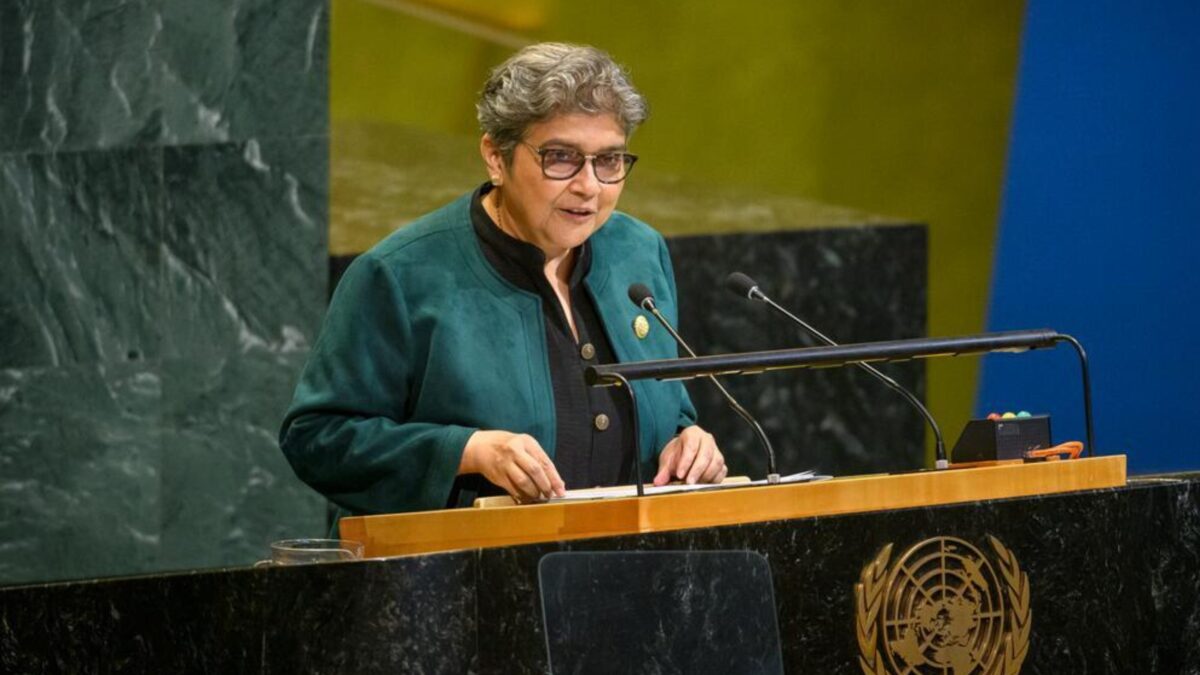
UN chief António Guterres has decided to appoint Bangladeshi diplomat Rabab Fatima as the next UN Special Representative for Afghanistan, two diplomatic sources in New York tell Amu TV. The appointment becomes final if no Security Council member objects within 48 hours.

Fatima would take over leadership of the United Nations Assistance Mission in Afghanistan, or UNAMA, at a critical point for the mission, as the Security Council has extended its mandate for another year while ordering a strategic review of its work and future priorities.

She would succeed Roza Otunbayeva, the former president and foreign minister of Kyrgyzstan, whose tenure as the secretary-general’s special representative and head of UNAMA ended in September 2025. Since then, the mission has been led on an acting basis by Georgette Gagnon, the deputy special representative for political affairs.

Fatima is currently a United Nations under-secretary-general and the high representative for the least developed countries, landlocked developing countries and small island developing states. She has more than 30 years of experience in national and international public service, including diplomacy, policymaking, advocacy and program implementation.

Before taking up her current UN role, Fatima served as Bangladesh’s ambassador and permanent representative to the United Nations in New York from 2019 to 2022. During that period, she served as president of the executive boards of UNICEF in 2020 and UN Women in 2022, and as vice president of the UNDP, UNFPA and UNOPS executive board in 2021. She became the first woman elected to chair the U.N. Peacebuilding Commission in 2022 and also served as a vice president of the 77th session of the General Assembly.

A career diplomat, Fatima previously served as Bangladesh’s ambassador to Japan and as a director-general in the country’s Foreign Ministry. Her diplomatic career also included postings in New York, Geneva, Beijing and Kolkata.

Her expected appointment comes as UNAMA enters a period of reassessment.

The Security Council unanimously voted on June 15 to extend UNAMA’s mandate until June 17, 2027. The resolution also called for a strategic review of the mission, with a report expected by March 2027. The review is intended to assess UNAMA’s role, priorities and ability to carry out its mandate under current conditions in Afghanistan.

The one-year extension followed a shorter, three-month renewal in March. During negotiations earlier this year, council members debated whether UNAMA’s mandate remained realistic and fully implementable under current conditions, and whether its priorities should be streamlined or adjusted to developments on the ground.

UNAMA’s work includes political engagement, human rights monitoring, advocacy for women and girls, and coordination with international and Afghan stakeholders. The mission has faced growing challenges under Taliban rule, particularly as restrictions on women and girls have expanded and female Afghan UN staff have faced restrictions on entering their workplaces.

The appointment of a new special representative would restore permanent leadership to the UN mission after months under an acting head and place Fatima at the center of international engagement with the Taliban at a time when the Security Council is reconsidering the mission’s future direction.

UN chief to appoint Rabab Fatima as SRSG for Afghanistan: Two sources in New York
read more

UN officials urge Western nations to engage with Afghanistan to prevent it sliding into instability

By ELENA BECATOROS

Associated Press

It is crucial for Western nations to engage with Afghanistan to prevent the country from sliding back into instability that could have repercussions far beyond its borders, two top United Nations officials said.

“The lesson of (the) recent past is that ignoring Afghanistan is not a good thing to do,” the United Nations High Commissioner for Refugees, Barham Salih, told The Associated Press in an interview Tuesday alongside the head of the United Nations Development Program, Alexander De Croo, during a joint visit to the country.

Although many challenges and difficulties remain, “it’s wiser to engage, to support and promote the right type of policies to making sure that Afghanistan remains safe and secure,” Salih said, speaking via video link. “Without it, I think we may well risk instability, with all the implications of that instability,” whether that is drugs, extremism, criminal activity or the movement of refugees, he said.

Afghanistan hit by multiple crises

After four decades of conflict, the impoverished, aid-dependent country is now buffeted by multiple crises, from natural disasters and climate change to the largest influx of returning refugees the world has seen in decades.

“In Afghanistan, there is never a crisis just on its own. It’s always crisis on top of crisis,” De Croo told the AP. “And that you see here.”

Nearly 6 million people have returned to Afghanistan since 2023, the vast majority from neighboring Pakistan and Iran since those countries began a crackdown on migrants living there. Another roughly 2 million people are expected to return this year, the U.N. officials said.

The returnees have strained local communities, many of which already have scant resources in a country where poverty is rife and malnutrition stalks the most vulnerable.

This has been compounded by massive cuts in international aid and a Taliban government that has sidelined half of Afghanistan’s population, denying women and girls education beyond primary school and banning them from the vast majority of jobs.

The country is also internationally isolated. No Western nation has formally recognized Afghanistan’s government since the Taliban seized power in the wake of a chaotic withdrawal of U.S.-led troops in August 2021. Russia was the first country to officially do so, in 2025.

Last month, a delegation from the Taliban government traveled to Brussels to meet European Union staff for talks on diplomatic services and the return of Afghans from European countries. The meeting symbolized a small crack in Afghanistan’s diplomatic isolation.

Progress seen in some areas

Yet despite the significant challenges, Afghanistan has nonetheless shown improvement in some areas, notably in security and combating corruption and drug production, the U.N. officials said.

“I wouldn’t close my eyes to the fact that there is progress, and maybe progress that no one would have expected five years ago,” De Croo told the AP. He said drug production was down by 95% in a country that was one of the world’s major producers of opium and heroin.

“If now the international community turns its back to Afghanistan, the consequences will not only be in Afghanistan. The consequences will be much, much broader,” De Croo said.

“The message to Western countries is: if you want to have a stable and peaceful society, you are not only achieving that with domestic policy. If you want to live in peace and stability, your neighborhood also needs to be at peace and stability,” he added.

Draconian restrictions on women and girls remain

The harsh government-imposed restrictions on women and girls remain one of the greatest points of contention between the Afghan government and the international community. De Croo and Salih said they had discussed the issue in their meetings with Afghan officials during their visit to the country. Both said they believed the key to progress was engagement.

“We hope that constructive engagement will show the way forward in that regard,” Salih said. “It’s important that there is progress, there is tangible reforms that will allow for an inclusive system in this country.”

Aid cuts could have lasting repercussions

The international aid cuts have had “a very tangible impact” on the country, De Croo said, noting that 422 medical centers shut down in Afghanistan due to lack of funding in the space of a year. “Closed because the funding just disappeared. That is more than 3 million people that are impacted, that just lose their access to basic medical services,” he said.

Earlier this year, the World Food Program said funding cuts had forced it to turn away three out of four acutely malnourished children seeking help because it no longer had the funds to feed them.

The Afghan government launched a campaign to eradicate poppy cultivation soon after it seized power. But the dramatic cut in drug production was also due in part to farmers being given alternative crops to the cultivation of opium poppies, De Croo said, noting that funding for such programs had been severely curtailed.

“If we cannot continue working together with farmers in giving them an alternative for producing drugs,” then drug cultivation could return, he said.

Although international attention has shifted away from Afghanistan, Salih said that while challenges remain, there is now an opportunity for the rest of the world to engage with the country.

“It is vital to remind the world that the price of inaction far outweighs action,” Salih said. “You cannot ignore Afghanistan, and what happens in Afghanistan does not necessarily stay in Afghanistan.”


UN officials urge Western nations to engage with Afghanistan to prevent it sliding into instability
read more

The closure of Canberra’s Afghan embassy is another blow to people on the brink of losing hope

The Guardian
Thu 2 Jul 2026

After Kabul fell to the Taliban, consulates around the world became hubs of resistance. Now their light is dimming

The decision, by the Department of Foreign Affairs and Trade, reportedly followed a request from the Taliban and has left members of Australia’s Afghan community on edge.

I was a cadet journalist working in Afghanistan in 2012 when the news broke of Julian Assange taking refuge in the Ecuadorian embassy in London. I was amazed that diplomatic rules barred the British police from entering the embassy and arresting him.

At the time, I was covering the bloody Afghan conflict. The US had just deployed the “mother of all bombs” and the Taliban ruthlessly fought back using child suicide bombers.

There seemed to be no end in sight to the bloodshed and misery. The Taliban would boast the Americans might have watches but “we have the time”. They would drag things on, with no regard for the amount of death and destruction caused.

Then came the day when a deal was signed in Doha, Qatar, between the Trump administration and the Taliban, and the nascent Afghan democracy fell apart. With it went all the rights and freedoms that Afghan citizens, especially women and girls, had become acquainted with thanks to efforts by the US and allies including Australia, who had built schools and nurtured democratic institutions in the war-ravaged country.

Before the Taliban stormed Kabul, most western countries shut their embassies there and flew staff out. For the hundreds of thousands of Afghan soldiers, rights activists and other officials who feared Taliban persecution, the country’s diplomatic missions in nearby Iran, Pakistan and other countries became safe havens.

When I embarked on my own journey out of the country, I saw women shedding tears outside the Afghan embassy in Islamabad as they looked at the tricolour flag still flying high. Unlike inside Afghanistan where the Taliban had replaced the flag with their own, and were enforcing their gender-apartheid policy, outside the country embassy staff kept the old flag and were still treating women as human beings. And they didn’t just offer momentary emotional support – consular services stayed busy beyond official working hours to issue and sort crucial documents to help citizens with their private, financial, educational and other needs.

In the first couple of years of Taliban rule in Kabul, Afghan embassies in most capitals around the globe remained hubs of resistance. They tried to keep the tricolour flag flying high and, with the support of host countries, act as de facto representatives of the fallen democracy.

The closure of the Canberra embassy is another blow for people on the brink of losing identity and hope. For the bustling diaspora, who include members of the Afghan female cricket and football teams living in exile, this represents a further erosion of trust.

On Australia’s part there seems to be reluctance to fight the Taliban on a diplomatic front, instead choosing to ignore the country altogether. But for those Australian soldiers, diplomats and aid workers who lived through the war, together with the Afghans who made huge sacrifices for the promise of a fair and free future, the embassy’s closure is heartbreaking.

Among Canberra’s political power brokers, the Afghan war and the fall of Kabul may now be a distant memory. But it is still possible to salvage a better future for the next generation by not abandoning modern diplomacy when it is needed the most.

  • Shadi Khan Saif is an editor, producer and journalist who has worked in Afghanistan, Pakistan, Germany and Australia

The closure of Canberra’s Afghan embassy is another blow to people on the brink of losing hope
read more