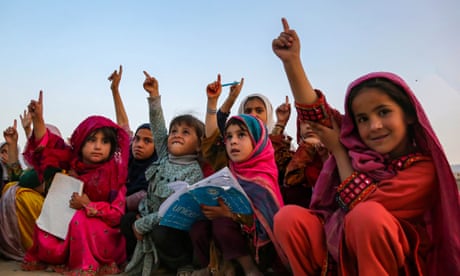
As the world commemorates 16 Days of Activism to end gender-based violence, Afghans discuss their experiences under the Taliban.
Right now, women and feminist organizations around the world are commemorating the International Day for the Elimination of Violence Against Women with the 16 Days of Activism campaign. Starting on November 25 and running through December 10, this year’s campaign calls on governments worldwide to share how they are investing in the prevention of gender-based violence.While the campaign itself is worldwide, 16 Days of Activism should pay special heed to Afghanistan. In just 28 months, the Taliban have dismantled Afghan women’s and girls’ rights — imposing draconian restrictions regarding their education, employment and freedom of movement. Any perceived violation of these oppressive policies is often met with harassment, intimidation, and verbal and physical abuse orchestrated by the Taliban’s Ministry of Vice and Virtue. And when women are detained by authorities, they have been subjected to cruel treatment, including torture.The Taliban’s anti-women policies, combined with an emboldened patriarchal system, have made Afghanistan the lowest-ranked country in the 2023 Women, Peace and Security Index. With humanitarian aid to Afghanistan drying up, the 16 Days of Activism offers a chance to renew international attention so that Afghan women and girls are not left behind.
To ensure that Afghan voices are included in this year’s conversations, USIP launched an online survey asking Afghans both inside and outside the country about their personal experiences and views about the impact of the Taliban’s policies toward women to better understand where their needs lie.
Taliban’s Policies Have Rolled Back Two Decades Worth of Gains
Almost immediately after the fall of Kabul in August 2021, the Taliban began rolling back the over two decades of gains women had achieved in politics, governance, education, health and the private sector.
Within months, the Taliban suspended the Afghan Constitution, which had obligated the government to protect and promote human rights; replaced the Ministry of Women’s Affairs with the Ministry for the Propagation of Virtue and Prevention of Vice; ordered professional and working women to stay home until further notice; prevented women from travelling on long-distance (72 km/45 miles) road trips without a mahram; and imposed a strict dress code on women.
Those we interviewed, both men and women, underscored the immense impact that stringent measures on women and girls have had on Afghan society. Particularly, they pointed to the prohibitions on employment and education, the mandated dress code, and the requirement for a mahram as encroachments on fundamental women’s rights.
Additionally, a number of respondents highlighted instances of public humiliation — where the Taliban’s religious police employed loudspeakers from moving vehicles or within crowds to critique women and their mahram, focusing on elements such as clothing choices, hijab styles and shoe colors.
One woman from Kabul said, “The Taliban view us as criminals. As soon as we step outside our homes, the religious police run to us to intimidate us, to scare us and to remind us that we belong at home.”
These restrictions only intensified when women interacted with government agencies, where they were subjected to degrading behaviors, harassment and insults.
In this context, women are treated as second class citizens, with no agency over decisions about their own body and life. The mental toll has been enormous — women we talked to expressed feeling suffocated, depressed, isolated and worthless. Consequently, there has been a surge in suicide attempts among Afghan women and girls, and they now account for three out of every four suicides and suicide attempts in the country.
“The Taliban have robbed us of our identity and are taking our agency away,” said a woman from Paktia. “They want us to hide behind the walls of our homes. They don’t see us as human beings.”
They want us to hide behind the walls of our homes. They don’t see us as human beings.
In the numerous responses, the Taliban were not the only underlying cause of violence against women. The widespread lack of awareness regarding women’s rights among members of the Taliban has also allowed deeply ingrained and traditional perceptions regarding gender roles to resurface in Afghan society — with the Taliban sparking a resurgence in other forms of gender-based violence.As a woman from Nangarhar noted, “The Taliban’s policies have unfortunately normalized various forms of abuse, including physical, mental and financial abuse of women.” Meanwhile, a teacher from Jawzjan expressed a sense of loss under Taliban rule: “Over the past two years, our society has regrettably regressed by several decades.”
Forced Marriages and Domestic Violence
Financial hardship further compounds the challenges faced by women, with the prevalence of underage and forced marriages on a significant uptick. The dismal state of the Afghan economy, along with the lack of education for girls, has compelled families to wed their daughters out of perceived economic necessity. Furthermore, there is a disturbing trend of marrying young girls to much older men.
The abrupt decline in women’s employment and economic standing — many women were employed teaching in girls’ schools that are now closed, or in beauty parlors that are banned — coupled with restrictions on education and freedom of movement, has taken a toll on their mental well-being. Meanwhile, soaring unemployment and poverty in Afghanistan mean families are spending more and more time within the confines of their home, fostering an environment that is often rife with distress, tension and domestic violence.
Beyond acts of physical abuse, domestic violence can also take the form of isolating women from social engagements, publicly or privately disrespecting women, ignoring their opinions, taking control of their financial affairs, and restricting financial independence.
Tragically, honor killings further compound the issue of domestic violence, and husbands who display negative behavior toward wives who give birth to girls represents another distressing manifestation of gender-based violence within familial settings.
A Justice System Steeped in Anti-Women Sentiments
For victims of domestic abuse, the Taliban’s justice system is a nightmarish ordeal. Perpetrators routinely go unprosecuted in Taliban courts (with cases involving murder an exception), allowing abusive Afghan men to no longer fear repercussions for the harm they cause women and girls.
As one woman from Jawzjan told USIP: “In the republic era, individuals facing charges related to violence against women and those avoiding legal consequences sought shelter in regions controlled by the Taliban, deeming them safe havens. Currently, the entire country has transformed into a sanctuary.”
Women who attempt to leave their marriages encounter further obstacles in exercising their legal rights. In March 2023, the Taliban invalidated numerous cases of divorce that were settled under the previous government. These women, who had once managed to secure independence, now find themselves coerced to reunite with their ex-husbands. Even those who manage to maintain their divorce face issues over child custody and the collection of alimony.
Meanwhile, the Taliban Supreme Court’s recent disclosures do not include any initiatives to reel in child and forced marriage, or the practice of Taliban officials taking multiple wives. Despite their previous claims to the contrary, it’s clear where the Taliban’s legal priorities lie regarding violence against women and girls.
The cumulative effect of these impositions is a stifling environment where women’s voices are devalued, their rights are curtailed, and their overall wellbeing is compromised. In assessing life under Taliban rule, it is crucial to address not just the external threats posed by Taliban decrees, but also how those restrictions perpetuate and worsen harmful behaviors in a domestic setting.
The Taliban have only emboldened already-existing patriarchal norms in Afghanistan. Any attempts to foster a more equitable and just society must also address these root causes so that every individual, regardless of gender, is treated with dignity and respect.
Protecting Afghan Women and Girls
Comprehensive and immediate measures to address the challenges faced by Afghan women and safeguard their rights and well-being is urgently needed.
During this year’s 16 Days of Activism, Afghan women are calling on the international community, particularly the United States and Europe, to utilize the Global Magnitsky Human Rights Accountability Act and the global human rights sanctions regime adopted by the European Council in 2020 “to target individuals, entities and bodies – including state and non-state actors – responsible for, involved in or associated with serious human rights violations and abuses worldwide, no matter where they occurred.” The Magnitsky sanctions could send a message that Taliban rule cannot be normalized without addressing fundamental violations of women’s rights.
Meanwhile, the U.N. Security Council bears the responsibility of preserving international peace and security. In Afghanistan, over 50 percent of the population faces severe marginalization by the Taliban —treated as criminals for exercising what should be protected freedoms and systematically excluded from all facets of society. A commissioned report from the U.N. Security Council’s special coordinator for Afghanistan, Feridun Sinirlioglu, calls for a new U.N. envoy to lead efforts to normalize the international community’s relationship with the Taliban if the Taliban observe international rights and security norms. The U.N. Security Council should not do this, however, without clear conditions on women’s rights and women’s security that must be met for the Taliban to increase their international standing.
In the meantime, it is essential to provide robust support and resources to U.N. Special Rapporteur on the Human Rights Situation in Afghanistan Richard Bennett. He has a mandate to document and report on human rights violations, with a particular focus on the rights of women and girls. It is crucial that he is able to provide comprehensive oversight on the Taliban’s discriminatory practices to provide authoritative benchmarks for rights-based conditionality.
Outside the U.N., the Organization of Islamic Cooperation (OIC) can take more concrete steps to address human rights violations against Afghan women and girls as a way to uphold Islamic values. The Taliban’s national restrictions on education, movement and employment are unprecedented among OIC states and inconsistent with classical interpretations of Sharia. The OIC can deliver this message most forcefully in support of women’s rights.
Inside Afghanistan, religious scholars and the media have a vital role in raising awareness and educating male family members about the significance of respecting the rights of women and girls, both within households and in the broader societal context. Promoting an understanding of Islamic rights through diverse channels, including social media, conferences and community initiatives, is essential in fostering positive change. Together, these measures can contribute to creating a more equitable and supportive environment for Afghan women.
More than two years have passed, and there is still no news about the reopening of school for girls above the sixth grade.
At the end of the 1402 solar school year, a number of sixth grade girls have expressed concern about not being able to go to school next year.
They asked the caretaker government not to prevent girls from going to school in the next academic year.
More than two years have passed, and there is still no news about the reopening of school for girls above the sixth grade.
Zahra and Zainab, who have just finished the sixth grade, talk about their last day at school and meeting their classmates and teachers.
“The last day of our school was very sad. Me and all my classmates were crying because we cannot go to school anymore, the teachers were also crying because they couldn’t see their students anymore,” said said Zainab, a sixth grade student.
“We said goodbye to our classmates and teachers. It’s a very sad feeling that you can’t see your classmates anymore. I spent 6 good years in school and from now on I don’t want to sit in the corner of the house,” said Zahra, the sister and classmate of Zainab.
At the same time, Zahra and Zainab’s family, stressing the importance of their children’s education, have asked the caretaker government not to prevent girls from attending schools.
“I do not want us to remain in these problems and for our children to remain in poverty and illiteracy in the future. We request the elders of the Islamic Emirate to solve the problem of girl’s schools,” Mahboobullah, Zahra and Zainab’s father told TOLOnews.
The Islamic Emirate has already said that the caretaker government is trying to provide education to girls above the sixth grade.
“In today’s world where everyone is turning to technology, unfortunately, in Afghanistan as an Islamic country, girls above the sixth grade do not have the right to education and knowledge of humanities,” said Palwasha, a women’s rights activist.
More than 800 days have passed since the gates of schools were closed to girls above the sixth grade in the country.
Sher Mohammad Abbas Stanikzai, Deputy Minister of Foreign Affairs, said in a program yesterday (Thursday) that blocking the gates of schools is one of the fundamental reasons for people and for some countries to distance themselves from the Islamic Emirate.
Girls Over 6th Grade Concerned About Their Educational Future
The MoE’s spokesman, Mansour Ahmad Hamza, said that the education sector is active across the country without any favoritism based on ethnicity, language and area.
The Ministry of Education denied the claims of the Human Rights Watch (HRW) report, saying that the ministry pays serious attention to the quality of education and its growth throughout Afghanistan.
The MoE’s spokesman, Mansour Ahmad Hamza, said that the education sector is active across the country without any favoritism based on ethnicity, language and area.
The ministry said that no female teacher has been fired so far and legal action will be taken against the perpetrators of corporal punishment of students in schools.
Previously, Human Rights Watch criticized the policies applied to the education sector in Afghanistan in a report and said that the “wrong” policy of the Islamic Emirate is harming the boys, girls and women of this country.
“The ministry has taken some steps. We can say that some of these steps are to provide facilities for the students,” Hamza said.
According to the MoE, nearly 2 million children have been enrolled and provided with educational opportunities within the last year.
“When we draw such [talented] teachers, we in fact present experts, engineers and doctors for the future of our country,” said Mohammad Jahid Mushtaq, a university lecturer.
Meanwhile, Maulana Fazlur Rehman, the leader of Jamiat Ulama e Islam, a Pakistani political party, met with Jane Marriott, the British High Commissioner and they discussed the stability of Afghanistan and the status of girls’ education there.
Jamiat Ulama e Islam Pakistan said in a statement that Maulana Fazlur Rehman called for attention to be paid to the educational situation of “women and children ” in Afghanistan.
“A legal path solution should be found for this issue because this is the issue that affects the recognition. Over the past two-years, this issue has not been paid very much attention,” said Mohammad Ajmal Zurmati, a political analyst.
Earlier, the Human Rights Watch in a statement said the “Taliban’s abusive educational policies in Afghanistan are harming boys as well as girls and women,” Human Rights Watch (HRW) said in a report on Wednesday, adding that the departure of qualified teachers has led to regressive curriculum changes.
However, Biden did not give details about where the American forces are stationed.
In a letter to the US Congress, President Joe Biden said that US forces stationed in the region are ready to respond to “possible threats” arising from Afghanistan.
He said that the US military personnel remain postured outside Afghanistan to address threats to the United States “homeland and United States interests that may arise from inside Afghanistan.”
However, Biden did not give details about where the American forces are stationed.
So far, the Islamic Emirate has not reacted to this comment, but has previously said that Afghanistan’s soil is not a threat to any country.
“The Islamic Emirate has taken serious steps against every element causing insecurity in Afghanistan. It has taken an effective stance. So Afghanistan is not insecure,”
Asadullah Nadim, military analyst, said that the networks which are active in Afghanistan don’t have the capacity to attack the US.
“The networks that are active in Afghanistan including the Taliban don’t have the ability to attack the US and its allies and even the neighboring countries,” he said.
“The US is concerned that Daesh or al-Qaeda will come under Russia’s control and get access to the modern weapons that can cause problems for the US,” said Sarwar Niazai, political analyst.
On November 30, the US State Department released a report dated April 2023 that focused on terrorism in 2022 and which claimed that Al-Qaeda, Daesh and other regional terrorist groups remained active in Afghanistan.
Biden: US Ready to Respond to ‘Possible Threats’ from Afghanistan
The Islamic Emirate has not yet commented about the meeting but earlier stressed the presence of envoys of the Islamic Emirate.
The Reconstruction of Education for Women in Afghanistan is part of the agenda of the two-day meeting with the presence of foreign envoys and former Afghan officials as well as civil rights activists due to be held on Sunday in Doha, capital of Qatar.
The first day of the meeting is expected to discuss the issue of women’s education in Afghanistan.
According to the agenda of the meeting seen by TOLOnews, the US special envoy for Afghan women and girls, Rina Amiri, and the former Afghan minister of education, Rangina Hameedi, will also participate in the meeting.
“In education, we find hope for future generations. Throughout history, the cultivation of knowledge has had a profound effect on nations, elevating standards, promoting innovation, and fostering social progress,” the Doha Forum wrote on its website. “The education sector in Afghanistan, however, is failing to achieve such progress, particularly when it comes to Afghan women.”
The Islamic Emirate has not yet commented about the meeting but earlier stressed the presence of envoys of the Islamic Emirate.
“The issues which are being discussed about Afghanistan are obvious, which will be the deprivation of girls and women from education and higher education. But how to solve this issue and what is the practical path to solve this issue belongs to the interim government and nation of Afghanistan,” said Suraya Paikan, a women’s rights activist.
Wahid Faqiri, political analyst, said that girls and women in Afghanistan have been deprived.
“The rights of girls and women of Afghanistan have been violated. They have been deprived of education and work. The Afghans want from all the international community including the Doha forum to prioritize the issue of girls education in their agendas,” he said.
The participants of the session will discuss various issues including the issue of Palestine and the crisis in Syria.
Afghan Women’s Education Part of Doha Forum’s Session
Police have been searching for undocumented Afghan nationals across Pakistan
In the shaky mobile phone footage, women’s voices can be heard panicking. The camera moves in and out of focus, positioned through a crack in a door frame.
Across the yard, Pakistani police are outside a property, looking for undocumented foreigners. The officers flip through papers as several men sit expectantly inside.
Then the video cuts out.
Across Pakistan, unannounced arrivals of police are becoming increasingly common in a crackdown on hundreds of thousands of foreigners who do not have the right documents to stay.
The vast majority affected are Afghans, who now face the threat of deportation.
EPA
Some 400,000 people have crossed from Pakistan to Afghanistan in the last two months
Many have reason to be fearful of returning to their country, after the Taliban seized power in 2021.
They include journalists and human rights activists, members of the LGBT community, contractors who worked for US-led forces or the Afghan military, and women and girls who can no longer receive an education in their country.
But the raid in the footage the BBC was sent by the family who filmed it, was targeting an area in Pakistan known for a particular ethnic group – the Hazara. Predominantly Shia Muslims, they have long been persecuted by Sunni extremists.
Members of these two branches of Islam share many beliefs but differ on many other aspects of religion – and the sectarian divide has torn communities apart over the years. Out of fear of persecution in Afghanistan, many Hazaras decided to cross the border to Pakistan.
“Life under the Taliban felt like a prison, they didn’t see us as Muslim, they called us infidels. We never felt safe with them,” Shakeba, a 17-year-old Hazara from Afghanistan, told the BBC. She arrived in Pakistan in early 2022.
Shakeba spoke to the BBC on condition that we protect her identity
Shakeba has seen police raids on her neighbourhood but so far they haven’t been to her house.
She’s terrified that she or her family will be picked up if they leave its four walls – they’ve been in hiding for the last three weeks.
“Our faces look different. Even if we wear Pakistani clothes, we are easily identifiable. They identify us and shout ‘Afghani, Afghani!’.”
Hazaras are of ethnically Mongolian and Central Asian descent; their features differentiate them from much of Pakistan and Afghanistan’s populations.
Like other Afghans in this article, Shakeba’s name has been changed to protect her identity.
Afghans make up almost all of the estimated 1.7 million foreigners that Pakistan says have no right to live in the country.
Its move to expel undocumented foreigners came after tensions soared following a spike in cross-border attacks. Islamabad blames them on Afghanistan-based militants, a claim the Taliban government in Kabul denies.
In the last two months, more than 400,000 people have crossed from Pakistan to Afghanistan.
A highly uncertain future awaits them – some are staying in camps, others have set off across the country to start life again, often taking little with them as winter approaches.
EPA
Some Afghans are staying in tents since returning – others have gone overland to try to rebuild their lives
Many new arrivals from Afghanistan since 2021 have faced long delays securing any form of formal documentation in Pakistan, including those with refugee claims. This left them with two main options when the new policy was announced – leave and take their chances back home in Afghanistan or stay and risk the knock on the door from the police.
For Shakeba, there was no hesitation.
“It wasn’t a decision,” she says. She and her family arrived in Pakistan after they received multiple threats to their lives, she says. “I said to my family, we will stay here until they force us to go back. It is not a place for Hazaras, it is better to be here and pray for our luck.”
Fida Ali, another Hazara, said: “Of course there is radicalism in Pakistan, but Afghanistan is on a completely different level.”
A former teacher, he arrived in Pakistan just over two years ago, soon after the Taliban seized power as foreign forces evacuated. “When the internationally supported government collapsed, so did many of the institutions we were working for. The second reason for leaving is that as a minority, we were a number one target.”
The fear of return
For Hazaras, Pakistan has not always felt like the safer alternative to its neighbour, but when the Taliban retook power many joined huge numbers of Afghans who fled over the border.
Getty Images
The Hazara people traditionally live in the mountainous central belt of Afghanistan
“Yes, Hazaras face persecution in Pakistan but many feel that they are being brought back to the slaughter house if they return to Afghanistan,” says Jalila Haider, a lawyer and human rights activist.
She is a Pakistani Hazara and has been offering legal aid to many who have been arrested and threatened with deportation in the last few weeks. She explains that there is a significant lack of trust between the Hazaras and the Taliban because of recent history.
Shakeba says this led to a real fear.
“We were scared of the Taliban, that they might kill us like they did before,” she told the BBC.
When the Taliban were last in power from 1996-2001, Hazara fighters fought against them. Hazaras were killed in their thousands by the Taliban, according to Human Rights Watch who accuse the Taliban of carrying out massacres at Mazar-i-Sharif in August 1998, Yakaolang in 2001 and Robak in May 2000, not distinguishing between combatants and civilians.
A Taliban spokesperson said this was not true, and that these deaths were part of armed conflict, with casualties on both sides.
Amnesty International says it has documented instances of torture and executions of Hazaras since the Taliban returned to power. The Taliban government denies these accusations too. Hazaras are also regularly the target of militant groups such as so-called Islamic State.
Taliban spokesperson Suhail Shaheen said the Pakistan policy of deporting so many Afghans in the run-up to winter is “an attempt to put pressure on the young Islamic government in Kabul”.
“We welcome Afghan refugees of all ethnicities including Hazara to return to their country. And we assure them that their life, property and honour is protected and they can lead a normal life in Afghanistan,” he told the BBC.
Fida Ali says Hazaras are accused by the Taliban of supporting the US and its allies in Afghanistan
Pakistan’s caretaker Prime Minister Anwaar-ul-Haq Kakar has promised that at-risk individuals will not be sent back.
How such individuals are identified is unclear and the ministry did not respond to a BBC request for comment. No list has been made public. Pakistan’s Commissioner for Afghan refugees Abbas Khan has also said any suggestion Hazaras were harassed by police was “fabricated”.
But Ms Haider says she has seen many people go into hiding.
“In towns, I have seen many of the shops and businesses run by Hazaras and other Afghans closed because they are afraid. I fear it will create another human tragedy. How will they eat?
“There is no mercy for the Hazaras. There is a very low chance they can get jobs or opportunities in Afghanistan. They face the challenges many other Afghans face, but more intense because of their ethnic group.”
Under the previous Afghan government, Hazaras found new opportunities.
In 2004, they were formally recognised as citizens. Many took more prominent positions in civil society, government and the military.
“There is no doubt that within the last two decades, the Hazara people were supportive of the process,” Fida Ali says of the government the Taliban unseated.
“Now that means we are accused of supporting the allies. It is another factor that means we face extreme danger.”
Baqir and his family have been in Pakistan for two years – he says they can’t go back
All the Hazaras the BBC spoke to show the same frustration, fear and hopelessness.
Baqir, who worked with the military and government in Afghanistan, is laying low with his family. They arrived in Pakistan about two years ago and he says returning would be “like playing with my life”.
“We can’t go back to our own country, maybe death will be awaiting us there; and here no-one hears our voice – we are totally lost!”
With no documents, no certainty and no recognition as refugees, all say they can only wait and hope.
“We really don’t know where to go or what to do,” Shakeba says. “We have lost everything. The dreams I have for my life are all gone.”
Afghan Hazara refugees live in fear of being deported by Pakistan
While the Islamic Emirate of Afghanistan (IEA) maintains that it deserves full-scale recognition, it has not been given the country’s seat at the United Nations. In early December 2023, the UN General Assembly will again consider whether or not to allow the Islamic Emirate to take Afghanistan’s seat at the world body. The argument plays out in the context of a worldwide discussion about whether and how governments should deal with a regime that critics say denies women and girls almost every individual right, has a dire general human rights record and is narrowly based. AAN’s Thomas Ruttig has been analysing the impasse, noting the intra-Republic rivalry to also represent Afghanistan at the UN, and scrutinising UN procedures and considerations to try to make sense of it all.
A view of delegates inside the General Assembly Hall during the first day of the 78th session of the General Assembly held on 19 September 2023. Photo by UN Photo/Paulo FilgueirasThe Islamic Emirate of Afghanistan’s quest for diplomatic recognition
Since the Taleban returned to power in August 2021, the United Nations General Assembly (UNGA) has rebuffed the IEA’s attempts to take the country’s seat. However, diplomatic recognition, including by the UN, is perhaps the IEA’s foremost foreign policy goal. It figures prominently in many speeches and statements of its leaders. Most recently, the IEA’s designated UN representative, Muhammad Suhail Shaheen, accused the world organisation of acting “without neutrality in determining the seat of Afghanistan” and using the matter to put “pressure” on the Emirate (see ToloNews here). The IEA argues that it is the legitimate government of Afghanistan based on the claim that it has full territorial control, has ended the war and brought security to all Afghans.
Yet, so far, only China appears to have come closest to recognising the Emirate, if recognition is measured by an acceptance of the other’s ambassadors. [1] This is in contrast to the Taleban’s first time in power, from 1996 to 2001. Back then, Pakistan, Saudi Arabia and the United Arab Emirates maintained diplomatic relations at the ambassador level until they eventually severed ties under US pressure after the 9/11 al-Qaida attacks.
The IEA seems more fully isolated diplomatically this time. A closer look, however, shows a more ambiguous picture. An overview of the IEA’s current diplomatic relations and interactions compiled by Aaron Y Zelin, a fellow at the Washington Institute for Near East Policy, in August 2022, concluded that it is actually “far less isolated today” than during the 1996-2001 period (see here).
When his piece was published, Zelin counted eight countries where Afghanistan’s diplomatic missions were under IEA control. By November 2023, IEA deputy foreign minister Sher Muhammad Abbas Stanakzai said this number had risen to “up to 20” (ToloNews here), including the Afghan embassy in Tehran (see ToloNews here) and the strategically important consulate-general in Istanbul (Pajhwok here).[2] Turkey reportedly also accepted a new IEA-appointed diplomat in October 2023 at the Afghan embassy in Ankara (see Iran International here).
Zelin found 378 publicly announced meetings between representatives of the Taleban and diplomats from 35 other countries, mostly Middle Eastern states (35 per cent), but with China engaging “more often than any other [individual] country.”[3] (See this AAN report by the author on China-Taleban relations.) The volley of diplomatic interactions has continued since Zelin’s August report, without interruption.
Even more importantly, a number of countries still have ambassadors officially posted to Afghanistan. They include China and other neighbouring countries such as Pakistan, Iran and most of the Central Asian republics, along with Russia, Saudi Arabia, Qatar, the United Arab Emirates and Japan. Indonesia, which was involved in mediation between the former government and the Taleban before 2021, reopened its embassy in Kabul in February 2022 and although its diplomats continue to work from Islamabad, it does have a charge d’affaires in Kabul (see Indonesia’s The National Kompas here). In July 2023, a Taleban delegation paid an “unofficial visit” to Jakarta (see VoA here). While some ambassadors seem to be based more or less permanently in Kabul, such as those of China, Iran and Russia,[4] most others appear to be coming and going.[5]
Western countries have not officially closed their embassies in Kabul nor have they officially broken off diplomatic relations. [6] Rather, they do not maintain diplomatic personnel in the country, as was the case for many countries during the Soviet occupation of Afghanistan (1979-1989) when they either withdrew their staff from the country or downgraded relations to the chargé d’affaires level.[7] Some countries still have non-Kabul-based acting ambassadors or more junior diplomats and there is also a (shrinking) number of special representatives for Afghanistan (ranked as ambassadors). Most Western engagement with IEA officials takes place in Qatar’s capital Doha with diplomats below ambassador level representing their countries in meetings. [8]
The United Nations’ political mission (the UN Assistance Mission in Afghanistan, UNAMA) has been operating in Afghanistan without interruption since March 2002 (mandated by UNSC resolution 1401). [9] Most recently, the UN Security Council (UNSC) has started deliberating the findings and recommendations of a recently completed independent assessment on Afghanistan carried out by senior Turkish diplomat Feridun Sinirlioğlu. His mandate from resolution 2679was to “provide forward-looking recommendations for an integrated and coherent approach among relevant political, humanitarian, and development actors.” The assessment, delivered on 28 November, proposed among other things, a conditions-based “roadmap” with the “end state” of “the reintegration of the State of Afghanistan into the international system.” (In April 2023, UN Secretary-General Antonio Guterres appointed senior Turkish diplomat, Feridun Sinirlioğlu, to conduct an independent assessment to “provide forward-looking recommendations for an integrated and coherent approach among relevant political, humanitarian, and development actors, within and outside of the United Nations system, in order to address the current challenges faced by Afghanistan,” as mandated by UNSC resolution 2679 (see Turkey’s Hurriyet Daily News here).[10] Many are reading this goal to mean diplomatic recognition.
While all this activity is of a distinctively higher level than it was during the first emirate, at the UN itself, the firewall that has so far prevented the Emirate from taking Afghanistan’s UN seat is holding. The IEA believes the decision to deny it the seat – or more accurately, the lack of a decision to change the status quo – is keeping it from achieving international recognition, more generally, and is denying it access to, among other things, more extensive development aid and sanctions relief.
This report analyses the UN rules and procedures and aspects of international law that come to bear in the debate about Afghanistan’s UN seat. In this area, UN rules often seem arcane and opaque, so are worth unpicking. They allow ‘non-decisions’ and the absence of debate on the matter of the IEA’s claim to the seat, useful for maintaining the status quo without really having to talk about it publicly. The report will also show that the competition to occupy the seat is not only a two-horse race between the Taleban and the former government, but also a power struggle between the current acting representative, who inherited the seat after the Islamic Republic of Afghanistan-appointed envoy resigned, and other former officials of Republic, now in exile.
Rules and procedures at the UN
For the second time since the establishment of the IEA, on 16 December 2022 in the 55th plenary meeting of its 77thsession, the United Nations General Assembly deferred a decision on granting Afghanistan’s new rulers the country’s seat at the UN (see the Credentials Committee’s 12 December report A/77/600), UNGA resolution A/RES/77/239 and the transcript of the 16 December 2022 55th plenary meeting A/77/PV.55). [11]
Importantly, while the UNGA deferred the decision on the Emirate’s request to take over Afghanistan’s seat, it also did not explicitly reject the request (more on the committee’s reasons for this deferral below). At the same time, as well, it did not explicitly stipulate that the previously-credentialled representative should remain in place. However, as Rebecca Barber wrote, in a paper published in the International and Comparative Law Quarterly, “based on the Assembly’s practice and procedural rules there was little doubt that this was to be the case.” [12] This standstill over who should rightfully represent the country has resulted in the continuation of the status quo, leaving a relatively junior diplomat, who has not been formally appointed by any government, occupying the country’s seat.
If earlier decisions are an indication, UNGA should consider the matter for a third time in early December 2023 and take a decision by adopting a resolution (see last year’s here) proposed in the UN Credentials Committee report. [13] Every year, this body of nine annually changing members checks the credentials of member-states’ representatives and, based on the documents it has received, takes note of who has been put forward to be credentialled for that year’s upcoming UN General Assembly. [14]
The credentials are usually straightforward procedural matters, except in unusual cases such as Afghanistan under the IEA. [15] (Other current controversial cases are Myanmar, Libya and, somewhat differently, Venezuela.) [16] Whether the Committee does anything more than just pass on information to the UNGA is debated. Barber argues that: “This delineation of the credentials process as being only about the procedural requirements of representation at the UN, and not about the recognition of the status of governments more broadly, was articulated in a 1970 memorandum by the UN Legal Counsel. That memorandum described the examination of credentials as a ‘procedural matter’, limited to assessing compliance with the Assembly’s procedural rules, and not involving questions of ‘recognition’ or ‘substantive issues concerning the status of governments’.”
However, in 1996, the Committee’s report, which includes the Legal Counsel’s opinion on Afghanistan, provides a fuller record of proceedings and shows just how active the ‘non-decision’ on Afghan representation at that time was: it followed a debate about what to do between the Committee members. Moreover, judging by its membership, this committee is powerful – in a committee where the General Assembly appoints the members yearly, China, Russia and the United States have been members every year since 1947. [17] That fact and the opacity with which it works do not give the appearance of a mere rubber-stamping body (see also Euronews reporting here).
Neither the committee nor the UNGA have a debate or hold a formal vote on credentials, even for controversial cases. The General Assembly always adopts, by acclamation, the Credential Committee’s report with a short resolution. The decision is valid for one annual session of the UNGA (September to September). What can be said is that the procedures allow for controversial questions of recognition to be deferred without public discussion or even a decision to do something having to be made.
Interestingly, another important multilateral institution, the International Criminal Court (ICC) in The Hague, sought clarification from the UN about who represented Afghanistan in the context of its Afghanistan investigation. In October 2021, it sent letters to the UN Secretary-General and the ICC Bureau of the Assembly of States Parties (ie, the ICC member-states) for “information on the identification of the authorities currently representing the Islamic Republic of Afghanistan by Monday 8 November 2021” (author’s emphasis). The letter showed that, as Ehsan Qaane wrote in a 2021 report for AAN Delaying Justice? The ICC’s war crimes investigation in limbo over who represents Afghanistan, the ICC judges “are not convinced that the diplomats appointed by the former regime can truly represent Afghanistan before the court. However, they themselves cannot contact the Taleban authorities directly, as that would imply recognition.” In this letter, the judges reasoned that “they believe the decision of who represents a state is of a “political nature” and a matter of “constitutional and international law,” beyond their mandate. The responses to the ICC’s query, wrote Qaane, offered no further clarification on the issue:
The two institutions did respond, but were of little help. The Bureau of the ICC Assembly of States Parties said, on 26 October 2021, that “due to its nature and functions, it [the Bureau] does not hold the type of information that is requested.” The UN Secretary General, meanwhile, told the judges on 18 October 2021, that the decision of government recognition was not his to make, but was “a matter for individual Member States.”
How was the last decision on Afghanistan’s UN seat taken?
The committee’s relative obscurity allows it to be opaque. Indeed, International Crisis Group’s UN Director Richard Gowan described it to the Associated Press as one of the “least transparent U.N. bodies” (see here), adding that “the fact that it isn’t transparent allows it to fudge certain decisions and kick hard decisions down the road.”
Its most recent recommendation on Afghanistan, which was adopted by the UNGA on 16 December 2022 and was valid for UNGA’s 77th session from 13 September 2022 to 5 September 2023, reads:
The Chair proposed that the Committee postpone its consideration of the credentials pertaining to … the representatives of Afghanistan … to the seventy-seventh session of the General Assembly, and to revert to consideration of these credentials at a future time in the seventy-seventh session. The proposal was adopted without a vote.[18]
Given that the Credentials Committee usually meets three times a year, in March, June and September, its recommendation on Afghanistan’s seat for the current 78th UNGA should have already been taken, but will not be made public before the UNGA makes it official by adopting the Credentials Committee report.
The case of Afghanistan: competing requests
According to the UN’s rules of procedure for credentials, a head of state or foreign minister must submit credentials for their representatives at least one week before the opening of the UN General Assembly. [19] In Afghanistan’s case, the Credentials Committee has a problem, as it received in both 2021 and 2022 (the committee’s 2023 recommendation is not yet publicly available) what it described in similar wording in both its reports as “two communications concerning the representation of Afghanistan … indicating different individuals as representatives.”
In 2021, it had one letter dated 14 September 2021 from the Permanent Representative of Afghanistan to the United Nations in New York and “another dated 20 September 2021 from Afghanistan’s Ministry of Foreign Affairs” (see here). In 2022, the first letter, dated 6 September 2022, came from Afghanistan’s Chargé d’affaires ad interim to the United Nations in New York, followed by a second one, on 17 September 2022 from “the Ministry of Foreign Affairs of Afghanistan” (see here).
At first glance, the Credentials Committee left the matter of who exactly sent both communications unclear (see here). In both years, the first letter obviously came – as is usual – through Afghanistan’s permanent mission in New York and should represent the credentials submitted by the Islamic Republic of Afghanistan. The Islamic Republic of Afghanistan (IRoA) continues to be registered on the UN’s list of “Official Names of the United Nations Membership” (here) and its protocol list (here). The country is simply recorded as Afghanistan on the list of member states, but with the pre-1978 and Republic-era green, black and red flag still shown (here).
Although not spelled out, it seems the second communications were from the Islamic Emirate of Afghanistan’s foreign ministry. [20] Indeed, IEA foreign minister Amir Khan Muttaqi did send a letter to UN Secretary-General Antonio Guterres in September 2021, nominating the Emirate’s Doha-based spokesman Suhail Shaheen as their permanent representative and asking for credentials for him. A UN spokesman confirmed that Muttaqi’s letter was received and forwarded to the Credentials Committee (see Reuters here). [21] The Credential Committee references the letter in its 1 December 2021 report (see here):
The Committee had before it two communications concerning the representation of Afghanistan at the seventy-sixth session of the General Assembly, indicating different individuals as representatives to the seventy-sixth session of the Assembly. The first was dated 14 September 2021 from the Permanent Representative of Afghanistan to the United Nations in New York. The second communication was dated 20 September 2021 from the Ministry of Foreign Affairs of Afghanistan.
The Chair proposed that the Committee defer its decision on the credentials pertaining to … the representatives of Afghanistan to the seventy-sixth session of the General Assembly. The proposal was adopted without a vote.
The result is a diplomatic oddity, a junior diplomat appointed by a government that no longer exists currently occupying Afghanistan’s seat at the UN. Naseer Ahmad Faiq has declared that he no longer represents the old government, which has never officially abdicated, and that he does not represent the Islamic Emirate of Afghanistan either, but only the “oppressed groups in Afghanistan” (comment made to media – full quote below). [22]
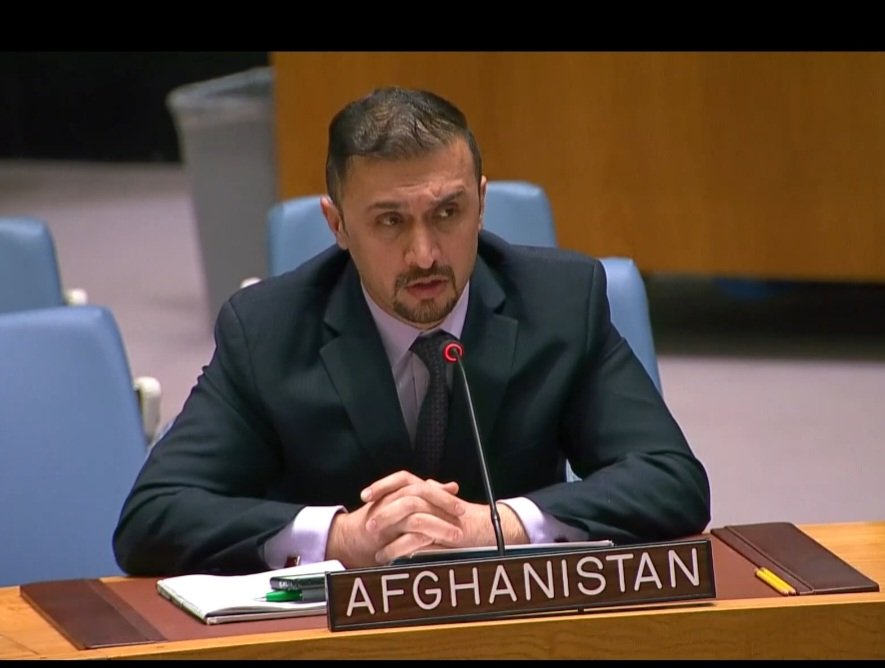
Afghanistan’s Chargé d’affaires ad interim to the United Nations, Naseer Ahmad Faiq, speaking at the UN Security Council on the situation in Afghanistan. Source: UN Web TV, 20 December 2022.
Faiq assumed the helm at Afghanistan’s Permanent Mission in New York after the country’s permanent representative, veteran diplomat Ghulam Mohammad Isaczai (also spelled Ishaqzai) resigned in December 2021. [23] Faiq’s new role was made public “in an official tweet” by Afghanistan’s Permanent Mission to the UN on 16 December 2021, without mentioning who had appointed him (see Ariana news here). The letter to the UN – if there was indeed a letter – naming him heading Afghanistan’s mission to the UN has not been publicly released. [24]
Isaczai had notified the UN of his resignation on 16 December 2021, according to a UN spokesman (see AP report here). He had been scheduled to address the final day of the UNGA high-level meeting on 27 September 2021 (six weeks after the fall of the Islamic Republic), but he later withdrew the request to speak (see the German news website RedaktionsNetzwerk Deutschland (RND) here). [25]
There was speculation in the media about the reason behind the resignation. The Associated Press said he had resigned “after the country’s current Taliban rulers sought to replace him with their own envoy” (see here). Foreign Policy quoted one Afghan diplomat saying he had resigned because he thought there was no government in Afghanistan for him to represent at the UN and two other diplomats saying he expected to be appointed to a senior UN post in Ethiopia.[26]
After the credentials committee’s decision to defer any action in 2021, the chair, Sweden’s UN Ambassador Anna Karin Enestrom, declined to respond to questions from journalists about whether the current ambassador for Afghanistan still represented his country (see Reuters here).
Intra-Republic conflict
Further controversy about the country’s permanent representation in New York played out in early 2022, before the UN credentials committee’s most recent (non-)decision. On 9 February, reports emerged in the Afghan media that the mission had announced the appointment of Muhammad Wali Naeemi as Afghanistan’s Permanent Representative and Chargé d’affaires to the UN, replacing Faiq (ToloNews here and Khaama Press here).
The statement said that Naeemi, who had been deputy permanent representative under Isaczai, had not been able to assume his post earlier for health reasons, but “considering that Naeemi as the deputy representative has recovered, and based on the UN’s standards that after the ambassador and the permanent representative his deputy will take over responsibilities, Naeemi has taken the responsibilities as Chargé d’affaires from 4th February 2022” (quotes from the ToloNews report).
The last of the Republic’s foreign ministers – who has maintained that he still holds this position – Muhammad Hanif Atmar, also sent a letter to the UN communicating Naeemi’s appointment. Faiq, however, continues to hold himself to be Afghanistan’s representative and posted a copy of the letter on X (formerly Twitter) here. The media also reported on 8 February 2022 that Faiq had accused “corrupt individuals and traitors from the former corrupt government” of having staged “evil plots and conspiracies” against him, following a statement he made at a UNSC meeting discussing the situation in Afghanistan on 26 January 2022. In that statement, he had also announced that he was “not representing the former corrupt government” and demanded “the confiscation and freezing of Afghanistan’s assets illegally transferred to [bank] accounts of the former corrupt government officials” (see the text of his statement here). Later, he claimed that after that speech, he had “received a call from one of the top Taliban leaders asking him to represent them at the UN” but had declined (see the UAE’s English-language daily The National here). Indeed, in a series of interviews in 2023, Faiq underscored that he was not the Emirate’s representative either. For example, he told the Turkish Anadolu news agency: “We are not in contact with the Taliban. We are not representing the Taliban. We are the only voice of the oppressed groups in Afghanistan” (see here).
The UN did not act on Atmar’s letter. Instead, it deleted the names of Ashraf Ghani as Afghanistan’s head of state and Atmar as foreign minister from its official protocol list, leaving their places blank but retaining the Islamic Republic of Afghanistan as the country’s official designation. ToloNews first reported this on 22 February 2022, saying that the updated list had been published on 15 February (see ToloNews here and the current UN Protocol and Liaison Service list, as of 6 November 2023, here).
Although these approaches have further obfuscated Afghanistan’s place at the UN, it seems that the decision has simply been left open and not taken in favour of any of the two Afghan contenders for the seat, leaving Faiq as Afghanistan’s default representative to the world body, only because no decision has been made to choose someone else. The most recent list of UN member states heads of mission (as of 1 November 2023) continues to list Faiq as Afghanistan’s representative (see here). For the third year running, however, Faiq did not make a statement in Afghanistan’s name at the 2023 General Assembly, due, reported AP, to “the credentialing dispute.”
Faiq can, nevertheless, still attend UN meetings as Afghanistan’s representative in the current General Assembly (see here). He also attended and spoke at the 26 September 2023 UNSC meeting, where the Secretary-General’s Special Representative for Afghanistan, former Kyrghyz president Roza Otunbayeva, briefed the council on the situation in Afghanistan (see here). Most recently, on 1 November 2023, he spoke at the UNGA’s Third Committee, discussing the report of the United Nations High Commissioner for Refugees (see his post on X here) and on 5 October during the discussion on the advancement of rights of women and girls (here). Faiq unsuccessfully put Afghanistan forward as a candidate for the UN Human Rights Council in October 2022 (see his post on X here) and voted in favour of a UN resolution that condemned Russia’s war on Ukraine, which Afghanistan had reportedly co-sponsored in March 2022 (see his post on X here).
Faiq’s 2022 request to be re-accredited has a further weakness. After the controversy over Atmar’s letter and Faiq’s distancing himself from the former government, it is very likely that his letter did not carry Atmar’s signature and, therefore, did not fulfil the UN requirement that such a request must come from a foreign minister. However, this appears to have had no influence on the Credential Committee’s stance.
The Emirate’s position
International diplomatic recognition is a major foreign policy goal for the Islamic Emirate. It has repeatedly called on governments to establish full diplomatic relations, although so far, to little avail. It hailed the acceptance by the People’s Republic of China of the credentials of its ambassador on 1 December 2023 as an “important chapter” (see VoA here): it was the first time a country had formally done so and followed another first for China, in September 2023, the appointment of a new ambassador to Kabul. This was a sign, the BBC reported the Emirate as saying, for other nations to establish ties with its government. However, in reality, the number of countries with embassies and some even with ambassadors in Kabul as well as the number of countries which have allowed the IEA to either take over their embassies/consular offices or post an Emirate official at Afghanistan’s diplomatic missions is relatively few. And none have, so far, fully recognised the regime.
The stated obstacles have remained consistent. Immediately after the Taleban took power, Russia’s Foreign Minister Sergey Lavrov, for example, made full recognition dependent on, among other things, the Taleban’s willingness to form an “inclusive government” (see Russian foreign ministry’s press release here). This position was repeated during the September 2023 meeting of the Russia-hosted Moscow Format consultations on Afghanistan, which was also attended by the five Central Asian Republics, China, India, Iran and Pakistan. Participants at the meeting repeated their demand for the establishment of “a balanced, broad-based, inclusive, accountable and responsible government in Afghanistan.” While they made no explicit reference to recognition, they did, however, express “their interest for expanding engagement with the current Afghan authorities in the areas of culture, sport and education” (author’s emphasis; see the meeting’s final declaration here).
Yet the IEA has repeatedly insisted that it has the right to Afghanistan’s seat at the UN as it controls all of Afghanistan.Mutaqqi’s 2021 letter requesting the UN to accept the Emirate, according to UN spokesperson, Farhan Haq, argued that former president Ashraf Ghani had been removed and was no longer recognised as the country’s head of state and that the mission of the Republic-appointed representative “is considered over and that he no longer represents Afghanistan”(see German news site Web.de here).
The IEA also criticised the UN General Assembly’s 6 December 2021 decision to continue acknowledging Ghulam Mohammad Isaczai as Afghanistan’s permanent representative to the United Nations (see Ariana news here), calling it “unfair.” Abdul Qahar Balkhi, theIEA foreign ministry’s spokesman, tweeted: “The new Afghan government, as an accountable authority with sovereignty over entire Afghanistan (sic), which has ensured security for all Afghans, has a legitimate right to represent the Afghan people in the UN” (see ToloNews here). “Giving Afghanistan’s seat to Ishaqzai, who has no working relation with Kabul and no authority over any part of Afghan territory is deemed a blatant denial of the Afghan people’s legitimate right,” ToloNews reported Balkhi as saying.
During the Faiq/Naeemi controversy, Inamullah Samangani, the Emirate’s deputy spokesperson, said “the only solution is that Afghanistan’s chair at the UN is given to the current government of Afghanistan” (see Pakistan-based The Frontier Post here). In March 2023, the Emirate again raised its claim (see Pajhwok news here) for its ambassador-designate, Suhail Shaheen, to take over Afghanistan’s permanent mission in New York. “It is our right to be represented at the United Nations,” the Emirate’s spokesperson Zabiullah Mujahid told ToloNews (see here).
From the Emirate’s point of view, the opaqueness with which the Credentials Committee operates, the lack of debate in the General Assembly and the non-decisions make it impossible to find purchase to argue its case.
What does international law say?
International law distinguishes between the recognition of states and the recognition of governments. In general, states recognise other states, rather than governments. There is no “formalised procedure and, in particular, no international body” (and certainly not the UN) that determines “whether a state exists or whether a government is authorized to act on behalf of a state,” as a 2020 memo by the Academic Services of the German Bundestag (parliament) looking at the legal framework for a decision on Taleban recognition made clear (see here). This means that individual “state practice and customary international law resulting from it” are used by each state to decide questions of recognition. The memo stresses that there are “discrepancies” in the practice of various states.
Under normal circumstances, ie in times of peace and constitutional order, “state identity is not affected by the change of its government,” write Federica Paddeu and Niko Pavlopoulos in a piece published on the Just Security website (see here). In other words, states tend to continue diplomatic relations with an incoming government without issuing a formal expression of recognition
Since World War II, most states have narrowly focussed on a new government’s effective control of territory and have thus avoided complex political pronouncements about legitimacy. Switzerland, for example, enshrines neutrality as a core virtue of its foreign policy and adheres to “the principles of universality (the principle that wherever possible, Switzerland maintains diplomatic relations with all states) and of effectiveness (the requirement that the state to be recognized must have undoubted sovereignty),” as laid out in a legal memo published by its Federal Department of Foreign Affairs (last updated in April 2023 see here). The memo adds:
For the sake of the certainty of international law, Switzerland as a general principle refrains from setting additional conditions for recognition.…
The only precondition for the recognition of a government under international law is its effective exercise of sovereign power (first and foremost, control of a substantial part of the territory and of the apparatus of administration).…
If a state maintains normal diplomatic relations with a new government, this is merely a declaration that the new government is effective, not that it is legitimate [author’s emphasis].
Such an approach by any state may be rooted in the consideration that debates about legitimacy are complex and may not be politically expedient – whether disputatious, contrary to trade or other state interests or simply time-consuming.
However, sometimes concerns about legitimacy outweigh the principle of effective control and then states can be forced to consider questions of the legitimacy of the new government and whether to recognise it. For example, as the Bundestag paper highlights, this can happen when there has been “a change in the form of government by a change of the form of the state or due to an unconstitutional or otherwise irregular transfer of sovereign power within the state” such as “civil war, military coups [or] disputed election results.”
In Afghanistan’s case, statehood is uncontroversial, as is the IEA’s effective control of territory. What is controversial is whether the Emirate is a legitimate government. In August 2021, Afghanistan’s form of state changed from an Islamic Republic to an Islamic Emirate, and not by peaceful means. [27] It would appear, therefore, that UN member-states have considered the new regime’s legitimacy and, as a result, have refrained from recognising the IEA and re-establishing full diplomatic relations. Most have either not sent any diplomats, or only lower-ranking ones, and only a few an ambassador to Kabul. Also, in most cases, they have not received IEA diplomats. Many still seem to recognise the Islamic Republic of Afghanistan or at least allow diplomats appointed by it to continue their work.
The legitimacy question also plays out between the various Afghan political forces, all of whom interpret the issue of Afghanistan’s seat in New York as ‘recognition by the UN’. The Taleban, for their part, have always insisted on the continuity of the Emirate, and the 20 years of the Islamic Republic of Afghanistan as an interregnum; they have never recognised the Republic as Afghanistan’s legitimate government, describing it as a puppet of foreign forces. They are unswerving in their demands for recognition “by the UN,” as the UN’s envoy to Afghanistan, Roza Otunbayeva, pointed out in her comments to the Security Council in July 2023.
It is worth noting, however, that the United Nations is neither a state nor a government and does not have the right to ‘recognise’ a government (see UN website here).
The UN’s practice in the Credentials Committee should turn on this same question of legitimacy, particularly regarding upholding the UN Charter, although by not discussing the matter publicly or making an active decision on who gets the Afghan seat, neither the Committee nor UNGA are actually grappling with the issue of legitimacy. Otunbayeva used the language of recognition – in her UNSC comments in July: “The Taliban ask to be recognized by the United Nations and its members, but at the same time they act against the key values expressed in the United Nations Charter” (see the full transcript of her statement here). The Emirate took issue with her claims that its governance structures were “highly exclusionary, Pashtun-centred and repressive,” calling her assessment “baseless and biased” (see ToloNews here).
On balance, and based on the body of UN resolutions and repeated calls by member states for an inclusive government and respect for human rights, especially those of women and girls, it could be surmised that it is because states do not consider the Emirate legitimate that they have rebuffed its attempts to be recognised and admitted to the United Nations. However, this has never been publicly discussed or debated by either the Credentials Committee or the UNGA, so it is just surmise.
Importantly, while sending or keeping ambassadors in Kabul, as China, Russia, Iran and some other countries have done, could be seen as de-facto recognition of the IEA, this or indeed even establishing full diplomatic ties with the Emirate would still not constitute de-jure recognition and would not imply that the country in question considers the Emirate to be legitimate. [28]
Still, even partial diplomatic relations, such as existing lower-level diplomatic contacts, without the full gamut of diplomatic relations, are highly controversial and have drawn sharp criticism among the general public outside of Afghanistan and among some in the Afghan diaspora. Such pressure is another factor that governments need to take into account when deciding to recognise another government. In the eyes of many who are not well-versed in the intricacies of international law, recognition might imply legitimacy.
Recognising governments-in-exile
The Swiss legal memo also mentioned ‘special cases’, particularly after a coup or civil war, where “a legitimate government loses all or part of its power over the state and even flees abroad, becoming a government in exile.” In these instances, the memo says, “the former government sometimes continues to be recognized as the legitimate government (the de jure government) even if it has lost effective control of the state – at least temporarily – and this control is being exercised on the ground by a new, different government (the de facto government).”
One recent example is Yemen. There, the Houthis took effective control over large swathes of the country, yet the former government, in exile in Saudi Arabia, continues to be recognised by many states (see Reuters here). The Houthi government is even subject to a range of sanctions by the UN Security Council, including asset freeze, travel ban and arms embargo (see UNSC here and here), not unlike the current IEA.
In Afghanistan, a similar situation emerged in 1996 after the Taleban had toppled the government in Kabul, which called itself the Islamic State of Afghanistan (ISA). After extensive deliberations, the committee decided to “defer any decision on the credentials of the representatives of Afghanistan until a later meeting.” In other words, the ISA (headed by the late Burhanuddin Rabbani, himself president by dubious means) was allowed to continue to occupy Afghanistan’s seat at the UN, even as its territorial control shrank to the full control of only one province. In 1996, the Taleban also nominated their representative, who was not credentialed (see the Credential Committee’s 23 October 1996 report A/51/548). [29]
During the Soviet occupation (1979-89), Afghanistan’s governments were not considered legitimate by most UN member-states. At the time, significant majorities in the UNGA supported resolutions condemning the Soviet occupation. While many countries withdrew their ambassadors or closed their embassies in Kabul, most did not completely break off relations,[30] and the governments of the time were able to retain the country’s seat at the UN. This is another example of how many states do not consider legitimacy to be the prime argument when it comes to diplomatic recognition of other governments.
In the current situation, Afghanistan’s former government (or president) never formally abdicated. Ashraf Ghani and other politicians have repeatedly made statements from abroad, using the Republic’s black, red and green flag as a backdrop, sometimes still claiming to represent the Islamic Republic (see for example, Ghani in this late August 2021 Khaama Press report or former foreign minister Atmar’s bio on X, where he still calls himself “Foreign Minister of the Islamic Republic of Afghanistan”). At the same time, the former government is bitterly disunited and has not declared itself a government-in-exile, with one small exception: the former first vice-president, Amrullah Saleh, who, in the immediate aftermath of the Taleban takeover, claimed on 17 August 2021 that he was still the legitimate head of state because he, unlike Ghani, was still on Afghan soil (see his post on X, here). In September 2021, the Afghan embassy in Switzerland announced that Saleh would be leading a government-in-exile (see Khaama Press here). Saleh is no longer in Afghanistan and, at any rate, does not seem to have broad support among his former government colleagues. The existence of a government-in-exile, led by Saleh or any other person, has never been publicly mentioned again.
The absence of continuity, consensus and, at the very least, some degree of cohesion among the Republic-era political elite, as well as the gap left after the collapse of the old regime, could prove a hurdle to widespread recognition of any Afghan ‘Republican’ government-in-exile that ever did come into existence.
Conclusion
The matter of who represents Afghanistan at the UN remains unresolved and the country’s seat continues to be held by a diplomat from the government toppled by the Taleban, but not appointed by it. While the UN has been using a procedural ruse to withhold the seat from the Islamic Emirate, its de facto authorities continue to assert their right to occupy it.
If state practice is that states usually recognise other states, but not governments, that effective control of a country by the government is considered the main (if not only) criteria for recognition and that even diplomatic recognition does not imply legitimacy, then why do UN member-states not just go ahead and give the green light to the UN General Assembly to hand over Afghanistan’s UN seat to the Emirate?
In reality, the situation is more complicated. Legitimacy has emerged as a criterion in state practice for the recognition of governments, at least in a few cases where power is taken by force and human rights violations of entire social groups are at play, as the open decisions on Myanmar’s and Afghanistan’s seats show (with the collective denial of citizenship to the Rohingya ethnic group and the forced displacement into neighbouring countries of two-thirds of them in the former and the systematic denial of almost all rights to the entire female population in the latter). The acceptance and implementation of obligations under the UN Charter and other international conventions should be, according to UNGA resolution 396 of 1950, of central importance for UN member states. In Afghanistan’s case, one of the founding principles of the UN, “faith … in the equal rights of men and women” – is of particular significance. [31]
In a situation where no UN member-state, including those who have more active diplomatic interactions with the Islamic Emirate of Afghanistan, such as China and Russia, seems to have plans to upgrade their prevailing partial to full diplomatic relations, the UN Credentials Committee will likely maintain its previous course over the question of who should occupy Afghanistan’s UN seat and, as it has done since 2021, defer the decision for another year. Up to now, all other member-states, including Russia, China and other countries in the region continue to point to the need for substantial changes in Taleban policies on women’s rights and the formation of an ‘inclusive government’ as a precondition for full diplomatic recognition and have supported UN resolutions to this avail.
There is, however, no sign from the Emirate’s leadership that they are willing to oblige these demands. Restoring full relations in the absence of any movement from the Emirate on these demands would implythat previous concerns over legitimacy no longer exist. It would mean that the current, curious situation will continue, and Afghanistan will have a representative occupying its seat at the UN who claims not to represent either the current or previous government, but to speak for the country’s people.[32]
What might change matters is the Special Coordinator Sinirlioğlu’s independent assessment and the Security Council’s response to it. It might be possible for UN member-states to offer some goodwill gesture, in an attempt to break the deadlock, but giving Afghanistan’s seat to it now would be premature and meet strong international opposition. Public opinion in donor countries, many in the Afghan diaspora and those critical of IEA policies inside the country would be aghast at such a step under the current circumstances.
Slow and cumbersome procedures at the UNGA and its Credential Committee give member-states another year to deliberate and discuss the independent assessment report and establish mechanisms to implement whatever they decide is the right path forward. Such an approach also gives the Emirate’s leadership time to consider whether it wants to shift on what appear to be the preconditions (even if the UN does not call them that) for recognition and for gaining the UN seat. These seem pretty clear: a major one is that the IEA starts, as its critics would see it, interacting more positively with the Afghan population, civil society and non-Taleban political actors and to amend its policies on women and girls in particular.
It is also possible to foresee the Credentials Committee and the General Assembly continuing to delay, defer and take non-decisions, leaving the situation to drift and an exasperated Emirate’s quest for recognition frustrated.
Edited by Roxanna Shapour, Jelena Bjelica and Rachel Reid
References
References
↑1
China’s Foreign Ministry spokesperson Wang Wenbin refuted speculations that Beijing had formally recognised the Emirate: “China has always believed that Afghanistan should not be excluded from the international community.… We hope that Afghanistan will further respond to the expectations of the International community, build an open and inclusive political structure (and) implement moderate and stable domestic and foreign policies…. As the concerns of all parties receive stronger responses, diplomatic recognition of the Afghan government will naturally follow,” he told the media on 5 December. See this AFP report published by India’s English-language daily the Hindu.
↑2
The Ministry of Foreign Affairs’ website provides a list of IEA’s diplomatic missions.
↑3
In September 2023, the Taleban accredited a new Chinese ambassador. See Al-Jazeera here.
↑4
Russia was the first to meet IEA representatives in Kabul “within 48 hours of the takeover,” as reported by the BBC.
↑5
At the same time, many ambassadors appointed by the former government have clung to their posts as the last bastions of the fallen Islamic Republic (see Foreign Policy here), such as the one in Tajikistan who continues as Afghan ambassador to the country’s Central Asian neighbour, while the Afghan consulate in Khorog, in eastern Tajikistan, has fallen into the Emirate’s hands (see Radio Free Europe/Radio Liberty (RFE/RL) here). Some are tacitly in contact with Kabul, as former AAN colleague Ehsan Qaane wrote in 2021 (see this AAN report), or with roving Taleban envoys, as became apparent when one of them showed up in Germany on 16 November, crossing the border with a Schengen visa from the Netherlands where he had attended an international WHO conference (here).
↑6
There are some exceptions, such as Australia, which has closed its embassy.
↑7
The United States and the United Kingdom, for example, maintained a small team at their embassies in Kabul from the start of the Soviet occupation of Afghanistan in 1979 until the Soviet withdrawal in 1989, after which they closed their missions along with France, Italy and Japan.
↑8
The exceptions are Norway’s ambassador, who met the Emirate’s foreign minister in Kabul in October 2022 (see the Afghanistan Ministry of Foreign Affairs website here) and the UK’s chargé d’affaires, who did the same in summer 2023 (see Middle East Monitor here).
↑9
In 1996, the Taleban asked UNAMA’s predecessor mission, UNSMA (United Nations Support Mission to Afghanistan), to leave the country. However, UNSMA staff continued to visit Kabul; they included the author of this report in 2001-02.
↑10
The assessment report, which was due to be presented to the UNSC by 16 November 2023, has not been publicly released, but has been leaked and is widely distributed. The report can be found on the PassBlue website here.
↑11
The first decision was taken in December 2021, four months after the Taleban took power as noted in the Credentials Committee’s report UNGA A/76/550.
↑12
See Rebecca Barber, ‘The Role of the General Assembly in Determining the Legitimacy of Governments,’ International and Comparative Law Quarterly 71, no. 3 (2022): 627–56 (here).
↑13
UNGA appointed the current members of the UN Credentials Committee during the first session of the 77th plenary on 5 September 2023. They are Andorra, China, Grenada, Nigeria, Russia, Solomon Islands, Suriname, Togo and US. See UN Web TV here, from 27:20min.
↑14
This year’s official UNGA schedule, does not list this as an agenda item, but it will likely be amended to include it once the final schedule is published, as was the case last year when the report of the Credentials Committee was listed as an agenda item. See last year’s the official schedule here.
↑15
In 1950, UNGA Resolution 396 set out the procedure for deciding on who is entitled to represent a member state: “whenever more than one authority claims to be the government entitled to represent a Member-State in the United Nations (…), it should be considered by the General Assembly, or by the Interim Committee if the General Assembly is not in session.” See this UNGA Resolution A/RES/196 on Interim Committee from 1948.
↑16
In Venezuela’s case, the US registered its objection to credentials given to the Maduro government but did not block the decision or insist on a debate or vote.
↑17
See A/77/PV.1 for members appointed to the committee by the 77th general assembly in September 2022 and those of the previous year here.
↑18
The UNGA resolution 2022 simply reads:
The General Assembly,
Having considered the report of the Credentials Committee and the recommendation contained therein,
Approves the report of the Credentials Committee.
55th plenary meeting
16 December 2022
↑19
Rule 27 of the UNGA Rules of Procedure: The credentials of representatives and the names of members of a delegation shall be submitted to the Secretary-General if possible not less than one week before the opening of the session. The credentials shall be issued either by the Head of the State or Government or by the Minister for Foreign.
↑20
The UN does not use the Taleban’s chosen name for their state and usually only refers to it as the country’s ‘de facto authorities’ (see, for example, the UN statement after the IEA banned Afghan women from working for UN agencies in Afghanistan) and, recently, as the ‘State of Afghanistan’ (see, for example, the recent assessment of the UN Secretary-General’s Special Coordinator for Afghanistan which has not been released but was leaked and can be found on the PassBlue website here.
↑21
Muttaqi reportedly also requested to be allowed to address the General Assembly during its annual high-level meeting which ended a day later, on 21 September 2021.
↑22
Faiq is a 46-year-old career diplomat who has served in various positions in the foreign ministry in Kabul and twice before at the Afghan UN mission in more junior positions (see Afghans Bios here). In Geneva, the UN’s second main hub, another Republic-appointed diplomat, Nasir Ahmad Andisha, is still in charge as Permanent Representative of the Islamic Republic of Afghanistan to the United Nations Office in Geneva, see here.
↑23
Isaczai is a seasoned Afghan diplomat with over two decades of experience working for the UN and had been appointed to this position in June 2021, four months before the fall of the Republic, by then President Ashraf Ghani, after Adela Raz moved into the role of Afghan ambassador to the US. Before taking up his post as Afghanistan’s permanent representative to the UN, Isaczai had served in various UN positions, most recently as Resident Coordinator in Azerbaijan (2016-2021) and in the Democratic People’s Republic of Korea (2013-2015). He is currently the Deputy Special Representative and Resident Coordinator at the United Nations Assistance Mission for Iraq (UNAMI) (see his UN bio here).
↑24
In a bizarre detail, the residence of the head of mission of Afghanistan – among the poorest countries in the world – is in New York’s Trump Tower, one of the city’s most expensive pieces of real estate. One of Faiq’s predecessors, Zaher Tanin (Observer Daily here), oversaw its purchase and Faiq is still using it. The number of staff at the mission has reportedly dropped from 16 before the Taleban takeover to four, including Faiq (here).
↑25
The high-level UNGA meeting is reserved for heads of state or government and foreign ministers. Representatives of countries who nominate lower-ranking diplomats are scheduled to speak according to their rank, with the lowest at the end.
↑26
In January 2022, Isaczai became the UN’s ad interim Resident and Humanitarian Coordinator in Jordan and was then appointed Deputy Special Representative for Iraq in the United Nations Assistance Mission for Iraq (UNAMI) and UN Resident Coordinator there by Guterres in July 2022. here.
↑27
The most recent cases include Mali (2020), Myanmar (most recently in 2021) and Niger (2023). In these countries, military governments control most of their countries’ territories after military coups, but came to power by unconstitutional means and many countries considered whether to express or withhold explicit recognition. Similar developments occurred after Venezuela’s controversial elections in 2018.
↑28
For a good explainer on legitimacy and the differences between de facto and de jure recognition, see Stefan Talmon, ’Recognition of governments in international law with particular reference to governments in exile’, Chapter 2: ‘Recognition and its Variants’, Oxford University Press, 2004.
↑29
Senior Taleban politician Abdul Hakim Mujahed used to reside in New York and had some unofficial diplomatic contacts there. He later returned to Afghanistan under a reconciliation programme. For details on efforts in this regard during the first emirate, see Bette Dam. ‘Looking for the enemy: Mullah Omar and the unknown Taliban’, HarperCollins, 2021.
↑30
No state officially broke off diplomatic relations with Afghanistan either during the first Emirate or the second Emirate – with the exception of Pakistan, Saudi Arabia and the UAE after 9/11.
↑31
All UN Security Council members, including China and Russia, voted in favour of a UNSC resolution 2681 on 27 April 2023. The resolution, which was co-sponsored by the United Arab Emirates and Japan, urged the Taleban “to swiftly reverse the policies and practices that restrict the enjoyment by women and girls of their human rights and fundamental freedoms “and ensure their “full, equal, meaningful and safe participation” (see AP here).
↑32
One aspect adding a degree of uncertainty is what calculations are made in Beijing and Moscow. Russia and China have used Afghanistan-related matters to score points in their global tug-of-war with ‘the collective West.’ But judging from the latest meeting of the Moscow Format, where they upheld their demand of an ‘inclusive government’ in Afghanistan, this is not very likely.
Whose Seat Is It Anyway: The UN’s (non)decision on who represents Afghanistan
Meanwhile, political analysts believe that the resumption of Afghan embassy’s activities will improve the relations between Kabul and Delhi.
Arindam Bagchi, a spokesman for India’s Ministry of External Affairs, said that the Afghan embassy in New Delhi and the consulates in Mumbai and Hyderabad are functioning.
Bagchi made the remarks to reporters in a weekly press briefing.
However, he said that India’s position on the “recognition of the entity has not changed.”
“I guess the Afghan diplomats who are here continue to provide services for the Afghan nationals,” he said.
Meanwhile, political analysts believe that the resumption of Afghan embassy’s activities will improve the relations between Kabul and Delhi.
“For us, it is a positive [step], I see it as a positive move. The reopening of the embassies is also a lobby for the Islamic Emirate. It both benefits the nation and the government,” said Sultan Mohammad Sultani, political analyst.
“It would be better for the Islamic Emirate to have good diplomatic relations with all of the countries. The countries which are concerned about Afghanistan should meet their wishes through diplomatic paths,” said Amanullah Hotaki, a political analyst.
Earlier, the acting Consul General of Afghanistan in Mumbai, Sayed Mohammad Ibrahimkhil, said in a video that he and the Consul General of Afghanistan in Hyderabad, Zakia Wardak, have taken the responsibility for the consulate services of Afghanistan’s embassy in New Delhi based on requests of the Indian government.
India Says Afghan Embassy, Consulates ‘Functioning’
The Islamic Emirate has also asked the ICC to investigate the war crimes of other countries committed in Afghanistan.
Amnesty International called on the International Criminal Court (ICC) to prioritize and accelerate the delivery of justice for victims of crimes committed by the Taliban, as well as by other actors in Afghanistan.
In part of the declaration of Amnesty International, it stated that the delivery of justice for the victims of war crimes should be accelerated.
The statement said: “The International Criminal Court (ICC) must prioritize and accelerate the delivery of justice for victims of crimes committed by the Taliban, as well as by other actors in Afghanistan before the 2021 takeover.”
“We demand that the International Criminal Court should prioritize the issue of dealing with war crimes in Afghanistan and provide information regarding the investigation that they started a year ago, where this investigation has reached,” said Zaman Sultani, South Asia researcher of Amnesty International.
The Islamic Emirate has also asked the ICC to investigate the war crimes of other countries committed in Afghanistan.
“The crimes committed by the occupying countries in Afghanistan are the responsibility of the powerful countries. This international organization cannot hold them accountable, so we have no hope from this organization, but if it is seen that they are neutral, we will speak about it,” Zabihullah Mujahid said.
Military analysts have different views about the demand of Amnesty International.
“If the court wants to cover all these crimes and bring the perpetrators to court, they should start from the United States, but unfortunately, America is a country that does not hand over its own person to a foreign and international court,” said Salim Paigir, a military and political analyst.
Earlier, the Guardian newspaper reported on the war crimes of British soldiers in Afghanistan and said that at least 80 Afghan citizens were killed during the mission of British special forces in Helmand between 2010 and 2013, and only one British soldier killed 35 Afghan citizens during his six-month stay in Helmand.
Amnesty Intl Calls for Probe of War Crimes in Afghanistan
The Taliban is causing “irreversible damage” to Afghanistan’s education system through the reintroduction of corporal punishment, curriculum changes and the use of unqualified teachers to replace women, most of whom have been barred from schools, Human Rights Watch has warned.
After taking power in 2021, the Taliban banned girls from secondary schools. A new report from Human Rights Watch (HRW), published on Wednesday, warns that boys’ education has also suffered under the Taliban, although this has gone largely unreported.
HRW said the ban on female teachers had left a gap that had been filled by unqualified men and had reduced the range of subjects being taught.
Sahar Fetrat, assistant women’s rights researcher at HRW, said: “The Taliban are causing irreversible damage to the Afghan education system for boys as well as girls. By harming the whole school system in the country, they risk creating a lost generation deprived of a quality education.”
Taliban could be convinced to open girls’ schools, says Afghanistan ex-education minister
The report said subjects such as the arts, sports and civics had been removed from the curriculum in many schools.
A document obtained by HRW, which it could not verify, proposed some of the changes that had occurred in schools. The document described the previous Afghan curriculum as using “un-Islamic and non-Afghan standards that resemble western standards”.
It complained that the curriculum encouraged western values and dress, promoted democracy, covered other faiths and taught pupils about non-Muslim writers, including Shakespeare.
HRW said there had been an increase in corporal punishment in schools since the Taliban took power. Boys are beaten and slapped, and have their feet whipped for having a mobile phone or not complying with new rigid rules on haircuts or clothing, which must be traditionally Afghan.
Zaman A, a pupil from Herat province quoted in the HRW report, said: “The Taliban’s strict rules are suffocating. Currently, as a student, wearing anything colourful is treated like a sin.
“Wearing shirts or T-shirts, ties or suits are all treated like crimes,” he said. “Every day, there are several cases where boys get punished during morning assembly or in classrooms for some of these reasons.”
HRW also said boys were coming under increasing pressure to work instead of going to school as Afghanistan grapples with drought, conflict and a crippling economic crisis. More than 28 million Afghans are in need of urgent assistance, with 6 million people at emergency levels of food insecurity – one step away from famine.
The rights group said boys were struggling with anxiety and depression because of the pressure to support their families.
While progress was made in education under the previous Afghan government, the Taliban swiftly banned girls from school after taking power in 2021. Last year it banned women from higher education, including from medical degrees, which will affect the future number of female healthcare workers.
Last week a report by ACAPS, a non-profit organisation that supports aid workers with analysis of humanitarian situations, reported that the Taliban’s promises to ease curbs on women and lift restrictions on access to education had been merely symbolic, used in negotiations with international partners but in effect unimplemented.
Fetrat said: “The Taliban’s impact on the education system is harming children today and will haunt Afghanistan’s future. An immediate and effective international response is desperately needed to address Afghanistan’s education crisis.”
Taliban causing ‘irreversible damage’ to whole education system in Afghanistan
The United Nations says aid workers are still in a “race against time” to remove rubble and rebuild after the devastating earthquake struck eastern Afghanistan last month, killing at least 2,200 people and cutting off remote areas.
The 6.0-magnitude quake on Aug. 31 was shallow, destroying or causing extensive damage to low-rise buildings in the mountainous region. It hit late at night, and homes — mostly made of mud, wood, or rocks — collapsed instantly, becoming death traps.
Satellite data shows that about 40,500 truckloads of debris still needs to be cleared from affected areas in several provinces, the United Nations Development Program said Wednesday. Entire communities have been upended and families are sleeping in the open, it added.
The quake’s epicenter was in remote and rugged Kunar province, challenging rescue and relief efforts by the Taliban government and humanitarian groups. Authorities deployed helicopters or airdropped army commandos to evacuate survivors. Aid workers walked for hours on foot to reach isolated communities.
“This is a race against time,” said Devanand Ramiah, from the UNDP’s Crisis Bureau. “Debris removal and reconstruction operations must start safely and swiftly.”
People’s main demands were the reconstruction of houses and water supplies, according to a spokesman for a Taliban government committee tasked with helping survivors, Zia ur Rahman Speenghar.
People were getting assistance in cash, food, tents, beds, and other necessities, Speenghar said Thursday. Three new roads were under construction in the Dewagal Valley, and roads would be built to areas where there previously were none.
“Various countries and organizations have offered assistance in the construction of houses but that takes time. After the second round of assistance, work will begin on the third round, which is considering what kind of houses can be built here,” the spokesman said.
Afghanistan is facing a “perfect storm” of crises, including natural disasters like the recent earthquake, said Roza Otunbayeva, who leads the U.N. mission to the country.
 Afghanistan Peace Campaign


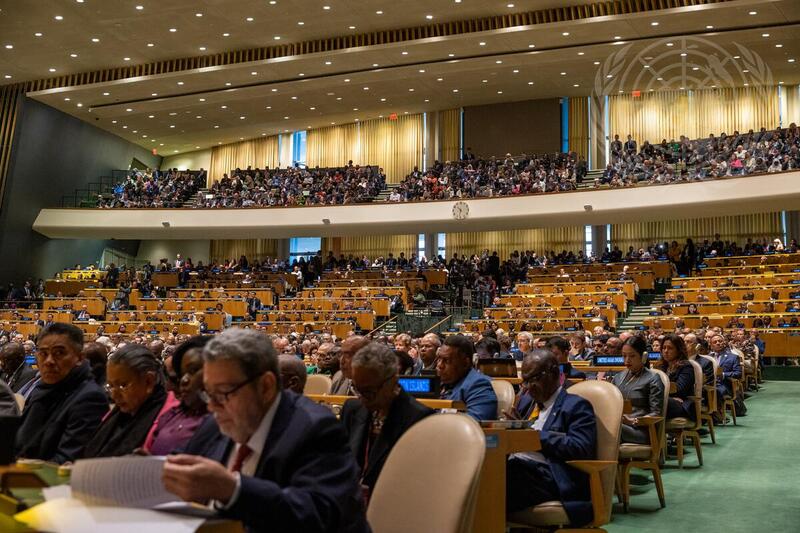 A view of delegates inside the General Assembly Hall during the first day of the 78th session of the General Assembly held on 19 September 2023. Photo by UN Photo/Paulo FilgueirasThe Islamic Emirate of Afghanistan’s quest for diplomatic recognition