By Hilary Whiteman, Anna Coren and Abdul Basir Bina
Karachi, Pakistan
Arzo is so weak she spends most of her day lying on a thin mattress in a dimly lit room under a ceiling fan that steadily circulates the polluted air of Pakistan’s largest city.
To pass the time, she watches makeup videos on her cellphone, the glow of the screen illuminating the faded freckles of a teenager whose skin now rarely sees the sun.
Arzo is a long way from her home in Afghanistan, where she lived with her parents before being smuggled across the border for medical treatment.
Her older brother and sister, Ahamad and Mahsa, now care for her in a rented room in Karachi, their temporary refuge from life in Afghanistan under Taliban rule.
“Don’t worry,” whispers Ahamad, as he kisses Arzo’s hand. “You will be fine. Don’t worry, we are with you always. I’m hoping you will be fine soon.”
CNN is not using Arzo’s or her siblings’ real names because they fear reprisals from the Taliban, and being discovered by Pakistani officials, who have deported more than 26,000 Afghans since announcing a crackdown on undocumented migrants in October.
Being forcibly returned to Afghanistan would mean certain death for the 15-year-old, her siblings say, because she needs medical care they say isn’t available in their home country.
The siblings don’t normally talk about why their little sister is so unwell – they don’t want to upset her. As they told CNN their story, Arzo silently wept.
A girl with ambition
Arzo dances barefoot in jeans to pop music with her sisters inside a home in Afghanistan. She smiles as she twists her hands in time with the beat.
Ahamad said the video was filmed six months after the Taliban seized control of the country in August 2021. Schools were closed but his sisters were confident they would reopen.
They didn’t. Instead, the Taliban gradually reimposed the repressive policies that shrank the role of women in society during their previous rule from 1996 to 2001, despite assurances they wouldn’t.
Women are banned from most workplaces, universities, national parks, gyms and going anywhere in public without a male chaperone.
And girls are no longer educated beyond sixth grade.
Afghan women once worked in this popular national park. Now they’re not even allowed to visit
Mahsa had already graduated high school, but Arzo still had three years ahead of her.
When their village school closed, their worried father sent his daughters to study English at an education center in Kabul, but that soon shut, too.
Back at home, Mahsa took up tailoring to pass the time. But Arzo drifted deeper into depression.
“Most of the time she said, ‘I hope we should move from this place, I don’t want to be here, there is no education and I want to become a doctor,’” Mahsa recalled Arzo saying.
One day in July, Mahsa walked downstairs to find her sister staring at her with bulging eyes.
“I asked her, ‘What happened to you?’ She said that she drank acid. I didn’t believe it, so I put my fingers in her mouth and she vomited up blood,” Mahsa said.
Doctors see rise in suicides
Experts say reliable statistics on suicide and suicide attempts aren’t compiled in Afghanistan, but rights groups and doctors say they’ve seen an increase under Taliban rule.
Dr. Shikib Ahmadi has been working six days a week and longer hours than ever, seeing patients at a mental health clinic in Afghanistan’s western Herat province. He’s using a pseudonym because he fears the Taliban will punish him for speaking to foreign media.
Ahmadi said the number of female patients at his clinic has surged 40% to 50% since the Taliban’s takeover two years ago. Around 10% of those patients kill themselves, he said.
Their lives restricted by the Taliban, girls and women are turning to cheap household items to attempt suicide, he said. Rat poison, liquid chemicals, cleaning fluids, and farming fertilizer – anything they think will ease their grief.
Ahmadi says he tries to tell them things will get better, that schools will reopen, that they can work at home while they wait, tailoring or doing something that gives them purpose.
But the truth is he doesn’t know if classes will ever resume, and his own hope is fading.
“I don’t see any good future for anyone in this country,” he said.
Another group of girls has just graduated from sixth grade – the end of their education under Taliban rules.
Ahmadi fears that will mean another wave of self-harm and suicide.
Taliban compounds misery for women in Afghanistan with order to close all beauty salons
“Last year, everyone had a hope that next year the schools will be open. The government promised that they will open the schools,” he said.
“But since this year, the schools are not open, so people lost their hopes. I feel like the number of suicides will increase.”
CNN has contacted the Taliban for comment about the reported rise in suicide among women.
In a statement provided by the Taliban’s Ministry of Foreign Affairs to the Office of the United Nations High Commissioner for Human Rights in January, the group claimed that female suicide rates had fallen since they came to power.
“In the last 20 years, there were many case (sic) of women committing suicide, but by the grace of Allah, we do not have such cases now,” the statement said.
The claim is contradicted by multiple reports, including from UN experts, who said in July that “reports of depression and suicide are widespread, especially among adolescent girls prevented from pursuing education.”
Arzo is fed fluids through a feeding tube while she waits for an operation to repair her wounds.
Javed Iqbal/CNN
The Taliban’s return
Arzo was born in 2008, seven years after the United States and its allies invaded Afghanistan and removed the Taliban leaders the US accused of harboring al Qaeda terrorists behind the 9/11 attacks.
Under the Western-backed Afghan government, a devastating civil war raged for years, but life had nonetheless improved for Afghan women. Many started school, earned degrees and became role models for girls like Arzo and Mahsa.
But everything changed in 2021 when the US and its allies started pulling out of Afghanistan, creating space for the resurgence of Taliban fighters, who’d retreated to rural areas of Afghanistan and Pakistan.
Back in power in the cities, the Taliban reimposed their radical Islamist ideology, carrying out extrajudicial executions, arbitrary arrests, and unlawfully detaining anyone considered a threat to their leadership, according to rights groups.
Two years on from Taliban takeover, Afghan women are being ‘erased from everything’
Ayesha Ahmad, an associate professor in global health humanities at St. George’s University of London, was conducting in-depth interviews with women in Afghanistan who had fled domestic violence when the Taliban moved in.
“I will never forget the day of the takeover, the frantic calls and communications and the absolute terror that they were feeling because they knew what the reality would be, and they were right,” she said.
Now many more women are vulnerable to violence, she said, and some see suicide as the only escape, despite the cultural stigma and shame it would bring on their families.
“Suicide is a sin in Islam, and in this context of religious extremism, women are not going to be seen as a victim,” she said.
With little sympathy from the Taliban leaders who created this situation, Afghanistan’s women are looking outside their country for support.
Heather Barr, associate director of the women’s rights division at Human Rights Watch, said Afghan women worry the world is beginning to accept that what’s happening to them is normal.
“Everyone’s kind of shrugging and saying, ‘Well, it’s Afghanistan.’ It should be intolerable to all of us. Because what happens in Afghanistan, and how the international community does or doesn’t respond, has huge implications for women’s rights globally,” she said.
“We have to be saying to our governments that this can’t be seen as normal. This can’t be treated as just one more country with a domestic issue.”
‘I cry for her future’
Ahamad wasn’t in Afghanistan in July when his sister drank the acid.
He had already fled to Pakistan, fearing retribution from the Taliban for his work as a journalist before they took power. He told CNN his father and uncle took Arzo to a local doctor, who gave her some medicine and told them to go to Kabul if her condition worsened. It did.
In Kabul, a doctor said the acid had damaged her esophagus and stomach and she was unlikely to survive surgery. So, they decided to take her to Pakistan, where Ahamad was waiting with a doctor. Ahamad then took Arzo to Karachi, where another doctor inserted a feeding tube into her stomach.
That was three months ago. Since then, Ahamad says Arzo has steadily lost weight and now weighs about 25 kilograms or 55 pounds.
“Her situation is not good at all. The doctors installed the pipe to her stomach for feeding so she can gain weight and be ready for the real operation,” in January, Ahamad said.
“Maybe she won’t gain weight,” he said. “And maybe they won’t do the operation.”
Mahsa sits on the bed, her needle piercing fabric with enough precision to keep her mind focused on the task. She would like to return to study, but right now caring for her sister is all that matters.
“I can’t sleep at night because she is in pain,” Mahsa said.
The siblings know they’re taking a huge risk by speaking out – they fear the Taliban’s reach in Pakistan and for their parents, who are still living in Afghanistan.
But they’re desperate.
Neither can work, the siblings say, and they don’t have the $5,000 needed for Arzo’s surgery, as well as money for the room, food for themselves and the cans of powdered milk and juice they need to keep her weight from dropping.
They don’t want to think about what happens if the last of their money runs out, or if the Pakistani police come knocking on the door.
Since October, when Pakistan’s government announced it was no longer tolerating the presence of undocumented Afghans, nearly 400,000 have returned to Afghanistan, according to the UN’s High Commissioner for Refugees (UNHCR) and the International Organization for Migration (IOM).
In October, the UN’s OCHR urged Pakistan to halt the removals, warning that those who returned were at “grave risk of human rights violations.”
The most vulnerable included “civil society activists, journalists, human rights defenders, former government officials and security force members, and of course women and girls as a whole,” spokesperson Ravina Shamdasani told journalists in Geneva.
Pakistan has defended its Illegal Foreigners Repatriation Plan (IFRP), saying in a statement that it’s “compliant with applicable international norms and principles.”
Ahamad wants a safe place to go with his sisters, where they can rebuild their lives, resume their studies, and start to work as they’d always planned to do.
He knows that returning to Afghanistan is not an option for his sisters, especially Arzo, who cries with despair at the suggestion.
“If she returns to Afghanistan, she will face the same fate. It would be better to live in a peaceful country and continue her education and proper treatment,” Ahamad said.
For now, they live within the four walls of a room heavy with grief for the girl who used to dance barefoot but now struggles to find the strength to lift her head.
“I don’t cry in front of her, but I kiss her and cry while she sleeps at night, for her future, for her treatment, so she can survive this sickness,” said Ahamad.
Oppressed by the Taliban, she swallowed acid. Now her siblings are trying to save her life
The meeting is the first between Mawlawi Abdul Kabir and a foreign official within the past three months.
The Prime Minister’s office said in a press release that the Political Deputy Prime Minister Mawlawi Abdul Kabir met with Robert Chatterton Dickson, chargé d’affaires ad interim of the UK Mission to Afghanistan, and discussed many issues.
In the meeting, the Political Deputy Prime Minister emphasized the need to give the seat of Afghanistan to the representative of the Islamic Emirate in the United Nations and asked countries to send their representatives to Afghanistan.
“The Islamic Emirate has committed to having good relations with all countries but with conditions that the countries do not interfere in the internal affairs of Afghanistan and let the Afghans continue improving and developing amid stability,” said Zabiullah Mujahid, the Islamic Emirate’s spokesman.
The meeting is the first between Mawlawi Abdul Kabir and a foreign official within the past three months as the deputy PM was absent from the office due to health issues.
“The deputy Prime Minister asked the Britain chargé d’affaires to give the Afghanistan seat at the UN to the Islamic Emirate. I think this a useless wish. The Islamic Emirate should bring reforms inside the country,” said Wahid Faqiri, international relations analyst.
“The meeting between the Deputy Prime Minister and chargé d’affaires is effective for the improvement of the situation in Afghanistan,” said Ahmad Khan Andar, political analyst.
Returning to his office, Mawlawi Abdul Kabir on Wednesday met with many members of the cabinet, where he discussed the Afghan refugees deported by Pakistan.
Geng Shuang, Chinese envoy at the UNSC, stressed the need to ensure that Afghanistan does not become a hub for terrorist organizations.
The UN Security Council said in a statement it has extended for another year the mandate of the team monitoring sanctions on the “Taliban and associated individuals and entities, which threaten Afghanistan’s peace, security and stability.”
The 15-member body, the statement said, “unanimously adopted resolution 2716 (2023) (to be issued as document S/RES/2716(2023)), directing the Monitoring Team to support the Committee established by resolution 1988 (2011), designating sanctions on individuals, groups, undertakings and entities found to be part of and linked to the Taliban.”
“Further to the text, the Monitoring Team is to gather information on instances of non-compliance with measures that include the freezing of funds and assets, prevention of travel and supply or transfer of arms and related equipment, established by resolution 2255 (2015),” UNSC said. “It is also to facilitate, upon request of Member States, assistance with capacity-building, and provide recommendations to the Committee for actions to respond to non-compliance.”
The new mandate will expire in December 2024.
According to the statement, the US ambassador to the UN, Linda Thomas-Greenfield, whose delegation was the penholder on Afghanistan sanctions issues, welcomed the mandate’s renewal, saying the voting result is a “confirmation of the continuing importance of the 1988 sanctions regime” in supporting peace and security in Afghanistan.
The Team’s reporting remains crucial to understanding both the impact of the sanctions and the events on the ground in Afghanistan, she said, adding that “these insights enable Member States to track whether the Taliban follows through on its commitments,” including on counter-terrorism, human rights for women and girls and unhindered humanitarian access.
Geng Shuang, Chinese envoy at the UNSC, stressed the need to ensure that Afghanistan does not become a hub for terrorist organizations.
The international community must integrate the country into “the family of nations,” he said, expressing appreciation for the provision encouraging the Monitoring Team to visit Afghanistan and communicate with all Afghan parties.
He also urged the council to make timely adjustments to sanctions measures to avoid any negative impact on the Afghan people.
The team’s reports are a useful support for the Committee, said Anna M. Evstigneeva, envoy of the Russian Federation.
She said they are pleased that the text of the adopted resolution notes the importance of the travel of the team to Afghanistan, which remains a key condition for the mandate’s implementation.
But the Islamic Emirate condemned the decision, saying that the imposition of sanctions does not benefit any side.
“It is better that the countries and organizations understand that the imposition of sanctions is not the solution. The failed experiences will not be beneficial,” said Zabiullah Mujahid, the Islamic Emirate’s spokesman.
The Islamic Emirate’s leaders within the past two years have repeatedly voiced criticism over sanctions imposed on them by the international community.
UNSC Renews Mandate of Team Monitoring Sanctions on Islamic Emirate
There are no more state-sponsored women’s shelters in Afghanistan
The Taliban government in Afghanistan is putting women abuse survivors in prison and claiming it is for their protection, according to a UN report.
The UN said the practice harms the survivors’ mental and physical health.
There are also no more state-sponsored women’s shelters as the Taliban government sees no need for such centres, the report noted.
The Taliban’s suppression of women’s rights in Afghanistan is one of the harshest in the world.
The United Nations Assistance Mission in Afghanistan’s (UNAMA) said that gender-based violence against Afghan women and girls was known to be high even before the Taliban took over Afghanistan.
But since then, such incidents have become even more common, given the impact of economic, financial and humanitarian crises which have afflicted the country, UNAMA said. Women have also been increasingly confined to their homes, which heightens their vulnerability to domestic and intimate partner violence.
Before the Taliban retook power in 2021, there were 23 state-sponsored women’s protection centres or shelters in Afghanistan, according to UNAMA, but these have since vanished.
Taliban officials told UNAMA there was no need for the shelters as the women must be with their husbands or male family members. One said such shelters were “a western concept”.
The officials said they would ask for male members of the family to make a “commitment” to not harm the woman survivor.
In instances where she had no male relatives to stay with, or where there were safety concerns, the survivor would be sent to prison “for her protection”. This would be similar to how some drug addicts and homeless people are housed in the capital Kabul, noted UNAMA.
But UNAMA said this “would amount to an arbitrary deprivation of liberty”.
“Confining women who are already in a situation of vulnerability in a punitive environment would also likely have a negative impact on their mental and physical health, re-victimisation and put them at risk of discrimination and stigmatisation upon released.”
UNAMA also noted that for a one-year period from 15 August 2021, the Taliban administration’s handling of gender-based violence complaints was “unclear and inconsistent”.
For example, there is no clear distinction between criminal and civil complaints, which does not ensure effective legal protection for women and girls.
The complaints are mostly handled by male personnel, and UNAMA noted that the absence of women personnel “discourages and inhibits survivors from lodging complaints”.
Survivors are now no longer guaranteed redress for their complaints, including civil remedies and compensation. They are reportedly more afraid of the Taliban government and their arbitrary actions and thus choose not to seek formal justice, said UNAMA.
While there were efforts to advance women’s rights between 2001 and 2021 – including law and policy reforms – these have “all but disappeared”.
Since retaking power in 2021, the Taliban government have all but broken their earlier promises to give women the right to work and study.
Girls in Afghanistan are only allowed to attend primary school. Teenage girls and women have also been barred from entering school and university classrooms.
They are not allowed in parks, gyms and pools. Beauty salons have been shut, while women must dress in a way that only reveals their eyes. They must be accompanied by a male relative if they are travelling more than 72km (45 miles).
Afghanistan: Taliban sends abused women to prison – UN
When the Islamic Emirate of Afghanistan (IEA) retook power, it started reclaiming state land that had been seized during previous administrations. In October 2022, the IEA established the Land-Grabbing Prevention and Restitution Commission, within the Ministry of Justice, whose purpose is to investigate land-grabbing under the Islamic Republic, restore any state land and prevent it happening in the future. The IEA has also established a special court to which any party with an objection to a decision by the commission can appeal. AAN’s Ali Mohammad Sabawoon gives an account of the commission’s work and assesses how much usurped land has so far been reclaimed.
Disputes over land ownership have been a major issue in Afghanistan for decades, helping to fuel the broader conflict since 1978 (for more on this, see this USIP paper). With each turn of the political wheel, a new set of actors took power and could seize or redistribute land, making disputes ever more complex. Many disputes over land are between citizens, and the IEA has said these have to be dealt with by the courts. The commission it has set up deals solely with what the Emirate believes could be usurped state land – and this is also the subject of this report.
This report looks at how the Emirate has dealt with historical state land-grabbing since the takeover. It provides a short historical background to land-grabbing and previous attempts to counter it and then details the legal framework adopted by the newly-created land-grabbing commission and special court and provides an overview of the commission’s work through five case studies in Kabul, Kandahar, Nangrahar, Uruzgan and Helmand provinces.[1] To gain granular detail of the commission’s work in these provinces, AAN interviewed 16 people with direct knowledge of the commission’s work (seven face-to-face interviews and nine by phone). The interviewees included journalists, tribal elders and IEA officials.
A short background of land-grabbing
State land comprises forests, ‘protected land’ (ie protected from development by the state or protected by law) and non-irrigated land. Only non-irrigated land can legally be sold or leased by the state, and then only under certain conditions.[2] However, such rules broke down under the Republic and in earlier periods when there was widespread grabbing of state land by senior officials, their close relatives and other influential and powerful figures (see Middle East Institute (MEI) report here). They either took the land for themselves and sold it on to others, or distributed it to clients and supporters, especially to relatives, sympathisers, factional comrades and fellow tribe members, further strengthening their power among their own community and thus their relevance at the national level. The phenomenon was especially common in or around Afghanistan’s cities. In some cases, the land-grabbers made sure to obtain legal documents from the government to show that they had been granted the land legally. This was possible for those holding high office, their relatives or other powerful individuals, who could threaten or bribe officials or give them a share of the land as a reward for the title deeds.
Attempts to reclaim such land were made – or seen to be made – under the Republic. In 2014, the Karzai government established a law which was passed by the Wolesi Jirga (lower house of parliament), determining punishment for the usurpers of land. At that time, members of the Wolesi Jirga and deputy of the commission established for evaluating state and public land in the parliament, Sher Wali Wardak,saidthat 1.3 million jeribs (226,000 hectares) of state and public land had been usurped by 5,300 people. That number, he said, included members of parliament, ministers and commanders (see media report here). However, the issue appeared to drift – certainly, no reports were published to indicate whether or not any land, or how much, had been reclaimed based on the efforts made by the Wolesi Jirga commission
Two years later, in 2016, the new president, Ashraf Ghani, asserted that “the culture of land usurpation is not accepted by the nation anymore.” He said he had appointed provincial governors, heads of police, municipalities, corps commanders and others whose first and fundamental duty was to prevent land usurpation (see Ghani’s Facebook page here). However, a former government official in Kandahar told AAN that a delegation tasked by Ghani to investigate just one case, the Aino Mena township in that city, just took money from “the owner” (Mahmud Karzai, brother of then former president Hamed Karzai), as a fine for having built on state land – USD 27,00 per jerib. Nothing changed. It was an example of how those who had usurped land could challenge even the power of the president of the Republic.
Land was also an issue for the Taleban leadership even before they captured power, as evidenced by it being regulated by two decrees issued by Sheikh Hibatullah Akhundzada during the insurgency: state land can be leased to the public, he ordered in 2017, while private land must not be seized by the ‘mujahedin’ (Taleban fighters and commanders) or anyone else (ordered in 2019). Following the takeover, Hibatullah’s first two published orders also concerned land. In the first five weeks of Emirate rule, he had ordered an end to the usurpation of state land, which he said had been “the norm” under the “puppet administration.” He also ordered provincial governors “to rigorously prevent the grabbing of Emarati [state] land and hand over usurpers to face sharia law.”
A month later, in October 2021, he again banned land-grabbing, this time for land whose ownership was unclear. Only the supreme amir, ie himself, the order decreed, “Based on necessity and expediency, can give [such land] to a member (of the Muslim community) as property.” The decree drew a parallel with what it said was the amir’s right to “withdraw from the public coffer [bait ul-maal]” and presumably give money to someone, again because of expediency. Elsewhere in the amir’s body of orders, this is also banned for others. In March 2023, the ban on officials selling land, or transferring land to individuals or corporations, was repeated, unless there was a specific decree from the amir (for the texts of the decrees up to March 2023 and an accompanying report, (see here and here).
The land commission, the special court and their objectives
The supreme leader of the IEA, Sheikh Hibatullah, established the Land Grabbing Prevention and Restitution Commission (in Pashto, de zmako de ghasab de makhniwi aw de ghasab shoyo zmako de istirdad kamesuin) by decree in mid-October 2022. See this report on the Supreme Court website and the text at the end of this report. The commission is headed by the Minister of Justice, with the Ministers of Agriculture, Irrigation and Livestock, Urban Development and Housing and Work and Social Affairs as members. The commission has 11-member delegations in each province (12 members in Kabul), as well as 146 administrative and technical employees. The supreme leader also appointed a court consisting of a judge, mufti (cleric able to give fatwas or religious decisions), head of the court and a clerk (moharir) (see a tweet from the spokesman of the IEA here). He also ratified the draft law that the members of the commission had prepared. The draft law consists of four chapters and 22 articles, in Pashto and Dari languages (see the draft law here and read AAN’s translation of part of it in the Resources section of this website).
When the commission intends to assess any land, according to a journalist who has followed commission proceedings, it first invites community elders to a meeting and speaks to them. It provides them with information about the process and tells them to come along with any kind of ownership documents they have. The commission then sees and assesses the documents. If they are legal, they simply tell the people that the land or property does belong to them and no one else has any business with their land. If someone fails to present legal ownership documents to the commission, it will conclude that the property lacks legal documentation and the person who claims to own it is banned from building on the land or selling it. Anyone breaking this ban is forcefully stopped by the IEA. However, the commission gives people a chance to appeal its decision and submit their case to the special court. The author has seen neither any published number of cases presented to the court nor a breakdown of how many are successfully appealed and how many fail.
According to the Minister of Urban Development and Housing, Hamdullah Nomani, speaking at a gathering on 28 June 2023 to celebrate the achievements of the ministry during the previous year, 80 per cent of land in Afghanistan is owned by people who only have informal documents, which are not acceptable to the courts, based on current rules and regulations. He said eleven kinds of documents were accepted by the IEA and mentioned three – a legal ownership documents issued by the state (sharie qabala), letters of guarantee (de wasiqai khatona) and in some cases, tax receipts (see Pajhwok report here).
As the minister said, ownership of the vast majority of private land is evidenced by a customary document (orfi qabala). This is not an official document, nor is it issued by the state, but by the owner of a plot of land at the time when he or she wants to sell it or transfer its ownership. It is a customary guarantee that the land is theirs. If any third party claims ownership of it through witnesses, documents or other means and goes directly to the buyer to claim ownership and if the land is proven to belong to that third party, the seller of the land would have to give the buyer a refund. Importantly for this report, if a landowner only has an orfi qabala, and the government claims the land, the document is worthless. The commission will insist that the land belongs to the state.
The commission has been working apace. IEA-run newspaper Hewad Daily, quoting Ministry of Justice spokesman Hamid Jahadyar, wrote on 30 May that by that point, the commission “had assessed four million jeribs (800,000 hectares) of land, of which 500,000 jeribs (100,000 hectares) had been identified countrywide and taken and delivered to IEA departments.”
Two months later, on 27 July 2023, the secretary of the commission, Ehsanullah Wasiq, said in the commission’s accountability session (milat ta the zawab wayalo programme) that it had by then evaluated 7,949,721 jeribs (about 1.6 million hectares) of land.[3] Of that, the vast majority – 7,551,343 jeribs (1.5 million hectares) had been identified as state land and 589,499 jeribs (118,000 hectares) had been retaken and registered in the government’s land bank.
These statistics represent the bare bones of the commission’s work so far. To better understand the impact of its judgements, AAN has conducted five provincial case studies.
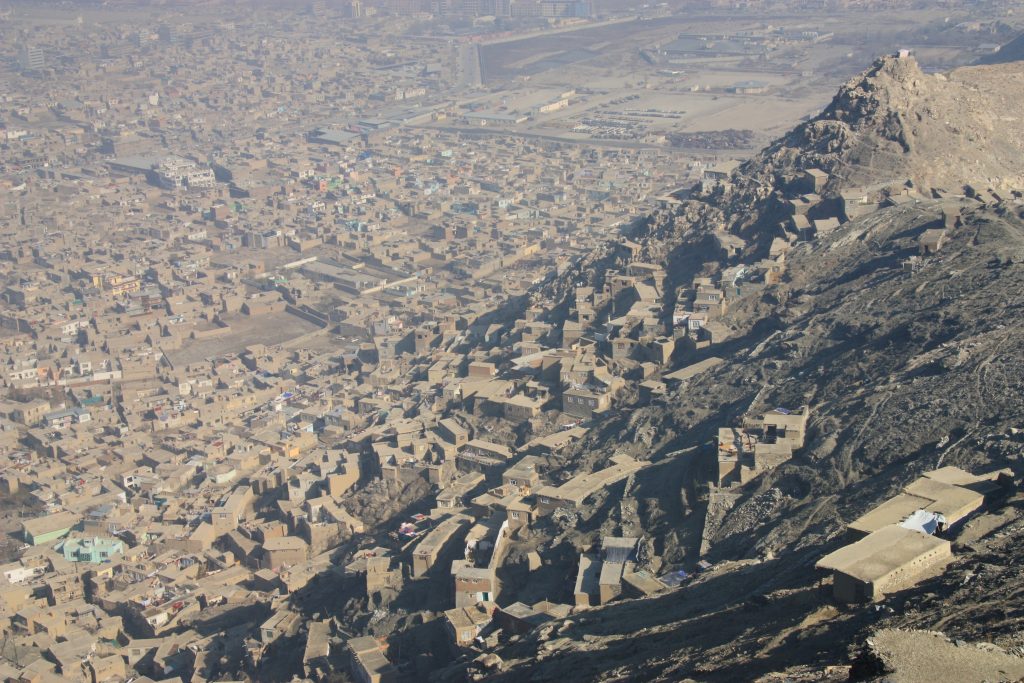
Houses on the slopes above Kabul built on state land. In the Old City below, much of which was destroyed in the 1990s civil war, land grabbing and informal development has taken place, largely on private land. Photo: Fabrizio Foschini, 2012
Provincial Case Studies
Kabul
In terms of cost and quality, Kabul holds the first position in the usurpation of land in Afghanistan. Ten square metres of land in Sherpur, the upmarket neighbourhood in the heart of the capital, is worth more than hundreds of jeribs of land grabbed in Marja or Nad Ali districts of Helmand or any other province.
Land-grabbing began early in the capital. In 2003, armed police, led by Kabul Chief of Police Abdul Bashir Salangi, and acting on the orders of then Minister of Defence, Marshall Muhammad Qasim Fahim, violently and suddenly levelled the homes of people living in Sherpur. The land belonged to the ministry, but as Joanna Nathan, writing for the Middle East Institute (MEI), described, the residents had been there for decades and were given no opportunity to argue their case or indeed pack up their belongings. All of those directly involved in the destruction (ie minister, police chief and most of the police) belonged to the group which had captured Kabul in 2001, the Shura-ye Nizar network within Jamiat-e Islami. The minister then handed out plots of land to commanders, cabinet ministers and other well-connected individuals, most of them Shura-ye Nizar comrades or other powerful figures in the government. Two Shura-ye Nizar commanders received multiple plots, according to MEI. For a list of those receiving plots compiled by the Afghanistan Independent Human Rights Commission (AIHRC), published by MEI and with added biographical information from AAN, see the end of this report.
There were only three high-profile state officials who publicly criticised the move, then Minister of Finance, Ashraf Ghani, who also refused a plot, head of the AIHRC, Sima Samar, and AIHRC employee Nader Naderi. Beneficiaries defended taking the land. For example, as reported by MEI, Education Minister Yunus Qanuni claimed the land-grabbing was legal because the Ministry of Defence owned the land and could distribute it as it wished. Central Bank governor (later Finance Minister) and head of the Afghan Millat party, Anwar ul-Haq Ahadi told journalists he was entitled to the land and denounced anyone who dared criticise the process as participating in “political terrorism.” Nathan ended her report:
The Sherpur evictions were a seminal event in puncturing the enormous hope that had surrounded the 2001 intervention. The resulting mansions serve as monuments to the powerlessness of ordinary Afghans and a daily reminder to Kabulis of the impunity of the new administration and international inaction.
The table below lists the people who received plots of land in Sherpur, originally published by MEI and sourced to the Afghanistan Independent Human Rights Commission. Details in the status column have been amended by AAN: information from the AIHRC, via MEI, is in plain text; information added by AAN is in italics.
Governor of the Afghanistan Bank, Afghan Millat party leader
1
2
Habiba Sarabi
Minister of Women’s Affairs
1
3
Khaleq Fazel
Chair of Evaluation and Review Commission on State Industries
1
4
Marshal Qasim Fahim
Minister of Defence, Shura-ye Nizar
1
5
Muhammad Yunus Qanuni
Minister of Education, Shura-ye Nizar
1
6
Kabul Mayor’s Deputies [sic]
Khaled, finance office for the late Shura-ye Nizar leader Ahmad Shah Massud during the ‘Resistance’ (Tajik from Mazar-e Sharif)
1
7
Hamid Seddiqi
Head of Protocol, Ministry of Foreign Affairs Employee of former King’s Office
1
8
Hedayatullah Dayani
Employee of former King’s Office
1
9
Malik
Possibly General Malik, who led the rebellion against General Dostum, allowing the Taleban into Mazar-e Sharif in 1997 and subsequently oversaw the murder of thousands of Taleban fighters.
1
10
Haji Muhammad Mohaqeq
Minister of Planning, Hezb-e Wahdat
1
11
Baba Jan
Commander, former PDPA, then Shura-ye Nizar
1
12
Haji Almas
Commander,Hezb-e Islami
1
13
Amanullah Guzar
Commander, latterly Shura-ye Nizar
8
14
Abdul Rahim
Minister of Justice, Shura-ye Nizar
6
15
Halim Khan
1
16
Shakir Kargar
Minister of Water & Power, Jombesh-e Meli
1
17
Baba Jalandar
Commander, Shura-ye Nizar
1
18
Gul Haidar
Commander, Shura-ye Nizar, head of security southeast zone (Loya Paktia)
1
19
Commander Gada
Shura-ye Nizar
1
20
General Momen’s family
Jombesh-e Meli, although close to Shura-ye Nizar, died in 1994.
1
21
Gul Agha Sherzai
Minister of Urban Development, commander in Kandahar
1
22
Haji Ferozi
055 Corps Commander
1
23
Haji Katib
Ministry of Defence Employee
1
24
Muradi
Director of Planning, Kabul Municipality
1
25
Bismillah Khan
Deputy Defence Minister, Shura-ye Nizar
1
26
General Aziz
1
27
Jegdalik
Mayor of Kabul, Shura-ye Nizar
1
28
Haji Qadir’s family
Minister of Public Works, Hezb-e Islami Khales, assassinated in July 2002
1
29
Dr Taj Muhammad
Minister of the Interior, married to the niece of his predecessor, Yunis Qanuni (from Shura-ye Nizar)
1
Details of the recipients in the status column have been amended by AAN: information from the AIHRC, via MEI, is in plain text; information added by AAN is in italics.
The usurpation of state land in and around Kabul has been a constant of the past two decades, said AAN analyst, Fabrizio Foschini, who has followed the issue closely. He says, however, that its forms changed over time.
From the more brazen grabs of state lands such as in Sherpur in the early years of the Republic, land appropriation schemes evolved, coming to involve ‘land development firms’ usually linked to powerful government officials or the hijacking of government housing projects meant for specific categories (civil servants, returnees, etc).
In other cases, it was the plight of specific dispossessed groups, such as the Kuchi nomads, that provided the excuse for occupying state land: political patrons emerged who helped the landless settlers secure their squats around the capital in exchange for support at elections or in other mobilisations meant to increase their own relevance as powerbrokers, while also extracting economic dividends from the allocation of the plots thus conceded by the government.
Calls for the government to do something about land-grabbing were futile because, most of the time, it was members of the government, senior figures in the armed forces and politicians – or their relatives – who were doing the land-grabbing. Another such example was the brother of the Second Vice President, Abdul Karim Khalili, Haji Nabi. According to a 2013 report from Radio Liberty, he acquired 50 jeribs (10 hectares) of state land belonging to the Ministry of Defence in the north of Kabul and built a township, called Omid-e Sabz on that land. The report also said that he usurped more than one thousand jeribs (200 hectares) on the slopes of Koh-e Korukh, (Korukh Mountain) in the neighbourhood of Omid-e Sabz.
Reclamation of land in Kabul by the IEA began by the municipality soon after the takeover, before the land-grabbing commission was set up. For example, a road in the Spin Kali area of Khushal Khan, located in district five, was taken back by the municipality. The road leads from Khushal Khan towards Dast-e Barchi and joins the ring road in the Dar-ul-Aman area. AAN saw that a 40-metre-wide road was being asphalted and some houses that had been built on the road or on its brink had been completely or partially destroyed by the government. One resident, Sayed Khan, said the road had been built during Daud Khan’s era (1973-78) and, over the years, people had encroached on it with their house-building. He said officials from the Republic had also tried to reclaim the road, but “the people refused to return this part of the road to the government.” He said IEA officials had also come and asked people to present their legal ownership documents. When they could not, he said the officials gave them only a three-day deadline and, on the fourth day, came with different kinds of vehicles and bulldozers and started razing the houses or parts of them, to the ground. Sayed said the government had not reassured the people with promises of alternative places to live.
However, after hearing different accounts of what had happened, it became clear to the author that the situation of landowners varied: some had legal documents and others did not, but all had seen parts of their houses destroyed. Two people living on what had been agricultural land said the officials had promised to compensate them. Another man, who was busy repairing the parts of his home that had been destroyed, said the amount of compensation had yet to be specified by the IEA.
The same road also connects to Chaharahi-ye Qambar and then on to Kotal-eKhair Khana in district 17, where hundreds of houses have been destroyed by Kabul municipality since the IEA takeover to fit in with the government’s master plan for the capital. In the area from Chaharahi-ye Shaheed to Qasaba in district 15, 450 houses were also razed (see YouTube video reports by Afghanistan Map here and Kabul Show here).
On 10 June, Pajhwork reported, quoting the municipality, that 100 jeribs (20 hectares) of land had been retaken from usurpers and that according to the city plan, the land would return to a green area and a road was planned to be constructed through the area as well (see Pajhwok report here).
AAN also visited Tarakhel township, located around 30 kilometres northeast of Kabul, in Bagrami district of Kabul province. According to residents, the township had been built in the era of Hamid Karzai, most probably in 2007, on around 35,800 jeribs (7,160 hectares) of land. They said Karzai had granted this land to Mullah Tarakhel Muhammadi, an MP in the Republic. The land was then divided between Mullah Tarakhel and Haji Monjai, a tribal elder not from Tarakhel’s tribe, but another important political actor and like Mullah Tarakhel with a jihadi background with Hezb-e Islami. These two men then distributed the land to the people of their clans and they, in turn, sold it on to different people from different provinces who built houses there. The township has a large bazaar with many shops and markets. The previous government also built some schools in the township, but not enough to meet the requirements of the residents in terms of basic education.
One of those who bought land and built a house in the township, Nur Khan, who is originally from Sayed Karam district of Paktia province, told AAN that an IEA official from Kabul municipality (whether with the commission, or not, he did not say) had come to the township and spoken to the people and to Mullah Tarakhel himself. He said they surveyed the land and found the plot was not bigger than the limit stated in the document that Karzai had given to Tarakhel.
Nur said the officials then said the width of the streets in the document was 12 metresand there were places specified for parks, schools, mosques and clinics, but none of these appeared on the ground. “The officials then told the people that [from now on] all construction work was banned and no one could buy or sell the land.”
Another resident, who is from the Tarakhel clan, Sharbat Khan, however, said that if a person had the approval of an NGO to carry out construction, the IEA would allow the building to go ahead. He said a Norwegian NGO had given some people around 300-500 USD to make a shelter. Pajhwok news agency reported on 26 October that a ‘credible source’ had revealed to it that Mullah Tarakhel had been summoned by the commission and arrested (see Pajhwok report here).
An IEA official, who wished to remain unnamed, told AAN that Tarakhel had been ordered by the Minister of Justice to vacate his house, but he had not. He said the minister had him arrested and sentenced him to one week of detention. Even though his time was completed, the official said, Tarakhel’s detention was lengthened for 10 more days. Mullah Tarakhel’s brother, Musa Khan, said in a video posted on Facebook on 8 November that he had emptied Mullah Tarakhel’s home, his guest house and madrasa on the order of the Minister of Justice. In the video, he requested the minister to release his brother. The official said that Tarakhel was then released
The process of identifying and reclaiming state land is also underway in the Omid–e Sabz township. According to a report from the Afghan Voice Agency (AVA) from February 2023, the commission, in its initial deliberations, had declared that the township was built on state land. As to the even more valuable Sherpur land, it has not yet been reported whether or not the IEA has begun to look into it. High-profile Taleban are now living in some houses, like those of two former vice presidents, brother of Ahmad Shah Massud, Ahmad Zia Massudand Jombish-e Melli leader, Abdul Rashid Dostum. However, the IEA official told AAN that the commission would discuss Sherpur soon. He said the IEA had established a commission to investigate all the homes of people who had left Afghanistan (evacuated in August 2021), including in Sherpur and asked those who had moved into the houses – mostly Taleban – to leave or pay rent into a special bank account which, if the house is proved to have been legitimately owned, will be transferred into the owner’s personal account.
The official also said they would be discussing other neighbourhoods, “in PD [police district] 17, the townships of Tilayi, Safa, Zakirin, and in Sar-e Kotal-e Khair Khana, where Amanullah Guzar usurped land [and also] Dasht-e Champtala, taken by commanders related to [leader of mujahedin faction, Ettihad-e Islami and later MP, Abdul Rabb Rasul Sayyaf] and to the Hazara ethnic group [sic] and in Mullah Ezat’s township in PD 5, and in Khushal Khan Mena, Kampani, Kart-e Mamurin, Afshar, Mirwais Maid and other [neighbourhoods].”
In the summer, at its accountability session, the commission’s secretary, Ehsanullah Wasiq, said the fate of about 41,972 jeribs (8,394hectares) of usurped land in Kabul had been sent to a special court for its final decision. It has apparently decided in the state’s favour, given the recent announcement of a new law ratified by the supreme leader of the IEA. It said that “41,970 jeribs of land in PDs 8, 16, 17, 20 and 21 of Kabul city have been declared as state land and the Ministries of Agriculture, Hajj and Awqaf, and Information and Culture ordered to rent the land out on lease to their current owners, according to sharia principles.” The new decree says reclaimed state land in Kabul will be leased out to its ‘current owners’, but does not mention what would happen to the land that had changed hands several times.
Informal settlements in Kabul were estimated in 2017 to account for around 70 per cent of the built-up areas in the capital (see p20 of this 2017 study of Kabul), with the assumption that that proportion would have grown since. AAN analyst Fabrizio Foschini writes:
Most of the land on which these houses were built did not feature in the master plan and was originally state land. That includes everything from shantytowns erected by IDPs to well-off residential projects, built by land developers connected to Republic-era political powerbrokers. Nowadays, the total area of Kabul city is estimated at over 1,020 km2 (510,000 jeribs). Taking into consideration only the built-up areas of the city, assessed in 2019 to be around 35 per cent of the total, the amount of grabbed state land in the capital looks bound to exceed by far the 42,000 jeribs (84 km2) that the IEA has so far declared as usurped.[4]
AAN raised the issue of the new law, which turns former owners into tenants, with residents who are living on land declared as state-owned in PD 8 (Kart-e Naw, Rahman Mena, Shah-e Shahid, Qalacha and Beni Hesar), PD16 (Microrayon One, Qala-ye Zaman Khan, Deh Khodaidad, Alukhel, Bagrami, Sharak-e Khorasan and Shahrak-e Cement Khana), PD17 (Bustan-e Kabul, Chamtala, Bagh-e Aref Khan)and PD21(Hudkhel and Deh Khodaidad), and Tarakhel township. It appears that the court’s decision and decree has yet to be shared with the local people. If this became the pattern nationwide, it could represent a new income stream for the government and the effective and ongoing transfer of resources from private households to the state.
Butkhak on the eastern periphery of Kabul has witnessed massive unplanned urban growth since this photo was taken in 2010. The land was partly state, partly privately-owned land, as well as pastureland, rights to which were claimed by local Pashtun tribes. Photo: Fabrizio Foschini
Helmand
In Helmand province, land-grabbing took place in the era of Hamid Karzai. Self-appointed police chief of Helmand province in 2001 Abdul Rahman Jan, grabbed a reported 20,000 jeribs (4,000 hectares) of government land in the districts of Nad Ali, Marja and Nawzad in the same year. He then settled members of his clan on this land (see AAN report here). A resident of Marja district told AAN that the Taleban had themselves also distributed non-irrigated land in Marja district well before the takeover. Residents use the term dashti simi (desert areas) for this land, as it was not part of the green, canal-irrigated areas of Nad Ali district, which was distributed to people during Zahir Shah’s reign. The resident believed the people to whom the land had more recently been distributed belonged to the Taleban or were pro-IEA, with each family considered eligible for 15 jeribs because a member had been martyred while fighting in Taleban ranks – they included children of fathers who had been killed – or were Taleban fighters. He said the distribution had taken place by issuing a small piece of paper as an order (amr) but that, after the takeover, no more land had been distributed or given to the people (see also AAN’s report about the sale and distribution of state land by the Taleban during the Republic here). The interviewee said that sometime after the takeover, the IEA had takenback any land whose new owners had failed to fertilise and was still fallow, but had not reclaimed land from those who had improved and were actively using it.
A source in the IEA, who had received a document giving him ownership of 15 jeribs of land in Marja district before the takeover, but had yet to receive the land, told AAN that he and many others he knew had been denied land after the takeover. He said the document he had received had been signed by Mawlawi Yaqub, the current defence minister, who was then a deputy leader. He was not willing to discuss or speculate about the reason behind the refusal, as he saw it, to honour the order. However, another source in Helmand said that some commanders of the IEA had been involved in the distribution and the refusal might be because there had been corruption in the distribution. Another interviewee said that, before the takeover, the Taleban had distributed land in Nad Ali and Nawzad districts as well as Marja.
So far, the IEA has not reclaimed the land distributed by Abdul Rahman Jan in Nad Ali, Marja and Nawzad districts or that distributed by the Taleban in Nad Ali and Nawzad districts. However, the interviewee in Marja said there were rumours that the IEA would seek to reclaim it.
Uruzgan
The pattern of land-grabbing in Uruzgan province is different from other provinces because, interviewees told AAN, in a district like Dehrawud, state land was taken directly by local people, rather than being grabbed by a powerful individual and then sold, leased, or districted by him (or rarely her).
Pajhwok, an Afghan news agency, reported that the commission had taken around one thousand jeribs (200 hectares) of land back from the residents in the Jono area of Dehrawud district. It said that some houses and agricultural fields had been destroyed by the government and the residents forcefully displaced from their houses. The report quoted the spokesman of the security headquarters, Mullah Bashir, saying that the local people had been found to have grabbed state land and following the special court’s decision, the authorities had warned the people to leave the area, but they had not moved (see Pajhwok report here).
A local journalist said that many people had grabbed the land in the Jono area and made gardens and houses on it, under the pretence that because it bordered their land, it was theirs. He said the residents had failed to present ownership documents.
This local journalist also said that after the destruction and taking back state land, the people of that area had come together and protested in reaction to the step taken by the government. The protest ended without a result.
So far, AAN’s interviewee said, 20,000 jeribs (4,000 hectares) of state land had been taken back by the IEA in Dehrawud district.
Kandahar
The most high-profile dispute over land ownership in this province is over the land on which the exclusive Aino Mena township in district 11 of Kandahar city was built. This is some of the most valuable land in Kandahar and the construction of houses, parks and buildings providing services on it, laid out to a regular and well-made plan, has further lent value to the location. However, questions remain as to its legal ownership: Was the state land legally purchased by Mahmud Karzai, brother of then president Hamid Karzai, before construction began in 2003? Did the then governor, Gul Agha Sherzai, sell it, and if so, did he do so legally? Do the people who live there and purchased homes have a right to their property? Both of the Karzai brothers stayed in Afghanistan after the fall of the Republic, meaning the IEA cannot just confiscate the land as they might if the brothers, like other senior politicians, had fled in 2021.
When the township was in its initial phases of construction, the Taleban sought to dissuade individuals interested in buying the land by contacting a local media outlet, but the matter was kept quiet and their warning was not reported back then.[5]
Around ten months ago, Mahmud Karzai was reported to have been banned from travelling outside the country (see Azadi Radio report here). He told the media that the Minister of Justice had asked him to stay in the country because of differences between him, as head of the township, and his deputy, Abul Hamid Helmandi. Mahmud Karzai said the minister had said that his (Mahmud’s) signature might be needed during any division of the property. The two men are also head and deputy head of AFCO, the company responsible for building and other related activities of Aino Mena, which was set up in 2002 (see Tolo News report here).
An engineer from Kandahar city, Khan Muhammad, told AAN that two different issues were at play. First, there were indeed differences between Karzai and his deputy, but these had been resolved. Second, Khan said, Mahmud Karzai had been found to have grabbed 1,300 jeribs of state land neighbouring Aino Mena and the IEA has already taken this back. AAN was unable to find a written report on this. However, a source in the IEA confirmed that this land had been retaken.
On 27 July 2023, the secretary of the Land Grabbing Prevention and Restitution Commission, Ehsanullah Wasiq, spoke about Aino Mena in the government’s accountability programme, although without mentioning Mahmud Karzai by name. He said the land had been sold by then governor Gul Agha Sherzai, to “the ones” who had built a township on the land, adding, “Whether the land was sold in a legal way (sharei tariqa), or not, or the land is considered the property of those who bought it, or not, the issue has been submitted to the special court and the special court will make [a] decision about it in the next days.” So far, however, no reports have been released as any Special Court decision.
In late May 2023, the IEA said it had clarified ownership of 1,500 jeribs of land in Shakur Karez area near the Amir Lalai hotel in Daman district, next to the Kabul-Kandahar highway, as belonging to the state. Theycirculated a video showing their officials razing down the walls of illegal buildings. Dozens of IEA officials are seen in the video destroying the walls, shouting while pushing the walls to collapse (see a video report here).
A source in Kandahar told AAN that the person had bought an amount of land and usurped an equal amount of state land neighbouring his newly acquired land. The source said the government had destroyed a house built on the land and drills (deep wells, locally called, barma). He said that the usurper then reclaimed the land in the court and alleged that his land was forcefully taken from him.
The densely farmed and densely populated province of Nangrahar where state-land promised to returnees from Pakistan and teachers never reached its intended recipients, but was grabbed instead, while leased state land of the Nangrahar Canal was illegally sold on. Photo: Fabrizio Foschini, 2011.
Nangrahar
Nangrahar might be one of the most complicated provinces in terms of land-grabbing, not only because of the variety of ways in which state land was grabbed, but also the sheer amount – 485,000 jeribs (97,000 hectares), according to the Agriculture Department of this province, (as reported by the state-owned Hewad newspaper).
For example, land in two townships, intended for returnees coming back from Pakistan and teachers, was usurped. 3,000 plots out of the 8,000 allocated for returnees in Chamtala township in Surkhrod district were stolen in 2008, as reported by AAN in this 2012 report. As we also reported, in Sheikh Misri township, on the border between Surkhrod and Chaparhar districts, teachers and returnees who had been given ownership documents in 2005 were unable to obtain their plots. The returnees had protested in Jalalabad city, but failed to receive the promised land. Powerbrokers sold the land, and the returnees and teachers never received their land. A local journalist in Nangrahar, who wished to remain unnamed, told AAN that some land was allocated to the teachers in the Kama district and in the Gamberi desert, but the plots were never given because, he said, the area’s residents said they owned the land.
The returnees settled in two camps, Form Ada Camp and Kabul Camp. However, according to the journalist, the commission has warned them to leave the camps because it says they were built on state land and the returnees have usurped it.
There is also land in Nangrahar that was usurped and then sold on. The IEA has asked these new owners to come along with documents to prove the ownership. For example, a tribal elder who, along with other people of his clan, had bought land in the Sayyaf Family township in Surkhrod district was summoned by IEA officials. He told AAN the officials had asked them to present any kind of document they had to prove their ownership. When they presented only the documents of the land which they had bought from the brother of a leading senator (both brothers still live in the country), he said, the officials did not accept them. “We finally told the IEA that we’d bought the land from that mentioned person and that he had taken money from us several times by sending police or his bodyguards when we had built houses there.” The tribal elders said the person told the commission, “I was a paid representative of a well-known jihadi leader and was just obeying his orders.” The tribal elder said, “The IEA then jailed him for a few days.” The elder said it was still unknown to them what the IEA would do with their issue.
Amid the process of retaking state land, a delegation of the commission visited a township in the area near to Sayyaf Family township in Surkhrod district and discovered that the township, which was built on 3,648 jeribs (730 hectares) of state land, had been sold by one tribal elder Haji Gul Meran to another, Sabawoon, without any legal documentation.
The IEA officials warned the residents not to do any kind of construction work in the township and to avoid selling and buying houses and land. The report, published on the Ministry of Justice website, did not provide any other information (see the report on the Ministry of Justice website here).
There were also other kinds of land-grabbing in Nangrahar. For example, the Ministry of Agriculture, Irrigation and Livestock (MAIL) leased out around 14,000 jeribs (2,800 hectares) of the Nangrahar Canal land to private investors. The leases ran for 90 years. However, the investors then divided the land into residential plots and sold them to people – an illegal act. AAN quoted a provincial council member, in its 2012 report, saying the investors “told the buyers: for 90 years the state cannot say anything to you, and after that, who knows.” However, a new government has demanded answers. The journalist we interviewed told AAN that so far, 2,000 jeribs (400 hectares) of canal land had been repossessed by the IEA and that efforts to recover more were ongoing.
Conclusion
Reactions to the reclaiming of state land, in Kabul at least, seem largely to depend on who is speaking. Generally, it appears to be welcomed. People think the government should take back land from anyone who has usurped it. However, those who bought land, sometimes after it had changed hands several times, argue differently: the IEA should hold the big land-grabbers accountable, but not the poor people who subsequently bought it.
Those who have bought land and possess only orfi qabalas (customary ownership documents) have said they were always ready to pay some amount towards the cost of the land to the government. In this scenario, they would receive legal documents of landownership and the government would get thousands of millions of afghanis. The new law does, in some conditional cases, give the option to take money from the current owners and issue them legal documents. However, so far, those people who bought state land have not been informed whether this will be possible or whether, instead, as the law appears to imply, they will have to pay rent for the homes they thought were their own. Being transformed from homeowner to tenant would be hard.
During the Republic, any decision made by the government against the ‘the people’ could be challenged, especially if a person or group had a connection with high-ranking officials or powerful politicians. However, now, everyone thinks that the IEA has banned protests and who would dare violate the Emirate’s law?
Grabbing of state land under the Republic was rampant and widespread. Most of the major land-grabbers are long gone, but they have left a mess of disputes behind, which the IEA will find difficult to resolve without alienating those who thought they had become landowners and will now be dispossessed. Those now former landowners will also be looking particularly closely at what happens in a neighbourhood like Sherpur, in Kabul, where some high-profile members of the IEA are now living, having taken over villas there. There is one other issue that may prove troublesome. The amir has reserved to himself the right to distribute state land. If redistribution does happen, it would be particularly upsetting to anyone who has lost property in the process of the state reclaiming its land.
Edited by Kate Clark
References
References
↑1
These provinces were chosen for this research for the following reasons: first, they featured many cases of land-grabbing and these, compared to other provinces, had been exposed previously, though none of them thoroughly. Second, AAN knew that in these provinces the activity of the commission was intense. Third, the author had well-informed sources in these provinces to provide him with good and accurate information.
↑2
There are three types of land in Afghanistan – private, public and state. Public land comprises pastures and graveyards. Graveyards cannot be transferred or leased, but ‘common pastureland’ can be transferred or leased out by the government to anyone it chooses. ‘Special pastureland’ (maximum area 2,700m2) cannot be leased or sold by anyone, including by the government, but can use it for social purposes, such as a playground or for grazing cattle or other livestock.
↑3
This is a programme in which government ministries provide detailed reports of their activities during the previous year. It started during the Ghani administration and the IEA has continued it.
↑4
Foschini adds:
Built-up areas, at 35 per cent of the total, are at an all-time high due to in-fill (they were 20 per cent in 2000). As of 2019, the rest consisted of barren land (53%), vegetation (11%) and water bodies (0.1%) according to land use surveys made with GIS/GPS technology.
↑5
When the project of this township was in its initial stage, most probably in 2008, this author was sitting in the office of a local reporter. The local reporter received a call from the Taleban, saying that all people should be aware that the land of the Aino Mena township was a government asset and people should not buy property there. The Taleban warned that when the government of the Islamic Emirate came into power, all the property would be retaken from anyone who had land or built houses in the township.
A few days later, the author, who was a working journalist at the time, asked the reporter what had happened to the issue, as he wanted to write a report about the case. The journalist said when he contacted the authorized body of the township, he was told to be aware that the authority has spent millions of dollars on this township and that the journalist should be careful not to write a report in this regard. He said he then decided not to make a problem for himself and simply forgot about reporting it.
Land in Afghanistan: This time, retaking instead of grabbing land?
Zabihullah Mujahid, the spokesman of the Islamic Emirate, said that the problem of Afghanistan and Pakistan should be solved jointly.
The Ministry of Foreign Affairs of the caretaker government of Pakistan asked the Islamic Emirate to hand over the perpetrators of the recent attack in Dera Ismail Khan in that country.
Mumtaz Zahra Baloch, the spokesperson of Pakistan’s foreign ministry, also said they wanted the prevention of “terrorist actions from Afghanistan’s soil against Pakistan.”
Meanwhile, Bilawal Bhutto Zardari, the former foreign minister of Pakistan, also said that after the Islamic Emirate again took over Afghanistan, the prisoners who were released from the Afghan prisons included people who were involved in terrorist activities in Pakistan.
Zardari added: “After the political changes in Afghanistan, the prisoners who were released from Afghanistan’s prisons included those people who were involved in terrorist activities in Pakistan And the government of Pakistan did not prevent their release.”
But the Islamic Emirate once again pledged that the territory of Afghanistan will not be used against any country, including Pakistan.
Zabihullah Mujahid, the spokesman of the Islamic Emirate, said that the problem of Afghanistan and Pakistan should be solved jointly.
Mujahid said: “Afghanistan also has the same policy of not harming any country from its territory after the Islamic Emirate came to power. If someone was imprisoned here and they fled to Pakistan, the Islamic Emirate is not to blame, and this problem must have a proper solution.”
At the same time, a number of experts emphasized the need to solve the challenges.
“Pakistan wants to manage their economic situation with military bases,” said Salim Paigir, a military analyst.
This comes as the Ministry of Foreign Affairs of Pakistan in a statement on Thursday demanded an investigation into the recent attack, to arrest its perpetrators, to condemn it at the highest level, and not to use Afghanistan’s soil against Pakistan, as well as to hand over members of the Pakistani Taliban.
Pakistan Wants Handover of Attackers Allegedly in Afghanistan
More than 450,000 Afghans have left the country since Pakistani authorities launched a deportation drive in October.
Islamabad, Pakistan – The Pakistani government has announced that undocumented Afghans awaiting paperwork to resettle to a third country will be allowed to stay in Pakistan for two more months.
The extension of the deadline on Wednesday from the end of this year to February 29 comes amid Pakistan’s drive to expel more than one million foreigners living in the country without paperwork.
According to the United Nations refugee agency (UNHCR), more than 450,000 people have returned to neighbouring Afghanistan since the deportation campaign began in early October. Ninety percent of them did so “voluntarily”, according to the Pakistani government, but the UNHCR says they cited fear of arrest as the primary reason for their decision to leave.
Announcing the extension, interim information minister Murtaza Solangi said anybody overstaying the new deadline would be fined $100 monthly, with a cap set at $800.
“These measures were aimed at encouraging the Afghans residing illegally in Pakistan to obtain legal documents or finalise evacuation agreements as soon as possible in a third country,” Solangi added.
The announcement followed a visit to Pakistan by US State Department officials to discuss the issue of Afghan refugees. It is estimated that nearly 25,000 Afghans require paperwork for resettlement in the United States.
Pakistan estimates that more than 1.7 million Afghan nationals have long lived in the country without documents, with the majority arriving in different waves since the Soviet invasion in 1979.
The last such major influx of an estimated 600,000 to 800,000 people took place two years ago after the Taliban took control of Afghanistan.
Pakistani authorities have cited a dramatic surge in violence this year – there have been more than 600 attacks in the first 11 months of 2023 – for the deportation drive.
Interim Interior Minister Sarfraz Bugti said in October that 14 out of 24 suicide attacks in the country over that period were carried out by Afghan nationals. He did not provide any evidence.
The Taliban has denied any accusations of providing shelter to fighters, maintaining their position that Afghanistan’s soil is not being used for cross-border violence.
SOURCE: AL JAZEERA
Pakistan extends deadline for Afghans awaiting third-country resettlement
Pakistan’s army chief is in Washington this week seeking U.S. assistance against what Islamabad alleges are terrorist havens in neighboring Afghanistan.
General Asim Munir is trying to convince U.S. security and defense officials that militant groups such as Tehreek-e-Taliban Pakistan (TTP) and Islamic State’s Khorasan offshoot (IS-K) pose a threat not only to Pakistan but also to U.S. and global security, experts say.
“In seeking U.S. sympathy and support for Pakistan’s counterterrorism concerns, he may note the many years of U.S.-Pakistan military cooperation that includes some counterterrorism collaborations, as well as many years of military education and training exchanges,” said Michael Kugelman, director of the South Asia Institute at the Wilson Center.
“He will likely also note that both countries face threats emanating from Afghanistan, whether IS-K or TTP,” Kugelman added.
On Wednesday, Munir met with Secretary of Defense Lloyd Austin and discussed “recent regional security developments and potential areas for bilateral defense cooperation,” according to a brief statement from the Pentagon.
Despite the withdrawal of troops from Afghanistan over two years ago, the United States has retained what U.S. officials term over-the-horizon capabilities in the region: the ability to strike targets in response to security threats. In July 2022, a U.S. drone strike killed Ayman al-Zawahiri the former al-Qaida chief in Kabul.
On Wednesday, Jan Achakzai, Pakistan’s acting information minister, posted on X and subsequently deleted a series of proposed actions in response to a deadly attack on a military camp in northwest Pakistan on Tuesday. The attack, involving a vehicle-borne blast and shooting, resulted in at least 23 deaths and over 40 injuries, according to Pakistani authorities.
The de facto Taliban authorities in Afghanistan have consistently rejected Pakistan’s allegations, saying they do not permit groups and individuals to pose threats to any country from Afghan soil.
Pakistan has grappled with the TTP insurgency for nearly two decades, but Pakistani officials claim that the group has escalated its terrorist activities since the Afghan Taliban regained power in Afghanistan in 2021.
US response
Before coming to Washington, Munir met Thomas West, the U.S. special representative for Afghanistan, in Islamabad.
“The United States stands with Pakistan against terrorism in the region,” West wrote on X, adding that the TTP poses “grave security challenges.”
While expressing sympathy and understanding, the U.S. — at least for now — does not seem to be considering military action specifically against TTP hideouts in Afghanistan.
“With respect to relations between Pakistan and Afghanistan, obviously we support diplomatic resolution to all of the various issues between those two countries,” State Department spokesperson Matthew Miller told reporters on Monday.
The United States has funded several counterterrorism capacity-building programs in Pakistan focused on law enforcement and justice, Miller said Wednesday when asked what kind of support the U.S. would offer Pakistan.
Washington’s position appears grounded in its own risk assessment.
A recent U.S. intelligence assessment indicated that “al-Qaida has reached its historical nadir in Afghanistan and Pakistan” is unlikely to revive itself.
The other terrorist group of particular U.S. concern, IS-K, has reportedly been weakened by Taliban counterterrorism operations, according to the assessment.
Senior U.S. officials have said they will hold the Afghan Taliban accountable for their counterterrorism commitments made under the U.S.-Taliban Doha agreement.
“The U.S., and particularly the current administration, is fed up with military involvement in South-Central Asia,” Robert Grenier, the former head of counterterrorism at the Central Intelligence Agency, told VOA in written comments.
“Absent attacks on U.S. interests clearly emanating from Afghanistan, the U.S. will remain neutral,” he said.
Proxy turned enemy?
Since their emergence as an extremist Islamist movement in Afghanistan in 1990s, the Taliban have often been labeled a proxy group for the Pakistani military and intelligence.
During the U.S.’s two decades of war in Afghanistan, former Afghan and U.S. officials consistently accused Pakistan of providing shelter and support to Taliban insurgents.
Many Pakistanis celebrated the Taliban’s return to power in Afghanistan in 2021, including former Prime Minister Imran Khan, who declared that Afghans had broken the “shackles of slavery.”
“The [Afghan] Taliban want to assert their independence from their former patron, and that is being expressed through defiance and an unwillingness to help Islamabad if it doesn’t serve the Taliban’s interests,” said Kugelman of the Wilson Center.
Pakistan has recently started deporting tens of thousands of Afghan refugees and undocumented migrants, a move independent observers believe is intended to exert pressure on the Taliban to adhere to Islamabad’s security demands.
Afghans Face Abuses in Pakistan, US Announces Hotline
About 3 million Afghan nationals live in Pakistan, and Pakistani officials say some of them are involved in terrorist and criminal activities.
Some Pakistani officials have called on the country’s powerful army to take unilateral action against purported TTP havens inside Afghanistan.
For years, the Pakistani military executed large-scale operations against TTP in the country’s northwestern regions bordering Afghanistan, but the group, which fights for a Shariah-based regime in Pakistan, has managed to survive.
Until the Taliban seized power, Pakistani officials advised the former Afghan government to negotiate a political settlement to end the Taliban insurgency in Afghanistan.
Now, the Afghan Taliban say TTP is an internal issue for Pakistan to handle.
VOA senior diplomatic correspondent Cindy Saine contributed to this story.
Pakistan Seeks US Help Against Pakistani Taliban in Afghanistan
The political analysts said that Washington and Kabul should exchange the detainees in a bid to pave the way for an improvement of relations.
The US Department of State’s spokesman, Mathew Miller, said that Washington does not have a higher priority than the safety and security of US citizens overseas.
He made the remarks in response to a question about Ryan Corbett, an American who’s been detained by the “Taliban” and has been held captive there for 16 months and how willing Kabul is to engage on the topic of detainees at the moment: “So I don’t want to try to assess their willingness. What I will say is that, of course, we have no higher priority than the safety and security of U.S. citizens overseas. Not just in this meeting but in previous meetings we have continually pressed for the release of Americans detained in Afghanistan. Special Representative West did meet with a representative of the Taliban this week and pressed for the release of Ryan Corbett and other American detainees.”
“So I wouldn’t want to assess their willingness other than to say it is the highest priority for us and we will continue to work on it,” he said.
Meanwhile, the Islamic Emirate’s spokesman, Zabiullah Mujahid, said that “if any American came to Afghanistan and committed a crime they might be detained but there is no [American] soldier to be detained,” he said.
The political analysts said that Washington and Kabul should exchange the detainees in a bid to pave the way for an improvement of relations.
“I believe that the release of this person [American detainee] will have a positive impact and it will help with the arrival of tourists,” said Wahid Faqiri, an international relations analyst.
The US officials previously also said that they have discussed the fate of the Americans in Afghanistan in their meetings with the Taliban officials.
Releasing Americans Detained in Afghanistan is US Priority: Miller
This comes as the interim Afghan government has been globally criticized for its strict policies towards women and girls.
The UN Assistance Mission in Afghanistan (UNAMA) urged the “de facto Taliban authorities to take all necessary steps to protect Afghan women and girls from gender-based violence, in line with their obligations under international human rights law to “respect, protect and fulfill women’s and girls’ rights to non-discrimination and to the enjoyment of de jure and de facto equality.”
UNAMA in a 24-page report stressed the “de facto authorities should confirm or clarify the applicable legal framework that prescribes and regulates the administration of justice regarding complaints of gender based violence against Afghan women and girls.”
According to the report, between 15 August 2021 and 15 July 2022, UNAMA observed that the “de facto authorities’ handling of complaints/cases12 of gender-based violence against women and girls was unclear and inconsistent.”
“With a view to understanding how the Taliban de facto justice system handled and addressed these complaints,” the report said.
The report said that the “de facto authorities” shared that they use Sharia law to process and adjudicate complaints of gender-based violence against women and girls, as well as the laws of the former Government, with Sharia law taking precedence in cases of conflict with the laws of the former Government.
“A de facto official of the now repurposed Attorney General’s Office in the Northern Region stated, however, that punishments for [gender based] violence against women crimes under Sharia law [compared to the laws of the former Government] are much lower,” the report reads.
However, the report said it is unknown how Sharia law under the “de facto authorities interprets gender-based violence against women and girls and the related sanctions and remedies.”
This comes as the interim Afghan government has been globally criticized for its strict policies towards women and girls.
“The activities of national and international organizations could be effective when they are able to create a space for negotiations between the Afghan society and the institutions of the ruling government such as the Vice and Virtue Ministry, police and intelligence,” said Palwasha Paiwandi, a political analyst.
But the Islamic Emirate pledged that all cases will be addressed without discrimination in Afghanistan.
“The voices of men and women are heard equally. If there is a legal issue, the legal institutions will take actions in this regard. If it belongs to the judicial system, the judicial institutions are opened for the people including men and women. There is no such problem that men would have access but not women,” said Zabiullah Mujahid, the Islamic Emirate spokesman.
UNAMA Urges ‘Taliban’ to Take Steps to Protect Women From Violence
The United Nations says aid workers are still in a “race against time” to remove rubble and rebuild after the devastating earthquake struck eastern Afghanistan last month, killing at least 2,200 people and cutting off remote areas.
The 6.0-magnitude quake on Aug. 31 was shallow, destroying or causing extensive damage to low-rise buildings in the mountainous region. It hit late at night, and homes — mostly made of mud, wood, or rocks — collapsed instantly, becoming death traps.
Satellite data shows that about 40,500 truckloads of debris still needs to be cleared from affected areas in several provinces, the United Nations Development Program said Wednesday. Entire communities have been upended and families are sleeping in the open, it added.
The quake’s epicenter was in remote and rugged Kunar province, challenging rescue and relief efforts by the Taliban government and humanitarian groups. Authorities deployed helicopters or airdropped army commandos to evacuate survivors. Aid workers walked for hours on foot to reach isolated communities.
“This is a race against time,” said Devanand Ramiah, from the UNDP’s Crisis Bureau. “Debris removal and reconstruction operations must start safely and swiftly.”
People’s main demands were the reconstruction of houses and water supplies, according to a spokesman for a Taliban government committee tasked with helping survivors, Zia ur Rahman Speenghar.
People were getting assistance in cash, food, tents, beds, and other necessities, Speenghar said Thursday. Three new roads were under construction in the Dewagal Valley, and roads would be built to areas where there previously were none.
“Various countries and organizations have offered assistance in the construction of houses but that takes time. After the second round of assistance, work will begin on the third round, which is considering what kind of houses can be built here,” the spokesman said.
Afghanistan is facing a “perfect storm” of crises, including natural disasters like the recent earthquake, said Roza Otunbayeva, who leads the U.N. mission to the country.
 Afghanistan Peace Campaign