According to Mujahid, the relationship between Kabul and Beijing is expanding with each passing day.
Zabihullah Mujahid, spokesperson for the Islamic Emirate, said that the interim government has official interactions with China, and Beijing has been striving to invest in various sectors in Afghanistan.
According to Mujahid, the relationship between Kabul and Beijing is expanding with each passing day.
The spokesperson for the Islamic Emirate said: “The relationship between Afghanistan and China is in a very good state. We have official interactions and exchanges, especially with China making significant efforts to invest in Afghanistan’s economic sector.”
At the same time, Sultan Barakat, a university professor in Qatar, said that China plays an important role in Afghanistan’s progress.
He told Reuters news outlet that China’s words are heard more in Afghanistan than those of others.
Sultan Barakat, a professor and researcher in Doha, said: “China can create significant progress in Afghanistan, and their words are heard more than others in Afghanistan.”
But is China a reliable neighbor for Afghanistan?
“We should proceed with great caution with China because China is not interested in the people of Afghanistan but in Afghanistan’s mines. Afghanistan should be able to use that to its advantage,” Salim Paigir, a political analyst, told TOLOnews.
“China generally has a soft policy towards Afghanistan. We should take advantage of this point, and China needs Afghanistan,” said Mohammad Emal Dostyar, an international relations analyst.
Since the return to power of the Islamic Emirate in Afghanistan, although no country, including China, has recognized the Islamic Emirate, China, in an unprecedented move, accepted Bilal Karimi as the ambassador of the Islamic Emirate in Beijing.
Islamic Emirate: Relations Between Kabul and Beijing ‘Expanding’
Abdul Qayum Karzai was one of the figures who participated in the Bonn Conference in 2001.
Abdul Qayum Karzai, brother of former Afghan President Hamid Karzai, passed away yesterday (Thursday) at the age of 77 in the state of Maryland, USA.
He was born in 1947 in the village of Karz in Kandahar. Abdul Qayum’s father, Abdul Ahad Karzai, was an influential tribal elder and served in the National Assembly of Afghanistan during the reign of King Zahir Shah.
Shahzada Masoud, a close associate of Abdul Qayum Karzai, said: “As far as I know, Qayum Khan Karzai, for the past four decades, was a person who frequently traveled from the United States to his country and made significant efforts to bring lasting peace and stability to this nation.”
Abdul Qayum Karzai completed his primary education at Mirwais Khan Nika School in the village of Karz, Kandahar, and then studied political science and economics in the United States.
Abdul Qayum Karzai was one of the figures who participated in the Bonn Conference in 2001.
In 1384 (solar year), Karzai was elected as the representative of the people of Kandahar in the Wolesi Jirga; however, he later resigned from this position by his own decision.
He was also a candidate in the 1393 (solar year) Afghan presidential elections.
Several political figures in the country, including Abdullah Abdullah, the former Chairman of the High Council for National Reconciliation, expressed condolences over Abdul Qayum Karzai’s death and added that Mr. Karzai was a patriotic man.
Nemat Hanif, a poet and writer, said: “The family was very good and dedicated to serving our country. They always thought about how to serve the country in various ways and means.”
Abdul Qayum Karzai, the elder brother of former President Hamid Karzai, passed away on Thursday, at the age of 77 due to illness in the state of Maryland, USA.
The spokesperson for the UN Secretary-General said that special representatives of countries have been invited to attend the Doha meeting to create “greater clarity and coordination” in the global response to the situation in Afghanistan.
Stephane Dujarric stated that human rights and women’s rights are important priorities for this meeting.
On Tuesday, May 28, in a press conference, the UN Secretary-General’s spokesperson said that the UN will continue to engage with the Taliban. He said, “We continue our current engagement with the current rulers of Afghanistan because they are the rulers of Afghanistan.”
Dujarric added that the UN consistently and continuously raises the issue of women’s and girls’ rights with the Taliban, rights which, according to him, women and girls in Afghanistan have been deprived of.
Meanwhile, recently The Taliban’s Ministry of Foreign Affairs has announced a review meeting for the third Doha meeting’s agenda and has approved participation.
Meanwhile, most of the country especially regional states have urged the Taliban to form an inclusive government, and respect diversity and ethnic rights, human rights and women’s rights including education and employment however, the Taliban claim that it’s an internal matter of the country and their government is inclusive.
The third Doha meeting is scheduled to be held on June 30 and July 1.
UN Spokesperson: Human and women’s rights in Afghanistan top priority at Doha meeting
The Food and Agriculture Organization (FAO) of the United Nations has announced that Afghanistan needs food assistance. Seventy-seven percent of the Afghan population faces an “emergency level of food crisis.”
On Wednesday, May 29, this organization released a statement calling for a strategy tailored to the region’s climate to aid in the growth and self-sufficiency of agriculture in the country.
The statement mentioned that 15.8 million people in Afghanistan are “severely food insecure.”
The Food and Agriculture Organization also reported the distribution of some wheat seeds to farmers.
According to the organization’s report, out of these, 4 million people, including 3.2 million children under five years old, suffer from “acute malnutrition,” and 3.4 million others are in the “emergency phase.”
Several humanitarian aid agencies and the United Nations have previously warned of an increasing emergency level of food insecurity in Afghanistan.
Reports indicate that the return of refugees and the rise in natural disasters, such as floods and earthquakes, have increased this need.
The United Nations Office for the Coordination of Humanitarian Affairs also requested $3.06 billion to address humanitarian aid in Afghanistan.
UN: 27% of people in Afghanistan facing food crisis
Under-Secretary-General for Political and Peacebuilding Affairs, described the situation of women in Afghanistan as an example of lost rights.
Several United Nations officials expressed concern over the situation of women in Afghanistan during a meeting titled “Women, Youth Must Have Greater Participation in Peacebuilding Efforts” in New York.
Rosemary DiCarlo, Under-Secretary-General for Political and Peacebuilding Affairs, described the situation of women in Afghanistan as an example of lost rights.
The main issues discussed at the meeting included the rights of women in Afghanistan, particularly the prohibition of girls from attending universities and secondary schools.
DiCarlo said at the meeting: “Ultimately, it comes down to a simple vision — of overcoming obstacles that deny the full contribution of women.”
Sima Bahous, Executive Director of the United Nations Entity for Gender Equality and the Empowerment of Women (UN-Women), said: “1.1 million girls are without schooling since the 2021 ban in Afghanistan.”
Meanwhile, Stéphane Dujarric, spokesperson for the UN Secretary-General, emphasized the importance of engaging with current Afghan officials while also stressing the need to ensure the rights of women and girls in Afghanistan.
Dujarric said: “We continue on the same path in terms of Afghanistan which is engaging with the de facto authorities, because they are the de facto authorities in Afghanistan. We also continue to push them constantly and continuously on the issue of the rights of women and girls which are their rights to have which are being denied on a daily basis almost across the border.”
However, the Islamic Emirate reiterated that women’s rights in Afghanistan are ensured within the framework of Islamic law.
Zabihullah Mujahid, spokesperson for the Islamic Emirate, said: “Men and women in Afghanistan have rights, and the Islamic Emirate is committed to providing those rights as endorsed by Islamic law. The Islamic Emirate strives to address the rights of all citizens of the country.”
Meanwhile, Afghanistan’s representative at the UN Human Rights Council emphasized efforts towards gender equality in Afghanistan and called for the removal of restrictions on women and girls in the country.
UN Officials Concerned About Situation of Women in Afghanistan
Dreaming of quitting your job to go traveling around the globe? Well, one American did just that on a quest to visit every country in the world and ended up at the border between Afghanistan and Pakistan.
“There was an eerie silence and stillness in that moment, and those simple three words will forever be engraved in my mind,” Eli Snyder, a 25-year-old from Kansas City, Missouri, told Newsweek, recalling the moment a Taliban official at the border looked him the eye and said “Welcome to Afghanistan” during his visit back in January.
The Taliban are a militant group that ruled Afghanistan in the late 1990s and early 2000s and regained control of the country in 2021 following the withdrawal of U.S. troops.
Americans are advised against traveling to Afghanistan. The U.S. Department of State warns that “travel to all areas of Afghanistan is unsafe.” Its current travel advisory for Afghanistan is “Level 4: Do Not Travel, due to armed conflict, civil unrest, crime, terrorism, and kidnapping.”
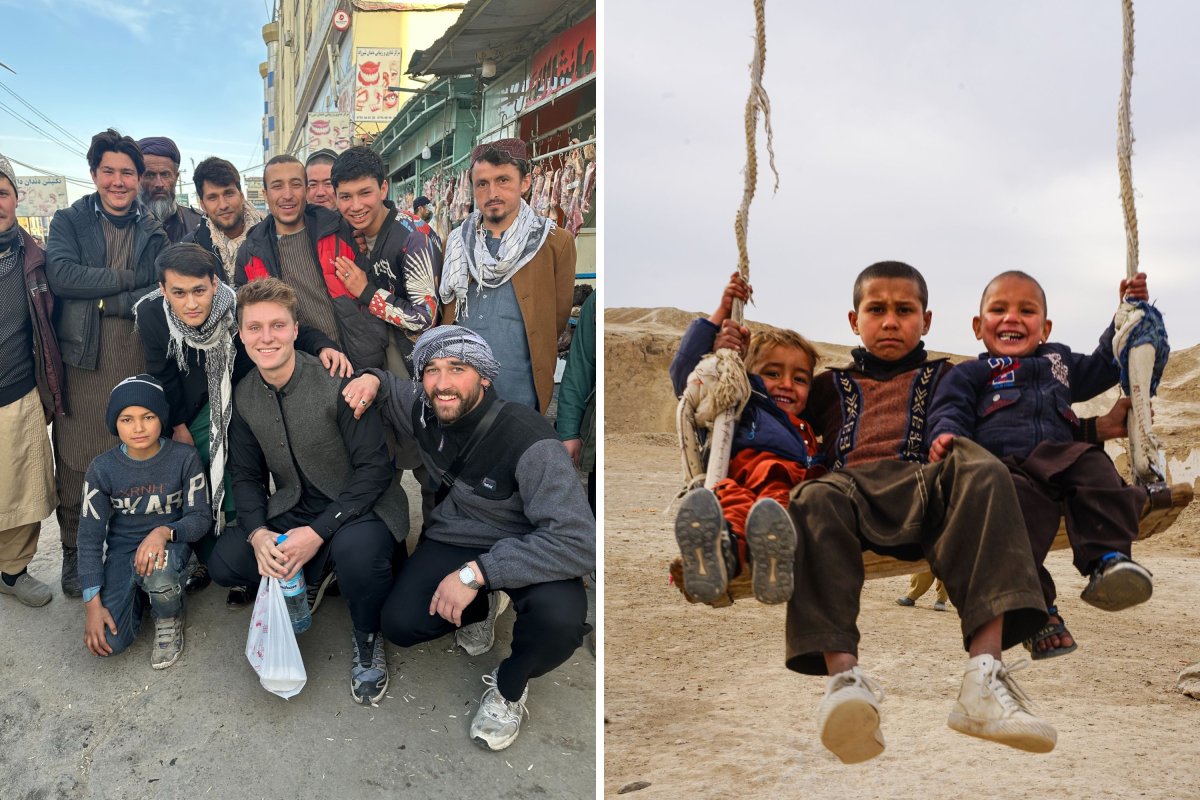
Eli Snyder is pictured in Afghanistan in January. “I live for visiting places as dissimilar as possible from how I’ve grown up in suburban America,” he told Newsweek.ELI SNYDER
On May 17, three Spanish tourists were killed and four other foreigners were wounded in Bamiyan, a city just outside the Afghan capital of Kabul, after gunmen opened fire as the group walked through a market. The attack, which was claimed by the Islamic State group, is believed to be the first assault against foreign tourists since the Taliban’s takeover in 2021.
During Snyder’s visit to Afghanistan, he explored several areas of the country, including Bamiyan. Speaking about the recent attack there, Snyder said: “That’s absolutely heartbreaking and my thoughts and prayers are with the families affected. I’m not here to vouch for the Taliban…However, I will say that shooting is not a reflection of what travel to Afghanistan is like.”
“In general I felt safe in Afghanistan…safer than big cities in the U.S. and Western Europe after dark, that’s for sure,” he said. “I live for visiting places as dissimilar as possible from how I’ve grown up in suburban America outside of Kansas City. Sometimes this means visiting a dangerous place. But it remains true, as I’d much rather visit Pyongyang [the North Korean capital] than Winnipeg.”
Snyder is a University of Michigan Ann Arbor college graduate who quit his job with “a goal of traveling to every country in the world” by the age of 35.
He has been sharing his travel adventures on his social media accounts (@snydtheexplorer on TikTok, Instagram and YouTube) and recently shared snapshots from his trip to Afghanistan in a viral TikTok video posted on May 15, which has garnered 1.8 million views.
“This is what it’s like to backpack in Taliban-controlled Afghanistan as an American,” he says in the video, which shows footage of him walking along the streets of the country, visiting a bird market, drinking tea with locals and trying different foods.
His latest viral post comes as travel is set to reach “record highs” in 2024, with global tourism spending expected to reach $2 trillion, according to a December 2023 survey by market research firm Euromonitor International.
Jet-setters say they’ll cut down on other areas of personal spending to prioritize leisure travel this year, according to a global survey of over 10,000 travelers across nine countries, conducted by Ipsos and the Hilton hotel group.
‘Absolutely Out of Body Experience’
Snyder, who is currently spending a month in Buenos Aires, was inspired to visit Afghanistan after seeing the country named among the favorite places of travelers who have visited every country and hearing “the best things about the hospitality, nature and food.”
He spent 10 days in Afghanistan, visiting Kabul, Bamiyan and the Band-e-Amir national park in the Bamiyan province in central Afghanistan, as well as the city of Mazar-e-Sharif and the town of Balkh in the Balkh province in northern Afghanistan.
Snyder was accompanied by Valentin Oeckl, a 22-year-old who’s traveling from Germany to Australia without flying. The pair met in Islamabad, Pakistan where Oeckl was staying in order to get a visa for entry into Afghanistan.
Snyder warned: “Only the most experienced traveler should consider traveling to Afghanistan without a guide, and even then, it will be a daunting experience.”
However, he and Oeckl could not afford to pay for a guide, so they navigated the country without one, which was “the most challenging thing.”
Snyder’s favorite place for nature in Afghanistan was Bamiyan, which he enjoyed for its “snow-capped mountains, crystal clear rivers and stunning blue lakes,” while his favorite city was Mazar-e-Sharif.
Left, Eli Snyder, on the left, with Valentin Oeckl. Right, Snyder walking in a street in Afghanistan.ELI SNYDER
He noted: “Afghanistan isn’t a country you visit for tourist attractions per se, but a country where you can walk out of your doorstep and be immediately stimulated by the ongoing ebb and flow of daily life.”
There are too many memorable moments from the trip to recount, Snyder said, but the most poignant one was when he crossed the border into Afghanistan from the town of Torkham in Pakistan.
Snyder recalled: “We had walked through the long corridor of barbed wire fences, and found ourselves alone in the Afghanistan immigration office. We handed over our passports to the Taliban official, who stamped us into the country, looked at us in the eyes and said ‘Welcome to Afghanistan.’
“From then forward, everything was an absolutely out of body experience. But perhaps the craziest part was the end of the trip, when we would wake up and go walk around the markets, chatting with locals and the Taliban as if it were just another day,” he added.
The “only hairy moment” during his trip was on the morning of his first day in Kabul. He and Oeckl didn’t have their permits yet and were walking to the office of the country’s Ministry of Information and Culture.
“We were apprehended and they were stern with us for not having our permits, but mostly they were just curious to see two tourists walking around Kabul without a guide,” the traveler said.
Eli Snyder picture with locals in Afghanistan. “I’d much rather visit Pyongyang [the North Korean capital] than Winnipeg,” he told Newsweek.ELI SNYDER
Staying Safe While Exploring Afghanistan
Snyder’s “top tip” for keeping safe on a trip to Afghanistan is to explore the country with a guide. He noted: “Of the micro niche tourist scene that exists for visiting Afghanistan, a gross majority have a private guide to assist with daily activities and Taliban interactions. The issue is that guides cost thousands of dollars due to the demand and the fact that people will pay anything for safety.”
Snyder also said he was able to navigate the country without a guide with the help of tips from a blog by Diána (@theglobetrottingdetective on Instagram), a Hungarian solo female traveler who traveled around Afghanistan for four weeks.
“Without her trip reports, I wouldn’t have had the confidence, information, resources, contacts etc…to successfully and safely execute my trip,” he noted.
Other than following general safety rules as you would in any foreign country, Snyder said one thing that has kept him safe all over the world, from Afghanistan and Iraq to the favelas in Brazil and the ghettos in the U.S. is simple—smile.
“When you smile at someone and look them in the eye, displaying a warm and sincere and non-threatening demeanor, it is the most effective method to diffuse any instigation that I’ve ever known. Just smile, be kind, and you’ll be alright wherever you are,” he noted.
What It’s Like Backpacking in Taliban-Controlled Afghanistan as an American
The Atlantic has often channeled the resources of poetry—its charged and immediate patterns of language—to mourn and memorialize the war dead. The earliest years of the magazine spanned the Civil War, during which the editors published dirges, elegies, and ballads that told stories to console, to heal, to hearten. An elegy for Rupert Brooke took the sonnet into a new, modern vernacular at the time of the First World War. In October 1944, the magazine put together a portfolio of Soldier Verse; in 1960, The Atlantic published Robert Lowell’s “For the Union Dead,” a poem that reflects on the uses of monuments and memorials.
“Departing Afghanistan” continues and deepens this legacy. William H. McRaven, a retired Navy admiral and the former commander of U.S. Special Operations Command, wrote “Departing Afghanistan” in June 2021, prior to the evacuation in August.
The poem emerges from a period of deep reflection and personal soul-searching: Had all the losses, over 20 years, been worth the fight? In its emphasis on the experience of service members, and in its haunting refrain, “Departing Afghanistan” provides neither a defense nor an explanation. After all, the decision to go to Afghanistan and to leave Afghanistan was never the decision of the service members.
Instead, for this Memorial Day, Admiral McRaven offers a probing inquiry and a sustaining melody—and a message to the service members that, as McRaven put it to me: “for twenty years they fought with courage and convictions, they kept Americans safe and they should have no regrets as we depart Afghanistan.”
— Walt Hunter
The Hindu Kush will be quiet now,
silence will come to the ancient lands.
The roar of the planes
will fade in the night
as we depart Afghanistan.
The scholars will chide us
and the pundits will pan,
why did we stay so long
when we should have been gone—
gone from Afghanistan.
But the fight was a good one,
noble and right,
no matter how long it took.
Not a soul has been lost on American soil,
not a single building shook.
For 20 years our people were safe,
living their lives in peace,
raising their families across the land,
because our soldiers fought—
fought in Afghanistan.
It was a tragic waste, some will say,
the loss of so many men.
The rows and rows of headstones
on the graves at Arlington.
But a noble life is never a loss,
no matter where they may fall.
To the soldier who did their duty,
they’re a hero forever, for all.
Make no mistake about it,
we came for a righteous cause.
We fought with courage and conviction.
We fought for the betterment of all.
And for those who cheer our final days,
be careful about what you wish.
For the fate of the Afghan people
is unlikely to be filled with bliss.
The children will weep as their future fades
and old women will cry to their men.
“They weren’t so bad,”
the elders will say,
as we depart Afghanistan.
We pray for the people of Afghanistan,
they are warm and kindly souls.
We pray that their future
will be filled with success
as the days and years unfold.
I hope those we saved will remember us,
and the innocents we harmed will forgive.
But to those who bore arms against us,
may you regret each day that you live.
The winds will howl through the vacant FOBs,
through the plywood and houses of tin.
The tarmacs will rot
in the noonday sun
as we depart Afghanistan.
Some will say it was right.
Some will say it was wrong.
Let the history books decide.
But every soldier did their best,
of that, no one can deny.
We ache for those warriors we lost
and the loved ones who bear the pain.
If only we could have saved them all,
and brought them home again.
The Hindu Kush will be quiet now
and silence will come to the ancient lands.
For those who served
let there be no regrets
as we depart Afghanistan.
A Times investigation uncovered a brutal campaign enacted by U.S.-backed forces during the war in Afghanistan.
I covered the war in Afghanistan and went back after the Taliban took over.
General Abdul Raziq was one of America’s fiercest allies in the fight against the Taliban. He was young and charismatic — a courageous warrior who commanded the loyalty and respect of his men. He helped beat back the Taliban in the crucial battlefield of Kandahar, even as the insurgents advanced across Afghanistan.
But his success, until his 2018 assassination, was built on torture, extrajudicial killing and abduction. In the name of security, he transformed the Kandahar police into a combat force without constraints. His officers, who were trained, armed and paid by the United States, took no note of human rights or due process, according to a New York Times investigation into thousands of cases that published this morning. Most of his victims were never seen again.
Washington’s strategy in Afghanistan aimed to beat the Taliban by winning the hearts and minds of the people it was supposedly fighting for. But Raziq embodied a flaw in that plan. The Americans empowered warlords, corrupt politicians and outright criminals in the name of military expediency. It picked proxies for whom the ends often justified the means.
I’ll explain in today’s newsletter how using men like Raziq drove many Afghans toward the Taliban. And it persuaded others, including those who might have been sympathetic to U.S. goals, that the U.S.-backed central government could not be trusted to fix Afghanistan. If there was ever any chance that the United States could uproot the Taliban, the war strategy made it much harder.
A savage campaign
My colleague Matthieu Aikins and I have covered Afghanistan for years. After America’s chaotic withdrawal from Afghanistan, we were suddenly able to visit people and places that were off-limits during the fighting. We traveled there, hoping to learn what really happened during America’s longest war.
Alongside a team of Afghan researchers, we combed through more than 50,000 handwritten complaints kept in ledgers by the former U.S.-backed government of Kandahar. In them, we found the details of almost 2,200 cases of suspected disappearances. From there, we went to hundreds of homes across Kandahar.
We tracked down nearly 1,000 people who said their loved ones had been taken or killed by government security forces. We corroborated nearly 400 cases, often with eyewitnesses to the abductions. We also substantiated their claims with Afghan police reports, affidavits and other government records they had filed. In each of the forced disappearances, the person is still missing.
Even at the time, U.S. officials grasped Raziq’s malevolence. “Sometimes we asked Raziq about incidents of alleged human rights abuses, and when we got answers we would be like, ‘Whoa, I hope we didn’t implicate ourselves in a war crime just by hearing about it,’” recalled Henry Ensher, a State Department official who held multiple posts on Afghanistan. “We knew what we were doing, but we didn’t think we had a choice,” Ensher said.
The cost
It would be too simple to say that Raziq’s tactics were entirely in vain. They worked in some respects, reasserting government control in Kandahar and pushing insurgents into the hinterlands. Raziq earned the admiration of many who opposed the Taliban. More than a dozen U.S. officials said that without him the Taliban would have advanced much faster.
But Raziq’s methods took a toll. They stirred such enmity among his victims that the Taliban turned his cruelty into a recruiting tool. Taliban officials posted videos about him on WhatsApp to attract new fighters.
Many Afghans came to revile the U.S.-backed government and everything it represented. “None of us supported the Taliban, at least not at first,” said Fazul Rahman, whose brother was abducted in front of witnesses during Raziq’s reign. “But when the government collapsed, I ran through the streets, rejoicing.”
Even some who cheered Raziq’s ruthlessness lamented the corruption and criminality he engendered — a key part of why the Afghan government collapsed in 2021. After Raziq’s death, his commanders went further. They extorted ordinary people and stole from their own men’s wages and supplies.
“What they brought under the name of democracy was a system in the hands of a few mafia groups,” said one resident of Kandahar who initially supported the government. “The people came to hate democracy.”
Historians and scholars will spend years arguing whether the United States could have ever succeeded. The world’s wealthiest nation had invaded one of its poorest and attempted to remake it by installing a new government. Such efforts elsewhere have failed.
But U.S. mistakes — empowering ruthless killers, turning allies into enemies, enabling rampant corruption — made the loss of its longest war at least partly self-inflicted. This is a story Matthieu and I will spend the coming months telling, from across Afghanistan.
The only thing faster than the American withdrawal from Afghanistan might be how quickly the world moved on.
The Biden Administration largely stopped talking about it. Most news organizations were already scaling back in Afghanistan when the Taliban took over.
But a question remained, at once basic and vast.
How did it come to this? How did the group that the United States invaded Afghanistan to eviscerate wind up back in charge?
With the war’s end, The New York Times could finally reach people and places that had been off limits during the fighting — to figure out what really happened.
We found that one of America’s most important partners in the war against the Taliban — a celebrated general named Abdul Raziq — had carried out a systematic campaign of forced disappearances that killed hundreds, if not thousands, of people.
General Raziq’s story was not just a familiar one of tragedy and loss in a faraway war. Across Afghanistan, the United States elevated and empowered warlords, corrupt politicians and outright criminals to prosecute a war of military expediency in which the ends often justified the means.
America’s Monster: A Times Investigation
How the United States backed kidnapping, torture and murder in Afghanistan.
A Brutal Campaign: Hundreds of Afghan civilians were abducted in America’s war on the Taliban. It all led back to one man.
Who Was Abdul Raziq?: The Afghan commander was a key American ally — and his brutality may have cost the United States the war.
Takeaways: Raziq’s story was not just a familiar one of tragedy and loss in a faraway war. Here’s what we found.
General Raziq was the police chief responsible for security across Kandahar. The U.S. military lionized him for years as a fierce combatant and a loyal partner. American generals made pilgrimages to see him.
But his battlefield prowess was built on years of torture, extrajudicial killings and the largest-known campaign of forced disappearances during America’s 20-year war in Afghanistan, The Times found.
We obtained hundreds of pages of ledgers belonging to the former U.S.-backed government. In them, we identified almost 2,200 cases of suspected disappearances in Kandahar Province alone, with families reporting missing relatives.
Working off that list, we collected detailed evidence of 368 cases of forced disappearances and dozens of extrajudicial killings attributed by families, witnesses and official records to American-backed forces under General Raziq.
That is almost surely a gross undercount. The Times only logged cases that were corroborated by at least two people. Many of the families who had reported missing loved ones were impossible to locate, and many others never filed complaints.
A mechanic and a rickshaw driver. Tailors and taxi drivers. The human tally helps explain why many Afghans so quickly embraced the Taliban after the American withdrawal.
“None of us supported the Taliban, at least not at first,” said Fazul Rahman, whose brother was abducted. “But when the government collapsed, I ran through the streets, rejoicing.”
How We Did It
When the Taliban took over the country, they inherited nearly everything that had belonged to the U.S.-backed government. The computers, rickety office chairs, even tea glasses.
They also inherited documents, at least those that hadn’t been destroyed.
The Times obtained and combed through a decade’s worth of handwritten ledgers, made available to us by the Taliban, stretching from 2011 until the American-backed Republic of Afghanistan collapsed in 2021.
Using the ledgers as tips, local Times researchers searched for the families of the disappeared. Each was asked to fill out a form with the details of the disappearance and provide records to substantiate the claim: police reports, affidavits, medical files, government documents, whatever they had.
We spoke with nearly 1,000 families and narrowed that list to hundreds of verified cases of forced disappearance.
In each case, the person is still missing.
Why Did The Americans Support Raziq?
General Raziq was one of the United States’ most important allies in Afghanistan. When he took charge of units in Kandahar, he managed to beat the Taliban there.
He was always dogged by accusations of human rights abuses. But the Americans stood by him until the last.
When he was gunned down by an undercover Taliban assassin in 2018, he was standing next to the top American commander in Afghanistan, Gen. Austin S. Miller, who celebrated him as a “great friend” and “patriot.”
He was seen as the only partner capable of beating the Taliban in the heartland of the insurgency.
“We knew what we were doing, but we didn’t think we had a choice,” said Henry Ensher, a former State Department official.
But many Afghans say General Raziq used his position, and his American support, to pursue personal vendettas and decades-long tribal rivalries. To many everyday citizens, General Raziq was the cruel hand of the American government. Even the Taliban seemed preferable.
Like so much about the war in Afghanistan, this is something that former top American officials say they never truly understood.
Azam Ahmed is international investigative correspondent for The Times. He has reported on Wall Street scandals, the War in Afghanistan and violence and corruption in Mexico, Central America and the Caribbean.
Investigating a Monster: What We Found and How We Did It
Three Spanish travellers and three Afghans were killed and five others, including McDowell, were severely injured.
Islamic State has reportedly claimed responsibility.
Three Spanish tourists and an Afghan shot dead in Afghanistan attack
McDowell said he was chatting with his travelling companions in a van in a shopping district when the gunman opened fire.T
“It was rapid, like ‘bang, bang, bang, bang’ … like firecrackers,” he told Australian Associated Press on Thursday.
McDowell, an engineer from Perth, said the gunman – who was armed with an AK-47 Kalashnikov rifle – fired into a shop that some of the group was in before turning on the van.
“Bullets started coming through the windscreen … We were fish in a barrel,” he said.
“I flung the door open and ran … Then I felt a slap on the arse.”
McDowell had been shot in the right buttock from close range as he attempted to escape the hail of bullets but did not realise at the time.
“I spun around and he was looking at me, pointing the gun,” he said.
The avid hockey player dropped to the ground and rolled under a car, fearing for his life.
“He came and stood beside the car … and I thought this is where he’s going to squat down and shoot under the car,” McDowell said.
“That was the moment I thought ‘I might die here’. I wasn’t scared. It all happened too quickly. I had too much adrenaline.”
The gunman continued firing indiscriminately. Three of McDowell’s tour group who were trapped in the van suffered serious gunshot wounds.
Watching the gunman’s feet, McDowell saw him turn and take a few steps away from the car, allowing him time to “wriggle out” and run to safety down an adjoining alleyway.
After the shooting stopped, McDowell walked back to the van and shops, where he found a gruesome scene and the bodies of two of the three dead tourists from his group.
“We’d only known each other for a couple of days, but when you’re in that sort of environment you become mates quickly. It’s just so senseless.”
McDowell and the other survivors were taken to a local hospital for emergency medical treatment before being transferred to a Kabul hospital, where he had surgery to remove bullet fragments from his buttock.
“It hit my arse cheek and burst and left a heap of shrapnel,” he said.
He has since been able to fly out of Afghanistan with his fellow travellers and was expected to return to Australia in the coming days.
McDowell said he had no doubt the gunman, who fled the scene, was targeting tourists.
Multiple foreign tourism companies offer package tours to Afghanistan, often visiting cities such as Herat, Mazar-i-Sharif and Bamiyan.
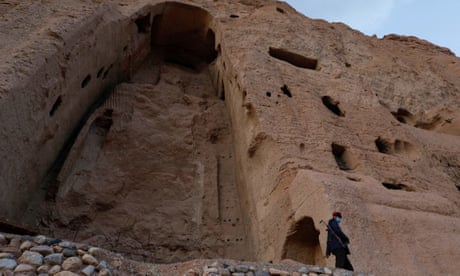
Bamyan is home to a Unesco world heritage site and the remains of two giant Buddha statues the Taliban blew up during their previous rule of Afghanistan in 2001.
‘We were fish in a barrel’: Australian tourist describes deadly Islamic State attack in Afghanistan
The United Nations says aid workers are still in a “race against time” to remove rubble and rebuild after the devastating earthquake struck eastern Afghanistan last month, killing at least 2,200 people and cutting off remote areas.
The 6.0-magnitude quake on Aug. 31 was shallow, destroying or causing extensive damage to low-rise buildings in the mountainous region. It hit late at night, and homes — mostly made of mud, wood, or rocks — collapsed instantly, becoming death traps.
Satellite data shows that about 40,500 truckloads of debris still needs to be cleared from affected areas in several provinces, the United Nations Development Program said Wednesday. Entire communities have been upended and families are sleeping in the open, it added.
The quake’s epicenter was in remote and rugged Kunar province, challenging rescue and relief efforts by the Taliban government and humanitarian groups. Authorities deployed helicopters or airdropped army commandos to evacuate survivors. Aid workers walked for hours on foot to reach isolated communities.
“This is a race against time,” said Devanand Ramiah, from the UNDP’s Crisis Bureau. “Debris removal and reconstruction operations must start safely and swiftly.”
People’s main demands were the reconstruction of houses and water supplies, according to a spokesman for a Taliban government committee tasked with helping survivors, Zia ur Rahman Speenghar.
People were getting assistance in cash, food, tents, beds, and other necessities, Speenghar said Thursday. Three new roads were under construction in the Dewagal Valley, and roads would be built to areas where there previously were none.
“Various countries and organizations have offered assistance in the construction of houses but that takes time. After the second round of assistance, work will begin on the third round, which is considering what kind of houses can be built here,” the spokesman said.
Afghanistan is facing a “perfect storm” of crises, including natural disasters like the recent earthquake, said Roza Otunbayeva, who leads the U.N. mission to the country.
 Afghanistan Peace Campaign