The Chair of the House Foreign Affairs Committee has stated that following the U.S. withdrawal and the fall of the Afghanistan government, “thousands of terrorists” escaped from prisons and are now aiding ISIS in attacks on other countries.
Michael McCaul criticized the Biden administration’s border policies, viewing them as a chance for terrorist groups like ISIS to strike the United States.
The Chair of the House Foreign Affairs Committee reiterated concerns about the consequences of the fall of the previous government of Afghanistan during a CBC interview.
He remarked, “We had the fall of Afghanistan. Thousands of ISIS members escaped from Bagram prison and eventually settled in areas of Afghanistan, Tajikistan, and Pakistan.”
He added, “They [ISIS-Khorasan] are making their way; they are entering the United States through Mexico.”
McCaul highlighted the arrest of eight ISIS suspects in the U.S., questioning how many more might be in the country.
American media reported that eight Tajik nationals were arrested on June 22 for alleged membership in ISIS-Khorasan in New York City, Los Angeles, and Philadelphia.
Concerns over ISIS-Khorasan’s expansion and its potential impact on U.S. security have prompted heightened vigilance and countermeasures, including a $10 million reward from the U.S. State Department for information disrupting ISIS-Khorasan’s financial operations.
Senior Congress member warns US withdrawal from Afghanistan boosts ISIS operation
The Chinese ambassador in Kabul expressed appreciation for the security provided for Chinese citizens and diplomats in Afghanistan.
The Ministry of Interior in a statement said that Khalifa Sirajuddin Haqqani, the acting Minister of Interior, had discussions with Zhao Xing, the Chinese ambassador, on security issues, including regional stability.
According to the Ministry of Interior’s statement, the continuation of security and technical cooperation and the expansion of relations between the two countries were discussed.
The Chinese ambassador in Kabul expressed appreciation for the security provided for Chinese citizens and diplomats in Afghanistan, the statement said.
The Ministry of Interior said: “In this meeting, the Chinese Ambassador thanked the leadership of the Ministry of Interior for ensuring the security of Chinese projects, diplomats, and citizens and emphasized continued cooperation with this Ministry. During this meeting, both sides emphasized regional stability, ongoing security and technical cooperation, and bilateral relations.”
At the same time, some political and military analysts called the cooperation between the two countries in security areas important for creating stability in the region. They said that to increase cooperation in these areas, the relations between the two countries need to expand.
“Afghanistan needs cooperation from all countries, especially regional countries and Central Asia, and China can cooperate with Afghanistan. From a security perspective, I think Afghanistan is currently not in a bad security situation,” Samim Shamsi, a political analyst, told TOLOnews.
“The land is under the control of the Islamic Emirate, and no harm comes from the borders to anyone, and they do not allow anyone else to do such a thing. Therefore, if the problems that exist in the air, since it is not under the control of the Islamic Emirate, if security is ensured in the air, investors will go where there is security,” said Mohammad Mateen Mohammadi, a military analyst.
Earlier, the Administrative Deputy of the Prime Minister had also asked the Chinese ambassador in a meeting to support the stance of the Islamic Emirate on the international stage.
Haqqani, Chinese Envoy Discuss Security Cooperation, Regional Stability
According to the Deputy Spokesperson of the Ministry, this decision stems from the failure of these consulates to engage with the Ministry of Foreign Affairs.
The Ministry of Foreign Affairs of the Islamic Emirate announced today (Tuesday) that consular services provided by Afghanistan in several Western countries are no longer recognized.
According to the Deputy Spokesperson of the Ministry, this decision stems from the failure of these consulates to engage with the Ministry of Foreign Affairs. Moving forward, any documents issued by these consulates will not be accepted by the Islamic Emirate’s authorities, and the ministry takes no responsibility for such documents.
“In London, Belgium, Berlin, Bonn, Switzerland, Austria, France, Italy, Greece, Poland, Sweden, Norway, Canada, and Australia, consular services such as affidavits, certifications, non-liability documents, passport issuance, passport extension stickers, and visa stickers are not accepted by the central administration, and the Ministry of Foreign Affairs holds no responsibility for these documents,” said Hafiz Zia Ahmad Takal, the deputy spokesperson of the Ministry of Foreign Affairs.
Afghan immigrants in European countries call for more consular facilities to be provided for them in European countries.
Yar Mohammad Pardis, an Afghan immigrant in France, said: “We want more progress in providing these services, especially in the area of passport issuance and renewal.”
Aziz Maarij, a former diplomat, said: “It is better to implement this principle; otherwise, Afghan citizens abroad will spend their money and receive documents, but if the Ministry of Foreign Affairs does not recognize them and they are not valid in the administration, it will lead to mistrust and a waste of time. “
Previously, the Afghan embassies in the Netherlands and Spain had reported their cooperation with the Islamic Emirate.
Certain Consulates Abroad Not Recognized By Islamic Emirate: MoFA
It’s the latest attempt by the Taliban to take control of Afghanistan’s embassies and consulates since returning to power in 2021. Many Taliban leaders are under sanctions, and no country recognizes them as Afghanistan’s legitimate rulers.
The country’s seat at the United Nations is still held by the former government, which was led by Ashraf Ghani, though the Taliban administration is seeking to claim that seat as well.
In a statement posted on the social media platform X, the Ministry of Foreign Affairs said that documents issued by missions in London, Berlin, Belgium, Bonn, Switzerland, Austria, France, Italy, Greece, Poland, Australia, Sweden, Canada and Norway are no longer accepted and the ministry “bears no responsibility” for those documents.
The documents would include passports, visa stickers, deeds and endorsements.
The ministry said people in those countries will instead need to approach embassies and consulates controlled by the Taliban administration — the Islamic Emirate of Afghanistan, as they call their government.
“All Afghan nationals living abroad and foreigners can visit the IEA political and consular missions in other countries, other than the above-mentioned missions, to access consular services,” the post said.
The Taliban did not immediately respond to queries seeking clarification or additional details.
An Afghan national living in London where he is pursuing a master’s degree, Asad Mobariz, said he was disappointed and frustrated with the decision. It’s unfair and impractical to expect Afghans in the affected countries to travel to another country for consular services, he said.
“This decision disregards our needs and places an undue burden on us,” he told The Associated Press. “These services are crucial for my ability to travel, work and maintain my legal status in the U.K.”
The move puts the burden on Afghans living in Europe and will lead to increased financial strain and potential legal issues for those unable to access consular services locally, he said.
Another Afghan national, Adnan Najibi, who lives in Germany, said discrediting embassies was unlikely to benefit the Taliban.
“I live in a small town with a relatively low population; however, I still see that there are hundreds of Afghans living here,” Najibi said. “If someone previously obtained an Afghan passport, marriage certificate or any other document in a day, it may now take weeks or even longer.”
The German government said Tuesday it was assessing the potential impact of this announcement.
Afghanistan’s embassy in Britain said on X that it “firmly declares” it will continue all its consular and diplomatic services without any interruption.
In March 2023, the Taliban said they were trying to take charge of more Afghan embassies abroad. Their chief spokesman, Zabihullah Mujahid, said the administration had sent diplomats to at least 14 countries.
The new development means the closest available Afghan embassies for people in Europe are likely to be in Spain and the Netherlands. In October, those two countries said they were working with Taliban authorities in Kabul after the Taliban suspended consular services at Afghanistan’s embassies in London and Vienna over what they said was “lack of transparency and cooperation.”
Since the Taliban takeover, some countries have retained active diplomatic missions in Afghanistan, including Pakistan and China.
Michael Kugelman, director of the Wilson Center’s South Asia Institute, said the Taliban were confident and emboldened, buoyed by the informal recognition they have received from many countries.
They are apparently trying to force Afghans to engage with the Taliban instead of with diplomats loyal to the former administration, he said.
“It’s about giving the Taliban more diplomatic clout abroad and consigning the pre-Taliban holdouts to irrelevance. The fact that many of these missions aren’t very active anyway makes Taliban efforts easier to pull off,” Kugelman said. “It’s like pushing on a door that’s already open.”
The Taliban have received informal recognition through establishing bilateral ties with countries such as Russia, China, Iran and Pakistan, and holding high-level meetings with officials from those countries. This past month, the Taliban were the Afghan representatives at United Nations-hosted talks on Afghanistan in Doha, Qatar, although the U.N. stressed that this did not amount to official recognition.
The NGO was allowed to reopen days later, after signing a statement saying it would not allow women employees to come to the office, according to the mission’s latest report on human rights in Afghanistan. The report did not disclose the office’s location for “protection reasons.”
Since taking over, the Taliban have stopped girls’ education beyond the sixth grade and banned women from many jobs and most public spaces. Restrictions on women and girls are a major obstacle to the Taliban gaining official recognition as the country’s legitimate government.
The Taliban were not immediately available for comment on the report.
The Taliban say they no longer recognize Afghan diplomatic missions set up by the former government
The bipartisan panel will study the conflict’s myriad failures with a mandate to recommend how the United States can avoid a repeat performance.
Against the backdrop of America’s roiling political landscape and two raging foreign wars, a coterie of former U.S. government officials and academics on Friday opened what will be an extensive examination of the United States’ 20-year foray in Afghanistan — the nation’s longest conflict.
“Today we make history,” said Shamila N. Chaudhary, co-chair of the Afghanistan War Commission. “Never before has the United States commissioned such a wide-ranging independent legislative assessment of its own decision-making in the aftermath of a conflict.”
The mission is daunting. The 16-member bipartisan panel has been tasked by Congress with determining what went wrong and what U.S. leaders could do differently the next time the United States goes to war. Their mandate encompasses policies and actions taken by four presidential administrations, the U.S. military, the State Department, U.S. allies, and many other agencies, organizations and people.
The commission has 18 months to carry out its research and untilAugust 2026 to deliver a final public report.
The U.S. withdrawal from Afghanistan in August 2021 ended the war but delivered the country back into the hands of the Taliban, an enemy Washington spent trillions of dollars trying to vanquish beginning in the aftermath of 9/11. The bloody and chaotic exit resulted in the deaths of 13 U.S. service members and scores of Afghans; left thousands of American allies behind to an uncertain fate; triggered broad, bipartisan outrage; and gave rise to bitterly politicized congressional inquiries and hearings.
The Republican-led House Foreign Affairs Committee is expected next month to deliver a final report detailing the findings of its investigation of the withdrawal. That inquiry has featured hours of heated and sometimes emotional testimony from Biden administration officials, military commanders, veterans and their families. The committee next week intends to interview Jen Psaki, President Biden’sWhite House press secretary at the time of the withdrawal.
The war commission’s 4½-hour discussion Friday, held in the Washington headquarters of the Veterans of Foreign Wars, featured former ambassadors, military officers and CIA personnel as witnesses. It drew a small crowd of observers, many of whom were also connected to the war.
Chaudhary and her co-chair, Colin F. Jackson, a former Defense Department official, are cognizant of the charged atmosphere that surrounds their undertaking. The commission itself was born of the collective outrage that followed the withdrawal three years ago.
But they stressed that they seek a dialogue that is thoughtful and apolitical, even if commission members were handpicked by Republican and Democratic lawmakers in the heat of national anguish. “We are bipartisan in our composition, but our work is nonpartisan,” Chaudhary said.
It’s hard to ignore the issue of blame, they concede. It “keeps coming up in our conversations,” Chaudhary told the panelists. People want to know if the commission will name and shame; if it will deliver some measure of justice by calling out the leaders who made the worst critical decisions in the war.
The commission will try not to do that, while at the same time endeavoring to produce “a full, objective, rigorous, unvarnished and unflinching account of our performance as a government and a military,” Jackson said. “We owe it to the generation that served in Afghanistan, and the generation that will serve somewhere else.”
It isn’t just an assessment of the war’sfailures. The commissioners’report will include guidance, they said: practical advice that could be applied to other wars the United States is involved in, such as those ongoing in the Middle East and Ukraine, or to wars that have yet to happen, but someday will.
If the first hearing can serve as a guide for what commissioners are likely to conclude, it’s that so many different things went wrong.
Consecutive administrations failed to address the critical role that Pakistan — an ostensible U.S. ally — played in sustaining and shielding the Taliban, said Nader Nadery, a witness who served as a senior Afghan government official. U.S. leaders also often prioritized short-term military goals over longer-term values, and sometimes employed rhetoric that undermined the Afghan government’s credibility, he said.
There were convoluted chains of command throughout the war; disruptive personality clashes between American decision-makers and agencies; and commanding officers served tours of duty that were so short as to represent “the institutional equivalent of a frontal lobotomy,” said another witness, Ronald Neumann, a former ambassador to Afghanistan and the author of “The Other War: Winning and Losing in Afghanistan” — published 11years before the U.S. withdrawal.
There was a terribly devised system for parliamentary elections that invited fraud, said Noah Coburn, a political anthropologist who provided testimony Friday. There was too much public meddling in Afghan politics by U.S. leaders, and too little policy input solicited from the Afghans. Poor U.S. decisions when it came to security partners, development and investments fueled corruption, which spread mistrust of the government and support for the anti-government Taliban, said Coburn. Civilian casualties, abusive warlords and poor security did that too.
It’s not that no one was saying this during the war. Much has been written. Experts and documentation of on-the-ground events were ample as they were happening, commissioners and panelists acknowledged. But often, U.S. officials failed to absorb the information, and consecutive administrations failed to use that knowledge to change course.
Jackson, the co-chair, said, “A fair question is, but what decisions are you going to look at?”
“The easy answer is we’re going to consider a much larger set of decisions than we can possibly cover in detail, and there will be a very difficult winnowing process,” he said.
Among the obvious points of interest, Jackson said, will be the decision to invade Afghanistan in the aftermath of the 9/11 terrorist attacks. The commissioners will examine the decision to surge U.S. forces in Afghanistan in 2009. They will look at the decision-making that went into negotiations with the Taliban. And of course, they will look at decisions related to the withdrawal.
The commissioners acknowledged that their mandate has become vast — to cynics, perhaps, so ambitious as to be almost impossible. What started as a mission to understand and to educate is also partly an exercise in collective therapy, the commissioners said, an opportunity not just for governmentofficials, but for the larger population, and particularly veterans,to come to terms with what happened.
“For so many of us, the war still lingers in our minds. We carry the moral, physical and emotional injuries in our daily lives,” Chaudhary said. “Closure may not be possible for everyone.” But a space is needed for “civic discourse,” she added.
Afghanistan War Commission opens inquiry of America’s longest conflict
Switzerland will reopen its humanitarian office in Afghanistan in autumn 2024 instead of summer as initially announced, reported SRF.
Four employees will be sent from Switzerland to oversee humanitarian projects financed by the Swiss federal government in the Afghan capital Kabul. According to the newspaper NZZ am Sonntag, a spokesperson for Switzerland’s Foreign Ministry confirmed the information.
The Swiss embassy in Pakistan will continue to be responsible for consular and diplomatic services, however.
After the Taliban seized control of the country three years ago, many Western nations, including Switzerland, fled and closed their offices there. Cooperation with the Taliban government was something many governments could not countenance given the regime’s cruel treatment of some people, women in particular.
However, the humanitarian situation in Afghanistan continues to worsen. According to the World Bank, 48% of Afghanistan’s population lives in poverty. Switzerland therefore sees a need for action.
The Afghanistan War Commission’s probe is getting very real.
If you played a role in Afghanistan policy over the past few decades, be prepared for a call.
In their first joint interview since the launch of the Afghanistan War Commission, co-chairs and veteran Afghan policy thinkers Shamila Chaudhary and Colin Jackson discussed their move into an active new phase, including interviewing the diplomats, generals and politicians who shaped the war.
Their goal? To determine just what went wrong in the 20-year conflict.
“No one will look like an unblemished hero, and nobody will look like a complete scapegoat,” Jackson said. “But the key is to be unflinching.”
The commission was established with bipartisan congressional support after the chaotic U.S. withdrawal in August 2021, but it’s obvious the seeds of failure were planted long before that. Chaudhary and Jackson are now tasked with developing a major, multipart report on how such mistakes can be avoided in the future.
Jackson is an academic, a military veteran and a former Defense Department official. Chaudhary is a former White House and State Department official. Both worked on Afghanistan policy during their years in the federal government, adding to their strong desire to understand why things fell apart.
In the interview, they discussed everything from talking to the Taliban to whether November’s presidential election could upend their work. And while they told POLITICO Magazine that they weren’t focused on ascribing blame, they acknowledged there’s plenty to spread around.
The following conversation has been edited for length and clarity.
Your commission launched its work roughly a year ago. Where are you at now?
Jackson: We’re at the end of the building the team, sort of midway into the genuine research part of the project. The nature of commissions is it takes some time to assemble the right team. We’re going to end up having a team of close to 50 people on the professional staff.
Chaudhary: The research and analysis stage allows us to do all the important pickaxe work that commissions do, which is put out requests for information and documents to the different executive branch agencies, to develop our extensive timeline of the war, and the decisions and the inflection points that we want to analyze in the course of our project. And then to also build our extensive list of people that worked on the war that we want to interview.
How granular is the timeline going to be? Am I going to be able to climb up and down it?
Chaudhary: So there’s the early part of the war, which was heavily focused on counterterrorism. During the Obama administration, we saw a surge, both military and civilian, and that needs to be documented. Then the latter part of the war which involved these intense discussions about negotiations. All of these themes were present throughout, but they got more complex over time, and we all have our own little sliver of it.
What’s really important about this project is that we’re able to put them all together into one overarching narrative that no one has ever seen before. What’s so critical about getting this right is producing quite a historic project and report for not just policymakers but for the American public and a global audience.
Your three key goals are to write an official history of the U.S. engagement in Afghanistan; lay out lessons learned from the experience; and make recommendations that could include changes in government process and structures. How will you ensure that people in power listen to you and follow through on your ideas?
Jackson: The imperative behind the entire project is learning. The experience of Afghanistan over 20 years is in the rearview mirror. The question is what can we make of it to improve the performance of a future generation in some unknown, future U.S. involvement abroad? We can’t guarantee the reaction of the U.S. government to this, but we can control the quality, depth, seriousness, rigorousness of the study that we produce.
Chaudhary: We believe just by virtue of existing, this project has impact. This has never been done before in relation to any other previous conflict or war. No other commission has been given this much time, this large of a scope, and this much independence and authority to do the work on such an intense issue in our foreign policy — and in recent memory. People are still kind of processing these issues. So I think that impact will be there, and it will speak for itself.
I know you’re trying to avoid making your report about laying blame. But let’s talk about blame.
I find it highly amusing when the Defense Department tries to blame the withdrawal chaos on the State Department, as if the Pentagon played no role in the Afghan army’s failures, or when members of Congress act like they had nothing to do with making it so hard to get visas for Afghan interpreters. Or when the CIA pretends it’s invisible in all this.
If you don’t assign blame here, there, maybe everywhere, then how will anyone be held responsible? And shouldn’t people and institutions be held responsible?
Jackson: My guess is that we will see flattering and unflattering portrayals of different institutions and agencies over this 20-year span. No one will look like an unblemished hero, and nobody will look like a complete scapegoat. But the key is to be unflinching, to pursue the truth as best we can understand it and lay it out to an informed general audience so that they can come to the conclusions that are appropriate.
Chaudhary: I think that we can draw a throughline throughout the conflict, in that there was a very limited approach at one point of the war, which then evolved into a whole of government approach. The dissonance amongst the agencies — that’s important for our work. We need to understand where the different U.S. stakeholders are coming from.
How does your work compare to the 9/11 Commission?
Jackson: We’ve been in active discussions with the 9/11 Commission, with the folks who were involved in that team on the professional side. And we’re doing our best to sort of extract what they learned from that process. They were the first to point out that the scope we had been given was considerably more challenging in many ways than looking at a single episode and looking to the left and right of it, which is what the 9/11 Commission did.
Chaudhary: The accessibility of the 9/11 Commission report is something that we want to reflect in our outputs, not just in the final report, but also how we engage with stakeholders throughout the process. A lot of people have read the 9/11 Commission report; it’s studied in high schools and colleges and universities.
It almost won the National Book Award.
Chaudhary: That’s right. The other critical aspect of the 9/11 Commission’s work that applies to us is how they objectively represent the perspectives of foreigners in their work. They do an excellent job of outlining interests and motivations of people and states and governments that a lot of Americans don’t know anything about.
What about Afghans? How can and will they play a role in your work? Because there’s no direct Afghan representation on the commission itself from what I can tell.
Chaudhary: Representation of multiple perspectives is really important for our work, in particular the Afghan perspectives and the Afghan experiences of the war. We’ve done several things to meet this need. We’ve hired a senior adviser for Afghan outreach. We are planning several outreach events and private engagement opportunities that will help educate us on the Afghan experience.
Several of our commissioners have lived and worked in Afghanistan for long periods of time, have published on these issues and are world-renowned experts. As we continue to do these engagements, we will meet more people and individuals who will inform our work.
Are you going to talk to the Taliban?
Chaudhary: That is under consideration, at the right time. Obviously, we want to talk about everyone that is part of the story of the war.
They were kind of a big part of the story of the war.
Jackson: The question of sort of timing on that is a relevant one, but we’re certainly open in principle as we are talking to all sorts of actors in the story.
The Pakistanis?
Jackson: Absolutely.
Chaudhary: Congress has asked us to look at the Pakistanis. They’ve asked us to look at the foreign interlocutors, other governments. We are willing to talk to everyone who is involved in the U.S. decision-making and the impact of that, and so whoever is involved in that we will have to consider that.
Jackson: We would be telling half the story, one hand clapping, if all we did was look at U.S. government plans in isolation.
On a technical level, some of these groups involved are designated terrorist organizations in one fashion or another. Can you nonetheless engage with them?
Jackson: Any engagement with groups like the Taliban is complicated. We see this in the story of the Afghan War, the United States government came up with ways of interacting with challenging groups and audiences. My guess is that something similar is at least in the realm of the feasible for the commission.
American politics are far more polarized than the post-9/11 years. How are you going to ensure that your work is not distorted by partisanship or that partisans won’t try to weaponize your work, including along the way?
Jackson: The payoff of this project, if done the right way, will not occur in the here and now, it won’t occur in this political season. It will be a future generation of professionals in the U.S. government who are applying insights that hopefully derive in this 20-year experience. So I think to become too narrowly focused on what will be inevitably polarizing sorts of attitudes in this year would be to miss the larger point here. If learning is the imperative, the political tensions of the present are decidedly secondary in our view.
Chaudhary: Our commissioners were appointed in a bipartisan manner from all the relevant committees, but as actors and agents of the commission, we are nonpartisan and we’ve built a nonpartisan professional staff and we’ve established bylaws to guide our work and to protect minority views and to protect that nonpartisan nature of our work. The history of this commission when it gets written, it will show that it came into existence because of bipartisan support.
A lot of folks ask us, “What happens if Trump wins the election? What happens to your work?” Our work is going to stay the same. We are persistent in our mandate. We are going to keep pursuing our goal of looking for answers and explanations of the war.
If I’m a government employee who played a role in Afghan policy in the past three decades, how could I be affected by your ongoing work? Will I get called in for an interview? Can I say no?
Jackson: We’ve been engaged in discussions with past and current decision makers in all branches of government, and I think those conversations will likely continue in various ways. There’s no way for us to fully understand the conflict — the decisions that were made, the alternatives that were considered — without canvassing the people who were involved.
So the bottom line for government employees is, “Yes, I could get called in.”
Chaudhary: The legislation is worded that we are to analyze U.S. decision-making, the individuals and the institutions that were involved in that. We will begin to delineate a process by which we identify who we want to talk to. It would be hard to interview everyone at every level that was involved. And so, depending on how we define decision-making, and which decisions we actually look at, that will determine who we speak with.
How do you expect and want U.S. military veterans to play a role in your work?
Jackson: There is no audience more interested in our work at some level than the veteran community — they’re intensely interested, and there is a hunger for accountability, understanding and the like. I think the way we ultimately get at that is by laying out for them the logic of the war in these key decisions.
I’m a veteran of the Afghanistan war. I served in uniform there in 2011. I have a son who’s an infantry officer now. I have a deep personal, visceral interest both in understanding the conflict in its totality and better arming my son and his comrades with a level of understanding that will ideally make them better.
Chaudhary: We’ve hired several professional staff who are also veterans of the war in Afghanistan and are guiding our extensive outreach. One of the reasons I took this project on was that I felt like I didn’t actually get exposed enough to the perspectives of veterans and Afghans as I was doing the important work of diplomacy from Washington.
What’s been the hardest part so far?
Jackson: Probably the hardest part and the greatest opportunity is the scope. It will be illuminating to take a look at how these parts fit together.
Chaudhary: I see the high level of expectations for our work from the different communities that participated in the war as one of the biggest challenges, but it’s also an opportunity for us to do good work together in a collaborative way that we weren’t able to do during war time.
The other challenge which is also an opportunity is the deep emotion and visceral response that looking at the war in Afghanistan elicits from people. That I see as something very organic and not to be ignored. And how we address emotion and empathy and moral injury through a policy project is a very challenging situation, but I see it as something that we should boldly take on because our country deserves this. Americans deserve it.
Jackson: If we do our work well, it will be foundational.
What’s a question you wish I had asked?
Jackson: You talk about key decisions — what key decisions?
I think the hardest part of the project will probably be narrowing even that set of key decisions to a manageable number. Clearly, there are ones that stand out in the popular understanding of the word, but there may also be ones that we discover in the process of inquiry where we say, “This was a critical inflection point in which there were opportunities to act differently. Why did we choose as we did? If we had chosen differently, what would that have done?”
And a key decision might be something like the decision to surge troops or go into peace talks or decisions about how to build the Afghan army.
Jackson: Or the organization of the Afghan government at the Bonn conference. We’re going to identify a series of sort of critical decisions or critical program decisions that were made.
We’re also going to say, okay, across all these strands of government, which were the large things and look to both the left and right of those decisions. What alternatives were considered? Why did we choose as we did? We’ll look at implementation of those decisions, and then a reaction of actors in Afghanistan and around Afghanistan.
Do you ever wake up and think, “Oh boy, what did I get myself into?”
Chaudhary: This is an incredible project to work on. I feel like all of the work that we all did, inside and outside government, deserves this chapter in the story now, because if we didn’t have this opportunity, it would remain unfinished.
Jackson: The best problem in the world is a job that’s sufficiently challenging that keeps you engaged all the time. And no matter how challenging the day-to-day stuff is, you’ve got this sort of North Star in that the American public deserves a full understanding and accounting of this intervention.
Nahal Toosi is POLITICO’s senior foreign affairs correspondent. She has reported on war, genocide and political chaos in a career that has taken her around the world. Her reported column, Compass, delves into the decision-making of the global national security and foreign policy establishment — and the fallout that comes from it.
‘Never Been Done Before’: A True Investigation of a Failed American War
Last week the bipartisan Afghanistan War Commission held its first public hearing since it was established in 2021, with members of the foreign policy great-and-good offering testimony on the origins of the conflict and why re-examining it is important. It is a solemn and noble exercise, founded on George Santayana’s famous aphorism that “Those who cannot remember the past are condemned to repeat it.” If we review the West’s 20-year deployment in Afghanistan, the logic goes, we will understand what we did wrong and we will not make the same mistakes in the future.
The commission was created by Congress with two purposes: first, to examine, in detail, with the calming distance of time, exactly what happened; secondly, more importantly, “to develop a series of lessons learned and recommendations for the way forward that will inform future decisions by Congress and policymakers throughout the United States Government.” It comprises 16 commissioners, eight appointed by the Democratic Party and eight by Republicans, and its co-chairs are Shamila N. Chaudary, a foreign policy academic who worked in the State Department and the National Security Council under President Barack Obama; and Colin Jackson, a Department of Defense official under President Donald Trump who served in Afghanistan.
This process of historical analysis and learning is scheduled to take four years. To put that in perspective, a newly commissioned infantry officer who was deployed to Afghanistan at the beginning of Operation Enduring Freedom in 2001 could be a general by the time the commission publishes its conclusions. NATO combat operations ended with the transfer of responsibility to the Afghan national security forces a decade ago, at the end of 2014, and it is already nearly three years since U.S. combat forces left the country.
The obvious model for this is the National Commission on Terrorist Attacks upon the United States, the so-called 9/11 Commission, which was created to establish “a full and complete account of the circumstances surrounding the September 11 attacks.” But that body moved at a wholly different pace, being set up only 13 months after the events it examined, and reporting in July 2004, less than three years after 9/11.
Its 585-page report was weighty and detailed, but manageable, and was addressing a dramatis personae many of whom—President Bush and Vice President Cheney, the secretary of State, secretary of Defense, national security advisor, director of the FBI—were still in post. The director of central intelligence, George Tenet, had only stepped down weeks before.
A more helpful comparison might be found in our experience in the United Kingdom. Although Lord Butler of Brockwell, former head of the civil service, had conducted a short review of the intelligence on weapons of mass destruction in Iraq in the first half of 2004, a year after the coalition invasion, it was regarded by many as an establishment whitewash. In 2009, Prime Minister Gordon Brown set up a full public inquiry into every aspect of the UK’s involvement in Iraq between 2001 and 2009. It was chaired by Sir John Chilcot, a former civil servant with long experience of intelligence and security derived from seven years as official head of the Northern Ireland Office.
The Iraq Inquiry conducted hearings for 18 months, and eventually published its conclusions in 2016, seven years after it was first established. They were undeniably exhaustive: the report consisted of 12 volumes and an executive summary, a total of 2.6 million words, and it was extensively and harshly critical of the conduct of British foreign policy. “The government failed to achieve its stated objectives,” it decided, “the consequences of the invasion were underestimated” and the “planning and preparations for Iraq after Saddam Hussein were wholly inadequate.”
These findings were extensively reported at the time and the prime minister, David Cameron, made a statement to the House of Commons on the report’s publication. In truth, though, the repercussions were muted. Sir Tony Blair had stepped down as prime minister nine years before; his first foreign secretary, Robin Cook, was dead, while his second, Jack Straw, was no longer in Parliament; Blair’s chief of staff, Jonathan Powell, had disappeared into the private sector; and the defence secretary, Geoff Hoon, was a largely forgotten footnote. Politics, bluntly, had moved on.
If a lesson was learned by the institutions of government, it was that major land commitments in the Middle East were financially and reputationally ruinous. British combat troops had left Iraq in 2011 and Afghanistan in 2015. A hope nurtured by some that there would be a reckoning for “guilty men” is only sustained if you think Sir Tony Blair is now in public disgrace and penury; and Jonathan Powell, Blair’s chief of staff, and Alastair Campbell, Blair’s pugilistic director of communications, are not respected consultants and broadcasters.
It may well be that the Afghanistan War Commission produces an impeccable, insightful and indispensable analysis of the United States’s deployment in the region when it reports towards the end of the 2020s. There may be some lessons which foreign policy experts absorb and implement. But, given the experience in Britain with the Iraq Inquiry, I can only advise management of expectations if anyone thinks Washington’s global stance will alter radically or that individuals will be held to account. It is simply too long ago.
Eliot Wilson is a freelance writer on politics and international affairs and the co-founder of Pivot Point Group. He was senior official in the UK House of Commons from 2005 to 2016, including serving as a clerk of the Defence Committee and secretary of the UK delegation to the NATO Parliamentary Assembly.
Don’t expect too much from the Afghanistan War Commission
The Chaman border crossing on the Pakistan-Afghan border reopened Monday after small traders ended a nine-month sit-in protest. The border had been closed due to a Pakistani government decision to implement a visa and passport program for travelers on both sides.
Initial reports indicate that small traders can now resume crossing with Pakistani and/or Afghan identity documents. Abdul Hadi, a trader, told VOA that the sit-in ended Sunday and that he crossed into Afghanistan on Tuesday.
The protesters’ committee spokesperson, Sadiq Achakzai, told VOA that Chaman Sit-in Committee members held talks with military leadership to resolve the issue. However, no official notification regarding the change has been issued by the government.
Former Balochistan caretaker interior minister Inayat Ullah Kahan Kasi, who mediated talks between Pakistan’s government and protesters, played a crucial role in ending the 9-month protest.
“I do not represent any government authority but government and security agencies assigned me the job to end the protest and I did it,” Kasi said.
Balochistan government spokesperson Shahid Rind refused to discuss the issue when VOA contacted him.
Pakistani officials have said that cross-border movement must be regulated to improve security and control smuggling.
Pashtun tribes straddling both sides of the British-era border’s Durand Line have historically moved freely for businesses and communal life.
A surge in violence in Pakistan since the Taliban took over in Afghanistan nearly three years ago has triggered security concerns and Pakistani government officials have insisted the border must be regulated.
Pakistani officials have blamed the Afghan Taliban for sheltering terror group Tehrik-e Taliban Pakistan (TTP) which, according to Pakistani authorities, carries out cross-border attacks targeting Pakistani security forces. The Taliban denies the accusations.
Zabihullah Mujahid, the spokesperson for the Afghan interim government, said recently in an interview with Khurasan Diaries, a Pakistani digital news platform, that border trade issues and other matters should be dealt with separately.
Pakistan’s military said in a statement July 16 that eight soldiers were killed when a suicide bomber rammed his explosive-laden vehicle into an army compound in Bannu, a remote city in northwestern Khyber Pakhtunkhwa province.
A splinter group of Pakistani Taliban, led by militant commander Gul Bahadur, claimed responsibility for the attack.
Traders end monthslong protest at Pakistan-Afghan border crossing
The order by the Supreme Leader of the Islamic Emirate of Afghanistan (IEA), Hibatullah Akhundzada, to cut the salaries of women on the public payroll to just 5,000 afghanis (70 US dollars) a month was a bombshell. The Amir’s order was short and ambiguously worded, driving anxiety and speculation: did it apply to all women working in the public sector – bureaucrats, teachers, doctors, policewomen, prosecutors – who go to the office every day? Or only those the Emirate has barred from coming to work, but who, up until now, have been paid in full? Jelena Bjelica and Roxanna Shapour (with input from the AAN Team) have been hearing from women who are or were working in the public sector about the Amir’s order and how it has affected their lives and family finances. They told AAN about the difficulties they already had making ends meet and their concerns about how they would weather the financial pressure if their salaries were cut.
News of the pay cap emerged in the last days of May 2024 after the acting Director of the Prime Minister’s Office of Administrative Affairs (OAA), Sheikh Nur ul-Haq Anwar, issued a circular instructing all government departments to set the salaries of all female staff at 5,000 afghanis. The circular had been prompted by an order signed by the Islamic Emirate’s Supreme Leader, Hibatullah Akhundzada, which said:[1]
The salaries of all female workers who were employed by the previous government and are currently receiving a salary from the Islamic Emirate should be set at 5,000 afghanis in all budgetary and non-budgetary units,[2] regardless of their previous wages (their salaries should all be the same).
This sentence appears to have been the order in its entirety. It alone was quoted by many media outlets, on social media and in official letters, which were widely distributed (see, for example, BBC Pashto on 6 June and a letter from the Ministry of Economy below).
The news sparked confusion, concern, indeed fear, among Afghan women working in the public sector, which in Afghanistan is referred to as the civil service (see, for example, this report on teachers from ToloNews).[3] Women employed in the health sector in Herat and Kabul held protests, calling on the government not to reduce what they said were their already meagre wages (see, for example, Amu TV here). There was also condemnation from international human rights bodies; the United Nations Human Rights Commissioner, Volker Türk, called on the IEA to rescind the measure, saying “[t]his latest discriminatory and profoundly arbitrary decision further deepens the erosion of human rights in Afghanistan,” (the full statement, issued on 13 June 2024, can be read here).
The vagueness and lack of specificity in the Amir’s one-sentence order sparked questions by employees, the media, social media users and apparently even some state institutions, which urgently sought clarification. For example, the Ministry of Education’s internal correspondence, which was widely shared on social media (see the picture below), asked “whether the decree of His Excellency, the Supreme Leader, applies to all female employees or only those who are not reporting for duty.” The letter also explained that it would take time for the ministry to amend its automated salary payment system to accommodate the change. In response, the acting Minister of Education ordered that “the salaries of all female employees should be suspended until further notice,” presumably until the Amir’s office provided further guidance (see this post on X from 30 June and an English translation below).
Internal Ministry of Education correspondence seeking clarification. Translation by AAN
The confusion was only cleared up a month later, and then just partially, when on 7 July, ToloNews tweeted some “breaking news”:
[T]he Ministry of Finance confirms to Tolonews that female employees who come to work every day are currently receiving their salaries just like male employees.
The spokesperson of the Ministry of Finance adds that the monthly salaries of female employees who do not show up for their duties have been set at five thousand afghanis.
The following day, Pajhwok quoted the spokesperson of the Ministry of Finance, Ahmad Wali Haqmal: “Only those women who have been compelled to stay at home will be paid 5,000 afghanis … all [other] female government employees, including teachers and doctors, who report to their duties, will receive their salaries as before.”
However, as of this writing, no official written statement or new order clarifying the particulars of the Amir’s instructions has been issued.
The situation is still confused, because it is not clear how the order will be implemented. As the interviews below show, a month after the order, most female employees still did not know how much they would be paid.
What women say
To understand how the order is affecting female civil servants and their families, we interviewed 18 women. Our sample was based on accessibility, that is, we interviewed women in places where we had contacts and/or our network had access. Our interviewees included women who were currently working, those who had been told to stay at home, but were still receiving a salary, and two women who have lost their jobs since the Emirate takeover. We ensured geographic diversity by talking to women in the provinces – Daikundi, Kandahar, Zabul, Ghazni, Balkh, Bamiyan, Panjshir, Sar-e Pul, Farah and Paktia— both in rural and urban areas – and in the capital. The interviewees included a mix of professions – midwife, teacher, prosecutor, administrator, health professional, school principal, etc. The interviews were conducted between 2 and 11 July 2024 and comprised the following questions:
How many people are contributing financially to your household?
How much was your salary under the Republic?
How much is your salary under the Emirate?
Are you working from the office? Are you being paid, but not going to work?
When did you last receive your salary?
Was it 5,000 afghanis or was it the same amount you had been receiving under the Emirate?
Do you normally get a salary top-up in addition to your base salary (for length of service, rank, qualifications, etc)?
Have you been officially informed that your salary will be reduced?
If there was a reduction in your salary, how will it affect the economy of your household and your life?
The table below highlights answers to some of these questions. We have intentionally omitted the occupation and location of interviewees from the table below to protect their privacy. Quotes later in this report do indicate the interviewee’s profession and province while providing no other identifying information.
Going to work
Only breadwinner
Family size
Salary IRA (afghani)*
Salary IEA (afghani)*
Last salary received
Officially informed
1
Yes
Yes
8
13,000
13,000
March-April (Hamal)
No
2
Yes
Yes
5
15,000
12,000
May-June (Jawza)
No
3
Yes
No
14
14,000
6,500
May-June (Jawza)
No
4
Yes
Yes
5
8,000
8,000
May-June (Jawza)
No
5
Yes
No
7
12,000
15,000
May-June (Jawza)
No
6
Yes
No
15
14,600
14,000
May-June (Jawza)
No
7
Yes
Yes
4
11,000
9,000
May-June (Jawza)
Yes
8
Yes
Yes
6
N/A
8,000
May-June (Jawza)
No
9
Yes
Yes
5
26,000
19,000
April-May (Saur)
No
10
Yes
No
7
18,000
13,000
May-June (Jawza)
Yes
11
Yes
No
12
35,000
14,000
April-May (Saur)
No
12
N/A
N/A
5
13,000
13,000
April-May 2022 (Saur)
N/A
13
N/A
N/A
5
11,700
11,700
Dec ‘23-Jan ‘24 (Jaddi)
N/A
14
No
No
6
11,000
10,000
May-June (Jawza)
No
15
No
Yes
6
9,000
9,000
May-June (Jawza)
No
16
No
No
6
23,000
11,000
April-May (Saur)
No
17
No
No
7
10,000
8,500
Feb-March (Hut)
Yes
18
No
No
6
9,300
8,000
Feb–March (Hut)
No
*USD 1 = 70 afghani
As can be seen, 16 of our 18 interviewees were still on the public payroll. Of the remaining two, one had been fired in May 2022 and the other said she had not heard from her employer since January 2024. However, of the 16 employed women, only 11 were going to work; five had been sent home after the IEA came to power but continued going to the office to sign their attendance sheets as instructed by the Emirate. Of the 11 that were going to work, one had been hired after August 2021 and another who was told to stay home in August 2021, had, in the meantime, been called back into the office because of an increased workload.
The average number of members in a family in our sample was 7.2. Half of the interviewees – nine – were the sole breadwinners for their families.
Most of the women in our sample had already seen cuts in take-home pay in line with the Ministry of Finance’s December 2021 salary reductions, which applied to all workers, men and women. The cuts varied according to grade, but the average was a 9.8 per cent cut.[4]
Three women said they were still receiving the same salaries as under the Islamic Republic of Afghanistan (IRA). Three others had seen their salaries significantly reduced after August 2021 – one after being demoted from grade 2 to grade 3.
One interviewee said the Emirate had increased her salary, and later her pay was effectively increased again by an additional 1,000 afghani (USD 14) a month after the Emirate stopped deducting pension contributions in April 2024.[5]
None of our interviewees had received the reduced salary of 5,000 Afghani at the time of the interview, nor had they received their salary for the month of Saratan (22 June – 21 July). 10 out of the 16 had received their Jawza (22 May – 21 June) wages. Three had last been paid in Saur (22 April – 21 May), one in Hamal (21 March – 21 April) and two not since the final month of the last financial year, in Hut (22 February – 20 March). Such delays in the payment of salaries are not unusual.
How did the women find out about the cut?
Only three interviewees said their superiors had officially told them that their salaries would be reduced. A teacher in Farah province said they had been informed about the cut at an official meeting at the Department of Education and told to prepare themselves. She said the payment of salaries for the month of Saratan (21 June – 20 July) had been deliberately delayed because of the new order.
All other interviewees had heard about the planned reduction from their co-workers, group chats, the news or social media. Every interviewee described how anxious and fearful it had made them. For example, one woman working for the Ministry of Labour and Social Affairs in Sar-e Pul had heard about the news on a group chat:
An official letter [maktub] saying that the salaries of women who aren’t working will decrease to 5,000 afghanis was posted in a [WhatsApp] group. I don’t know much about it because I haven’t been officially informed, but the letter was posted in a WhatsApp group that was created to deal with the central government’s budgetary issues. There are employees from different government offices in the group.
An employee of the National Statistic and Information Authority (NSIA) in Daikundi said she heard about the planned reduction on the news and social media. She was at a loss to explain why women civil servants who did the same job as their male colleagues would have their salaries reduced:
We haven’t received any official letters … but I’ve heard on the news and also on social media that a decree has been issued to reduce the salaries of female staff. It’s really upsetting for us because we work as hard as [our] male [colleagues], so why do they want to reduce our salaries? This is discrimination against women. Today, the finance manager said a letter had come saying women’s salaries will be 5,000 afghanis from the month of Jawza [22 May-21 June]. I hope it’s not true. Instead of [giving us] an increase, they [plan to] reduce our salaries! They shouldn’t do it. Delays in paying our salaries are normal, but the work pressure is the same as it was in the past…. This news will cause women psychological difficulties.
A prosecutor in Kabul who goes to work every day said she had heard about the salary cut from the media and despite her colleagues’ reassurances that the order would not affect her, the threat of a reduction in her wages had left her acutely anxious:
I first heard the news through the media. Later, an order came to our office. But officials in the department said it can’t be implemented [because] the decree doesn’t have a wareda and sadera[date of receipt or execution]. Until the issue is clarified, [they said]: Don’t worry. But it did really worry me. A few days later, an official letter did come from the Ministry of Finance and made it clear that the salaries of those who stay at home would be 5,000 afghanis and those who come to work every day would have the same salary as before – there would be no changes in their salaries.
A midwife in Ghazni told a very similar story.
We haven’t been informed officially, but I heard from different sources and saw on social media that the government has decided to reduce the salaries of female employees. They’d already done it once [the December 2021 cuts to all employees’ wages] when they came to power and that’s already had its [ill] effects. People’s financial circumstances aren’t good. They can hardly manage to cover their daily expenses as it is. So, they shouldn’t reduce [our salaries] again.
If our interviews are any indication, the vagueness of the order’s wording caused a great deal of distress to female employees and their families, even those who might eventually discover they were not targeted for a wage cut. The fact that the order was not transmitted directly or officially to female employees, but was rather widely reported and discussed on media and social media, only exacerbated the confusion and concern.
Women in the public sector
The public sector in Afghanistan has been the biggest employer of women in the last 20 years. Under the last government, the number of women working in both the public and private sectors had been rising, precipitated in part by the Republic’s plans and policies designed to facilitate their access to jobs and other economic opportunities.[6] In those years, 18.5 per cent of Afghan women participated in the country’s labour force, but only 13 per cent of those women were in salaried positions, mainly in the public sector.[7]
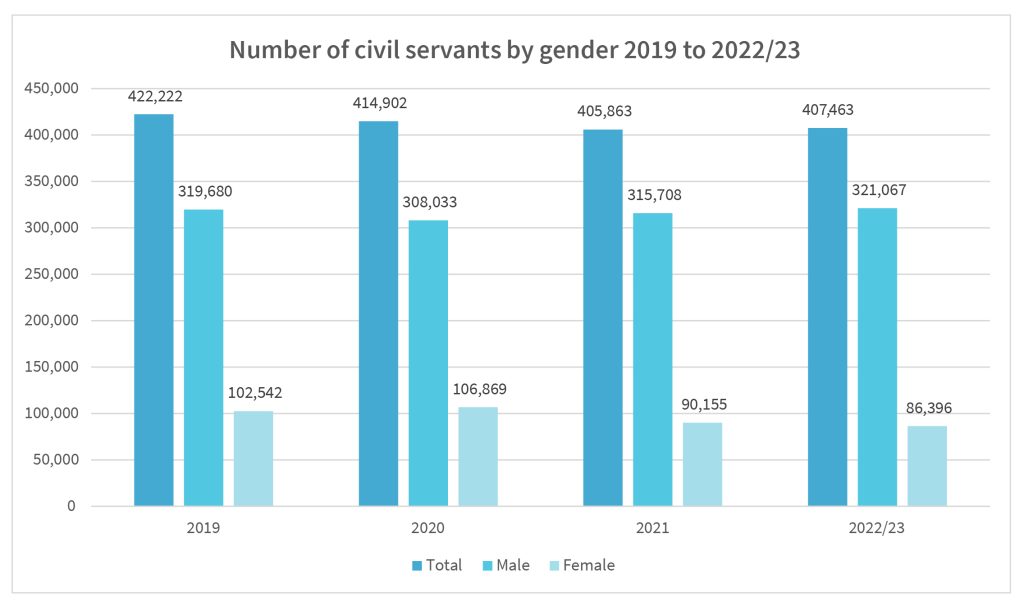
The proportion of women working in the public sector, Afghanistan’s biggest source of paid work for both men and women, has fluctuated over the last 20 years between 18 and 26 per cent. In 2005 and 2020, for example, women accounted for 26 per cent of public sector workers, but in every year between 2014 and 2018, as well as in 2021, they accounted for 22 per cent.[8] A year after the fall of the Republic, the proportion was still 21 per cent (this was measured for the Afghan year, then 1401, equivalent to March 2022 to March 2023).[9]
Data taken from NSIA Afghanistan Statistical Yearbooks 2019 to 2022/23. Graph by AAN
Far fewer women were ever employed in higher grade positions; see the 2020 data in the graph below as an example. Furthermore, women’s participation varied significantly between ministries, with women underrepresented in all ministries except the Ministry of Women’s Affairs (MoWA) and the Ministry of Labor, Social Affairs, Martyrs and Disabled. The IEA abolished Women’s Affairs in 2021 and transferred most of its female staff in the provinces to the provincial Directorates of Vocational Training, which itself has recently been merged with the Ministry of Labour and Social Affairs.
Data taken from NSIA Afghanistan Statistical Yearbooks 2020. Graph by AAN
The total number of women working in the public sector under the Islamic Emirate remains elusive, with far higher figures than NSIA’s being reported by some government officials. For example, in its 23 July 2023 accountability session, the Ministry of Economy (MoE) said that “92,000 women work in the education sector and 14,000 in the health sector, they work in airports, banks, but as already mentioned, efforts are ongoing to prepare a suitable environment for women.” This would mean that some 106,000 women work in the education and health sectors alone, not taking into account women employed in other sectors. The figures are drawn from the AAN 2024 report ‘How The Emirate Wants to be Perceived: A closer look at the Accountability Programme’ (p 57). The same AAN report quotes the Ministry of Interior (MoI) saying that around 1,955 policewomen were serving in different fields and receiving salaries and the Ministry of Public Health reporting that women accounted for 22 per cent of its personnel (p 60).[10] It is not known, therefore, the potential number of women hit by the Amir’s order, but it is clear it is substantial.
Anxieties about an uncertain future
The abrupt nature of the Amir’s order put a spotlight on the precariousness of many Afghan women’s lives, in this instance, those working in the public sector. Their lives were already difficult, but they would have counted themselves among the lucky few who still had a regular income. Trying their best to keep their heads above water and provide for their families, this latest incursion on their right to a livelihood threatens to remove a safety net because, as one said: What can you do with 5,000 afghanis?
The quotes below reflect answers to the last question from our questionnaire: If there was a reduction in your salary, how would it affect the economy of your household, and your life? All interviewees said a salary cut would affect their lives dramatically. Many said they would have to leave their jobs because they could not survive on the reduced income. The midwife from Ghazni, for example, was concerned about how the anxiety was affecting their quality of work.
If someone is worried about their own life and expenses, how could they think about doing their job properly? People are already anxious about the news and, if it really happens, they’ll be hit hard. I’m the only person working in my family. No one else works because unemployment has increased. The cost of everything is very high – there’s the house rent, the electricity bill and other expenses. How can we manage if they reduce our salaries? They should have a thought for the people and if they don’t help or increase their salaries, at least, they should not reduce them.
Another midwife, from Kandahar, who sometimes gets paid by an NGO,[11] said she would leave her job if her salary was cut:
We hope the reduction won’t take place. We’re barely keeping on top of the necessities now. If the salaries are reduced, this’ll definitely harm the economy of our household badly. I’ll leave my job. So far, the salary [I get] from the NGO has supported our household. But if the NGO stops paying my salary and the government reduces my wages, I won’t go to the hospital even though leaving the job and losing even this 5,000 afghanis will badly affect my family’s finances, but it’s also very difficult to work full-time and do night shifts.
A policewoman from Kabul, who had already taken her son out of school so that he could work and help support the family, told us that if the Islamic Emirate really does reduce salaries, it will be extremely hard for women, especially widows like her who have no adult man to support them and are not qualified for any work other than their current occupation:
My son sells plastic bags because I can’t cover all the family’s expenses with my income. He has to work even though it’s not his time to work – he should be in school. He only makes 50 afghanis (USD 71) a day, with a lot of difficulty, and sometimes he can’t sell any bags. It’s been a month since he fell ill and we’re wondering what to do. The cost of living is very high and our income is low. 5,000 afghanis would only be enough for the rent and electricity. The taxi for me to go to and from work is expensive. Sometimes, I get sick and have no money to go to a doctor. 5,000 afghanis can’t cover all our expenses. I hope this is only a rumour or a lie and they won’t reduce my salary.
I ask the Islamic Emirate not to reduce the salary of any employee who’s working, whether she’s a policewoman, a doctor or a teacher. We’ve been serving our country. We carried on with the wages we got and lived with many problems. If they don’t increase the salaries, at least I hope they don’t reduce them.
The NSIA employee in Daikundi said that reducing the salaries of female civil servants amounted to an injustice:
If they really reduce the salaries of female employees, it will be a great disservice to women. It’s an injustice that’s done to them. Instead of reducing salaries, they should increase them because everything is expensive and we manage our lives with the wages they pay us. For example, from my salary, I pay 1,500 [USD 21] a month for the car fare to and from work. I also pay 1,500 afghanis a month for lunches. All our colleagues pay this much for lunches because the government doesn’t provide us with lunch and doesn’t pay for it either. My family is big and we have a lot of expenses. The price of goods has reached its peak. I spend 5,000 afghanis a month to buy flour, rice and oil. If the government pays us 5,000, we can’t do anything with it. It is really upsetting and so discouraging.
She appealed to the government:
We ask the government, if it has made such a decision, they should change it. Let us work in our country alongside men. Women work like men, so why should their income be reduced?
A teacher in Paktia said that all female teachers in her province were working because there was a teacher shortage:
The salaries that I and other teachers receive are very low and not enough for our families. We have teachers who are their families’ breadwinners. What can they do with a salary of 5,000 afghanis? They cannot meet their needs…. What should they do with their children’s school expenses, illnesses, food and clothes? These decisions cause problems for everyone.
She went on to talk about the plight of female public sector workers who have been forced to stay home since the re-establishment of the Emirate:
In general, all women [civil servants], whether they go to work or [have to stay] at home, should return to their duties because women have [only] stayed at home according to the decision of the Emirate. I have friends who are suffering immensely because they’re at home. They want to return to their duties. We need women in every department and they should pay the salaries of all women.
She went on to expand on the overall economic situation and compared the current circumstances for public sector workers to life and work under the Republic:
In general, the people’s economy has been badly damaged. People have become unemployed…. government offices are closed to women. Most of those who worked in the previous government are now unemployed. They’ve not been asked to come to their duties again. People’s purchasing power is weakened. Security is good, but security alone cannot change people’s lives…. Poverty and hunger can also kill people. Unemployment is a big problem that all people struggle with … but especially women. This recent decree regarding the reduction of women’s salaries will make their lives worse…. Under the previous governments, if the salaries were low, they provided other facilities for their employees. For example, they gave them coupons. The rents were lower, the price of goods was not so high and people could manage their lives with lower wages.
The prosecutor in Kabul talked about the entreaties of her female colleagues who are still forced to stay at home and came to the office only to sign their attendance sheets:
Many of them developed psychological problems when they heard their salaries were going to be reduced. Most are the only breadwinners of their families – they’re widows, or they don’t have anyone else [in the household] who can work, or they can’t find work. Every day, our colleagues call and ask what changes have been made regarding salaries. Just last week, our colleagues who had come in to sign [their attendance sheets] were crying and begging the head of our department to convey their message to the authorities not to reduce their salaries. You can’t do anything with 5,000 afghanis. They asked the head of our office to ask the authorities how women who are breadwinners can live with 5,000 afghanis.
The teacher in Farah said news of the salary cut had been a blow coming on top of the cost of transport to faraway locations where teachers had been transferred to:
Recently, there have been forced transfers. The IEA has forced some of us to go to teach in the districts and villages. They say: You should go and teach in remote areas; that is your jihad and if you don’t have a mahram, you should leave your job. A lot of women did leave their jobs because the locations were far away and they didn’t have a mahram. For women who teach far away [from their home] areas, 5,000 afghanis can’t cover even the car fare. What about their other expenses? Most women like me are the only breadwinners of their families because their husbands are unemployed now. It’s also natural that we get sick sometimes and we need to pay for doctors and medicine. How can we cover all these expenses?
A high school teacher from Mazar-e Sharif who, like everybody else, had already seen her salary reduced since the Emirate took power, was particularly bleak about the future:
My salary has already been cut and that has had an ill effect. My purchasing power has already weakened. It’s not my fault. They’ve forced us to stay home and not teach. Now, they’re going to reduce [the salary] again. They want us to die gradually, and that is all it is.
From being told to stay home to cuts in pay
Two days after it took power, spokesperson Zabihullah Mujahid said that men and women would be working “shoulder to shoulder” in the Islamic Emirate.
The issue of women is very important. The Islamic Emirate is committed to the rights of women within the framework of Sharia. Our sisters, our men have the same rights; they will be able to benefit from their rights. They can have activities in different sectors and different areas on the basis of our rules and regulations: educational, health and other areas. They are going to be working with us, shoulder to shoulder with us. The international community, if they have concerns, we would like to assure them that there’s not going to be any discrimination against women, but of course within the frameworks that we have (see full transcript on Al Jazeera).
The pledge had been echoed earlier in the day by a member of the Taleban’s Cultural Commission, Enamullah Samangani, when he announced not only the IEA’s general amnesty for those who had worked for the Republic, but also that they were ready to “provide women with [the] environment to work and study, and the presence of women in different (government) structures according to Islamic law and in accordance with our cultural values” (see France 24).
A week later, the IEA appeared to change its stance: Mujahid said women should stay at home, the BBC reported on 24 August 2021: “Our security forces are not trained (in) how to deal with women – how to speak to women (for) some of them,” Mr Mujahid said. “Until we have full security in place … we ask women to stay home.” He called it a “temporary procedure.” Reports soon started emerging in the media that women working in government were being denied access to their places of work (see, for example, The Guardian on 19 September 2021).
In televised debates, in news and on social media, women raised concerns about their future under IEA rule and predicted that the qualifier “according to Islamic law and in accordance with our cultural values” would be used to deny them their rights as would the IEA refrain that they merely wanted to create an appropriate environment for women to be active in the workforce (see for example this 27 August 2021 Afghanistan International debate between the Republic’s last Deputy Minister of Education, Victoria Ghauri and a member of the Emirate’s Cultural Commission, Anamullah Samangani and this 10 September 2021 ToloNews Farakhabar programme with women’s rights activist, Tafsir Siaposh and Islamic scholar Abdul Haq Emad debating the right of women civil servants to return to work).
Finally, on 20 September 2021, the Emirate ordered women working for the government to stay home until further notice.[12] What emerged was a situation where most jobs previously filled by women were handed over to men and only those women whose jobs could not be carried out by a man, such as primary school teachers and health workers, were allowed to continue working.
The situation continued much the same until the recent order, although with greater pressure on women workers created by the Amir’s ban on women working for NGOs, international organisations and embassies issued in December 2022, the closure of universities to girls in the same month and the firming up of the ban on girls’ education beyond primary school. In the Accountability Sessions in summer 2023, there was even boasting about continuing to pay women who were at home, for example, by Director of the Secretariat of the Supreme Court Mufti Abdul Rashid Saeed:[13]
Despite these limits [imposed by foreigners, presumably a reference to sanctions], the Islamic Emirate continues to pay the salaries of all the employees who serve in the government. Women are at home, but the Islamic Emirate is dedicated to upholding their rights and according them the privileges they once enjoyed. Women continue to occupy the majority of office positions. In accordance with sharia, we grant women full rights.
Statements from various officials indicate that the plan to reduce salaries will affect only those women who have been forced to stay at home. The government’s motivation must be cutting costs. Pressure on the budget, which was only approved two months into the financial year, indicating a wrangling over the public finances, has been reported elsewhere, for example by the World Bank, which said in May that increased planned spending for 1402/March 2023-24 had left a budget deficit of 18.4 billion afghanis (USD 2.6 m). In earlier years since the Emirate took power, it said, quoting “anecdotal information,” the deficit had been covered by “treasury cash reserves left over from the republic era.” However, especially given the Emirate lacks borrowing options to finance its deficit, “the only viable strategies are to increase domestic revenues or cut unnecessary spending.”[14]
Cutting the wages of women compelled to stay at home may make budgetary sense and it is a relatively easy way, politically, to cut costs, given they are a group with little political clout or public voice. However, for the women themselves, the loss of income will be a heavy blow, especially as they have been forced to be economically inactive through no fault of their own. They feel they are left out in the cold. Moreover, it should be stressed that, nearly two months after news broke that the IEA planned the salary cap, there is still no official word about how it is to implement its plan and who, exactly, it applies to. Even if women fortunate still to be working in the public sector continue to be paid their salaries in full, the vaguely worded order and lack of clarity ever since has left them and their families needlessly racked with anxiety about the future.
Edited by Kate Clark
References
References
↑1
All English language translations are by AAN.
↑2
A budgetary unit is a state entity, such as a ministry, that by law can have allocations in the national budget, whereas non-budgetary units do not have explicit allocations in the national budget (budget codes) and are often, by not always, established for a specific time period and purpose.
↑3
The government of Afghanistan defines all government employees except military personnel as civil servants.
The Amir’s order followed another made in April 2024 that had abruptly abolished the government’s pension system. Since the fall of the Islamic Republic, retired public sector workers have not been paid their pensions. However, the Amir’s April 2024 order, which meant that pension contributions were no longer deducted from current workers’ salaries, signalled the unlikelihood that the state would start paying retirees their pensions ever again. See AAN reporting on the difficulties faced by Afghanistan’s public sector pensioners here.
↑6
These included the 2007-2017 National Action Plan for Women (NAPWA), the 2015 National Action Plan on Women Peace, and Security, and the 2017-2021 Women Economic Empowerment National Priority Programme.
↑7
The World Bank defines the labour force as comprising: “people ages 15 and older who supply labor for the production of goods and services during a specified period. It includes people who are currently employed and people who are unemployed but seeking work as well as first-time job-seekers. Not everyone who works is included, however. Unpaid workers, family workers, and students are often omitted, and some countries do not count members of the armed forces.”
The figures quoted in the text are from the Bank’s 2018 Afghanistan Issues Note: Managing the Civilian Wage Bill, which cited the 2013-14 Afghanistan Living Conditions Survey (ALCS) that indicated that only 18.5 per cent of women were then participating in the labour force. “Within this small, employed population,” it said, “only 13 per cent of female labour is in salaried positions, suggesting that female participation in the civil service is an important anchor for female participation in formal sector salaried employment.”
See the NSIA Statistical Yearbook 2022/23, published on 5 February 2024.
↑10
In its 2023 accountability session, the Ministry of Commerce and Industry (MoCI) said it had provided 7,263 business licences in the previous year, 1,000 of which were to women.
↑11
In Afghanistan, sometimes an NGO pays teachers or health workers. When that happens, the government does not pay their salaries for the months they get paid by the NGO. Then, when the NGO stops paying, they go back onto the government payroll.
The United Nations says aid workers are still in a “race against time” to remove rubble and rebuild after the devastating earthquake struck eastern Afghanistan last month, killing at least 2,200 people and cutting off remote areas.
The 6.0-magnitude quake on Aug. 31 was shallow, destroying or causing extensive damage to low-rise buildings in the mountainous region. It hit late at night, and homes — mostly made of mud, wood, or rocks — collapsed instantly, becoming death traps.
Satellite data shows that about 40,500 truckloads of debris still needs to be cleared from affected areas in several provinces, the United Nations Development Program said Wednesday. Entire communities have been upended and families are sleeping in the open, it added.
The quake’s epicenter was in remote and rugged Kunar province, challenging rescue and relief efforts by the Taliban government and humanitarian groups. Authorities deployed helicopters or airdropped army commandos to evacuate survivors. Aid workers walked for hours on foot to reach isolated communities.
“This is a race against time,” said Devanand Ramiah, from the UNDP’s Crisis Bureau. “Debris removal and reconstruction operations must start safely and swiftly.”
People’s main demands were the reconstruction of houses and water supplies, according to a spokesman for a Taliban government committee tasked with helping survivors, Zia ur Rahman Speenghar.
People were getting assistance in cash, food, tents, beds, and other necessities, Speenghar said Thursday. Three new roads were under construction in the Dewagal Valley, and roads would be built to areas where there previously were none.
“Various countries and organizations have offered assistance in the construction of houses but that takes time. After the second round of assistance, work will begin on the third round, which is considering what kind of houses can be built here,” the spokesman said.
Afghanistan is facing a “perfect storm” of crises, including natural disasters like the recent earthquake, said Roza Otunbayeva, who leads the U.N. mission to the country.
 Afghanistan Peace Campaign