The United Nations Children’s Fund (UNICEF) has called for greater attention to the plight of children in Afghanistan on the occasion of World Children’s Day, celebrated on November 20.
In a message shared on the social media platform X, UNICEF highlighted that “children pay the highest price for conflicts, natural disasters, and other emergencies.”
The organization emphasized that children, whose lives are at risk, have the right to be heard and to participate in decisions affecting their future.
The European Union, marking World Children’s Day, reaffirmed its commitment to supporting Afghan children through educational programs, healthcare, and protective measures.
The EU further stressed that children are the future of Afghanistan and pledged to stand firmly by their side.
World Children’s Day is celebrated annually on November 20 to advocate for children’s rights globally.
The situation in Afghanistan is dire for children, particularly girls who are banned from attending school beyond sixth grade. This policy not only denies them their right to education but also contributes to a cycle of poverty and inequality.
The ongoing humanitarian crisis, worsened by these restrictions, has led to an increase in forced and underage marriages as families struggle to cope. Without urgent action, millions of Afghan children, especially girls, face a bleak future marked by limited opportunities and systemic oppression.
UNICEF urges focus on Afghan children’s plight on world children’s day
Mohammad Abbas Khan, Pakistan’s High Commissioner for Refugees, has called for an international conference to increase the acceptance of Afghan refugees living in Pakistan by Western countries.
According to a report by the Dawn newspaper, Pakistan’s High Commissioner for Refugees emphasized that Western countries should expedite the process of accepting Afghan applicants currently residing in Pakistan.
The report stated that Mohammad Abbas Khan suggested this conference should address challenges such as the voluntary return of refugees to Afghanistan and their resettlement in third countries.
He added that a trilateral meeting with the Kabul administration and the UNHCR (United Nations High Commissioner for Refugees) would soon be held to discuss the challenges faced by Afghan refugees and migrants.
The Pakistani official noted that around 600,000 Afghan applicants are currently registered with the UNHCR in Pakistan, seeking resettlement in Western countries.
He further stated that the resettlement quota for UN-registered Afghan applicants this year is only 8,000 people.
Mohammad Abbas Khan emphasized that Afghanistan’s capacity to absorb returning refugees is extremely limited.
The situation of Afghan refugees in Pakistan highlights the urgent need for global collaboration to address their resettlement challenges. Without adequate international support, both the refugees and the host countries face significant humanitarian and logistical burdens.
This call for an international conference underscores the importance of shared responsibility in dealing with the refugee crisis.
It is a pivotal moment for Western countries to step forward and provide sustainable solutions for displaced Afghan families, ensuring their safety, dignity, and a better future.
Pakistan proposes International Conference to address Afghan refugee issues
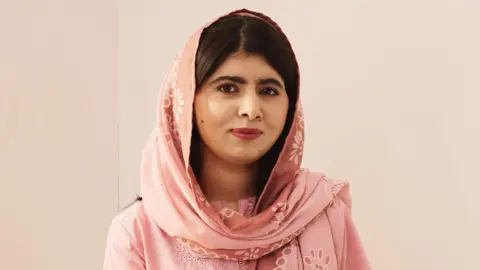
Malala Yousafzai has campaigned for women’s rights since she was shot by a Taliban gunman in 2012
A bullet failed to silence her, now Malala Yousafzai is lending her voice to the women of Afghanistan.
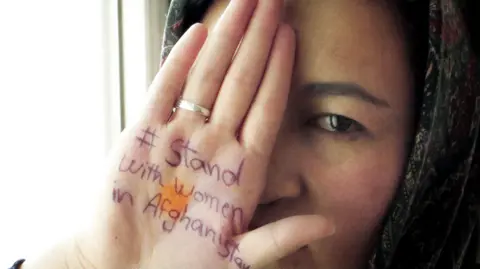
In just a few years since the Taliban retook control of the country, women’s rights have been eroded to the point where even singing is banned.
Malala has a personal history with the Taliban across the border in Pakistan, after a gunman from the hardline Islamist group shot her as she sat on a school bus.
The speed of change in Afghanistan, if not the brutality, has surprised Malala, who since that near-fatal shooting in 2012 has campaigned for equality.
“I never imagined that the rights of women would be compromised so easily,” Malala tells BBC Asian Network.
“A lot of girls are finding themselves in a very hopeless, depressing situation where they do not see any way out,” the 27-year-old Nobel Prize Winner says.
“The future looks very dark to them.”
In 2021, the Taliban regained power in Afghanistan, 20 years after a US-led invasion toppled their regime in the fallout of the 9/11 attacks in New York.
In the three-and-a-half years since Western forces left the country, “morality laws” have meant women in Afghanistan have lost dozens of rights.
A dress code means they must be fully covered and strict rules have banned them from travelling without a male chaperone or looking a man in the eye unless they’re related by blood or marriage.
“The restrictions are just so extreme that it does not even make sense to anybody,” says Malala.
But the rules have been defended by the Taliban, which claims they’re accepted in Afghan society and that the international community should respect “Islamic laws, traditions and the values of Muslim societies”.
Apple TV+
Malala’s worked on a new film that follows the lives of three Afghan women as their rights are stripped away
“Women lost everything,” says Malala.
“They [the Taliban] know that to take away women’s rights you have to start with the foundation, and that is education.”
It’s also reported a correlation between the lack of access to education and a rise in child marriage and deaths during pregnancy and childbirth.
“Afghan women live in very dark times now,” Malala says.
“But they show resistance.”
The Pakistan-born activist, who became the youngest person ever to win a Nobel Peace Prize, is an executive producer on an upcoming film, Bread & Roses, that documents the lives of three Afghan women living under the Taliban regime.
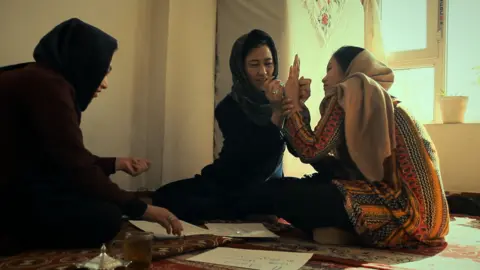
The documentary follows Zahra, a dentist forced to give up her practice, activist Taranom, who flees to the border, and government employee Sharifa, who loses her job and her independence.
But the film isn’t just about the stories of three women, Malala says.
“It’s about the 20 million Afghan girls and women whose stories may not make it to our screens.”
Bread & Roses was directed by Afghan filmmaker Sahra Mani and US actress Jennifer Lawrence was also brought on board as a producer.
Apple TV+
The Taliban were ousted when US-led troops invaded Afghanistan in 2001 but returned to power 20 years later
Sahra tells Asian Network her mission was “to tell the story of a nation under the Taliban dictatorship”.
“How slowly, all the rights have been taken away.”
Sahra managed to flee Afghanistan after the US-backed government collapsed following the withdrawal of troops in August 2021.
But she kept in touch with women back home, who would share videos which she then collected and archived.
“It was very important to find young, modern, educated women that have talent they were ready to dedicate to society,” says Sahra.
“They were ready to build the country but now they have to sit at home and almost do nothing.”
Retired US generals describe chaos of Afghan exit.
Afghan withdrawal was a dark chapter for UK – MP
Even though the film hasn’t been released yet, Sahra believes the situation in Afghanistan has already deteriorated to the point where it would be impossible to make if she started now.
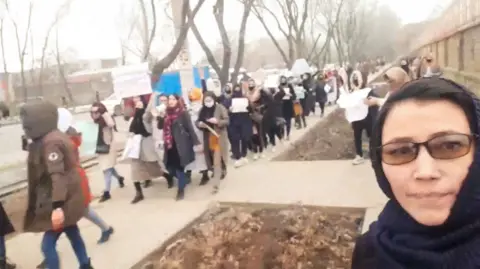
“At that time, women could still go out and demonstrate,” she says.
“Nowadays, women are not even allowed to sing… the situation is getting more difficult.”
The first-hand footage shows the women at protests – they kept the cameras rolling while being arrested by the Taliban.
And Sahra says the project only got harder over time as more of their rights were stripped away.
“We were really honoured that these women trusted us to share their stories,” she says.
“And it was really important for us to put their security in our priorities.
“But when they were out in the street asking for their rights, it was not for the documentary.
“It was for them, for their own life, for their own freedom.”
Apple TV+
US actress Jennifer Lawrence produced the film which she says is about “the nature of resistance”
Malala says that, for women in Afghanistan, “defiance is extremely challenging”.
“Despite all of these challenges, they’re out on their streets and risking their lives to hope for a better world for themselves.”
All three of the women featured in the film are no longer living in Afghanistan and Sahra and Malala are hopeful the film will raise awareness of what women who remain endure.
“They are doing all that they can to fight for their rights, to raise their voices,” Malala says.
“They’re putting so much at risk. It’s our time to be their sisters and be their supporters.”
Malala also hopes the documentary prompts more international pressure on the Taliban to restore women’s rights.
“I was completely shocked when I saw the reality of the Taliban take over,” she says.
“We really have to question what sort of systems we have put in place to guarantee protection to women in Afghanistan, but also elsewhere.”
And as much as Bread & Roses deals with stories of loss and oppression, the film is also about resilience and hope.
“There’s so much for us to learn from the bravery and courage of these Afghan women,” says Malala.
“If they are not scared, if they are not losing that courage to stand up to the Taliban, we should learn from them and we should stand in solidarity with them.”
The title itself was inspired by an Afghan saying.
“Bread is a symbol of freedom, earning a salary and supporting the family,” Sahra says.
“We have a saying in my language that the one who gave you bread is the one who orders you.
“So if you find your bread, that means you are the boss of you.”
That’s exactly the future she hopes to see for the women of Afghanistan and, based on what she’s seen, one she believes they will achieve in the end.
“Women in Afghanistan, they keep changing the tactic,” she says.
“They keep searching for a new way to keep fighting back.”
Listen to an extended interview with Malala and Sahra on BBC Asian Network News Presents at 23:00 on 18 November or catch up on BBC Sounds.
Bread & Roses will be streamed globally on Apple TV+ from 22 November.
Additional reporting by Riyah Collins.
Malala: I never imagined women’s rights would be lost so easily
When the Taliban began a sweeping redevelopment drive in Kabul soon after returning to power three years ago, they claimed there was a need to modernise Afghanistan’s historic capital. A new investigation, however, reveals that the Taliban’s regeneration programme has left thousands of people homeless and had a brutal impact on the most vulnerable communities, with claims of properties being demolished with children still inside.
Using satellite imagery, social media footage and testimony from Afghan residents, the findings offer a first comprehensive insight into the Taliban’s ambitious redevelopment of Kabul – but also its true cost.
Satellite analysis indicates that 1.56 sq km (385 acres) of the city – the equivalent of more than 220 football pitches – was flattened within the city between August 2021 and August 2024.
The investigation, a collaboration between the Guardian, the Centre for Information Resilience’s Afghan Witness project, Lighthouse Reports and the Afghan news outlets Zan Times and Etilaat Roz also uncovered signs that the destruction is in part linked to ethnicity.
The satellite analysis, carried out by Afghan Witness, showed that of the six most-affected districts – where at least 50,000 sq metres (12 acres) of residential properties were demolished – three were areas populated by the minority Hazara community and two were populated by the minority Tajiks.
Most affected was Kabul’s District 13, a predominantly Hazara area.
The investigation also analysed the large-scale razing of “informal settlements”. In some cases, the destruction of the sprawling slums, which are typically inhabited by poorer communities displaced by conflict or climate change – have been conducted so brutally that residents reported injuries and deaths.
In at least two settlements, residents allege that homes were demolished with people still inside. In one large slum – in Kabul’s District 22 – evicted families alleged that a four-year-old and a 15-year-old died during its demolition.
“Women, children and elderly men were begging for them to stop the destruction until we can find a shelter, but they wouldn’t listen,” said a resident, who had spent a decade in the settlement after being displaced from Pakistan.
He claimed in the aftermath of the demolition his young niece also died from lack of shelter after their home was destroyed during the heat of summer.
Residents who attempted to film such demolitions were reportedly beaten.
In another significant destruction of an informal settlement in the north of the city, the Taliban’s administration in Kabul tweeted a series of photos in August 2024 chronicling bulldozers razing structures.
Residents described scenes of mayhem and desperation as the site was demolished. “It was like the earthquake in Herat [which killed thousands last year]. Houses were buried; all our belongings were also buried,” said one resident.
The crude shelter one resident’s family in District 4 has been living in since the demolitions.
Others testified that homes were demolished with people inside. “My nephew came by, crying that his mother and brother were inside the house and the loader was demolishing it,” said one.
Jalaluddin, who lived in the settlement with nearly 50 family members for two decades, said he could not afford to rent a new home and was now living in an abandoned factory.
“We don’t even have tents – we just have shelters made from plastic pieces. Some days we don’t have anything to eat. We sleep with an empty stomach,” he said.
Many of the land-clearance projects in residential areas are for building or widening roads.
Fakhrullah Sarwari, an urban planner who worked with the former Afghan government, said: “Most of these plans were part of previous government plans, but they were unable to be implemented because they couldn’t force people to evacuate the area.
“We do need better mobility, but with the majority of the population living below the poverty line, demolishing homes to build wider roads doesn’t address underlying issues,” he said.
Human rights groups say women are particularly vulnerable after eviction, warning it can increase gender-based violence.
One woman, interviewed by Zan Times, reveals the difficulties of female-led households. Offering cleaning services door to door, she earns between one and three dollars a day and has struggled to get compensation from the Taliban after they demolished her home in a residential area in north Kabul.
One reason is that she is not allowed into Kabul’s municipal offices without a male guardian to accompany her, under the Taliban’s rules of segregation.
Residents say fear has prevented them protesting over the loss of their homes. Photograph: X/Municipality status
Another woman who lost her home in the same area can no longer work due to Taliban restrictions. Denied compensation, her family must rely solely on her husband’s modest income repairing shoes.
Of a dozen people evicted who were interviewed for the investigation, only one had found permanent accommodation since their eviction. Residents say fear prevents them from protesting at the destruction of their homes.
The demolitions come months after the UN warned that Afghanistan’s economy had “basically collapsed” with rampant food insecurity and 6.3 million people displaced within the country.
One woman, whose family home of 40 years was demolished in August 2023, said: “At first, they told us that they would compensate us and not leave us homeless, but once the houses were demolished, nobody cared about us.”
Her family stopped travelling to the municipal offices to ask for their compensation when they could no longer afford the bus fare.
The Taliban authorities have not commented on the findings. They have previously justified the demolition of informal settlements as reclaiming stolen land acquired by “opportunists and usurpers”. They also state that residential land is often cleared for infrastructure projects.
* Additional reporting by Sabrina Slipchenko, Elyas Nawandish and Kreshma Fakhri
Revealed: the truth behind the Taliban’s brutal Kabul ‘regeneration’ programme
Pakistani media reported that Islamabad shared “compelling evidence” with China’s Special Representative for Afghanistan, Yu Xiaoyong, regarding the presence of Tehrik-e-Taliban Pakistan (TTP) and other groups operating from Afghan territory.
According to The Express Tribune, Pakistan’s Ministry of Foreign Affairs presented this evidence during Yu Xiaoyong’s visit to Islamabad on Monday, November 18.
The report noted that the Chinese envoy’s trip to Islamabad came just days after Russian Special Envoy Zamir Kabulov’s visit, highlighting the growing international focus on Afghanistan’s role in regional security.
Citing sources, The Express Tribune stated that Pakistan briefed the Chinese envoy about the current situation in Afghanistan, detailing how terrorist groups such as the TTP have been using Afghanistan’s territory.
Pakistani officials reportedly shared compelling evidence about terrorist sanctuaries in Afghanistan and emphasized that it is time for a collective stance against the Taliban regime to ensure they fulfill their commitments to the international community.
The Afghan Taliban, however, have consistently denied Pakistan’s allegations, asserting that no terrorist groups are allowed to use Afghanistan’s soil against any country.
The conflicting narratives highlight the ongoing challenges in addressing regional security concerns and fostering trust among stakeholders.
These discussions underscore the growing frustration in Islamabad over what it perceives as the Taliban regime’s failure to act against militant groups that threaten regional stability.
Pakistan’s calls for a united international response indicate its desire to increase pressure on the Taliban government.
The involvement of China and Russia in these talks signals the international community’s recognition of the deteriorating security situation in Afghanistan and its broader implications.
A coordinated regional approach may be critical to addressing the escalating threats posed by militant groups.
Pakistan provides China with fresh information on TTP activities in Afghanistan
Prior to Yue Xiaoyong’s visit, Zamir Kabulov, Russia’s Special Representative for Afghanistan, also visited Pakistan and held talks on Afghanistan.
Yue Xiaoyong, China’s Special Representative for Afghanistan, met with senior Pakistani officials to discuss relations with Afghanistan and the role of neighboring countries in fostering peace and stability. The discussions were held with Amina Baloch, Foreign Secretary, and Ahmad Naseem Warraich, Additional Foreign Secretary (Afghanistan and West Asia) at Pakistan’s Ministry of Foreign Affairs.
According to a statement from the Ministry of Foreign Affairs, the talks focused on strengthening relations with Afghanistan and emphasized the critical role of neighboring countries in ensuring stability. The statement said, “The Chinese Special Envoy on Afghan Affairs, Ambassador Yue Xiaoyong, called on Foreign Secretary Ms. Amina Baloch today. He also held detailed consultations with the Additional Foreign Secretary (Afghanistan and West Asia), Ambassador Ahmad Naseem Warraich. Both sides exchanged views on relations with Afghanistan and reaffirmed the vital role of neighboring countries for a peaceful and stable Afghanistan.”
Prior to Yue Xiaoyong’s visit, Zamir Kabulov, Russia’s Special Representative for Afghanistan, also visited Pakistan and held talks on Afghanistan. China and Russia, key allies of Afghanistan’s interim government, have consistently expressed their support for peace and regional stability.
Ahead of his visit to Pakistan, Yue Xiaoyong told a Chinese media outlet that regional and neighboring countries had agreed to collaborate in achieving peace and stability in Afghanistan.
Political analyst Salim Paigir told TOLOnews, “Russia, China, India, and Iran are major regional powers that can play a significant role, provided that Pakistan acts sincerely in its dealings with Afghanistan and the region.”
Another analyst, Moeen Gul Samkani, stated: “China and Russia are seeking to create a military, political, and economic bloc, but the West and the United States are unlikely to allow this. The West aims to maintain control over Afghanistan and India to counter Russia, Iran, Central Asia, and China.”
Both China and Russia continue to stress the importance of neighboring countries in fostering peace and stability in Afghanistan. During his visit to Pakistan, Zamir Kabulov also underscored the critical role of Afghanistan’s neighbors in resolving the country’s challenges.
China, Pakistan Discuss Collaborating to Foster Peace in Afghanistan
Salvador pointed out that decades of continuous challenges have left Afghanistan’s healthcare system fragile, requiring a structural approach to address its issues.
Edwin Ceniza Salvador, the World Health Organization’s (WHO) Representative in Afghanistan, revealed in an exclusive interview with TOLOnews that 33% of Afghanistan’s population still lacks access to healthcare services.
He further explained that budget constraints have forced the closure of 226 healthcare centers previously supported by the WHO in Afghanistan.
Speaking about the healthcare gap, Salvador stated: “About 67% of the population currently has access, which means that about 33% of the population do not have access to the health services. And these are, like I mentioned, most people in the rural areas and most that are geographically difficult to access in winter seasons.”
Salvador pointed out that decades of continuous challenges have left Afghanistan’s healthcare system fragile, requiring a structural approach to address its issues. Reflecting on the impact of the 2021 political transition, he noted that many Afghan doctors have since left the country.
“There was a change in 2021. We’ll have to, number one, build again the capacity of the people who are remaining in the country. Number two, to see if some of the people who are abroad will be able to come back, so that they will be able to at least help the people back in their country,” Salvador said.
The WHO representative emphasized ongoing efforts to train midwives and underscored the need to support healthcare workers, particularly female doctors and nurses, across Afghanistan.
“The authorities, when I meet them, like when I visit the local authorities in the different provinces I’ve been, I basically said that now with the change that has been in place, we will come a time where we will run out of female midwives because the educational system has been impacted, you know, at the current state. The same for doctors. I basically also proposed and gave a scenario where I said, would you be comfortable where it is a male doctor treating your mother, your wife, your sister, your daughters, your aunties, and relatives,” Salvador warned.
In remote areas of Afghanistan, healthcare services remain inadequate, with many citizens unable to access even basic medical care. Nevertheless, the Ministry of Public Health has assured that efforts are underway to increase the number of healthcare centers throughout the country.
33% of Afghans Without Healthcare, WHO Official Warns
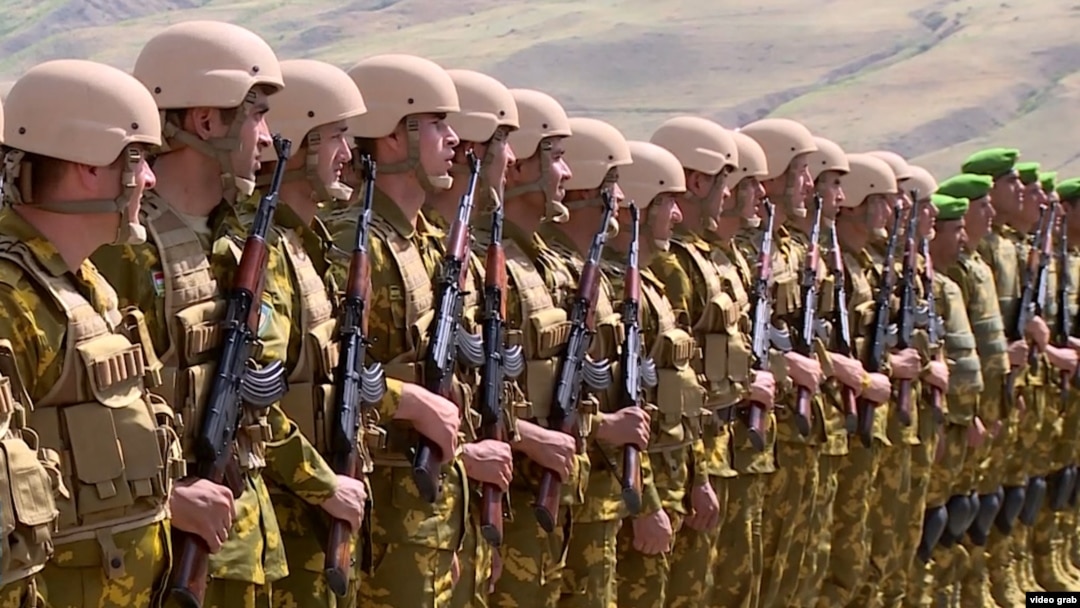
Tajik troops in the volatile Shamsiddin Shohin district bordering Afghanistan (file photo)
One Chinese national was killed and five others, four of them Chinese, were injured in a cross-border attack in Tajikistan’s Zarbuzi Gorge, two sources close to a Tajik investigation told RFE/RL’s Tajik Service on November 18.
The incident, which occurred in the southeastern Shamsiddin Shohin district, bordering Afghanistan, has not yet been officially addressed by the Tajik authorities.
According to the sources, the attack was carried out by armed individuals who crossed the border from Afghanistan. It remains unclear whether the attackers were criminals possibly involved in drug trafficking, a crime that is common in the area, or members of a militant group.
“Among the five injured, four are Chinese nationals and one is a local resident. All have been hospitalized in Shamsiddin Shohin district,” one of the sources said.
The Chinese nationals were reportedly working at a gold mine in the Zarbuzi Gorge. The attack marks the first known incident resulting in the death of a Chinese national in the volatile region.
The Shamsiddin Shohin district shares a porous border with Afghanistan that is often crossed by smugglers and militant groups.
Although the Taliban has assured neighboring countries that Afghan territory will not serve as a base for terrorist activities, Tajik authorities have been on high alert in recent years.
The deadly attack underscores persistent security concerns along Tajikistan’s southern frontier.
In August 2023, Tajikistan’s State Committee for National Security reported killing three members of the banned Ansarullah militant group and seizing weapons in a separate cross-border operation.
These incidents highlight the ongoing threats posed by instability in Afghanistan, despite regional efforts to secure the border.
Attack From Afghanistan Kills Chinese National In Tajikistan, Sources Say
Previously, the presidents of Türkiye and Uzbekistan have pledged support for Afghanistan during the 11th Summit of the Turkic States in Bishkek.
The President of Türkiye and the Emir of Qatar, in a joint statement, emphasized the formation of an inclusive government and the importance of respecting citizens’ rights in Afghanistan.
In this joint statement, released at the conclusion of the 10th High-Level Strategic Committee meeting between the two countries, both parties reiterated their commitment to strengthening Afghanistan’s stability and engaging with the country in coordination with the independent assessment of the UN Secretary-General’s Special Coordinator.
The Joint Communique of the 10th Session of the Supreme Strategic Committee Between Qatar, Türkiye reads: “Qatar and Turkiye reaffirmed their commitment to promoting stability in Afghanistan. They emphasized the importance of respecting fundamental rights and inclusive governance and also highlighted the need for coordinated engagement with Afghanistan.”
Although the Islamic Emirate has not commented on demands related to the formation of an inclusive government, it has praised the stance of the two countries on ensuring peace and stability in Afghanistan.
Hamdullah Fitrat, Deputy Spokesperson of the Islamic Emirate, stated: “We commend the stance of Qatar and Türkiye for emphasizing peace and stability in Afghanistan. Afghanistan’s stability benefits all countries. The Islamic Emirate ensures the Sharia-based rights of all Afghan citizens and, as a responsible government, strives for the security, economy, and well-being of its citizens.”
Sayed Akbar Sial Wardak, a political analyst, commented on the nature of an inclusive government, saying: “The definition and type of an inclusive government are not clear, and it is up to the Afghans to determine it. The current Afghan government should focus on this and discuss it to establish a system that satisfies all Afghan people.”
Previously, the presidents of Türkiye and Uzbekistan have pledged support for Afghanistan during the 11th Summit of the Turkic States in Bishkek.
Qatar, Turkey Advocate for Inclusive Govt and Stability in Afghanistan
With Donald Trump’s return to the U.S. presidency, the United States and the West face renewed opportunities and challenges in their approach to Afghanistan. His former envoy to Afghanistan, Zalmay Khalilzad, saw the election as an opening to fully implement the Doha Agreement, moving toward normalized relations, while the Taliban themselves have urged Trump for a “new chapter” in U.S.-Afghan relations.
Yet Trump’s new national security advisor, Mike Waltz, a decorated Afghanistan veteran, criticized the previous agreement, arguing that Washington had “unconditionally surrendered” and called for renewed U.S. fighting against the Taliban during the 2021 withdrawal. As the U.S. president who brokered the Doha Agreement, which set the stage for the complete withdrawal of all foreign troops from Afghanistan—and who once engaged in the controversial overture of inviting the Taliban to Camp David—Trump in his second term has a unique opportunity to build credibility with the Taliban to avoid past mistakes.
Trump will inherit a nearly deadlocked U.S. relationship with the Taliban, amid a waning Western focus. While Afghanistan’s neighbors are essentially moving toward de facto recognition, the recent closure of Afghan embassies in Europe and the quiet discontinuation of the position of the U.S. special representative for Afghanistan are signaling an increasing diplomatic decoupling between Kabul and the West. This has diminished the importance of formal recognition for the Taliban, eroding one of the West’s key leverage points.
The United States and its European partners have four key interests in Afghanistan: counterterrorism, counternarcotics, migration control, and the safe return of detainees held by the Taliban. Advancing these is fraught with challenges. Complicating matters further is a fifth, overarching concern—a moral obligation to protect human and women’s rights and preserve the gains from NATO’s 20-year intervention. Although promoting human rights was never the original aim of the U.S. intervention, and only part of European engagement, it has now become central to both genuine concerns and domestic political maneuvering.
For both the United States and Europe, the most pressing threat is the growing influence of the Islamic State-Khorasan Province (ISKP), a terrorist group that has established a foothold in Afghanistan and Pakistan. While the potential for this threat to be exaggerated exists, and alarmism should be avoided, ISKP has proved its capabilities, claiming responsibility for attacks that killed more than 200 people in Iran and Russia this year. Western intelligence agencies reported several foiled ISKP plots in Europe, including planned attacks at the Paris Olympic Games and a Taylor Swift concert in Austria—highlighting the group’s ambition and reach.
Navigating these complexities requires committed and coordinated U.S.-European diplomacy outside and inside Afghanistan. Just as they fought together, they must now present a united front in diplomatic efforts. While direct engagement with the Taliban remains controversial, positioning it as part of a broader trans-Atlantic effort makes it more politically viable. Instead of issuing ineffective demarches or hoping to fracture the Taliban from within, the West should accept Afghanistan’s current reality, engage where interests align, and practice strategic patience. The Taliban’s reclusive emir, Hibatullah Akhundzada, won’t live or lead forever, but the United States and Europe haven’t yet built ties with Afghanistan’s other key figures.
Demonstrating respect and granting legitimacy, such as formal recognition, are not the same. Since their first emirate in the late 1990s, the Taliban have sought international recognition, a U.N. seat, and diplomatic engagement, but more crucially, they have sought respect. Today, many senior Taliban leaders have spent years living abroad and have a stronger grasp of diplomacy than in the 1990s, spurred by the experiences, networks, and negotiating skills derived from the long process leading to the Doha Agreement in 2020. For the Taliban, de facto engagement and displays of diplomatic respect—such as Chinese President Xi Jinping personally receiving their ambassador—are far more significant than the de jure legitimacy of an international order they consider illegitimate.
There’s no shortage of engagement with the Taliban by non-Western powers. Aaron Zelin of the Washington Institute has meticulously tracked all Taliban diplomatic meetings since August 2021, nearly 2,000 in their first three years in power, with meetings accelerating year on year. When Uzbek Prime Minister Abdulla Aripov completed a formal visit to Afghanistan in August, it all seemed very “normal,” marking the highest-level visit since the Taliban took power. Hands were shaken, and trade deals were signed—and there was no mention of the Taliban’s policies toward women and girls or lack of inclusivity in government.
Countries such as China, Uzbekistan, and the United Arab Emirates are hosting Taliban ambassadors while avoiding the label of formal recognition or raising human rights concerns—a convenient diplomatic maneuver that the United States and European countries cannot replicate due to their own regulations and domestic politics.
However, while regional engagement enhances the Taliban’s legitimacy, it has yet to influence their behavior or prompt any meaningful compromises. Pakistani officials, for instance, are currently grappling with a surge in Tehrik-i-Taliban Pakistan (TTP) attacks, which have claimed the lives of thousands of soldiers and police. Pakistan should have leverage in its relations with the Afghan Taliban, given that many senior Taliban leaders were educated in Pakistani madrassas, sought refuge in cities such as Quetta and Karachi after the 2001 U.S. invasion, received support during the war, and still have family in Pakistan today. Yet this leverage seems absent.
Pakistan does not need to rely on culturally alien diplomats using translators to engage with the Taliban. It has a direct line through a rotating cast of envoys, both formal and informal, such as political leader Fazlur Rehman—a Pashtun and graduate of the same Darul Uloom Haqqania seminary as many Taliban leaders—and Muhammad Taqi Usmani, the most revered living Deobandi cleric. Usmani has urged them not only to curtail support for the TTP but also to allow girls to attend school. Yet even these pleas from figures within their own tradition have been soundly ignored. If the Taliban are ignoring Usmani, they certainly won’t respond to Western criticism, which is often more performative than practical. Similarly, they are also unlikely to heed Islamic leaders or scholars from traditions far from theirs.
After all, the Taliban are victors, and victors are not inclined to listen. They are also ideologues, which sets clear limits on their pragmatism. In September, during a ceremony in Peshawar, the Taliban’s consul general theres refused to stand for the Pakistani national anthem because it featured music. This act of defiance sparked more outrage in Pakistan than the countless TTP attacks that the Taliban have enabled. This highlights a point often overlooked in U.S. and European diplomacy, not just in Afghanistan but across the region: Perceptions of respect—or disrespect—carry immense weight, even in the face of deep-seated conflicts. The Taliban’s refusal to stand was more than a snub; it was a reminder of their ideological intransigence, even toward their former hosts.
If regional engagement is yielding few results, why shouldn’t the United States and Europe keep their distance? Because disengagement offers even less. Up until now, the Biden administration has maintained an international consensus on withholding formal recognition of the Taliban, leveraging it as a potential bargaining chip. However, as regional players are prioritizing realpolitik over ideology, with increased regional engagement—approaching de facto recognition—a Western strategy of nonrecognition is no longer an effective coercive tool. More importantly, the illusory promise of recognition does not offer a meaningful way to compel the Taliban. Instead, it has led to a prolonged stalemate between the international community’s principles and the Taliban’s rigid, exclusionary policies, leaving the Afghan people trapped in the middle of this impasse.
In Western diplomacy, engagement is often viewed as a form of leverage, a key component of transactional negotiations. In Afghanistan, sitting with your adversary is simply the necessary starting point, not a sign of concession. By being present in Afghanistan, regional countries have leveraged aspects of the Taliban’s own values—rooted in its specific version of Pashtun culture, ideas around hosting outsiders, and religious sensibilities—to their advantage. If the West were to adopt a similar approach, it could help secure the release of detainees and address more difficult issues, such as terrorism or migration.
As Pakistan has learned, engagement is not a cure-all for the challenges posed by the Taliban. The West’s predicament is different, and its interests in Afghanistan are more straightforward and less entangled. Abandoning Afghanistan completely may be tempting, but it would echo the mistakes of the 1990s, which ultimately led to the events of 9/11. Rather than sticking to value-based or transactional diplomacy, clinging to ideals it cannot enforce on the Taliban, the West must adapt its approach to protect its interests. Disengagement or inaction risks losing influence and the ability to advocate for a more inclusive and stable Afghanistan.
For NATO states involved in the Afghanistan war, the legacy of two decades of conflict, compounded by the Taliban’s resurgence, has made it a “toxic issue” to revisit. Proactively and directly engaging with the Taliban is a serious political liability for Western leaders. As a result, meaningful diplomatic efforts have been stifled by domestic political concerns and the fear of legitimizing the Taliban government.
In October, Tom West stepped down as the U.S. special representative for Afghanistan without a successor. His responsibilities now fall on John Mark Pommersheim, the deputy assistant secretary of state for Central Asia, and Chargé d’Affaires Karen Decker in Doha. The lower-profile Afghanistan Affairs Unit in Doha could adopt a quietly proactive approach, out of the spotlight. Any meaningful progress will require political and bureaucratic backing, as well as strong leadership from whoever eventually takes over these roles. At some point, U.S. engagement with the Taliban will need to be conducted openly and within Afghanistan itself. Despite the fears of another Benghazi, Washington must find a way to deploy its diplomats, as it did in Cuba in the 1970s and in dangerous outposts today. Without a cohesive approach, it is likely that U.S. engagement with Afghanistan will become fragmented, with various agencies acting independently and ineffectively.
The West still has real interests in Afghanistan, with the growing threat of ISKP, which has proved its capacity for global reach. While the Taliban cannot be fully trusted, they can serve as limited counterterrorism partners against this shared threat. Afghanistan’s migration crisis poses a pressing issue for Europe. More than 100,000 Afghans made first-time claims for protection in the European Union in 2023 alone, making them the second-largest group of asylum-seekers. Driven by rising right-wing populism, even once welcoming nations such as Germany have adopted harsher migration policies.
The West cannot meaningfully influence Afghanistan’s future from a distance. This makes Western diplomacy inherently transactional when it needs to be personal and pragmatic, especially with a group such as the Taliban. Maintaining an arm’s-length approach will breed distrust and suspicion toward any Western efforts to benefit from future changes in the Taliban’s power structure or leadership. This distance also alienates Western countries from the Afghans who live within Afghanistan. Relying on a U.N. envoy is unlikely to change that.
Instead, the United States and Europe could move beyond occasional engagement in Doha and sporadic meetings in Kabul to take a long-term approach by meeting with the Taliban and the Afghan people inside Afghanistan. This approach must be coordinated, coherent, and grounded in personal diplomacy. Having a presence in Kabul is not a mere gesture of goodwill; it is a diplomatic necessity. By following the example of regional states in demonstrating respect through dialogue, Western diplomats can leverage the power of face-to-face interactions, recognizing that effective diplomacy is rooted in building personal relationships.
For the West, being present in Afghanistan could eventually pave the way for pragmatic progress, whereas maintaining distance only ensures failure. Trump should leverage his unique credibility with the Taliban, as the architect of the Doha Agreement, to pursue a forward-looking diplomacy, rather than return to the mistakes of the past.
Jens Vesterlund Mathiesen is a special consultant at the Centre for Stabilisation at the Royal Danish Defence College.
Adam Weinstein is deputy director of the Middle East Program at the Quincy Institute.
Galina Mikkelsen is a research assistant at the Centre for Stabilisation at the Royal Danish Defence College.
The United Nations says aid workers are still in a “race against time” to remove rubble and rebuild after the devastating earthquake struck eastern Afghanistan last month, killing at least 2,200 people and cutting off remote areas.
The 6.0-magnitude quake on Aug. 31 was shallow, destroying or causing extensive damage to low-rise buildings in the mountainous region. It hit late at night, and homes — mostly made of mud, wood, or rocks — collapsed instantly, becoming death traps.
Satellite data shows that about 40,500 truckloads of debris still needs to be cleared from affected areas in several provinces, the United Nations Development Program said Wednesday. Entire communities have been upended and families are sleeping in the open, it added.
The quake’s epicenter was in remote and rugged Kunar province, challenging rescue and relief efforts by the Taliban government and humanitarian groups. Authorities deployed helicopters or airdropped army commandos to evacuate survivors. Aid workers walked for hours on foot to reach isolated communities.
“This is a race against time,” said Devanand Ramiah, from the UNDP’s Crisis Bureau. “Debris removal and reconstruction operations must start safely and swiftly.”
People’s main demands were the reconstruction of houses and water supplies, according to a spokesman for a Taliban government committee tasked with helping survivors, Zia ur Rahman Speenghar.
People were getting assistance in cash, food, tents, beds, and other necessities, Speenghar said Thursday. Three new roads were under construction in the Dewagal Valley, and roads would be built to areas where there previously were none.
“Various countries and organizations have offered assistance in the construction of houses but that takes time. After the second round of assistance, work will begin on the third round, which is considering what kind of houses can be built here,” the spokesman said.
Afghanistan is facing a “perfect storm” of crises, including natural disasters like the recent earthquake, said Roza Otunbayeva, who leads the U.N. mission to the country.
 Afghanistan Peace Campaign