Meanwhile, migration experts warn that implementing the decision could create new challenges for thousands of Afghan families.
Pakistan’s Ministry of Interior announced in a statement that, effective today (Friday, July 10), all Afghan nationals residing in the country without a valid visa will be subject to immediate arrest.
The directive instructs provincial authorities, local administrations, police, and other relevant agencies to implement the order in a coordinated and effective manner.
Kamaluddin, an Afghan migrant in Pakistan, said: “We ask the Pakistani government to revise its policy toward Afghan migrants. It should resume the visa issuance process, which has been suspended, and issue visas to Afghans through legal channels.”
Meanwhile, migration experts warn that implementing the decision could create new challenges for thousands of Afghan families.
Mohammad Jamal Muslim, a migrant rights activist, said: “By using its migration policy, Pakistan has placed migrants who are living there simply to survive under serious pressure. If the Islamic Emirate, international organizations, and human rights groups do not take action to address this situation, the crisis could become one of the most bitter chapters in relations between the two countries.”
A number of analysts also stress that the issue of migrants should not be turned into a political tool and that their return should be carried out in accordance with international principles—voluntarily, safely, and with full respect for human dignity.
Hemayatullah Ahmadi, a political analyst, said: “The international community and the United Nations should respond responsibly to Pakistan’s decision. Pakistan has, at different times, used Afghan migrants as a tool of political pressure against successive governments in Afghanistan.”
Earlier, the United Nations High Commissioner for Refugees (UNHCR) announced that approximately 2.5 million Afghan migrants are expected to return to Afghanistan by the end of the current calendar year.
Pakistan Orders Immediate Arrest of Undocumented Afghan Nationals
NEW YORK (AP) — A former Afghan general who also served in his nation’s National Assembly was extradited to the U.S. on Friday to face drug charges, authorities said.
Abdul Zahir Qadeer, 52, of Afghanistan, appeared in Manhattan federal court and was ordered detained until trial, federal prosecutors said in a release.
Qadeer was arrested in Nairobi, Kenya, on April 15 before his extradition to face charges that he conspired to import heroin and methamphetamine, along with related firearms offenses.
Authorities said he previously served as a general in Afghanistan’s Border Force and as first deputy speaker of Afghanistan’s House of the People.
It was unclear who is representing him on the U.S. charges, which if he is convicted carry a mandatory minimum of 10 years in prison and a maximum of life behind bars.
U.S. Attorney Jay Clayton described Qadeer as a large-scale international narcotics and military-grade weapons trafficker.
“In an attempt to traffic massive amounts of poison and weaponry — including heavy machine guns and rocket-propelled grenade launchers — Qadeer allegedly sold a two-kilogram test shipment to a buyer, which was delivered in South Africa,” Clayton said in a release.
The prosecutor said the buyer was actually working with the U.S. Drug Enforcement Administration.
Acting Attorney General Todd Blanche said in a release that Qadeer was “purporting to be a political leader in Afghanistan” while leading a criminal enterprise dealing in dangerous and addictive narcotics.
Former Afghan general and politician is extradited to US to face drug charges
Farzana, 40, is a midwife who covers 10 villages in Moqor district of Afghanistan’s Ghazni province. Until recently, worried mothers often sent her photos of newborns with rashes, swelling or skin infections so she could decide who needed help most urgently.
But since the Taliban began enforcing a ban on smartphones that took effect in June, Farzana says she has stopped using her smartphone out of fear. She can now only be reached through a regular phone line — a more costly option in a country where people rely heavily on WhatsApp for calls, messages, photos and urgent coordination.
“I cannot be everywhere at once,” said Farzana, who like many Afghans goes by one name. “Sometimes a photo or a message helps me understand whether a mother or newborn needs urgent help.”
Across Afghanistan, smartphones have become part of a fragile support system. Families use them to consult doctors remotely, arrange transport to distant clinics, send photos of wounds and symptoms, ask relatives for money, document abuse and reach schooling that is no longer available in person to many girls and women. That fragile network is now under threat.
Smashed and confiscated
Taliban authorities in Afghanistan have ordered government employees, judges, police and members of the military to stop using smartphones under a directive that took effect June 16. The order threatens violators with confiscation, destruction of their devices and punishment (which are not specified).
The use of what are known as feature phones — with calling and texting options but no touch screen and no photo or recording capabilities — is permitted.
The ban does not yet apply to private phone ownership by ordinary Afghan civilians. But in some provinces, restrictions have already moved beyond government offices and into hospitals, schools and universities, raising fears that the policy could become an early test for broader limits on public smartphone use.
The restrictions began as a verbal order from Taliban supreme leader Hibatullah Akhundzada and were later formalized in a military court directive circulated to court heads, police commanders and intelligence chiefs across the country’s eight administrative zones. The directive says anyone caught using a smartphone will have the device smashed and face “legal and sharia punishment.” Exemptions require a written decree from Akhundzada himself. A separate court order covers “all officials of the military and civilian institutions, including judges.”
The Taliban have also created monitoring lists recording employees’ names, positions, workplaces, mobile carriers and phone numbers. Security officials have instructed members to destroy their own smartphones and submit proof on a designated form.
One government employee in Herat, who requested that NPR not use his name for fear of retaliation by the Taliban, says phone restrictions had quietly been in place in his office for months before the June order took effect nationally. When he and his colleagues resisted, he said, officials confiscated and smashed their phones.
A possible trigger for the ban
The timing of the order followed protests in Herat in early June, after Taliban forces arrested women and girls accused of “improper hijab” — not meeting the dress code of covering the face and body in the prescribed manner and not wearing makeup. Witnesses said Taliban forces opened fire on demonstrators, killing at least one person. Video of the shooting spread online before the Taliban could contain it.
The Taliban administration did not respond to a request for comment.
The restrictions have reached deeply into education, where phones are not only tools for communication but also part of how students study, save lessons, contact teachers and stay connected to their families.
In Kandahar province, an 18-year-old madrassa student named Baryalai, who requested we only use his first name because he fears retaliation from the Taliban, said the change at his school was total. “Now there’s a complete ban,” he said. “No one brings smartphones anymore.”
Others see the policy very differently.
How schools are responding
At Kabul University, the leadership council ordered a complete smartphone ban for professors, staff and students effective June 21. The decision was announced at an academic council meeting where members were not permitted to ask questions. At Herat University, notices posted at the entrance warn that no one may enter with a smartphone, and the restriction extends into student dormitories, where Wi-Fi service has also been suspended. In Baghlan province, students carrying smartphones have been turned away at the university gate.
A student at Kabul University said the restriction has also made it harder for students to remain in touch with their families during emergencies. He asked that his name not be used because he has been targeted by the Taliban before and is afraid he would face retaliation for speaking out if they could identify him. His family lives in Badakhshan province, he said, and after a security incident involving students on July 4, his mother was terrified because she could not easily reach him.
“She was so worried,” he said. “If something happens, our families need to know whether we are safe. Without our phones, we are cut off from them.”
For many students, a phone is a classroom and a library. They use it to photograph lessons written on the board, receive assignments, download books, search for academic materials, use dictionaries and contact instructors outside class. For girls and women barred from secondary school and university, it can be one of the last ways to keep studying privately.
In Kandahar, the provincial Education Department said its own ban on students and teachers was rooted in a “sharia perspective” and warned that smartphones risked “the destruction of the future generation.” The Taliban’s higher education minister has called smartphones “one of the three main enemies of Muslims” and last October restricted their use on university premises to only the most senior administrators.
What could be lost
For many Afghans, however, the phone is not destroying their future. It may be one of the few tools they still have to protect it.
That is especially true in healthcare, where distance, poverty and Taliban restrictions already make treatment difficult. Afghanistan’s health system is under severe strain, with many hospitals and clinics facing shortages of staff, medicine and funding. Patients in rural provinces often travel for hours, sometimes across several districts or provinces, to receive treatment. For women, the barriers are even greater. Taliban restrictions on movement, education and employment have limited women’s access to care and threatened the future pipeline of female doctors, nurses and midwives.
In that environment, a phone can narrow the distance between a patient and help. A pregnant woman can call relatives to arrange transport. A mother can ask a midwife whether her newborn needs urgent care. A patient can send a photo of an injury before deciding whether to make a costly trip to a hospital. A health worker can consult colleagues through messaging apps.
For Farzana, those messages are part of daily work. They help her decide when a situation cannot wait.
“The ban makes it hard to attend to every woman in every village,” she said.
Faraidon Farzad, 29, grew up in a village in Malistan district of Ghazni province, where reaching a doctor was never simple. Now pursuing a Ph.D. in artificial intelligence, he has developed a system that analyzes smartphone photos of wounds for signs of infection — redness, discoloration and changes in tissue — that could help flag when a patient needs medical attention.
“Mobile phones are widely available, affordable and easy to use,” he said. “In many areas, especially rural communities, people may not have quick access to specialists, but they often have access to a smartphone. A mobile-based tool could provide early guidance and encourage patients to consult healthcare professionals sooner.”
Farzad’s project is not ready for broad use. But it shows what mobile technology could make possible in a country where access to medical care is already fragile.
Esmat Khan Amiri, 26, from Daykundi province, used his phone for a different kind of health-related action. After his father was repeatedly brought to an operating room at a hospital in Kandahar and turned back without surgery, Amiri posted a video describing the ordeal.
“I did not have power, money, or connections, but I had a phone,” he said. “I wanted people to know what was happening.”
The video spread on social media, and Amiri said the resulting pressure led the hospital to finally operate on his father.
Giving voice
“A smartphone is not only a tool for entertainment or communication,” Amiri said. “For people who are ignored, silenced, or discriminated against, it can become a voice.”
Since the Taliban returned to power in 2021, phone footage has repeatedly captured images the government could not control: protests, arrests, public punishments and complaints from inside hospitals. The same device that helps families seek medical advice can also expose mistreatment.
That visibility is part of what makes smartphones threatening to the Taliban. They allow information to move beyond official control — from a village, a classroom or a hospital ward to the wider public.
For Afghans who have few other ways to demand help, that matters. A phone can connect a mother to a midwife, a student to a lesson, a patient to a doctor or a family to an audience when institutions ignore them.
Now, as the Taliban moves to restrict smartphones, one of the country’s most popular tools has become one of its most contested.
Fatima Faizi is a journalist based in New York. She previously reported for The New York Times in Afghanistan, and her work focuses on human rights, women, education and the impact of Taliban rule on daily life.
New Delhi [India], July 10 (ANI): India and Afghanistan took stock of the bilateral ties during the 4th round of India-Afghanistan Joint Committee Meeting, here in the national capital on Thursday, the Ministry of External Affairs said in a statement.
India also reassured its continued commitment towards supporting the development of Afghanistan.
As per the MEA, the two sides reviewed the entire spectrum of bilateral relations, including cooperation in the fields of humanitarian assistance, development partnership, food security, healthcare, capacity building, education, sports, trade, visa and connectivity.
The meeting was co-chaired by M. Anand Prakash, Joint Secretary (PAI), Ministry of External Affairs of India, and Shuaib Baryalai, Director General, First Political Division, Ministry of Foreign Affairs of Afghanistan.
“The Indian side reiterated its continued commitment to supporting the welfare and development needs of the Afghan people. The Afghan side appreciated India’s sustained support and cooperation across various sectors,” the statement said.
It added, “Both sides reaffirmed the importance of maintaining regular consultations and agreed to remain in close contact. The next round of the Joint Committee Meeting will be held at a mutually convenient time.”
Earlier on Wednesday, the Afghan delegation also met MoS External Affairs Pabitra Margherita here in the national capital.
In a post on X, Margherita said, “The discussions focused on India-Afghanistan bilateral relations, including ongoing cooperation for the welfare and development of the Afghan people.”
Afghanistan’s Minister of Agriculture, Irrigation and Livestock, Mawlawi Ataullah Omari, arrived in New Delhi on Tuesday.
Meanwhile, last week at the press briefing in the national capital, MEA Spokesperson Randhir Jaiswal had reiterated India’s assistance to Afghanistan. He said, “We have an ongoing humanitarian assistance cooperation. We have been sending them medicines… and also been offering development projects which can bring benefit to the lives of people there.”
India also doubled down on Pakistan for its support to cross-border terrorism and strongly condemned the airstrikes that happened from Pakistan into Afghanistan, in which several civilian lives, including women and children, were lost. (ANI)
India-Afghanistan review wide-ranging ties as New Delhi reiterates support to welfare, development
A German newspaper has reported that several Afghan nationals without criminal convictions are being held in immigration detention pending deportation, raising questions about whether some recent cases align with Germany’s stated policy of primarily deporting individuals convicted of serious crimes or considered threats to public security.
The German daily taz reported that at least five Afghan nationals with no criminal records are currently being held in deportation detention facilities across Germany. According to the newspaper, the findings are based on its own investigation into recent detention cases involving Afghan migrants.
The report said the detainees are facing deportation despite having no known criminal convictions. Germany’s Federal Ministry of the Interior had not publicly commented on the newspaper’s findings at the time of publication.
According to taz, several of the detainees are being held in the southern state of Bavaria, while another Afghan national is being detained in Hesse. The newspaper also reported that a sixth Afghan man, who had been awaiting deportation in Lower Saxony, was temporarily released after refugee support organizations intervened on his behalf.
The newspaper said two of the six individuals had previously returned to Germany under the European Union’s Dublin Regulation, which determines which member state is responsible for examining an asylum application. The remaining four were reportedly detained by Germany’s Federal Police after re-entering the country.
German authorities have maintained that the country’s deportation policy remains focused on individuals who have committed serious criminal offenses or who are regarded as threats to public security. Officials have repeatedly said deportations to Afghanistan are intended primarily for people convicted of violent or sexual crimes, major drug-related offenses, or those classified as security risks.
Germany resumed deportations of Afghan nationals in 2024 after suspending removals following the Taliban’s return to power in Afghanistan in August 2021. The policy shift followed months of political debate over migration and public security, with the German government arguing that deportations would be limited to offenders posing significant risks.
The first deportation flight under the renewed policy departed in August 2024, when 28 Afghan nationals were returned with logistical assistance from Qatar. German authorities have since carried out additional deportation flights, with media reports indicating that approximately 215 Afghan nationals have been deported under the resumed policy.
Human rights organizations and refugee advocacy groups have repeatedly expressed concern about returning Afghans to a country where the humanitarian and human rights situation remains difficult. United Nations agencies have continued to warn of widespread economic hardship, restrictions on fundamental rights, and ongoing protection concerns for many Afghans, particularly women, former government employees, journalists, and civil society activists.
The taz investigation said several recent detention cases appear inconsistent with Germany’s publicly stated deportation policy because the individuals concerned reportedly have no criminal convictions.
Germany Plans to Deport Afghans Without Criminal Records
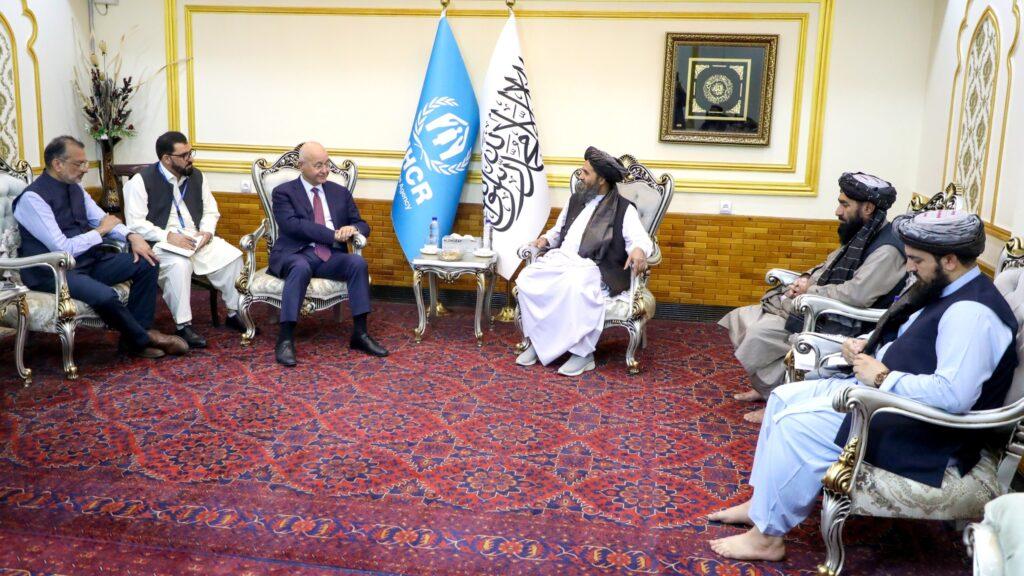
Interior Minister Khalifa Sirajuddin Haqqani also held talks with Barham Salih and his delegation.
Following their joint visit to Afghanistan, UN High Commissioner for Refugees Barham Salih and UNDP Administrator Alexander De Croo said in a joint statement that investment in protection, livelihoods, economic opportunities, and the reintegration of returnees is essential to achieving lasting stability in Afghanistan.
UN High Commissioner for Refugees Barham Salih said that millions of Afghans continue to rely on humanitarian assistance, adding that the ongoing return of Afghan migrants is placing increasing pressure on local communities.
Charlie Goodlake, spokesperson for UNHCR in Afghanistan, said: ” The Chiefs of UNHCR and UNDP visited Afghanistan for the first time from the 5th of July to the 8th of July. The focus of their visit was to see how humanitarian and development partners can work together, complement each other, to support returnees.”
Economic analyst Shams-ur-Rahman Ahmadzai said: “Following these meetings, the United Nations, particularly UNHCR, should establish structured systems and major projects in coordination with the Ministry of Refugees and Repatriation. If infrastructure projects are launched, they can create suitable employment opportunities for deportees and returning Afghans.”
Separately, Interior Minister Khalifa Sirajuddin Haqqani also held talks with Barham Salih and his delegation.
The two sides discussed addressing the challenges facing migrants, supporting returning Afghan refugees, and continuing humanitarian assistance.
Interior Ministry spokesperson Abdul Matin Qani said: “The meeting emphasized expanding cooperation, particularly on migration issues. We recorded a number of points to further strengthen cooperation in the future.”
During his visit to Afghanistan, Barham Salih also told Sky News that tensions between Afghanistan and Pakistan should be resolved as soon as possible, urging both neighboring countries to work toward easing the situation.
UNHCR, UNDP Call for Stronger Support for Afghan Returnees
Sadiq Zahirzai, a physician, called on the World Health Organization to expand its support for provincial health facilities.
Hanan Balkhy, the World Health Organization’s (WHO) Regional Director for the Eastern Mediterranean, says that nearly 150 health centers have been forced to close since the beginning of 2026 due to funding shortages.
She also reported that more than 22 million people in Afghanistan require humanitarian assistance, while 14.4 million people are in need of healthcare services.
In a post on X, Balkhy wrote: “This means that health workers are less able to vaccinate children, mothers are less able to find safe care and patients find it more challenging to access essential health services. These losses cannot be overlooked.”
Sadiq Zahirzai, a physician, called on the World Health Organization to expand its support for provincial health facilities.
“We urge the World Health Organization to provide greater support to healthcare centers in the provinces and help meet their operational needs.”
Sayed Shah, a resident of Nahr-e Saraj district in Helmand province, has brought his two-year-old son to Indira Gandhi Children’s Hospital in Kabul for treatment. His exhausted appearance reflects the hardship he has endured, saying the lack of pediatric specialists and standard medical services in Helmand forced him to seek treatment in the capital.
Speaking to TOLOnews, he said: “There is a large hospital in Bost, Helmand, but my child could not be treated there. I then went to a private hospital, but I couldn’t even afford to buy a single tablet. People there are under tremendous strain, so we came to Kabul for treatment.”
The head of the outpatient clinic and diagnostic center at Indira Gandhi Children’s Hospital said that between 6,000 and 7,000 patients visited the hospital over the past four days, around 70 percent of whom came from the provinces.
Mohammadullah Rasouli, head of the hospital’s outpatient clinic and diagnostic center, said: “Diagnostic and treatment facilities should be available in the provinces. Afghanistan’s economic situation is weak, and many people even have to borrow money just to cover the cost of traveling to Kabul.”
Dr. Mashal Faqiri also described the growing patient load.
“We examine approximately 120 to 150 patients every day. Some require hospitalization, some undergo surgery, and others are prescribed treatment. Around 70 percent of them come from the provinces.”
Meanwhile, families waiting anxiously for their children’s recovery are calling for the establishment of standard hospitals across Afghanistan’s provinces.
Mahfooz, who traveled from Parwan for his son’s treatment, said: “Healthcare facilities should be made available in our own provinces. Standard hospitals should be built, and every medical specialty should be available.”
Fazl Jalal, who came from Kunar for medical treatment, added: “When we seek treatment in Kunar, we are referred to Jalalabad. If treatment is not available there, we end up traveling all the way to Kabul, facing numerous hardships along the way.”
The World Health Organization had previously warned that, following the reduction and suspension of a significant portion of U.S. aid, at least 422 health facilities across Afghanistan had ceased operations by the end of June 2025 due to funding shortages, leaving more than 3.1 million people without access to essential healthcare services.
Separately, Afghanistan’s Ministry of Public Health announced on 25 December 2024 (5 Jadi 1403) that 318 district-level hospitals would be constructed across the country.
Funding Shortfalls Force Closure of 150 Health Centers Across Afghanistan
KABUL (Pajhwok): Deputy Prime Minister for Economic Affairs Mullah Abdul Ghani Baradar has urged the United Nations and international organisations to channel their assistance towards development projects to help provide housing, schools, electricity, clean water, employment and other essential services for returning refugees and internally displaced persons (IDPs).
He issued the call at a meeting with the United Nations High Commissioner for Refugees Barham Saleh in Kabul on Wednesday, according to a statement from his office.
It said the two sides discussed the situation of Afghan refugees, humanitarian and development assistance for returning refugees, and future cooperation in support of the Afghan people.
Mullah Baradar thanked the United Nations and international organisations for providing humanitarian assistance to Afghan refugees.
He stressed that the United Nations and international organisations should prioritise development assistance so that housing, schools, electricity, clean water, employment opportunities and other basic services could be provided for returning refugees and internally displaced Afghans.
For his part, Barham Saleh praised the efforts of the Islamic Emirate of Afghanistan (IEA) in the development sector and expressed hope that greater international assistance would be mobilised for Afghanistan to help improve the living conditions of the Afghan people.
Baradar urges UN, international organisations to focus aid on development
According to the report, Europe’s need to cooperate with the Islamic Emirate on the return of Afghan migrants created the conditions for holding the meeting.
Two weeks after a delegation from the Islamic Emirate met with representatives of 15 European Union member states, the U.S. magazine Newsweek described the Brussels meeting as a “diplomatic victory” for the Islamic Emirate in an analytical report.
According to the report, Europe’s need to cooperate with the Islamic Emirate on the return of Afghan migrants created the conditions for holding the meeting.
The report says the meeting resulted in three significant developments:
Breaking the taboo surrounding official dialogue between European institutions and the Islamic Emirate.
Using the issue of migration as a source of political and diplomatic leverage.
Launching discussions on the possible resumption of Afghan consular services in Europe.
Political analyst Idris Hamdi Zazi said: “The door to European Union countries has been opened to Afghanistan. Holding this meeting in Belgium signaled that Afghanistan has been recognized as an important interlocutor, and that the Islamic Emirate is viewed as a significant party for dialogue. In the future, discussions concerning Afghans are expected to continue with the Afghan delegation.”
Meanwhile, a number of political analysts say that, given Afghanistan’s need to engage with the international community, restoring Afghan consular services in Europe is of particular importance.
Former diplomat Aziz Maarij said: “The resumption of consular services in European countries is important not only for addressing the problems of Afghan migrants but also for facilitating trade relations.”
Earlier, European Parliament member Hannah Neumann said the meetings were not merely technical in nature. In her view, every invitation, visa issuance, or official meeting with representatives of the Islamic Emirate carries political significance.
Previously, Abdul Qahar Balkhi, spokesperson for the Ministry of Foreign Affairs of the Islamic Emirate, who led a delegation to the Brussels meeting on June 23, described the talks as “historic.”
Newsweek: Brussels Meeting Marks Diplomatic Victory for Islamic Emirate
Speaking to Sky News, he warned that extremist and armed groups could exploit the current situation, potentially fueling instability in the region and beyond.
The United Nations High Commissioner for Refugees, Barham Saleh, said at the conclusion of his visit to Afghanistan that tensions between Afghanistan and Pakistan should be resolved as soon as possible, urging both neighboring countries to work toward de-escalation and restoring stability.
Speaking to Sky News, he warned that extremist and armed groups could exploit the current situation, potentially fueling instability in the region and beyond.
Barham Saleh, the UN High Commissioner for Refugees, said: “Regarding the security situation, we must closely monitor developments in this country and remain alert to the possibility that extremist groups may exploit the current circumstances. My appeal is that these tensions be resolved as quickly as possible. They should not be allowed to continue.”
He also stated that existing mechanisms for addressing the situation of Afghan refugees—including the trilateral framework involving Afghanistan, Pakistan, and Iran, as well as the Swiss-facilitated Doha Process—should be reactivated and strengthened.
Barham Saleh added: “There is also the Doha Process and the Swiss-supported initiative aimed at finding strategic solutions for Afghan refugees. We need to reactivate and mobilize these frameworks to ensure that at least some of these challenges are addressed.”
Meanwhile, following visits to several provinces, the UN official, together with Alexander De Croo, head of the United Nations Development Programme (UNDP), held separate meetings with senior officials of the Islamic Emirate, including the Deputy Administrative Prime Minister, the Foreign Minister, and the Minister of Refugees and Repatriation. During the meetings, both sides emphasized support for returnees and strengthening Afghanistan’s economy.
Mawlawi Abdul Kabir, Minister of Refugees and Repatriation, said: “Since the Islamic Emirate came to power, millions of Afghan refugees have returned to the country. Unfortunately, most of them have been forcibly deported, and this process is still continuing from Pakistan.”
The visit by the two senior UN officials comes as, according to United Nations figures, more than six million Afghan migrants and refugees have returned to the country. Their successful reintegration into Afghanistan’s economy will require stronger international cooperation and support.
UNHCR Chief Urges Swift Resolution of Afghanistan-Pakistan Tensions
The United Nations says aid workers are still in a “race against time” to remove rubble and rebuild after the devastating earthquake struck eastern Afghanistan last month, killing at least 2,200 people and cutting off remote areas.
The 6.0-magnitude quake on Aug. 31 was shallow, destroying or causing extensive damage to low-rise buildings in the mountainous region. It hit late at night, and homes — mostly made of mud, wood, or rocks — collapsed instantly, becoming death traps.
Satellite data shows that about 40,500 truckloads of debris still needs to be cleared from affected areas in several provinces, the United Nations Development Program said Wednesday. Entire communities have been upended and families are sleeping in the open, it added.
The quake’s epicenter was in remote and rugged Kunar province, challenging rescue and relief efforts by the Taliban government and humanitarian groups. Authorities deployed helicopters or airdropped army commandos to evacuate survivors. Aid workers walked for hours on foot to reach isolated communities.
“This is a race against time,” said Devanand Ramiah, from the UNDP’s Crisis Bureau. “Debris removal and reconstruction operations must start safely and swiftly.”
People’s main demands were the reconstruction of houses and water supplies, according to a spokesman for a Taliban government committee tasked with helping survivors, Zia ur Rahman Speenghar.
People were getting assistance in cash, food, tents, beds, and other necessities, Speenghar said Thursday. Three new roads were under construction in the Dewagal Valley, and roads would be built to areas where there previously were none.
“Various countries and organizations have offered assistance in the construction of houses but that takes time. After the second round of assistance, work will begin on the third round, which is considering what kind of houses can be built here,” the spokesman said.
Afghanistan is facing a “perfect storm” of crises, including natural disasters like the recent earthquake, said Roza Otunbayeva, who leads the U.N. mission to the country.
 Afghanistan Peace Campaign