The ICG said that as the use of sanctions has increased, so, too, has awareness of their collateral effects.
The International Crisis Group (ICG), said in a new report that sanctions have become an increasingly prominent tool of US statecraft, but urged Washington to align sanctions policy with peacemaking efforts.
The ICG said that as the use of sanctions has increased, so, too, has awareness of their collateral effects.
“While the US looks to sanctions to further its goals in numerous conflicts, sanctions also sometimes obstruct peacemaking – that is, activities in the service of violence prevention and conflict resolution,” it said. “The more Washington uses sanctions, the more far-reaching the downsides are and the more pressing it is to address them.”
To align sanction policy with peacemaking efforts, the ICG said, the US administration “could do so by setting clear objectives for sanctions programs, subjecting them to rigorous periodic review, expanding and making permanent carveouts for peace activities, and addressing private-sector concerns about investment in previously sanctioned jurisdictions.”
It said sanctions can also impede US efforts to encourage private-sector investment in post-conflict settings. Investors often lack the confidence to enter markets where sanctions exist, even when the US Treasury has issued licenses specifically authorising certain transactions or when sanctions have recently been lifted, in part or in full. In these situations, sanctions have a “chilling effect” on business activity or, in the words of one former US official, hang over a country “like a black cloud”.
According to the report, private firms often express confusion about the scope of permitted activity and may err on the side of caution by refusing to do business in these places altogether.
“Such have been the calculations of many companies that had been active in Afghanistan before the Taliban takeover, which pulled out of the country despite the general licenses published by the US permitting extensive private-sector transactions as part of efforts to stave off state collapse,” the report said.
The ICG cited that the effects can seem trivial (some diplomats working on Venezuela in 2019 and 2020 were told to avoid buying anything, even a cup of coffee, for sanctioned members of the Maduro government), but in other cases they can prove a hurdle to dialogue.
“For example, some US officials have expressed regret at the designation of Afghanistan’s Haqqani network as a Foreign Terrorist Organization (FTO), which they said made it harder for the US government as a whole to come around to the idea of dialogue with the group on ending the conflict in Afghanistan,” it said.
US Should Align Sanctions Policy with Peacemaking Efforts: ICG
First, her dreams of becoming a doctor were dashed by the Taliban’s ban on education. Then her family set up a forced marriage to her cousin, a heroin addict. Latifa* felt her future had been snatched away.
“I had two options: to marry an addict and live a life of misery or take my own life,” said the 18-year-old in a phone interview from her home in central Ghor province. “I chose the latter.”
It was not an isolated act of desperation. Since the Taliban took control of Afghanistan in the summer of 2021, there has been a disturbing surge in the number of women taking their own lives or attempting to do so, data collected from public hospitals and mental health clinics across a third of Afghanistan’s provinces shows.
Taliban authorities have not published data on suicides and have barred health workers from sharing up-to-date statistics in multiple provinces, medics say. Health workers agreed to privately share figures for the year from August 2021 to August 2022 to highlight an urgent public health crisis. The data suggests Afghanistan has become one of very few countries worldwide where more women than men die by suicide.
The figures are partial but give a snapshot across Afghanistan’s wide demographic and geographic range. They cover provinces variously dominated by all of Afghanistan’s major ethnic groups, provinces ranging from southern deserts to northern mountains, and largely rural areas and others around major cities.
UN officials and human rights activists have raised the alarm about the sharp increase in the number of women attempting to take their own lives. They have explicitly linked it to Taliban restrictions on every aspect of women’s existence, from a ban on education above elementary level and a prohibition on most work, to a bar on entering parks, bathhouses and other public spaces.
“Afghanistan is in the midst of a mental health crisis precipitated by a women’s rights crisis,” said Alison Davidian, the country representative for UN Women. “We are witnessing a moment where growing numbers of women and girls see death as preferable to living under the current circumstances.”
The Taliban declined repeated requests for comment on suicide rates or on the data collected for this investigation.
The figures from healthcare providers show that out of 11 provinces surveyed, in only one did men account for the majority of suicide deaths and attempts.
That province was Nimruz, the main jumping-off point for dangerous attempts to cross illegally into Iran, which are made largely by men. Those who fail in their attempt to get over the border sometimes take their own lives there.
Everywhere else, women and girls made up a majority of those who died from suicide or were treated after trying to kill themselves, with the youngest recorded victims in their early teens. Overall, females made up more than three-quarters of recorded suicide deaths and treated survivors.
A graveyard in Herat city.
Those bleak figures are likely to underestimate the depths of women’s desperation. Suicide is considered shameful and often covered up in Afghanistan. Some women who attempt suicide will not be taken for treatment and some who die may be buried without a record that they took their own lives.
Roya*, 31, was found dead in her house in the city of Herat in May 2022 after years in an abusive marriage. Her younger brother, Mohammad*, said his sister had often told their parents about her husband’s attacks but they urged her not to leave him.
“Every time, my parents would persuade her to keep her family together,” Mohammad said. “One morning, we were informed that Roya had [taken her own life]. We never thought it would get this far.”
The family told people she had died of an illness, because they consider suicide unIslamic and shameful.
Shaharzad Akbar, a former chair of the Afghanistan Independent Human Rights Commission – an organisation targeted by the Taliban insurgency and now operating in exile – said social stigma meant such secrecy was common.
“The rare instance when [relatives] willingly admit to suicide is when they don’t want any member of the family to be accused of murder,” said Akbar, who is now executive director of Rawadari, a new Afghan human rights organisation.
Lost hope
Afghanistan’s history of conflict and poverty had fuelled a mental health crisis long before August 2021. A survey published in the journal BMC Psychiatry two months before the Taliban takeover found nearly half the population suffered from psychological distress.
But the loss of freedom and hope, and an increase in forced and underage marriages and domestic abuse, has made women even more vulnerable over the last two years.
About 90% of mental health admissions at the provincial hospital in western Herat were women “breaking down under the weight of the new restrictions”, one medic there said.
Nine in 10 women in Afghanistan are subjected to some form of domestic violence, according to the UN. Efforts to tackle the issue under the last government, from legislation to shelters, were imperfect but offered women some hope. Those efforts have now been dismantled by the Taliban.
“The mechanism to respond to domestic violence is totally eradicated; women have no choice but to bear the violence or kill themselves,” said Akbar.
Inside the Herat hospital’s mental health ward.
Warnings about female suicides are only intensifying as the Taliban tighten controls on every aspect of women’s lives, most recently banning beauty salons.
When Latifa woke up in a hospital bed surrounded by family and doctors, she was told that her cousin had disappeared after learning of her suicide attempt. She worries that he might return and says if he does she will try to kill herself again.
“If he comes back and my family tries to force me [into marriage] again, I will … make sure I don’t survive,” she said.
Medics in Herat province, which recorded the highest numbers of female suicides and attempted suicides, described a system overwhelmed, withonly 25 mental health beds for a population of millions.
Herat has recorded high levels of gender violence and female suicide for many years. Even so, medical need has soared since the Taliban took power. “Patients do not get the hospitalisation time and counselling they need,” one health worker said. “Many times, we put two patients in one bed.”
In May, the UN special rapporteur on the situation of human rights in Afghanistan, Richard Bennett, said he was “alarmed about widespread mental health issues and accounts of escalating suicides among women and girls”.
Some see suicide as the only remaining form of defiance possible in a country where authorities are seeking to remove women from public life entirely.
“They don’t have much room for expressing their protests and disagreements,” said Julie Billaud, an anthropology professor at the Geneva Graduate Institute and the author of Kabul Carnival, a book about gender politics in postwar Afghanistan. “The despair is settling in. Perhaps that [suicide] is the last attempt by those who have left no power to say something and be heard.”
* Names have been changed for the safety of interviewees
‘Despair is settling in’: female suicides on rise in Taliban’s Afghanistan
Bilal Karimi, the deputy spokesman of the Islamic Emirate, said that Afghanistan’s soil will not be used against any country.
British High Commissioner to Pakistan Jane Marriott claimed that Tehreek-e-Taliban Pakistan (TTP) and other terrorist organizations continue to operate in Afghan territory.
In an interview with Pakistani Geo News, Marriott said that if the activities of these groups in Afghanistan are not stopped, they may become a threat to Pakistan and the world.
“Pakistani military and security forces are bearing the brunt of these attacks across the border from Afghanistan. So, in many ways they are paying a price to keep the world safe, as well as Pakistan safe. Pakistan has deployed many security forces in the border area to try and stop terrorists from coming over the border,” Marriott said.
Several military experts offered different views on the allegations made by the British High Commissioner to Pakistan that there are terrorist groups operating in Afghanistan.
“There is definitely no terrorism in Afghanistan. We ask them if Pakistan asserts that the TTP is present, how can it enter Afghanistan from your territory since you do have a very powerful army,” Yusuf Amin Zazi, a military expert, told TOLOnews.
However, the Islamic Emirate denied the presence and activity of terrorist groups in Afghanistan.
Bilal Karimi, the deputy spokesman of the Islamic Emirate, said that Afghanistan’s soil will not be used against any country.
“Afghanistan is peaceful, stable, and secure; there is no instability or group that harms other nations from Afghan soil, and there is no basis for the claims and statements that are made,” Karimi said.
This comes as Pakistan has repeatedly criticized the presence of terrorist groups in Afghanistan and demanded that the Islamic Emirate fight against them.
British Official Claims TTP Operating in Afghan Territory
A part of the statement said that such propaganda gives motivations to the Daesh group and increases destabilization in the region.
The Islamic Emirate has once again denied the concerns of the UN Security Council members about Daesh activities in Afghanistan.
Speaking at the Security Council meeting on the 17th report of the Secretary-General on the threat posed by Daesh, UN counter-terrorism chief Vladimir Voronkov said that the situation in Afghanistan is growing increasingly complex, and that some 20 different terrorist groups are present in Afghanistan.
The Islamic Emirate said in a statement that the UNSC report about the presence of terrorist groups including in Afghanistan is not documented from evidence, which affects the reputation of the UNSC.
A part of the statement said that such propaganda gives motivations to the Daesh group and increases destabilization in the region.
“The path to negotiation and contact is effective and the Islamic Emirate believes in relations and engagement,” said Bilal Karimi, deputy spokesman for the Islamic Emirate.
The statement also said the existing sanctions on Afghanistan by the UN and other sides, and the freezing of Afghanistan’s assets abroad are the main reasons for the humanitarian situation in Afghanistan.
“Every problem which the international community has regarding Afghanistan, it should approach it through diplomatic paths because it cannot eliminate the problems through allegations,” said Ziaul Haq Madani, political analyst.
“After the Islamic Emirate came to power, even one acre of land is not in the hands of terrorists and Daesh has been defeated seriously. This is negative propaganda against the government,” said Kamran Aman, a military veteran.
The situation in Afghanistan is growing increasingly complex, with fears of weapons and ammunition falling into the hands of terrorists now materializing.
Kabul Denies UNSC Members’ Concerns About Daesh in Afghanistan
The Taliban government have banned women from visiting the Band-e-Amir national park in Bamiyan province.
Afghanistan’s acting minister of virtue and vice, Mohammad Khaled Hanafi, said women had not been observing hijab inside the park.
He called on religious clerics and security agencies to forbid women from entering until a solution was found.
Band-e-Amir is a significant tourist attraction, becoming Afghanistan’s first national park in 2009.
It is a popular destination for families and the ban on women attending will prevent many from being able to enjoy the park.
Unesco describes the park as a “naturally created group of lakes with special geological formations and structure, as well as natural and unique beauty”.
However, Mr Hanafi said going to the park to sightsee “was not obligatory”, Afghan agency Tolo News reported.
Religious clerics in Bamiyan said the women who were visiting the park and not following the rules were visitors to the area.
“There are complaints about lack of hijab or bad hijab, these are not Bamiyan residents. They come here from other places,” Sayed Nasrullah Waezi, head of the Bamiyan Shia Ulema Council told Tolo news.
Afghan former MP Mariam Solaimankhil shared a poem she had written on X, formerly known as Twitter, about the ban and wrote “we’ll return, I’m sure of it”.
Fereshta Abbasi, of Human Rights Watch, noted women had been banned from visiting the park on Women’s Equality Day and wrote it was a “total disrespect to the women of Afghanistan”.
Meanwhile Richard Bennett, the UN Special Rapporteur on human rights in Afghanistan, asked why stopping women from visiting Band-e-Amir “is necessary to comply with Sharia and Afghan culture?”.
The Taliban have a history of implementing bans on women doing certain activities on what it insists is a temporary basis, including preventing them from attending schools in December 2022.
The ban on visiting the Band-E-Amir national park is the latest in a long list of activities that women have been prevented from doing since the Taliban returned to power in August 2021.
Most recently, the Taliban ordered hair and beauty salons in Afghanistan to shut and in mid-July stopped women from sitting the national university entrance exams.
Afghanistan: Taliban ban women from visiting popular national park
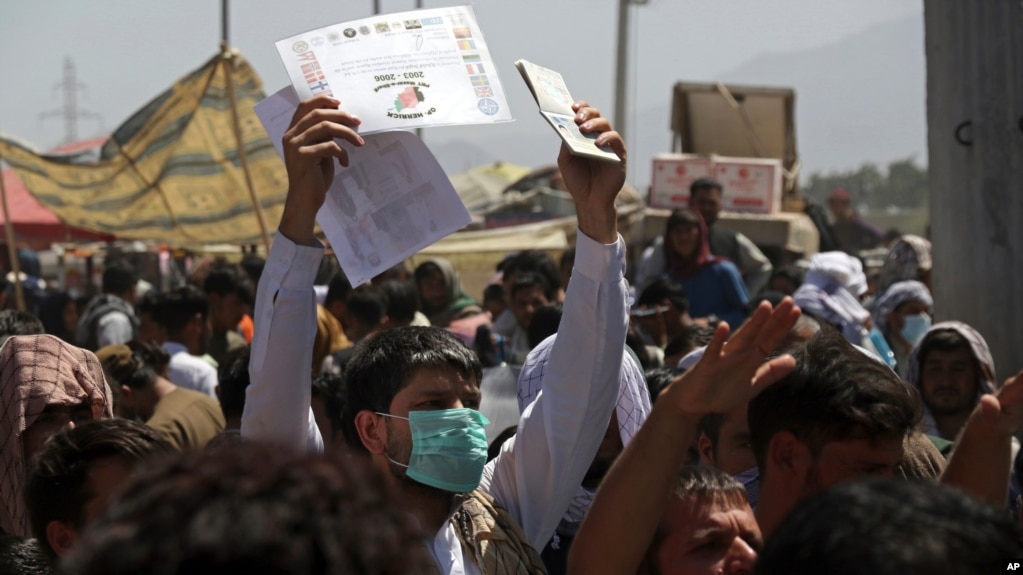
FILE — Hundreds gather, some holding documents, near an evacuation control checkpoint on the perimeter of the Hamid Karzai International Airport, in Kabul, Afghanistan, Aug. 26, 2021.
PENTAGON —
This month, the Taliban are marking two years since they retook control of Kabul, a swift blow that shocked the international community and set in motion a frantic evacuation led by the United States.
The violent and chaotic final phase of the U.S. withdrawal in August 2021 saw more than 122,000 people airlifted to safety, but at least 180 people, including 13 U.S. military service members, were killed when a suicide bomber detonated his explosives near Hamid Karzai International Airport’s Abbey Gate entrance on August 26.
Critics of the evacuation — known officially as a Noncombatant Evacuation Operation or NEO — say there is plenty of blame to go around.
“It was a Kafka-esque exercise in bureaucracy and red tape with no clear lines of authority while lives were on the line,” said Senator Richard Blumenthal, a Democrat from Connecticut, at a Senate hearing about a month after the evacuation ended.
“We were unprepared,” he said.
Was the State Department to blame?
U.S. officials who spoke to VOA at the time of the fall, and again in recent weeks, have placed the blame largely on the State Department. They say the U.S. Embassy in Kabul repeatedly ignored Taliban gains that were meant to be seen as “trip wires” to signal the need for a NEO.
On May 1, 2021, the Taliban controlled roughly 75 Afghan districts, according to the Foundation for Defense of Democracies’ Long War Journal. By July 12, the Taliban controlled more than 210 of Afghanistan’s roughly 400 districts.
But as Afghan territories fell like dominoes, efforts by the military to conduct an interagency tabletop exercise to prepare for the evacuation were delayed. The State Department continued to “move the date because Secretary of State Antony Blinken was on vacation,” according to one official who spoke on condition of anonymity because the person was not authorized to talk to reporters.
Two officials told VOA that the State Department initially did not want the evacuation to include Afghan nationals who had worked with U.S. forces and had applied for Special Immigrant Visas (SIVs) to the United States. Instead, State wanted the military to focus solely on airlifting U.S. citizens and embassy personnel.
VOA asked the State Department how many Afghans seeking SIVs the U.S. wanted to include in its initial evacuation plans, but the department declined to comment.
According to an after-action report by U.S. Forces-Afghanistan, during the interagency tabletop evacuation exercise on August 10, Afghanistan’s crumbling situation was presented to Biden administration officials with a prediction that Kabul could be fully isolated within 30 days. However, diplomats did not order an evacuation that day.
“There was a reluctance [from State] to plan for the worst, and a reluctance to start the needed evacuation,” a U.S. official close to the evacuation planning told VOA.
The State Department finally ordered the military to conduct an NEO on August 14, one day before Kabul fell.
“There was not a sufficient sense of urgency,” wrote authors of an After Action Review on Afghanistan released by the State Department this year.
Who was in charge?
By definition, NEOs are “conducted by the Department of Defense … when directed by the Department of State,” and officials have said friction between the two led to the haphazard evacuation.
‘Hunger Games’ Evacuations as US Left Afghanistan
NEOs are overseen by the chief of mission, who was U.S. Ambassador Ross Wilson.
One official told VOA that in addition to “waiting too long” to order the NEO, Wilson appeared to have “no policy [for] prioritizing how to get folks out.” Sometimes SIV applicants would get processed by State, other times not. Multiple C-17s left Kabul airport without any evacuees on the first day of the evacuation, said another official.
The State Department flew in a second ambassador and others to help with the NEO after Kabul fell, but processing remained the slowest part of the evacuation, frustrating military leaders, including Rear Admiral Peter Vasely and Brigadier General Farrell Sullivan, the officers responsible for coordinating the evacuation.
According to one official, Vasely was instructing military personnel to “load and go” in an effort to get as many people as possible onto planes so they could be fully processed in a safer location outside Afghanistan. State Department personnel, on the other hand, wanted to fully process potential evacuees before they boarded a plane.
International television audiences were shocked by scenes of desperate Afghans clinging to the undercarriages of planes as they took off, only to fall to their deaths.
The chaotic situation further devolved on August 26 when a suicide bomber unleashed a massive blast outside the airport’s Abbey Gate, where thousands of Afghans were clustered in a frantic effort to enter the facility in hopes of boarding an evacuation flight.
The attack, attributed to the Islamic State extremist group, killed an estimated 170 Afghans and 13 U.S. service members who had been manning the gate and trying to maintain order.
Was the military at fault for not using Bagram?
In the days, weeks and months after the attack, many criticized the U.S. military plan to use Hamid Karzai International Airport (HKIA) for the evacuation rather than Bagram Airfield, the Soviet-built base about 50 kilometers north of Kabul that had been the hub of U.S. military operations in Afghanistan for nearly two decades.
Command Sergeant Major Jake Smith oversaw the U.S. military departure from Bagram at the beginning of July 2021, as part of the scheduled departure of the last U.S. forces from Afghanistan.
U.S. President Joe Biden on April 14 of that year had ordered the military to remove all of its troops from Afghanistan by September 11, with the exception of a few hundred to protect the embassy. The Biden administration later changed the military’s withdrawal deadline to August 31.
In the spring of that year, Smith had recommended Bagram for any NEO, saying the vast military base had far better resources and capabilities than HKIA to handle the operation.
“Bagram could house 35,000 people without overloading the infrastructure, whereas HKIA could hold under 4,000. … Bagram held the logistical capability to meet the requirements of 130,000 people, HKIA did not,” he told lawmakers.
Bagram also had one more runway than HKIA.
From a security assessment, too, Smith told lawmakers in July that Bagram was a better option than HKIA.
“The events that happened on Abbey Gate, I believe, that would have not occurred in Bagram,” he said.
In 2017, Kabul was deemed so insecure that then Secretary of State Rex Tillerson asked Afghan President Ashraf Ghani to meet him at Bagram Airfield. Similarly, in November 2019, President Donald Trump landed at Bagram, but did not take the less than 15-minute helicopter flight to the U.S. Embassy in Kabul because of security considerations.
Michael Rubin, a senior fellow at the American Enterprise Institute, blames U.S. civilian decision-makers for ignoring Smith’s proposal to execute the NEO from Bagram.
“This was a prime example of the arrogance of civilian decision-makers who had never served in the military and had no real experience in Afghanistan haughtily ignoring those who did,” Rubin wrote to VOA.
To keep Bagram Airfield operational, U.S. military leaders say they would have needed at least 2,500 troops on the ground, significantly more than the Biden administration had ordered them to keep in the country.
U.S. forces vacated Bagram on July 2, at which point U.S. Central Command said the military withdrawal was “more than 90% complete.” By July 12, a month before Kabul fell and the day the top U.S. commander in Afghanistan, General Austin “Scott” Miller, relinquished command, the only American troops that remained in Afghanistan were those assigned to protect the embassy and those assisting Turkish forces with security at HKIA.
“What we wanted was an elegant solution that was not attainable,” retired General Frank McKenzie, commander of U.S. Central Command who oversaw the NEO, told VOA last year. “We wanted to go to zero militarily yet retain a small diplomatic platform in Afghanistan that would be protected.”
In September 2021, McKenzie told a House Armed Services Committee hearing, “I did not see any tactical utility to Bagram.”
Mark Milley, chairman of the Joint Chiefs of Staff, told the same hearing that “Bagram would’ve required exceptional levels of resources.”
Neither of the military officials spoke about Smith’s proposal to use Bagram for the NEO.
“The size of Bagram and its associated terrain would have demanded a much, much larger amount of troops to defend it,” Gian Gentile, a retired U.S. Army colonel and associate director of the Army Research Division at the RAND Corporation, a global policy research group, said in an interview.
“That view is the usual post-facto military lament that if policymakers would have only let us run the show, everything would have been fine,” he told VOA. “But again, that is a contorted inverse on how things work in a democracy.”
Could Ghani have changed the outcome?
Days before he fled from Afghanistan in three helicopters with his wife and closest aides, Ghani vowed he would not run away, even at the cost of his life.
Such assurances, and intelligence estimates about the strength and resilience of Afghan defense forces, prompted U.S. officials to believe that Kabul would not fall to the Taliban, even if the group claimed the rest of the country.
Ghani’s unexpected flight on August 15, however, left Afghanistan without a state for the U.S. to deal with while opening the door for the Taliban to walk into the deserted Presidential Palace in Kabul, less than three miles from the U.S. Embassy.
“If [Ghani] had not fled, things would have been different,” Sediq Seddiqi, a former deputy minister and spokesperson to Ghani, told VOA.
By staying, Seddiqi said, the Afghan president could have prevented the mayhem that followed his escape.
Others who knew Ghani and worked for him disagree.
“I believe President Ghani had totally lost credibility,” said Omar Zakhilwal, a former Afghan minister.
“If he had stayed in Kabul, the only thing he could have saved would have been his honor as a leader but not the government — it was just too late for the latter,” Zakhilwal told VOA.
Whether any U.S. or Ghani government action could have prevented or mitigated the events of August 2021 in Kabul remains in dispute, but neither the dramatic scenes at Kabul airport, nor the loss of life on August 26, can be reversed.
Milley told The Washington Post on Friday that he supported investigations, including those by House Republicans, into the Afghanistan withdrawal.
“I think any time that you can shed light and truth, determine lessons learned, I think that’s a valuable exercise,” he said.
Could State Department, Bagram or Ghani Have Made Afghan Airlift Less Chaotic?
Previously, the United Nations Security Council said in a statement on Friday that Daesh increased its operational capabilities inside Afghanistan.
The members of the United Nations Security Council (UNSC) once again voiced concerns about the presence and increased activity of the Khorasan branch of Daesh in Afghanistan.
Speaking at the Security Council meeting on the 17th report of the Secretary-General on the threat posed by Daesh, UN counter-terrorism chief Vladimir Voronkov said that the situation in Afghanistan is growing increasingly complex, and that some 20 different terrorist groups are present in Afghanistan.
“The situation in Afghanistan is growing increasingly complex, with fears of weapons and ammunition falling into the hands of terrorists now materializing. The in-country operational capabilities of Da’esh’s so-called Khorasan province, sanctioned as ISIL-K, has reportedly increased, with the group becoming more sophisticated in its attacks against the Taliban and international targets. Moreover, the presence and activity of some 20 different terrorist groups in the country, combined with the repressive measures put in place by the Taliban de facto authorities, the absence of sustainable development and a dire humanitarian situation, pose significant challenges for the region and beyond,” Voronkov noted.
The US Ambassador Linda Thomas-Greenfield in the meeting said that Afghanistan must deny safe haven to terrorist groups, including al-Qaida and ISIS-Khorosan.
“And I want to reiterate that capable law enforcement and broader security service responses are essential to preventing and countering terrorism and violent extremism. In South Asia, Afghanistan must deny safe haven to terrorist groups, including al-Qaida and ISIS-Khorosan, which continue to harbor ambitions to carry out attacks, and has claimed deadly attacks in both Afghanistan and Pakistan,” US Ambassador Linda Thomas-Greenfield told a UN Security Council meeting.
Ecuador’s delegate voiced concerns over the situation in Afghanistan due to the ability of ISIL-KP [Islamic State in Iraq and the Levant—Khorasan Province] to carry out attacks in the region, such as those that recently occurred on 30 July in Pakistan and 13 August in Iran.
Russian deputy ambassador Maria Zabolotskaya at the UN meeting on international terrorists threats blamed “the collective West’s intervention in the affairs of sovereign developing countries” and their “destructive role” for fueling the growth of terrorism. She claimed the West plundered the natural resources of these countries and only provided weak economic development and public administration.
She said foreign troops led by the United States were in Afghanistan for over 20 years “under the pretext of fighting terrorists” but they departed without defeating al-Qaida, leaving behind a huge quantity of weapons and military equipment. “And consequently, the Western weapons that were brought into the country to fight terrorism ended up, among other places, in the hands of the terrorists themselves,” she said.
However, Bilal Karimi, spokesman of the Islamic Emirate, in response to the statements of the members of this council, said that Daesh is not present in Afghanistan.
“We don’t have a Daesh that has a physical presence, a fixed location, or concrete activities, and Daesh has been defeated in Afghanistan,” Karimi noted.
Previously, the United Nations Security Council said in a statement on Friday that Daesh increased its operational capabilities inside Afghanistan.
According to the statement, the Daesh groups in Iraq and Afghanistan have been assessed by member states as the most serious terrorist threat in Afghanistan and the region.
“The report says that (Daesh Khorasan) has increased its operational capabilities inside Afghanistan, with the total number of fighters and family members associated with the group estimated at 4,000 to 6,000 people, a steady increase over the numbers reported in previous reports, while also becoming more sophisticated in its attacks against both the Taliban and international targets,” the statement said.
“These reports are definitely untrue because they get these reports from the people and they are in line with the opposition,” he said.
Panjshir province governor Mohammad Agha Hakim rejected the claims of international institutions and organizations regarding the violation of human rights in this province.
In an interview with TOLOnews, Hakim said that there have been no human rights violations in Panjshir province, and currently Panjshir is the safest province and there is no group to make it unsafe.
“These reports are definitely untrue because they get these reports from the people and they are in line with the opposition,” he said.
This official of the Islamic Emirate noted that for ensuring security of the province, 300 outposts and around 10,000 forces have been assigned to Panjshir.
“There are about 300 security outposts in the four surrounding areas of Panjshir, because Panjshir is a province that has borders with seven neighboring countries,” Hakim noted.
In a part of his speech, the governor of Panjshir said that they are trying to prevent schools from turning into security outposts in this province.
“We decided that every school should be evacuated and we thank God that 95% of the schools have been evacuated,” the governor further stated.
Mohammad Agha Hakim urged the people who left Panjshir after the reestablishment of the Islamic Emirate to return.
Panjshir’s Governor Rejects Claims of Human Rights Violations
A U.N. mission in Afghanistan reported summary killings, arbitrary detentions and torture of hundreds of onetime soldiers, police officers and others in the old government.
Since the Taliban seized control of Afghanistan in 2021, hundreds of members of the U.S.-backed former government have been detained, tortured or killed under the new government, despite Taliban leaders’ declaration of amnesty for actions during the long civil war, the United Nations reported on Tuesday.
The United Nations Assistance Mission in Afghanistan said in a new report that it had documented “at least 218 extrajudicial killings of former government officials,” primarily police officers and soldiers, committed by members of the new government, though the pace had slowed greatly since the first months after the takeover.
“In most instances, individuals were detained by de facto security forces, often briefly, before being killed,” it said. “Some were taken to detention facilities and killed while in custody, others were taken to unknown locations and killed, their bodies either dumped or handed over to family members.”
The killings were among some 800 documented human rights violations against members of the former government from the Taliban takeover on Aug. 15, 2021, until June 30, 2023, the U.N. mission said. The majority took place before the end of 2021, the report said.
More than 400 people were arrested and detained without any clear reason given. Many were held without any contact with their families, often by the national intelligence service. Some were never seen again.
The U.N. report “presents a sobering picture of the treatment of individuals affiliated with the former government and security forces of Afghanistan since the Taliban takeover of the country,” said the U.N. high commissioner for human rights, Volker Türk. “Even more so, given they were assured that they would be not targeted, it is a betrayal of the people’s trust.”
In a statement appended to the U.N. report, the Taliban government denied any knowledge of such offenses.
“After the victory of the Islamic Emirate until today, cases of human rights violations (murder without trial, arbitrary arrest, detention, torture, and other acts against human rights) by the employees of the security institutions of the Islamic Emirate against the employees and security forces of the previous government have not been reported,” it said.
Officials also reiterated that the government’s supreme leader, Sheikh Haibatullah Akhundzada, had issued blanket amnesty to all former government members immediately after the group seized power.
Some of those reportedly detained without charge, tortured or threatened said they had been accused of supporting small-scale insurgencies still ongoing against the Taliban, according to the report. In its reply, the Taliban cited that threat, suggesting that only people acting against them since the takeover had anything to fear.
“Those employees of the previous administration who joined the opposition groups of the Islamic Emirate or had military activities to the detriment of the system have been arrested and introduced to judicial authorities,” it said.
The report points to the difficulty the Taliban leadership may have had, after taking power, in redirecting fighters steeped in violence, retaliation, accumulated grievances and a culture that often considers revenge an obligation. It also underscores the complications of Taliban leadership trying to enforce a nationwide policy of amnesty among fighters of an insurgency that was once highly decentralized.
That context is important to keep in mind, according to Graeme Smith, an Afghanistan expert with the International Crisis Group. At the same time, he said, the advent of relative peace “actually puts a heavier legal burden on the Taliban” to uphold human rights than they would bear in the chaos of war.
The U.N. mission said it had included only reported violations for which it was able to document both that the episode had taken place and who was responsible. Its reporting standards, more cautious and rigorous than those of some human rights groups, are “the gold standard,” said Mr. Smith.
“I think we can be very confident that those are minimum numbers, because they are very careful in their work,” he said.
Of the documented victims, 72 percent had been in the military, the police or the National Directorate of Security under the old government, according to the U.N. report. Many of the killings appear to have been reprisals by individual Taliban fighters against their former enemies rather than a systematic revenge campaign.
Still, despite repeated Taliban assurances that such actions would be punished, the report said, “there is limited information regarding efforts by the de facto authorities to conduct investigations and hold perpetrators of these human rights violations to account.”
One witness report was from a person whose brother, a former police officer, was stopped on the road by the Taliban and taken away; three days later, his body was found with “the signs of many bullets.” In another instance, a former soldier was arrested last January, and more than two months later, “his dead body was returned to his family, bearing signs of torture.”
The Taliban government, badly in need of aid, wants to project a law-abiding image internationally even as it imposes increasingly repressive rule at home. The U.N. report addresses only offenses against former government officers, not the Taliban administration’s restrictions on women and girls or other policies that have drawn widespread international condemnation.
Richard Pérez-Peña, an international news editor in New York, has been with The Times as a reporter and editor since 1992. He has worked on the Metro, National, Business, Media and International desks.More about Richard Pérez-Peña
A version of this article appears in print on Aug. 23, 2023, Section A, Page 5 of the New York edition with the headline: Taliban Killed Hundreds Affiliated With Ex-Government, U.N. Report Says.
U.N. Says Taliban Committed Rights Abuses Despite Blanket Amnesty
AQCHA, Afghanistan — The morning sun was still rising over the shriveled wheat fields, and the villagers were already worrying about another day without water.
Rainwater stored in the village well would run out in 30 days, one farmer said nervously. The groundwater pumps gave nothing, complained another. The canals, brimming decades ago with melted snow from the Hindu Kush, now dry up by spring, said a third.
Village chief Mohammed Ishfaq threw his hands up. If everyone could hold out for two more years, he said, then the excavators and engineers — hundreds of them already working over the horizon — would arrive. “If we only had that water,” Ishfaq said, “everything will be solved.”
Two years after its takeover of Afghanistan, the Taliban is overseeing its first major infrastructure project, the 115-mile Qosh Tepa canal, designed to divert 20 percent of the water from the Amu Darya river across the parched plains of northern Afghanistan.
The canal promises to be a game changer for villages like Ishfaq’s in Jowzjan province. Like elsewhere in the country, residents here are suffering from a confluence of worsening food shortages, four decades of war, three consecutive seasons of severe drought and a changing climate that has wreaked havoc on rainfall patterns. Average temperatures across Afghanistan have risen by 1.8 degrees Celsius in the past 70 years (3.2 degrees Fahrenheit), or twice the global average.
Once the canal is completed — provisionally, two years from now — it could irrigate 550,000 hectares (more than 2,100 square miles) of desert, effectively increasing Afghanistan’s arable land by a third and even making the country self-sufficient in food production for the first time since the 1980s, according to Afghan officials and researchers. “It could impact every household in the country,” said Zabibullah Miri, the project’s head engineer at the state-owned National Development Corporation (NDC).
But for the internationally isolated Taliban, the canal represents a crucial test of its ability to govern.
The canal project was initially conceived in the 1970s under the first Afghan president, Mohammed Daoud Khan, and construction finally began in 2021 under the last, Ashraf Ghani. When the Taliban seized power in August 2021, it inherited the project and swiftly approved about $100 million for its construction, amounting to about a quarter of Afghanistan’s yearly tax income.
About 6,000 workers are now operating excavators and heavy-duty trucks around-the-clock, working to carve a ditch 100 meters (328 feet) wide — wider than the California Aqueduct.
Taliban leaders have seized on the canal as a tool to burnish their image.
“Praise be to God, the work is progressing as planned,” Abdul Ghani Baradar, the deputy prime minister and a senior Taliban leader, said in March during one of several site visits. The project would be completed “at any cost,” he said on his page on X (formerly known as Twitter), which sometimes shares aerial footage of the construction, photos of Taliban officials surveying work and triumphant music.
“Qosh Tepa provides the Taliban with a good narrative: ‘See, this is a project fully designed and fully funded by Afghans with no foreign support; we can do whatever the previous government couldn’t with Western support,’” said Mohammed Faizee, a former deputy foreign minister under the previous Afghan government who was responsible for overseeing water and border issues.
The canal will be built and financed not by international aid but by Afghanistan’s revenue from domestic coal mines, NDC officials say. But overseas Afghan experts say the country could face challenges not only in building the mega-canal — but also in operating it.
To save costs, the canal bed has not been sealed with cement, and along some stretches, briny groundwater has already seeped into the canal, tainting freshwater meant for irrigation.
Najibullah Sadid, a water resources engineer and researcher at the Federal Waterways Engineering and Research Institute in Germany, said feasibility studies have shown that 22 percent of water would be lost to seepage along some sections. Sediment might also clog the intake mechanism where the canal joins the Amu Darya, potentially requiring prohibitively expensive repairs, he said.
Sadid, who has previously trained employees at the Afghan Water Ministry, said he has held meetings with project officials in Afghanistan to show them his computer models, but got mostly blank feedback. “I don’t think the canal authority has employees with specialized expertise,” he said. “You need to be 100 percent sure with design. There’s no such thing as random engineering.”
Then there is the question of how much water Afghanistan will draw from the Amu Darya. Already, neighboring Uzbekistan and Turkmenistan have signaled their concerns that the reduced flow from the Amu Darya would affect their lucrative cotton fields. Uzbek Water Resources Minister Shavkat Khamraev said in June that a delegation had been sent to Kabul to convey Uzbek concerns.
Faizee, the former diplomat, said he feared the Taliban lacked the diplomatic and technical expertise to negotiate over water, one of the most combustible points of friction in Central Asia, an increasingly parched region.
Afghanistan, preoccupied by internal conflict, has long struggled to assert its claims over transboundary water resources while its neighbors, including Iran, Uzbekistan and Turkmenistan, have used more than their fair share, Faizee said. Although four Central Asian Soviet republics signed an agreement to allocate the Amu Darya’s water in 1987, the deal cut out Afghanistan.
If the new northern canal were not properly managed, Faizee said, it could lead to conflict similar to Afghanistan’s perennial dispute over the Helmand River with Iran, which has sometimes led to Iranian residents attacking Afghan refugees and Iranian officials threatening to invade Afghanistan. After three border guards — two Iranian and one Afghan — were killed in a shootout in May, Iranian President Ebrahim Raisi traveled to the area to champion “the water rights of Iranians.”
In a statement, Abdul Qahar Balkhi, a spokesman at the Afghan Foreign Ministry, acknowledged there were “questions” about the Taliban’s ability to manage the canal and contain water disputes, but said they would be solved.
“The Islamic Emirate of Afghanistan retains experienced water management experts and remains committed to water rights of neighbors in line with existing treaties,” Balkhi said. “As climate change has disproportionately harmed Afghanistan and the region due to consecutive drought years and depletion of water reserves, it is therefore vital that major carbon emitting countries take lead in tackling this crisis.”
Today, construction has progressed about 100 miles, reaching deep into a part of Afghanistan that researchers say has become increasingly desertified over the past century.
Next to a turn in the Amu Darya, workers are still driving piles into the earth for the canal’s intake. The first 30-mile stretch is already filled with groundwater, and workers have been experimenting with growing tree saplings along graded banks, next to towering sand dunes. After that, the canal dries out. The sun-blasted terrain seems devoid of life except for shrubs and construction workers toiling amid layers of sand and rock that blend into the sky.
Beyond the 100-mile mark, the canal remains but a plan. Ishfaq, the village chief, said he was told it would cross near the Aqcha bazaar, about a kilometer away, and surveyors had already come. But other villagers didn’t know much about the project. They only knew how their land and their rivers have changed over two generations, and how badly they needed it.
The river water from central Afghanistan, which used to flow until August, now runs dry by March. Droughts used to occur once a decade, not every two years.
Even wheat crops failed, said Azizullah Walizada, 62, as he crumbled tassels in his fingers that were too dry to yield any grain. The northern drought began three years ago, and his income began to dwindle. Like other villagers, Walizada sold off his cattle to make money to buy food, keeping one last emaciated cow.
“Even the trees are dying,” Walizada said.
Gerry Shih is the India Bureau Chief for the Washington Post, covering India and neighboring countries.
Taliban bringing water to Afghanistan’s parched plains via massive canal
The United Nations says aid workers are still in a “race against time” to remove rubble and rebuild after the devastating earthquake struck eastern Afghanistan last month, killing at least 2,200 people and cutting off remote areas.
The 6.0-magnitude quake on Aug. 31 was shallow, destroying or causing extensive damage to low-rise buildings in the mountainous region. It hit late at night, and homes — mostly made of mud, wood, or rocks — collapsed instantly, becoming death traps.
Satellite data shows that about 40,500 truckloads of debris still needs to be cleared from affected areas in several provinces, the United Nations Development Program said Wednesday. Entire communities have been upended and families are sleeping in the open, it added.
The quake’s epicenter was in remote and rugged Kunar province, challenging rescue and relief efforts by the Taliban government and humanitarian groups. Authorities deployed helicopters or airdropped army commandos to evacuate survivors. Aid workers walked for hours on foot to reach isolated communities.
“This is a race against time,” said Devanand Ramiah, from the UNDP’s Crisis Bureau. “Debris removal and reconstruction operations must start safely and swiftly.”
People’s main demands were the reconstruction of houses and water supplies, according to a spokesman for a Taliban government committee tasked with helping survivors, Zia ur Rahman Speenghar.
People were getting assistance in cash, food, tents, beds, and other necessities, Speenghar said Thursday. Three new roads were under construction in the Dewagal Valley, and roads would be built to areas where there previously were none.
“Various countries and organizations have offered assistance in the construction of houses but that takes time. After the second round of assistance, work will begin on the third round, which is considering what kind of houses can be built here,” the spokesman said.
Afghanistan is facing a “perfect storm” of crises, including natural disasters like the recent earthquake, said Roza Otunbayeva, who leads the U.N. mission to the country.
 Afghanistan Peace Campaign