 Afghanistan Peace Campaign

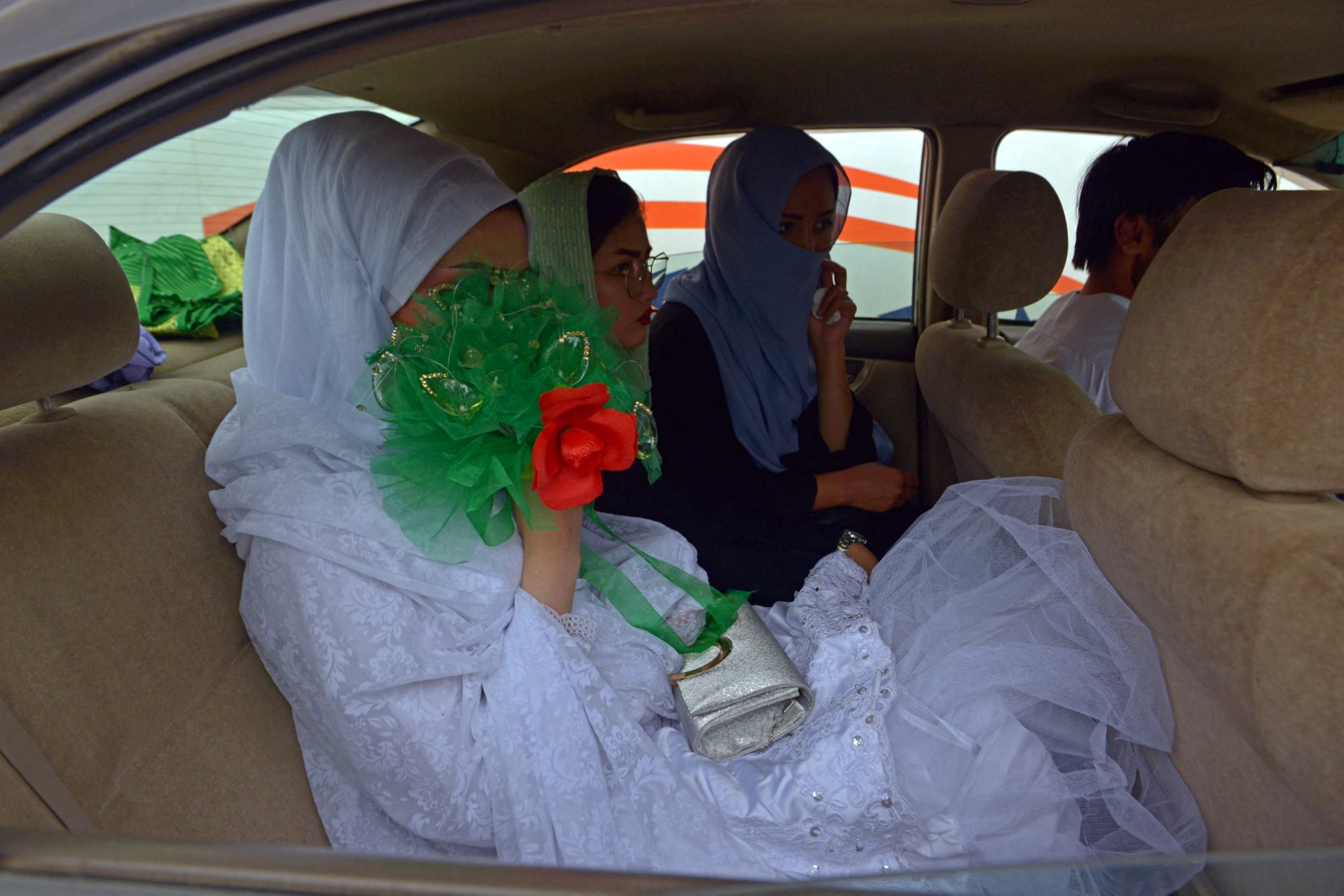 A bride arrives in a car at the wedding hall for a mass marriage ceremony in Kabul. Photo: Sahel Arman/AFP, 13 June 2022.
Growing up too fast
I was born in Mazar-e Sharif into a modest family. We didn’t have much money and we lived in the shadow of financial worries. I grew up knowing that life wasn’t going to be easy. I learned that some kids don’t really get to be children – they have to grow up faster than everyone else and take on responsibilities beyond their years.
Still, our home was filled with love and my parents tried their best to make us happy. They were determined that I should go to school. They said it was the only way for me to have a better life. So I went to school in worn-out clothes, taking the second-hand notebooks the extended family or our neighbours had given my mother for me. Even then, I had dreams. I wanted to stand on my own two feet.
In the afternoon, when I got home from school, I helped my mother with chores around the house. I helped her cook our family meals, cleaned the kitchen in the evenings, and on Fridays helped her with the laundry.
Later, when I was still in high school, I started working at a pharmacy. I learned how to check patients’ blood pressure and give injections when needed. I gave most of my earnings to my mother, but I kept a little for my own expenses. After graduating from high school, I took the university entrance exam. The day I got into university was the happiest day of my life. It felt like everything I’d worked for was finally paying off and my life was moving in the right direction.
Alongside my studies, I worked on a project run by an NGO in our area. The salary covered my college fees and other expenses and I was gaining practical experience for the future.
When everything changed
Then the Taliban came back and suddenly everything fell apart. The new government banned girls from going to university. Then, they banned women from working for NGOs and I lost my job. Just like that, it was all gone. It felt like the world had gone dark. I stayed at home with nothing to do and no future to work towards. It felt like my life was over.
It was during this time that my family decided I should marry. They told me there was a man who lived in Europe. They said he came from a family of means, that he had a stable job, that he would take me abroad and give me a secure future.
They talked about security, not happiness. No one asked me what I wanted. No one asked if I was ready.
The marriage I didn’t choose
This is how I agreed to marry a man I’d never seen. It was not my heart’s choice. It was what my parents thought best for me and I went along with their wishes as girls in Afghanistan tend to do.
I don’t blame my family for my misfortune. They thought they’d secured a better future for me – that I’d be happy and eventually go to Europe. Many Afghan families think this way. When someone who lives in the West shows up at their door and asks for their daughter’s hand, families are often blinded by the opportunity and the false hope. So it wasn’t unusual for my family to agree to the match and push me to accept it.
This is how I became a bride, but I felt no joy on my wedding day. After the wedding, my in-laws took me to their house in Kabul. No one welcomed me into that house and that family. There was no warmth, no kindness. From the very beginning, they made it clear that they didn’t like or respect me. They humiliated and abused me – emotionally, sometimes physically. I was expected to serve, to obey and to stay silent. That was my life, day in, day out.
My husband was in Europe and I had to stay in Kabul with his family while I waited for him to come and fetch me. I kept telling myself that he was busy, that he didn’t know how I was being treated by his family. I held on to the hope that one day he’d come, take me away and we’d finally start our life together in Europe.
But the days turned into weeks, then months. I waited for my husband, imagining what he might be like and wondering if he even thought of me. But he never came. I never saw him.
A house without kindness
Life in that house became unbearable. My in-laws treated me harshly. Their words were humiliating and even my small mistakes were met with anger. I learned to move carefully, to speak less, to make myself invisible.
Although my in-laws were rich, they didn’t support me. They didn’t cover my expenses and forced me to work from dawn till dusk to earn my keep. So I started working as a maid in a clothing factory. The factory was noisy and suffocating and everyone was busy meeting their quotas. No one there knew my story. No one seemed to notice my pain. No one asked.
My in-laws wouldn’t let me contact my family. It was the most alone that I’d felt in my life. The situation started to take its toll. I was always tired and I kept getting sick. My spirit was broken and my body was growing weaker by the day, until finally, I was diagnosed with diabetes. I remember going to the doctor by myself, paying the bill out of my meagre earnings and knowing that even my illness was something I had to face by myself. When I got home from the clinic, no one asked after my health. No one cared.
The night it ended
Then, one night, everything changed suddenly. It was late at night when my in-laws pulled me out of bed and turned me out of the house. They said they didn’t want me living with them anymore. The street was dark and empty. I remember standing there in the dark, shaking, trying to understand what had just happened. I had nothing with me and nowhere to go. That night could have ended very differently, but someone saw me – a kind neighbour who took pity on me and opened the door to their home to me.
The next day, they let me use their phone to call my family and let them know what had happened. They helped me get back to my family and even paid for the bus fare to Mazar-e Sharif.
Finding my way back
It wasn’t an easy journey. I was physically weak, emotionally exhausted and not sure how my family would react. I knew there would be talk in the family and the neighbours would gossip.
In Afghanistan, it’s not uncommon for a girl to disappear into the family she marries into. It’s not even unusual for her to be mistreated by her in-laws. But when a girl is sent back, tongues will wag. People will look for a reason and often they blame the girl. She must’ve done something, they’ll say in disapproving tones. Rooms will go quiet when she walks in – the silence is damning and pitying all at once.
But when I arrived in Mazar-e Sharif and stepped into my parents’ home, they embraced me. I’d been worried for nothing. For the first time in a long while, I felt safe and I knew I wasn’t alone. With their support, I began again from scratch. It wasn’t easy, but I didn’t lose hope. Being back with my family gave me the strength to start taking small steps to rebuild my life.
Still standing
Today, I am still standing.
I’ve known hardship, loss, and pain, but I didn’t disappear. I didn’t surrender to what had happened to me.
To other girls and women in Afghanistan, I say this: Stay strong, even when life feels impossible. Don’t lose yourself. If you fall, get back up, because you’re stronger than you think.
Edited by Roxanna Shapour and Kate Clark