 Afghanistan Peace Campaign
Afghanistan Analyst Network

Sultan Ali Keshtmand, who died aged 90 in exile in London on 13 March 2026 (Khaama Press), was an Afghan politician of Hazara origin who reached one of the highest positions ever attained by a Hazara in the Afghan government.[1] He served twice as head of the government, a position then officially called Chairman of the Council of Ministers. From May 1990 to 8 April 1991, he also served as Najibullah’s First Vice President.
Keshtmand’s first taste of government had come right after the PDPA seized power, when he briefly served as Minister of Planning, from April 30 to 23 August 1978, (AAN). He lost that position in one of the many factional PDPA power struggles (more about this below), but returned as head of government on 11 June 1981 during the presidency of Babrak Karmal (1979-86). This job had become vacant when state and party leader Babrak Karmal shed the dual role as head of state and head of government that he had held since the December 1979 Soviet invasion and the toppling of the Khalqi regime of Nur Muhammad Tarakay and Hafizullah Amin. Keshtmand held this position until 1986, when Najibullah replaced Karmal, and continued under Najibullah till 26 May 1988. His second tenure lasted only 15 months, from 21 February 1989 to 8 May 1990. Najibullah was then pursuing his National Reconciliation policy, a central plank of which was to bring in more non-party figures, resulting also in Keshtmand’s replacement by Fazl Haq Khaleqyar, the first non-PDPA member to hold that position.[2]
Keshtmand later served as First Vice President for a further five months (May 1990-January 1991), but later claimed he had virtually no authority in that role (quoted in Afghanistan International).
Keshtmand’s upbringing
In his memoir,[3] Keshtmand said he was born “in spring 1935” in the Chahardehi area of Kabul. Today the area, which was then countryside just south of Afghanistan’s capital, is part of Kabul’s urban Police District 6 (AAN). Keshtmand described his home village, Qala-ye Sultan Jan, as a “green island” in the middle of then uninhabited land on the eastern edge of Dasht-e Barchi. Today, Dasht-e Barchi has grown into a sprawling suburb of Kabul. The village was centred around a fort “with six towers,” owned by the largest local landowner – a Pashtun connected to the royal court. It was home to 20 families: two Tajik families and the rest Hazaras, most of whom were “landless or had little land.”
Keshtmand’s parents named him Sultan and added Ali, in keeping with a generations-long family tradition. His father was Najaf Ali. He doesn’t mention his mother’s name (AAN), but in his memoir, he spoke of her with warmth and respect. The family traced its origins to Ajrestan district in Ghazni province.[4] His great-grandfather, Sher Ali, and great-great grandfather Muhammad Ali, had migrated to the Kabul region after they were displaced from their lands in the wake of the Hazara wars during the reign of the ‘Iron Amir’, Abdul Rahman (1880-1901).[5] On their way, they spent some unspecified time in Daymirdad, today a district in Maidan Wardak province, in the village of Keshtmand’s mother’s ancestors.
Keshtmand wrote that his great-grandfather, Sher Ali, farmed other people’s land his entire life, and only managed to buy “a few jeribs”[6] of land in Chahrdehi late in life. From him, Keshtmand’s father inherited five and a half jeribs of irrigated land and eight jeribs of rain-fed land (lalmi). To make ends meet, he also worked on land belonging to a Kabul shopkeeper. In his youth, Keshtmand wrote, he and his brothers helped out by working and irrigating the land. Keshtmand described his family as a khanwada-ye dehqani (farming family) with “small” landholdings (kam-zamin) and referred to his father as a dehqan zahmatkash (toiling farm labourer). He later adopted the pen name, Keshtmand, as a nod to these roots (Khaama Press).
In his memoirs, he recounts the heavy tax burden imposed on Hazaras, which affected not only his family but also others, as well as the forced labour (begar) they had to endure. This burden was particularly high in Chahrdehi, he wrote, because of its geographical proximity to central government and its many local officials. As a result, his father lost his land, piece by piece, to the Pashtun nomads who traded daily necessities – such as cloth, salt or tea – often extending credit to the cash-strapped local population who thereby accumulated debts. Eventually, the family had to leave Qala-ye Sultan Jan and move to Kabul city proper, where his father ended up running a shop and the family had to live in a number of rented houses consecutively, reflecting a decline in social status in the Afghan context.
Keshtmand’s parents were illiterate, according to Anthony Arnold’s 1983 book, Afghanistan’s Two-Party Communism, but – in Keshtmand’s words – they were “very keen to educate their children.” All of his five brothers and three sisters would reach at least the lisans level (class 13). Keshtmand wrote that his mother’s grandfather, Mirza Ghulam Haidar, had been an educated man (roshanfikr), which had bolstered the idea that the children in the family should also be educated. Mirza Ghulam, he wrote, learned to read and write from a mullah when both were in jail during Amir Habibullah’s (1901-19) reign and, after his release, found a job as a clerk (munshi) in a government office.
Education and political activism
Keshtmand was initially educated at home before attending primary school in Chahrdehi, starting in year four, and later Ghazi High School, one of Kabul’s most prestigious schools, where he also learned English, as the High School had been established by the British Council in 1944 (Rah-e Parcham).
He then enrolled in Kabul University’s Faculty of Law and Political Sciences in the economics department, which became a faculty in its own right during his time there. Keshtmand wrote that he earned a living by writing and translating for newspapers and working as a private tutor. After graduating in 1961, he found employment at the Ministry of Mines and Industry, where he worked in various departments overseeing the country’s industries until 1972.
His interest in political and social issues began when he was a student at Ghazi High School. In his memoirs, he recalls that this was influenced by some of his teachers who had been involved in the earlier political and student movements of the 1940s-50s (AAN). During his final years at Ghazi and later at university, he and a group of his fellow students realised that “things could not remain as they were,” he wrote in his memories. As there was only limited freedom of expression, they began by organising “semi-political conferences and performances” and meeting progressive politicians. From these activities, a “small study circle” emerged. (Keshtmand does not provide the exact year.) Some participants, such as Abdul Samad Azhar, Dr Shah Wali and Keshtmand himself, would later become ministers in PDPA governments.
These circles were part of a broader scene of emerging political groups, the most famous of which, according to Keshtmand, was led by Karmal, who also attended several other circles as a guest, and to network. This is how Keshtmand came to know Karmal. He later described the future president, in his memoirs, as a bridge builder between the newly politicised youth circles and older activists, who were remnants of earlier reformist movements, to which Karmal, then a student leader, had also belonged.
Entry into politics and the formation of PDPA
On 1 January 1965, at the age of 30, Keshtmand took part in the secret founding congress of the PDPA. He was elected to its seven-member Central Committee. Later that year, he ran unsuccessfully for a seat in Afghanistan’s parliament in his home district, Chahrdehi. While he did not win, five other PDPA members, including Karmal, were elected.
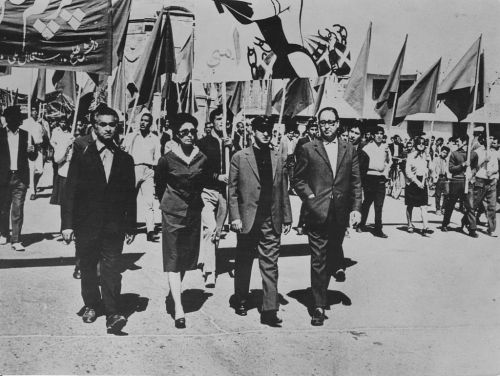
Around this time, Keshtmand, already working as a government employee, joined students and leftist groups in mass protests outside parliament during the so-called ‘decade of democracy’, which had begun with King Muhammad Zaher’s 1963 constitution, which introduced elements of parliamentarism. The protesters demanded ‘genuine democracy’, and after delivering a speech, Keshtmand was briefly imprisoned for the first time.
Before long, tensions emerged within the PDPA. In September 1966, Keshtmand was one of three Central Committee members to be dismissed as a result of their support for Karmal in his dispute with Hafizullah Amin, as recounted by two Russian authors, historian and journalist Vladimir Snegirev and retired KGB colonel Valery Samunin,[7] in their book Virus A: How we got into the torments of Afghanistan (published in English in 2012, as The Dead End: The Road to Afghanistan). These conflicts culminated in Karmal, Keshtmand and the other two Central Committee members formally leaving the party. In 1967, this split the PDPA into two main factions, Khalq and Parcham. Keshtmand aligned himself with the Parcham faction, led by Karmal.
PDPA rule, arrest, imprisonment and intrigues
In 1977, shortly before the ‘Saur Revolution’ of April 1978 that brought the PDPA to power, the party, pushed by the Soviet Communist Party through regional communist parties, reunited. Keshtmand became a member of the new PDPA Politburo following the reunification. However, soon after the PDPA capture of power, tensions between the two factions reemerged. The Khalqi leadership, headed by Nur Muhammad Tarakay, who was head of state and party, and his deputy, Hafizullah Amin, again moved to sideline the Parchamis. A handful of leading Parcham figures, including Karmal, were sent abroad as ambassadors; Keshtmand remained in the country as Parcham’s head in Karmal’s absence.
Facing increasing repression, Keshtmand turned to the Soviet embassy for help, according to Snegirev and Samunin. But Amin’s intelligence got wind of it, and in August 1978, he was arrested, along with the other remaining Parchami leaders and charged with participating in an alleged plot. He was tortured by the head of the country’s intelligence service (AGSA), Assadullah Sarwari. It was reported that his wife was also being tortured, which prompted him to sign a confession that was then published in the media. Keshtmand was sentenced to death. (In his memoir, he denied having confessed.)
After Amin overthrew and killed Tarakay in September-October 1979, he released many political prisoners and commuted the sentences of others, including Keshtmand, who was given 15 years. This was part of Amin’s efforts to shift the blame for the regime’s mass atrocities (AAN), which had cost it any initial popular support, solely onto his predecessor, Tarakay.
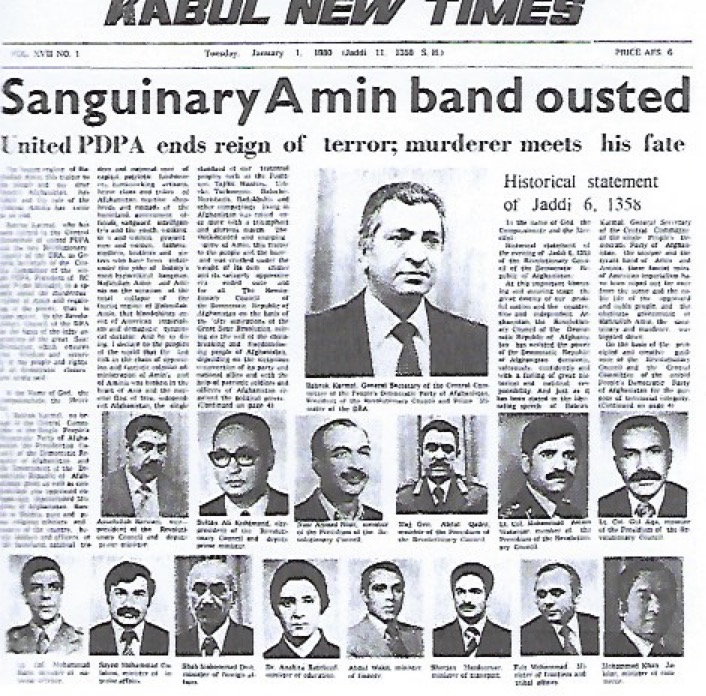
The Soviet invasion of Christmas 1979, which then removed Amin from power, also freed Keshtmand and many others from prison. He returned to the now Parcham-dominated PDPA Politburo and re-entered government. He became deputy head of the ruling Revolutionary Council (with Karmal at its top now), astonishingly serving alongside his erstwhile torturer Sarwari, who had managed to survive the transition.[8]
During his time in government, Keshtmand earned respect for his professional competence, even among those who opposed the PDPA regime and his political views. Keshtmand was an “able manager” with “excellent economic understanding,” an Afghan politician and economist in exile, told AAN. As de facto planning minister, from late 1979 onwards, the economist said, “he built up a large professional support staff that travelled with him to survey the situation in the provinces.” Notably, in 1988, when differences between him and Najibullah emerged, Keshtmand’s first premiership was cut short, but the president had to bring him back because he needed his economic management skills.
The distinguished Afghan Hazara writer, Sayed Askar Mousavi, also once said: “When you meet Sultan Ali Keshtmand, even if you are his opponent or enemy, you … respect him; because this person himself is a very excellent example of politeness and ethics” (Facebook). One such opponent, former second vice president Sarwar Danesh (a former member of the Shia/Hazara mujahedin party, Hezb-e Wahdat-e Islami), wrote in his obituary for Keshtmand: “With his background in the political struggle, expertise in economic affairs, political thought and managerial experience,” he had “a character that set him apart from many of his contemporaries” (Afghanistan International).
An advocate for Hazara rights
Another aspect of the respect Keshtmand earned, even among Hazaras opposed to the PDPA regime, was his commitment to Hazara empowerment. Immediately after the Saur coup in 1978, he reportedly said, “Brothers, today the five long centuries of Pashtun political domination has come to an end” (Khaama Press). In his memoirs, he wrote: “In the 1980s, the struggle to ensure legal and practical equality among all nationalities, tribes and ethnic groups was considered an inviolable and urgent duty of the party and the government,” reflecting what at the time was called “a principled approach to the national issue” in multi-ethnic Afghanistan. In a 2021 article published by the website Haqiqat,Keshtmand elaborated on the PDPA’s plans to federalise Afghanistan’s political system, noting that this “raised the question of autonomy for Hazaristan [as a first step].”[9]
During his time in government, several institutions were established to empower Hazaras politically, economically and militarily. The Shura-ye Ali-ye Melliyat-e Hazara (High Council of the Hazara Nationality)[10] as a political and social umbrella organisation, followed in 1989 by the Markaz-e Ensejam-e Omur-e Melliyat-e Hazara (Centre for the Coordination of the Affairs of the Hazara Nationality), a governmental structure, were designed to bring educated Hazaras into administrative and government positions.[11] Additionally, separate Hazara-only army units were created, some of which were composed of former mujahedin who had crossed over to the government side (Ibrahimi), and a new law on local government providing for elected local councils from the village to the provincial level was promulgated, although never implemented. There were also plans to create new ‘Hazara’ provinces. These, however, never came to fruition. In the end, only Sar-e Pul was created in 1988; only around one-third of its population is Hazara, but its first governor was from this community.
Efforts were also made during Keshtmand’s time in government to promote Hazara history and identity in the academic and public spheres. Research on Hazara history was advanced, notably through the academic journal, Gharjestan, whose editor, Professor Ali Akbar Shahrestani, headed Kabul University’s Faculty of Languages and Literature and later became Deputy Chairman of the Afghan Senate in 1988 (Facebook). New university teaching materials on Hazara history were introduced, largely based on a translation of Soviet-Tajik historian Lutfi Temirkhanov’s 1972 book, Khazareytsy, translated into English as National History of the Hazaras and in Dari as Tarikh-e Melli-ye Hazara.
For the first time, the media published articles about the repression and discrimination suffered by Hazaras under the monarchy, particularly after their violent incorporation into the Afghan state by Amir Abdul Rahman at the end of the 19thcentury.[12] The official media spoke of the ‘melliyat-e zahmatkash-e Hazara’ (the hard-working Hazara ‘nationality’), in order to counter deep-rooted societal biases.
On the war front, Keshtmand and other PDPA politicians had previously reached a tacit non-aggression agreement with Hazara mujahedin parties after they had liberated most of the Hazarajat. (The PDPA was only able to maintain a garrison in Bamyan that was barely active.) This allowed the Hazaras to develop local grassroots self-rule under the Coordination Council (Shura-ye Ettefaq), which was destroyed after four years by Iran-backed factions (Ibrahimi). This also kept the flow of food and other necessities open to the geographically isolated Hazarajat and spared the government from fighting on another front during the war with the mujahedin.
Responses, controversies and criticisms
Keshtmand’s initiatives have received widespread praise. Sarwar Danesh called him a “pioneer of federalism.” Another political activist, Jawad Waqar, recalled meeting Keshtmand, Najibullah and the president’s senior Soviet adviser in 1989, when, as an envoy sent by Abdul Karim Khalili (AAN), who was then a leader of Sazman-e Nasr (Victory Organisation), a Shia/Hazara mujahedin party (Ibrahimi), he travelled to Kabul to open a channel for negotiations (Etilaat-e Ruz, June 2026). Waqar said he expressed, in Khalili’s name, appreciation that Najibullah had said his government “has provided many privileges for the deprived and noble Hazara nationality, which is unprecedented” and even “recognised the right to autonomy in Hazarajat for the Hazara people, something that the Peshawar-based parties … will never accept.”
There was some convergence between Kabul – and Hazara politicians there such as Keshtmand – and the Shia mujahedin parties (AAN). Kabul was able to make political use of the fear among those parties about the widespread anti-Shia bias among their Pakistan-based and -supported Sunni counterparts (which became visible when they neglected the Shia parties in various mujahedin governments-in-exile formed in Pakistan). This enabled Keshtmand and others in Kabul to reach out to the Shia parties and drive a wedge into the mujahedin camp. At the same time, Kabul told envoys of the Shia parties that also Pakistan-based mujahedin parties were accepting arms and money from the government, as Waqar reported.
Keshtmand also claimed in his memoirs that Parcham had already prepared its own draft of a constitution based on a “federal parliamentary system” during President Muhammad Daud’s Republic (1973-78). According to his account, the Parcham draft was written largely by himself, “printed in a limited number,” and circulated directly and indirectly among party members, intellectual circles, members of the commission and other interested parties. The government was angry at the publication of this draft, but could not prevent its spread and instead, arrested and imprisoned several party activists for a while.
Danesh wrote that it was expected – among supporters of federalism – that Parcham would revisit the idea after coming to power. However, as he added, “political sensitivities and the circumstances of the time” prevented this and federalism was not included in the provisional constitution, “Basic Principles of the Democratic Republic of Afghanistan,” nor in the formal constitution adopted later by Najibullah.
What was both locally driven and state-sponsored, top-down Hazara emancipation was resented by some as ethnic favouritism, with some opponents holding a less-than-favourable view of Keshtmand. Afghan historian Hassan Kakar called him “one of Moscow’s yes men.”[13] American journalist Henry S Bradshaw cited Anthony Arnold in his Cold War-time book Afghan Communism and Soviet Intervention, to say that Keshtmand “was known as excessively corrupt, even by Kabul’s low standards and he helped establish a wealthy merchant class of his fellow Hazara Shi’ites.”[14]
Yet there were many who had only praise for Keshtmand’s integrity. Malek Setiz, an MP during the Islamic Republic of Afghanistan (2001-21), described him in a Facebook post as one of the cleanest politicians of his era, who lived in a simple apartment in Kabul. Ex-vice president Danesh, also a member of Khalili’s party, highlighted his struggles for federalism in Afghanistan (see Afghanistan International article cited above). Muhammad Mohaqeq, leader of a Wahdat breakaway party, also praised Keshtmand’s plans for the Hazara areas in his recently published memoir.
Other reactions following Keshtmand’s death included positive comments online about his integrity and humility, including from users who said they had worked under him (see, for example, this YouTube obituary by someone calling themselves an ‘Etahad (sic) Jawanan e Hazara’). Khaama Press editor Fidai Rahmati wrote that “Keshtmand was considered an important political figure within the country’s Hazara community and broader political landscape,” adding that his “leadership marked a historic moment for the Hazara community, representing a people who had long been marginalized from political power.”
Soviet withdrawal and transition of leadership
In 1982, as the Soviet leadership under Yuri Andropov (1982-84), for the first time, began to explore a possible withdrawal from and political solution for Afghanistan, Keshtmand was mentioned as a possible successor to the Soviet invasion-tainted Karmal, apparently even to Pakistan (which rejected the idea).[15] In early 1986, Mikhail Gorbachev invited the Afghan party leadership, including Keshtmand, to a private, unofficial meeting in Moscow, where he explained the Soviet Union’s plan to withdraw its forces and urged the party to prepare for this eventuality. While Karmal opposed Gorbachev’s plan, Keshtmand and others supported it, according to the memoirs of another PDPA co-founder and later minister, Karim Misaq, who was also a Hazara.
During this visit, Keshtmand also held separate discussions with Soviet Prime Minister, Nikolai Ryzhkov, on economic issues, including the management of the continued promised Soviet aid. When the group returned to Kabul, Misaq wrote, the Central Committee assigned a group of members, including Keshtmand, to persuade Karmal to resign, but they failed. Ultimately, the Soviets worked through Khalqi generals such as Sayed Muhammad Gulabzoy and Nazar Muhammad to secure Karmal’s agreement to the leadership change (see also this AAN report).
Danesh wrote in his article, cited above, that “many expected Sultan Ali Keshtmand to take over the leadership of the party and the government in Karmal’s place. However, for reasons – perhaps including ethnic considerations – Najibullah … was chosen as Karmal’s successor.”
In exile after the fall
In July 1991, after President Najibullah replaced Keshtmand as head of government for the second time, Keshtmand “quit the party, which he accused of being authoritarian [he likely meant Najibullah personally, a view shared by many] and of not truly believing in political pluralism,” according to American journalist Henry S Bradshaw (p343). Keshtmand then went to the Soviet Union but returned to Afghanistan in early 1992. Shortly after his return, he was attacked at a fatiha (funeral) prayer ceremony, sustaining serious head injuries and was transferred to Moscow for treatment, as he wrote in his memoirs.
From Russia, he went to the United Kingdom, where he was granted political asylum by the conservative government of John Major (The Guardian). There, he reportedly became even more outspoken about the rights of Hazaras and other minorities, arguing that the Pashtuns in Afghanistan had held too much power across successive Afghan regimes, past and present (Khaama Press). In the 2021 Haqiqat article quoted above, he joined those advocating for the establishment of a federal system in Afghanistan, arguing:
From my perspective, a political system that can provide the proper foundation for the convergence, solidarity and ensure unity of all peoples in the presence of different ethnic groups in Afghanistan, in a single and united country and to establish a lasting peace and justice, is a federal system.
He believed that such a system should be established by “the true and elected representatives from the villages to the cities,” and argued, “the time has come to end the practice and idea of centralism in the government structure.”
Marriage to Karima Badakhshi
In 1966, Keshtmand married Karima Badakhshi, who was born in September 1946 in Kabul and was the sister of Taher Badakhshi, like Keshtmand, a PDPA co-founder and a member of its first Central Committee.[16]
Keshtmand and Badakhshi had been classmates at Kabul University and their families were closely linked: Badakhshi married Keshtmand’s sister, Jamila. Karima Badakhshi had also studied at Kabul University’s faculty of economics. Later, she became a secondary school teacher and subsequently worked in the Ministry of Mines and Industries, like her future husband.
Under the PDPA government, Karima led the PDPA’s Democratic Organisation of Afghan Women and later served, until 1990, as head of the General Directorate of Kindergartens at the Ministry of Education. During her tenure, the ministry established 400 (up from 4) mainly workplace-based childcare facilities at government institutions and the few existing state-owned industrial enterprises, enabling women to find jobs – essential for both the PDPA’s policy of women’s emancipation and to the war effort, when many men were away fighting and labour was scarce. With support from East German advisors, Karima Keshtmand endeavoured to emulate the German Democratic Republic (GDR) kindergarten system.
Keshtmand’s life and career echoed both the possibilities and limits of reform within Afghanistan’s Soviet-backed state, as well as the enduring struggle for political inclusion among its marginalised communities.
Sultan Ali Keshtmand is survived by his wife, Karima, and their four children (Morning Star).
Edited by Roxanna Shapour and Kate Clark
References
| ↑1 | The highest-ranking Hazaras before Keshtmand were two ministers during the monarchy: Abdul Wahed Sarabi, who served as Minister of Planning from 1969 to 1973 and Muhammad Yaqub Lali, the Minister of Public Works from 1969 to 1971. After the Soviet invasion of Afghanistan, Keshtmand joined the Revolutionary Council. In May 1988, during President Najibullah’s policy of national reconciliation, he was appointed one of two vice presidents and 1990, Deputy Prime Minister. Years later, in 2001, Sima Samar made history as the first Hazara woman to hold a senior government position when she was appointed Deputy Head of Afghanistan’s Transitional Authority under Chairman Hamid Karzai. There were also two Hazara Second Vice Presidents during the Islamic Republic – Abdul Karim Khalili, 2004-2014, under President Karzai and Muhammad Sarwar Danesh, 2014-2021, under President Ashraf Ghani. |
|---|---|
| ↑2 | Muhammad Hassan Sharq, who served from May 1988 to February 1989, between Keshtmand’s two tenures, was also officially not a member of the PDPA. However, he was widely viewed as close to the party and was rumoured to have been a secret member. Sharq was eventually sacked due to his perceived ineffectiveness, particularly in handling economic affairs |
| ↑3 | Sultan Ali Keshtmand, Yad-dasht-ha-ye siasi wa ruidad-ha-ye tarikhi [Political Notes and Historical Events], 2nd edition, Kabul, Maiwand, 2003, (online version). |
| ↑4 | Ajrestan, a district in the western part of Ghazni province, is according to Keshtmand, inhabited by Mullakhel and Akakhel Pashtuns. |
| ↑5 | See Sayed Askar Mousavi, The Hazaras of Afghanistan, Curzon, Richmond, 1998. |
| ↑6 | Five jeribs equals one hectare. |
| ↑7 | Vladimir Snegirev and Valery Samunin, Virus A: How we got into the torments of Afghanistan, published in English by the National Security Archive in 2012, as The Dead End: The Road to Afghanistan. |
| ↑8 | Sarwari, a pro-Tarakay Khalqi, was removed by Amin after his takeover and, in October 1979, was accused of plotting a coup and imprisoned. During the Soviet invasion, he was released and brought back into government to placate the anti-Amin Khalqis. Over the following years, Sarwari held and lost various positions, eventually ending up in quasi-exile as the Afghan ambassador to Mongolia. After returning to Afghanistan in 1992, he was arrested and spent 13 years in detention before finally being tried for crimes against humanity, albeit under unfair circumstances (AAN). He initially received the death penalty, but his sentence was later commuted to 19 years in prison. He was released from jail in January 2017, after serving his full sentence. |
| ↑9 | In his memoir, he uses “Hazaristan (Hazarajat)”. |
| ↑10 | According to Soviet-style ‘nationalities’ policy’, a nation – which could be multi-ethnic – was called ‘mellat’ in Dari/Persian, while a ‘melliyat’ would be one of the larger ethnic groups, referring to what in former times would be translated into English as ‘national minority’. |
| ↑11 | Other key Hazara politicians in the PDPA regime were Ewaz Nabizada, head of the Nationalities Affairs in the Council of Ministers’ administration under Keshtmand, and Sheikh Ali Ahmad Fakkur, head of the Centre for Coordination of the Affairs of the Hazara people. Both were in touch with Hezb-e Wahdat and their predecessor parties such as Sazman-e Nasr, Shura-ye Ettefaq, Harakat-e Islami and others. |
| ↑12 | See Mousavi, The Hazaras of Afghanistan, [FN 8], p176. |
| ↑13 | See M. Hassan Kakar, Afghanistan: The Soviet Invasion and the Afghan Response, 1979-1982, University of California, 1995, p180. |
| ↑14 | Whether Arnold’s assessment was entirely unbiased is open to question, given that he had been “an intelligence officer specializing in Soviet affairs who served in Afghanistan in the 1970s” and “since his retirement in 1979 … has written and lectured on Russian-Afghan relations” (University of Nebraska). After all, US intelligence agencies were involved in the conflict over Afghanistan, including using forms of psychological warfare, at the time Arnold and Bradshaw were writing. |
| ↑15 | This is recalled former Washington Post foreign correspondent Selig S Harrison in Out of Afghanistan: The Inside Story of the Soviet Withdrawal, a 1995 book, he co-authored with UN special envoy Diego Cordovez who negotiated the Soviet pullback. (Oxford University Press, p98, p128). |
| ↑16 | Taher Badakhshi left the party in 1967 (or 1968, according to some sources) to set up his own faction. It became known as Settam-e Melli([Against] National Oppression) as Badakhshi believed that ethnic divisions, rather than the class divide, as the main issue facing Afghanistan, in contrast to the mainstream PDPA. He was arrested in 1978 and murdered in jail in October 1979 during Amin’s rule. |