 Afghanistan Peace Campaign
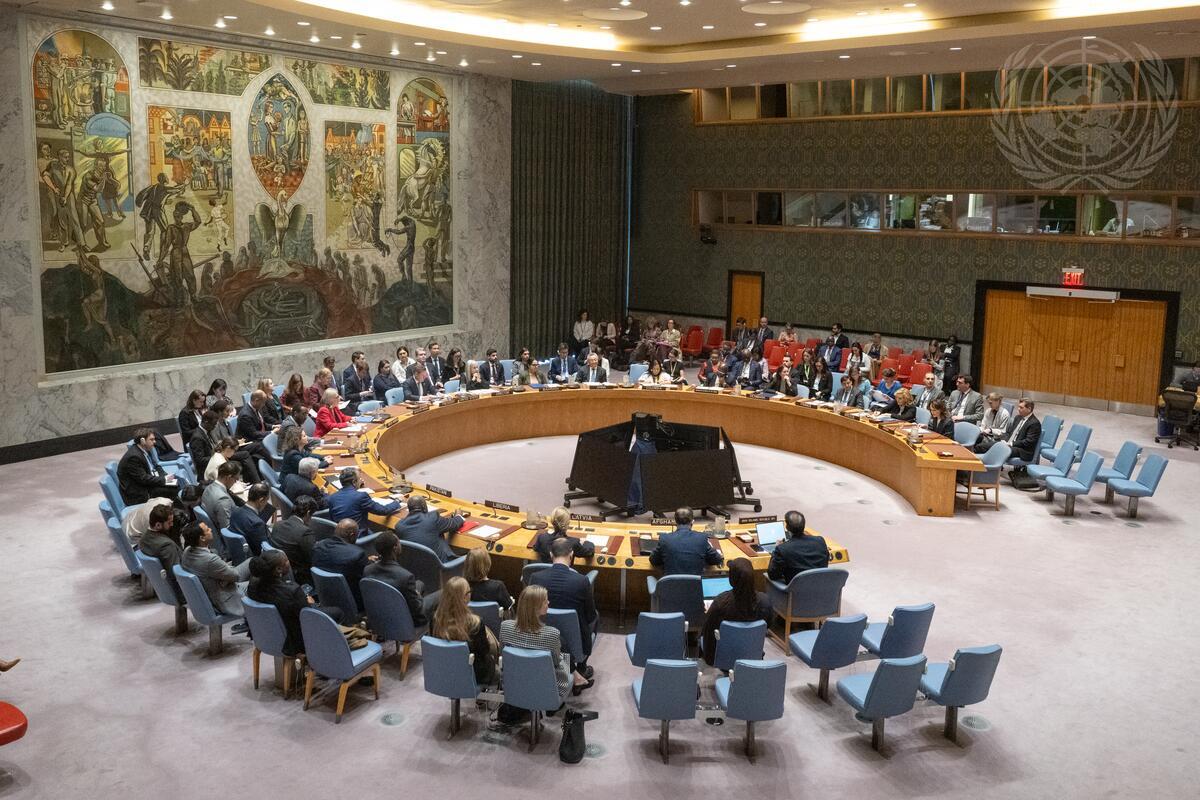 The Security Council meeting on the situation in Afghanistan. Photo: UN Photo/Eskinder Debebe, 9 March 2026.
Although US policy on Afghanistan has yet to be defined, the US request for a short mandate and reassessment comes as no surprise. Since December 2025, the US has been openly calling for the mandate to be reassessed as part of a broader repositioning of the US towards the UN (more on this below). In this report, we take a closer look at the discussion at the recent UN Security Council’s regular quarterly briefing on the situation in Afghanistan, held on 9 March, the evolution of UNAMA’s mandate to date and budget cuts that affect the UN as a whole and UNAMA in particular.
UN Security Council quarterly briefing
Every three months, the UN Security Council meets for a briefing on Afghanistan given by the UN representative in Kabul, the head of UNAMA or his/her deputy. The frequency of these briefings is set out in the UNSC Resolution, which also defines UNAMA’s mandate and is usually renewed annually.
The latest briefing (UN Web TV), held on 9 March, was important because it preceded a decision on the mandate. Acting head of UNAMA Georgette Gagnon said: “Afghanistan’s continued alienation from the international system remains the central issue,” adding that this has hindered progress on economic recovery, counter-terrorism cooperation and human rights. She noted that regional instability, particularly tensions between Afghanistan and Pakistan, and wider Middle Eastern conflicts, are increasing economic pressure on the country. Prices for basic goods are rising, humanitarian needs remain extremely high and international aid is falling short. While some positive developments exist – such as the Taliban maintaining a ban on opium poppy cultivation and starting infrastructure projects – serious concerns remain, especially the exclusion of women and girls from education and public life, including the ban on Afghan women working at the UN.
The US ambassador to the UN, Mike Waltz, castigated the Islamic Emirate of Afghanistan (IEA) for human rights abuses, restrictions on women, interference in humanitarian work and the detention of foreign nationals, terming this “hostage diplomacy” (USUN). “The Deputy SRSG,” he said, “cited a $1 billion shortfall, a requirement for humanitarian aid. I would submit that perhaps the international community would be more willing to fill that shortfall if the Taliban were not excluding half of its own population from basic rights and responsibilities.” He also said:
In light of the Taliban’s intransigence, we must carefully evaluate the utility of international assistance and engagement in Afghanistan. UNAMA’s budget is the largest of any special political mission in the world. Even after a reduction in its 2026 budget by 15%, this Council must consider carefully the funds we collectively provide for this mission’s budget when the mission’s female national staff are not even able to go into the office to work.
By contrast, China and Russia called for greater engagement with the Emirate.[1] China’s ambassador, Fu Cong, called for increased humanitarian aid, the return of Afghanistan’s frozen financial assets and the lifting of sanctions to support economic recovery, while also urging the IEA to improve women’s rights. “All concerned parties,” he said, “should work together to promote stabilisation and development in Afghanistan and its early integration into the international community.” Russia’s ambassador, Vasily Nebenzya, argued that pressure and isolation would not work and that pragmatic dialogue with the IEA was necessary to stabilise the country. “[D]espite all of the difficulties and the suffocating sanctions,” he praised the Emirate for undertaking “painstaking work … to solve the problems accumulated over the years of occupation.”
The briefing ended with sharp exchanges between Pakistan, India and (less so) Afghanistan over the ongoing Pakistan-Afghanistan fighting. Pakistan’s representative, Asim Iftikhar Ahmad, said Pakistan had acted in self-defence after witnessing “a surge in terrorist attacks, planned, financed and orchestrated from Afghan soil under the Taliban regime’s direct watch.” The more emollient Afghan representative to the UN, Naseer Faiq, a hangover from the Republic and not representing either it or the Emirate (AAN), rejected Taliban rule as illegitimate and argued that the Emirate’s repressive policies – especially against women and political opponents – had pushed Afghanistan towards isolation and instability. He urged Pakistan to cease strikes against civilian infrastructure and mourned Afghan civilian casualties, but also inferred that Pakistani attacks were “the dangerous spillover” of the Taliban having “provided a permissive environment for international terrorist groups.” Nevertheless, a furious Ahmad accused Faiq of being “sequestered in New York” and “completely cut off from ground realities,” and complained that Ahmad had said nothing about Pakistani casualties, including civilians.
The statement of India’s representative, Parvathaneni Harish, had mainly highlighted their humanitarian assistance to Afghanistan, but also posited that only coordinated international efforts could deal with “terrorism … a global scourge afflicting humanity.” He also accused Islamabad of “flagrant violations of international law.” Ahmad then, in turn, accused India of complicity and collusion, asserting that India had “always played the role of a spoiler in Afghanistan,” while Pakistan had “engaged responsibly in promoting peace, stability and prosperity in Afghanistan.” Naseer Faiq, responding to his “dear friend Ambassador Ahmad,” said he just wanted to say that “the current status quo in Afghanistan is the result of the wrong policies of our neighbouring countries, particularly those who provided support to the same groups in the past two decades.”
These bitter and longstanding regional rivalries ended the discussion, but overall, it showed broad agreement that Afghanistan faced severe economic and humanitarian problems, and concern about the cross-border fighting. It had also revealed, however, deep disagreements among the Security Council members about how to deal with the Emirate and how the country might be reintegrated into the global community. It again showed that women’s rights and human rights do not bear the same priority and importance for all member states and that for some, such as Russia and China, these should not be used as conditionalities in UN resolutions.
Following further closed-door negotiations on the new UNAMA mandate, it appears, however, that the US view that the mandate needed to be reassessed had consequences – a three-month technical rollover.

UNAMA mandate to date and its renewal
UNAMA, established by UN Security Council Resolution 1401 in March 2002, was originally mandated to support the implementation of the Bonn Agreement (December 2001).[2] Key priorities included: political reconciliation; humanitarian coordination; human rights promotion; state-building; and security sector reform.[3] Over time, this mandate has evolved to reflect the country’s needs and UNSC priorities.[4]UNAMA has undergone several reviews and evaluations to adapt its role to changing conditions in Afghanistan.[5]
After the fall of the Islamic Republic and the re-establishment of the Emirate, the Security Council unanimously adopted Resolution 2596 (2021) on 17 September 2021, extending UNAMA’s mandate for a six-month ‘technical’ period rather than the standard year. The new technical mandate narrowly focused on humanitarian aid coordination and the safety of UN personnel, as the previous ‘state-building’ objectives had become obsolete. In March 2022, the renewed mandate for one year reaffirmed that UNAMA’s role should be centred on humanitarian coordination and human rights.
The Council has not comprehensively discussed or adjusted UNAMA’s mandate and priorities since 2022. However, the mandate did come under close scrutiny in early 2023, when complex negotiations over its renewal shone a light on longstanding divisions within the Security Council over certain issues – human rights, women’s rights, peace and security, and governance (AAN). On 16 March 2023, Council members resolved their differences by passing two Afghanistan-related resolutions: one extended the UNAMA mandate until 17 March 2024, the other requested an independent assessment of in-country efforts.
The independent assessment presented to the UNSC on 9 November 2023 was driven by a desire to establish consensus on how the Security Council should deal with Taliban-ruled Afghanistan (AAN). While it generated a dynamic discussion about Afghanistan, the responses to its recommendations have degenerated into regular UNAMA-convened working groups on the least contentious topics, counter-narcotics and the private sector, rather than anything like the grand pathway of political engagement leading to the full reintegration of Afghanistan into the international community envisaged by the assessment
The discussion on how to engage with the Emirate, which underpins policy decisions on the UNAMA mandate, has pitted permanent Security Council members China and Russia on one side and the US, UK and France on the other. This division of views on how to deal with the Emirate remains to this day and is often reflected in the UNSC debates, as shown above. While Russia became the first country to recognise the Islamic Emirate in July 2025 (BBC) and China continues to have a good working relationship with Kabul, especially concerning business, based also on security concerns (AAN), the US has become more uncompromising in its policies towards the Emirate since Donald Trump became president for a second time.
First, a series of orders made as soon as Trump got into office in January 2025 halted refugee admission programmes in general, and terminated temporary protection status for Afghans in particular (AAN). Second, as of mid-2025, the Trump Administration terminated all foreign assistance awards with activities in Afghanistan,” per the Special Inspector General for Afghanistan Reconstruction (SIGAR), itself terminated in January 2026 (US Congress, AAN analysis). Other countries also suffered cuts in US aid, many severely, but only Afghanistan and Yemen saw all their aid cut in 2025.[6] (The US agency responsible for delivering civilian aid, USAID was also closed down in 2025, its remaining functions transferred to the State Department.)
A clearly defined US policy on Afghanistan has yet to be published and the discourse seems to be evolving, as evidenced by the US desire to see changes to UNAMA’s mandate already voiced at the UNSC’s previous quarterly briefing on Afghanistan in December 2025. The US representative to the United Nations for Special Political Affairs, Jennifer Locetta, told the Security Council that international engagement with the Emirate had so far produced no meaningful results and that UNAMA’s mandate must be reassessed (USUN). “[T]he United States’ top priority in Afghanistan,” she said, “remains the protection of US citizens and the homeland, which includes mitigating terrorist threats emanating from Afghanistan and securing the release of all of those unjustly detained.” As for UNAMA’s mandate, she said:
[W]e have to bear in mind the lack of results from international assistance and engagement in Afghanistan. As this Council considers the future of UNAMA, it must be sceptical of the Taliban.
All special political missions, including UNAMA, need to adapt to changing conditions on the ground. If Taliban conditions prevent UNAMA from carrying out these tasks, then the Council should consider realigning its mandate to these realities. In the future, it should focus on core peace and security issues guided by clear and achievable benchmarks.
Ambassador Locetta also called out the IEA for engaging in hostage-diplomacy, a curious accusation by a country which held 225 Afghan men and boys in Guantanamo, not charging them with any crime, nor holding them according to the laws of war, and indeed still detains one Afghan, Muhammad Rahim from Nangrahar, who was picked up by Pakistan in 2007, handed over to the US. He was the last man to be rendered by the CIA and tortured in one of its black sites before being taken to Guantanamo (AAN).
Locetta also complained about the Taliban’s lack of progress on “counterterrorism commitments.” Counterterrorism was one of the key issues negotiated in Doha in 2018-20 between the then-first Trump administration and the Taliban, talks from which the US also sidelined the then Afghan government and the UN, deciding to negotiate the unilateral pull-out of its troops and, consequently, other NATO troops from Afghanistan. What became known as the Doha Agreement, signed on 29 February 2020, included some promises by the Taliban not to allow individuals or groups that “pose a threat to the security of the United States and its allies” to operate from Afghanistan.[7] If there was a more detailed, standalone counterterrorism agreement negotiated in Doha, it has never been made public.
The country leading the way on negotiations to renew UNAMA’s mandate holds a very different position on Afghanistan. For the first time, China is the sole penholder on Afghanistan (SC Procedure).[8] Beijing has established greater vested interests in Afghanistan since the Taliban returned to power (AAN). When it indicated that it wished to act as a penholder on Afghanistan at the end of Japan’s mandate in late 2024/early 2025,[9] it almost turned into a major row between Beijing and Washington,[10] as the US, both under President Joe Biden and the newly-elected Donald Trump, firmly opposed China’s pitch (Just Security).
Despite such opposition, China has now officially assumed the penholder role, and negotiations on a new draft resolution to extend UNAMA’s mandate began on 3 March (Security Council Report). The initial draft of the resolution, originally by China to all members, sought a one-year renewal of the mission’s mandate and was largely identical to Resolution 2777 of 17 March 2025, with only minimal additions, mostly in the preamble. This was followed by an expert-level meeting on 5 March, one revised draft, and two rounds of comments. On Tuesday, 10 March, China placed a second revised draft under ‘silence procedure’, until the following day (11 March), meaning it would be assumed that members had accepted the draft unless they spoke up during that time period (Security Council Report). It was further reported by the Security Council Report on 13 March:
The US subsequently broke silence, requesting a shorter extension of the mandate. China then engaged in bilateral consultations with Council members before placing a third revised draft under the silence procedure on 12 March, which remained in effect until later that day, when it was again broken by the US. A further revised draft was subsequently placed under silence procedure until this morning (13 March). The draft text passed in silence and was put in blue [meaning the resolution was agreed] earlier today.
The current policy approach of the US administration towards UN special political missions is, as Locetta said, to “focus on core peace and security priorities guided by clear and achievable benchmarks.” US arguments over only giving UNAMA a three-month technical rollover had apparently centred on ‘value for money’. Security Council Report on 13 March, reported that:
It seems that the US argued that since UNAMA is one of the UN’s most costly special political missions and operates in a highly complex environment, the Council should first examine whether the mandate remains appropriate and fully implementable. In this regard, it apparently argued that a three-month technical rollover was the most viable path forward, providing the Council with additional time to hold discussions with all concerned stakeholders, including on streamlining the mandate and bringing it in line with current realities on the ground.
China and several other Council members objected to the US proposal, arguing, Security Council Report said, that a short-term renewal of UNAMA’s mandate could signal uncertainty about the mission’s future and might risk undermining its standing on the ground. Some members cautioned that such an approach might discourage engagement by the Taliban authorities if they perceive that the mission lacks firm backing from the Security Council, while also creating uncertainty among UNAMA staff. During the 9 March closed consultations on Afghanistan, UNAMA’s Georgette Gagnon made similar arguments, Security Council Report said. At that meeting, she called for support for a one-year extension of the mission’s mandate, noting that a short-term renewal could undermine confidence in the mission and the UN’s work in the country. Despite all of this, the US held firm to its position in favour of a short-term mandate, Security Council Report reported on 13 March that:
It [the US] also expressed scepticism about UNAMA’s role and its future. It seems that at the time of the expert-level meeting, there was limited clarity from Washington regarding its position on the question of UNAMA’s future. After China circulated the second revised text, it seems that the US permanent mission in New York received updated instructions from Washington, which indicated that the US was unable to support a year-long extension of UNAMA’s mandate, while indicating that its intention was not to end the mission. Rather, it apparently sought to streamline it so that it would better reflect the situation on the ground and allow the mission to effectively carry out its mandate.
What the US means exactly by ‘streamlining’ the UNAMA mandate is only likely to become clear in June and the lack of clarity about current US policy on Afghanistan makes it difficult to predict the ultimate consequences of it pushing for a three-month technical rollover.
Cuts in the budget
However, it is not only UNAMA’s mandate that has been under scrutiny; its funding has also been dwindling. UNAMA is funded through the regular UN budget, authorised by the General Assembly. The mission’s proposed budget for 2026 is USD 105 million (UN), a 15 per cent reduction from 2025. This represents a further decrease from previous years, for example USD 132.5 million approved for 2023 or over USD 140 million in 2019 and 2018. The proposed number of staff for 2026 across all UNAMA offices, both inside and outside the country, is 1,049 personnel, down from 1,136 in 2025 (UN).
This comes as no surprise, as the United Nations at large is struggling financially after the Trump administration refused to pay the annual contribution that about 60 member states normally make by the 8 February due date. President Trump has said the United Nations has not lived up to its potential and his administration has paid about USD 160 million of the nearly USD 4 billion it owes to the United Nations for 2025 and 2026 (AP). The US owes USD 2.196 billion to the UN’s regular operating budget from which missions like UNAMA are financed, including USD 767 million for 2026, Associated Press reported. The UN has said that 95 per cent of the arrears to the UN’s regular budget are owed by the United States (AP).
The US also owes USD 1.8 billion to the separate budget for UN peacekeeping operations (AP). On 2 March, Security Council Report said that “the US has sought to overhaul UN peace operations as part of a ‘go back to basics strategy’,[11] designed to cut costs and to reduce the UN to its vision of the UN’s core peace and security mandate.” Security Council Report also said that the US had pushed for some missions to wind down their operations and withdraw. It further said:
During several mandate renewal negotiations of missions … the US has also called for strategic reviews and benchmarks to assess mission progress and performance, as well as for the Secretary-General to present options for determining the future of specific missions. … [d]espite concerns expressed by some members about a hasty drawdown and the implementation of benchmarks that may not be in sync with realities on the ground, among others.
The US is not only shaping the future of UN peacekeeping, it has also effectively withdrawn from, or put under scrutiny, a number of UN entities dealing with development, climate change, humanitarian assistance and trade.[12] This followed two presidential actions. First, a 4 February Executive Order 14199 removed the United States from the UN Human Rights Council and initiated a review of US involvement in other entities such as the UN Educational, Scientific and Cultural Organization (UNESCO) and the UN Relief and Works Agency for Palestinian Refugees in the Near East (UNRWA). It also stopped funding these agencies and called for a broader review of other funding and membership devoted to international intergovernmental bodies. Second, a Presidential Memorandum, signed by Trump on 7 January 2026, ordered the US to withdraw from 66 international organisations that he said no longer served American interests (White House). Among these 66 organisations are 31 UN entities that, according to the White House, “operate contrary to US national interests, security, economic prosperity, or sovereignty.”
There are also other dynamics at play in the background. On 22 January 2026, President Trump launched the Board of Peace in January at the 57th World Economic Forum in Davos. Set up to oversee Gaza’s reconstruction, and with the US saying it will commit USD 10 billion towards establishing the Board (PBS). There was later talk that it would also address other global conflicts (White House press release, Reuters explainer, UK House of Commons Library explainer). This sparked fears that the new entity had been set up to undermine the UN (see, for example, The New York Times),[13] especially in light of the United States’ moves against the United Nations. For Human Rights Watch’s Executive Director, Philippe Bolopion, the US risks further undermining the rules-based multilateral system that has been the dominant world order since World War II, although it is not the only actor placing “the global human rights system is in peril,” (HRW World Report):
Under relentless pressure from US President Donald Trump, and persistently undermined by China and Russia, the rules-based international order is being crushed, threatening to take with it the architecture human rights defenders have come to rely on to advance norms and protect freedoms.
In this context, it can be seen that, as well as UNAMA’s mandate coming under scrutiny, the future of the UN, as a whole, in the current political climate is unclear.
Looking ahead to June
The 13 March Security Council Report said the recent discussions over renewing UNAMA’s mandate did appear to show “a shared understanding among Security Council members regarding the importance of UNAMA’s continued presence and the need to ensure effective implementation of its mandate.” Council members also seem to share some, but not all values and principles regarding human and women’s rights, as evident from the negotiated language of the resolution’s preamble. However, trying to discern the future of UNAMA, especially the tasks and priorities it may be mandated to carry out after June, remains unclear. Without a clear position on Afghanistan from Washington, it is a guessing game how this will all evolve. What can be said is that divisions in international forums, such as the UN, as well as an unclear US position on key issues, is not helping Afghans.
Edited by Kate Clark and Roxanna Shapour
References
| ↑1 | Despite their political disagreements over how to engage with the Taliban, UNSC members still want to maintain some oversight of sanctions and security issues in Afghanistan, as seen on 12 February 2026 during the vote on a 12-month extension of the Monitoring Team supporting the Taliban Sanctions Committee (UNSC Resolution 2816). China, Russia and the US all voted anonymously for the resolution. The resolution highlighted the monitoring team’s vital role, including providing critical analysis and enhancing the Council’s understanding of the situation in Afghanistan, especially as it relates to human rights violations and the plight of women and girls. The Resolution also highlighted the unacceptable use of hostage-taking as a leverage point in negotiations. It said that the Security Council strongly condemns “kidnapping and hostage taking for any purpose, including with the aim of raising funds or gaining political concessions.” |
|---|---|
| ↑2 | The core of the UN mission’s mandate entailed: (a) Fulfilling the tasks and responsibilities, including those related to human rights, the rule of law and gender issues, entrusted to the United Nations in the Bonn Agreement; (b) Promoting national reconciliation and rapprochement throughout the country; (c) Managing all United Nations humanitarian relief, recovery and reconstruction activities in Afghanistan. See also UNSC Resolution 1401 (2002), 28 March 2002. |
| ↑3 | In fact, the UNAMA mandate consolidated the UN Special Mission on Afghanistan (UNSMA)’s political mandate (UNSMA was established by the UN Secretary-General at the request of the UN General Assembly in 1993) and all UN humanitarian, relief, recovery and reconstruction activities in Afghanistan into a single mission. |
| ↑4 | For example, in 2003, election support and assistance to Afghanistan’s Independent Human Rights Commission, as well as a counter-narcotics component, were emphasised as the mission’s priorities. In 2005, the mandate emphasised, among other things, the rule of law and justice reform, including the reconstruction and reform of the prison sector. The 2006 mandate focused on the Afghanistan Compact, the outcome of the London Conference on Afghanistan held in January 2006 and the establishment of the Joint Coordination and Monitoring Board (JCMB), an oversight mechanism for the implementation of the said Compact. In 2008, the UNAMA mandate was further sharpened by Resolution 1806 (adopted on 20 March 2008), which established a broad country presence, expanded field offices and placed the Special Representative of the Secretary-General (SRSG) at the head of all UN activities in Afghanistan to ensure a more unified international approach. In 2010, the mandate included support for the Afghan-led reconciliation and transition process. In 2015, UNAMA was tasked with supporting the government in implementing its reform agenda, focusing on accountability, transparency and the rule of law. In 2019, the UNAMA mandate was renewed twice by the Security Council to maintain stability amid a high-stakes political transition and escalating conflict and in 2020 and early 2021, UNAMA was tasked with supporting the intra-Afghan negotiations. |
| ↑5 | In 2011, the UN Security Council requested a comprehensive review of the mission’s activities and field presence to align it with the evolving international presence and the transition of security responsibilities. In 2015, the Council called for a comprehensive examination of the roles, structures and activities of all UN entities in Afghanistan to support the country during the “Transformation Decade” and strengthen Afghan sovereignty and leadership. This led to the 2016 mandate, which emphasised a “One UN” approach aimed at improving coordination and effectiveness among UN agencies, funds and programmes in supporting Afghan national priorities. It also underwent a strategic review in 2017, which focused on optimising the UN’s structure and resources in Afghanistan and improving the mission’s field presence in line with the country’s evolving needs. |
| ↑6 | Seven African countries also lost all their US aid on 12 February 2025 – Burkina Faso, Cameroon, Malawi, Mali, Niger, Somalia, and Zimbabwe – according to an email sent to US officials because “there is no strong nexus between the humanitarian response and U.S. national interests.” (The Atlantic). |
| ↑7 | Mentioning al-Qaeda by name and then only once, the text largely stuck to the formula of individuals or groups that “pose a threat to the security of the United States and its allies.” The Taliban promised not to allow them to use the soil of Afghanistan, to cooperate with them, to give them visas, passports or travel permits and not to allow them to fundraise, recruit or train (see Part Two of the Doha Agreement). |
| ↑8 | As of 2026, China is the sole penholder on Afghanistan. A penholder at the UN Security Council (UNSC) is the member state leading the drafting and negotiation of resolutions on a specific agenda item. The nation that holds the pen on a given file has significant leeway to set the terms for how the Council approaches certain issues. |
| ↑9 | Japan was a penholder on Afghanistan in 2024. |
| ↑10 | In early 2025, China was a co-penholder with Pakistan on the Resolution extending UNAMA’s mandate up to March 2025. This caused major dispute at the UN, as Council members tussled over the penholdership of the file. See Richard Gowan, US-China Standoff on Who Runs the Afghanistan File at UN Signals Greater Tensions Ahead, Just Security, 14 February 2025. |
| ↑11 | The quote is from a 9 September 2025 letter from then acting US Representatives to the UN, John Kelley, to President Trump. |
| ↑12 | These include among others, UNESCO, UNHCR, the Department of Economic and Social Affairs, the International Law Commission, International Trade Centre, Peacebuilding Commission, Peacebuilding Fund, UN Conference on Trade and Development, UN Democracy Fund, UN Energy, UN Framework Convention on Climate Change (UNFCCC), UN Oceans, UN Population Fund, UN Water (see this Al Jazeera report for the full list). |
| ↑13 | The Board of Peace’s 20 founding members, in addition to the United States, include Argentina, Hungary, Indonesia, Israel Pakistan, Saudi Arabia, Turkey, Jordan, the United Arab Emirates, Uzbekistan and Qatar. Countries must contribute more than USD 1 billion to become permanent board members, but can join without cost for at least the first three years (New York Times). |